
MELU-222 · Lesson 12 of 12 · 22 min
Practice exam review and test-day strategy
▶ Video coming soon A video version of this lesson is on the way.
Eight weeks before his exam date, Jamal taped a study plan to the wall of the Cedar River break room. Each week had a theme, a set of practice questions and one timed practice exam on the weekend. Diane, Marcus and Nina all signed up to quiz him, and by the last two weeks the apprentices were asking him questions from their own classes to see if they could stump the future master. On a Tuesday morning in May he walked out of the PSI test center in Lansing with a passing score and a sore hand from flipping through his code book. This lesson pulls together what he learned about preparing for and taking the Michigan master electrician exam.
It reviews the main points of the course, offers a study plan and a set of practice problems that mix Michigan law with code lookups and calculations, and describes a test-day routine built around the format in the August 2026 PSI bulletin: 76 questions, 180 minutes and a passing score of 75. The practice problems are original and written for study; they are not real exam questions.
What the exam is really testing
The master exam tests three kinds of knowledge. First, Michigan law and administration: Act 407 licensing rules, Act 230 enforcement and permits, and the Part 8 rules. Second, the installation topics in the NEC as adopted in Michigan, from grounding and bonding to load calculations. Third, the knowledge needed to plan and supervise installations, which shows up as questions that combine several code requirements or ask what a master should check before work begins. The core courses built the second and third kinds of knowledge; this course built the first. The exam rewards candidates who can move between all three quickly.
An eight-week study plan
Jamal's plan gave each area real time without letting any one topic swallow the schedule. Weeks one and two covered the exam rules, the reference books and Michigan law, because those were the newest material for him and because the bound statute and rule printouts had to be prepared early. Weeks three through six worked through the installation topics in the order of the bulletin's outline, with one timed set of twenty questions each week. Week seven was a full timed practice exam under exam conditions, followed by a review of every miss. Week eight was for weak areas, a second full practice exam and rest.
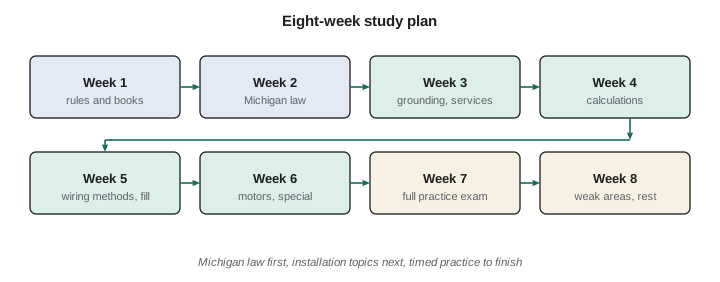
| Week | Focus | Practice |
|---|---|---|
| 1 | Bulletin rules, references, tabbed NEC, print and bind Michigan documents | Navigation drills: find 20 sections fast |
| 2 | Act 407, Act 230, Part 8 amendments | 30 law questions with the documents open |
| 3 | Grounding, bonding, services and feeders | 20 timed questions |
| 4 | Load calculations and conductor sizing | 20 timed questions with full worked steps |
| 5 | Wiring methods, box and raceway fill, overcurrent protection | 20 timed questions |
| 6 | Motors, special occupancies, power-limited circuits, theory | 20 timed questions |
| 7 | Full practice exam under exam conditions | 76 questions in 180 minutes, then review every miss |
| 8 | Weak areas, second practice exam, rest the last day | Targeted sets only |
Tracking weak areas
A study plan only works if it adapts. After each timed set, Jamal logged every missed question by topic and by the reason he missed it: did not know the rule, could not find it fast enough, misread the question, or made an arithmetic error. After two weeks the pattern was clear. He rarely missed questions because he did not know the material; he missed them because he misread a word like "minimum" or "except," or ran out of time on calculations. That told him to practice slower reading on the first pass and faster lookups for tables he used often.
# Tracking missed practice questions by reason (study aid)
misses = [
    ("load calc", "arithmetic"), ("Act 407", "did not know"), ("box fill", "too slow"),
    ("grounding", "misread"), ("Part 8", "did not know"), ("load calc", "too slow"),
    ("motors", "misread"), ("services", "misread"), ("Act 230", "did not know"),
]
from collections import Counter
by_reason = Counter(r for _, r in misses)
by_topic = Counter(t for t, _ in misses)
print("By reason:")
for r, n in by_reason.most_common():
    print(f"  {r:13} {n}")
print("Most-missed topics:", ", ".join(t for t, _ in by_topic.most_common(3)))By reason: did not know 3 misread 3 too slow 2 arithmetic 1 Most-missed topics: load calc, Act 407, box fill
The output from Jamal's week-two log shows two kinds of fixes. Three misses came from Michigan law he had not read closely yet, which more reading would fix. Three came from misreading, which only slower, more careful reading would fix. Counting reasons, not just topics, keeps a candidate from spending a week relearning material he already knows.
Practice problems
The following problems mix the areas the exam covers. Work each one with your references open, write down where you found the answer, and time yourself at about two minutes per problem. Answers are in the practice section at the end of the lesson.
- Problem 1. A journeyman received his license on September 1, 2025. Assuming he meets the hours requirements, when is the earliest he can meet the journeyman-time requirement for the master exam?
- Problem 2. Which act gives a township the choice to enforce the state construction code?
- Problem 3. On a 76-question exam with a passing score of 75, how many questions can you miss and still pass?
- Problem 4. A subcontractor first furnished material on July 7. By what date must it serve its notice of furnishing?
- Problem 5. Which NEC sections are tied to Michigan's surge protection amendment, and which kinds of occupancies does the amendment list?
- Problem 6. A company has two full-time employees and hires a third. When must it carry workers' compensation?
- Problem 7. Can a master electrician be the master of record for his own company and for his brother's company at the same time?
- Problem 8. A permit was issued on March 11, 2024. Which Michigan Electrical Code applies?
Exam day routine
Jamal kept exam day boring on purpose. The night before, he packed his identification, the PSI confirmation, his tabbed NEC and the three bound Michigan documents, checked them once more against the bulletin's rules, and went to bed early. He ate breakfast, left early enough to absorb a traffic delay, and arrived at the test center well before his appointment time, because late arrival forfeits the fee. At check-in he let the staff inspect his books without argument, stored everything else in the locker, and listened carefully to the instructions.
In the exam he followed his two-pass plan: answer the quick questions, mark the slow ones, keep moving, and save about 30 minutes for the marked questions. He watched his checkpoints at 45, 90, 135 and 150 minutes. On calculation questions he wrote short steps on the scratch material the center provided so he could check them on the second pass. He did not leave any question blank, because a blank is always wrong and a reasoned guess sometimes is not.
Reading questions carefully
Many wrong answers come from reading a question too fast. Watch for words that change the answer: minimum and maximum, shall and shall not, except, unless, and the specific occupancy or voltage. Check whether the question asks about Michigan or the NEC generally; in a Michigan exam, a question about a dwelling's emergency disconnect expects the Part 8 version. Check the units in calculation questions, and whether the answer should be rounded up to the next standard size. When two answers look right, reread the question for the word that separates them.
If you do not pass
Some good electricians fail the first time. If that happens, read the score report closely, compare it with your missed-question log, and build a short plan aimed at the weak areas. Remember the limits: the PSI bulletin allows two attempts within one year of approval, and section 713 imposes a one-year wait and a required course after two failures within two years. Use the second attempt seriously, not as another practice run. Marcus's advice from his own journeyman experience was blunt: study for the first attempt as if there were no second one.
Worked problem
Working a mixed question under time pressure
A practice question reads: "A Michigan electrical contractor without a master electrician owner must employ a master electrician who is: (A) licensed in any state and on call; (B) a full-time employee who lives in Michigan and is actively in charge of code compliance on all installations; (C) a part-time consultant who approves permits; (D) any journeyman with ten years of experience." How should Jamal handle it in under a minute?
Show solution
- Recognize it as an Act 407 question about the contractor license.
- Recall section 711: the business must employ a full-time master who lives in Michigan and is actively in charge of code compliance.
- Eliminate A (any state, on call), C (part-time) and D (journeyman, not master).
- Choose B.
- If unsure, confirm in the bound Act 407 printout under the electrical article, but only after answering the quick questions.
Answer: Answer B, using section 711, and move on.
A final review of the course
In the last week, Jamal reviewed the numbers and rules he expected to see, one lesson at a time. Licensing runs through LARA's Bureau of Construction Codes under Act 407. A master needs to be at least 22, with 12,000 hours over at least six years and two years as a licensed journeyman. The exam has 76 questions in 180 minutes with a passing score of 75, and only the NEC and the bound Michigan documents are allowed under the bulletin's rules. The 2023 Michigan Electrical Code took effect March 12, 2024, with amendments for the outdoor emergency disconnect and surge protection. Act 230 sets the order of enforcement: local unit, then county, then state.
He continued with the business topics. A master can qualify only one contractor, and a business without a master owner needs a full-time master employee who lives in Michigan and is in charge of code compliance. Workers' compensation applies at three employees at once, or one employee at 35 hours a week for 13 weeks in the last 52. Under the Construction Lien Act, a notice of furnishing is due within 20 days of first furnishing, a claim of lien within 90 days of last furnishing, service within 15 days of recording and suit within a year. MIOSHA runs the state safety plan. The code update course must be finished within 12 months after a code change.
The last week
The last week was for confidence, not cramming. Jamal took his second full practice exam on Saturday, reviewed every miss on Sunday, and spent the next three evenings on short targeted sets from his miss log. He stopped studying the evening before the exam, checked his books against the bulletin one last time, and went to bed early. He later said that the most useful thing he did that week was nothing at all on the last night.
Common mistakes
MistakeStudying only the NEC.
InsteadMichigan law and Part 8 amendments are on the outline; study them with the bound documents.
MistakeSpending ten minutes on one hard question early in the exam.
InsteadMark it and come back on the second pass.
MistakeLeaving questions blank.
InsteadA blank is always wrong; make a reasoned choice.
MistakeTreating the second attempt as practice.
InsteadAttempts are limited, and two failures can trigger a year's wait and a required course.
Summary and key terms
- The exam tests Michigan law and administration, NEC installation topics as adopted in Michigan, and planning and supervision.
- An eight-week plan with weekly timed sets and two full practice exams builds both knowledge and speed.
- Logging misses by reason as well as topic shows whether to study content, lookups or reading habits.
- On exam day, follow the bulletin's book rules, arrive early, use a two-pass plan with checkpoints and answer every question.
- If you do not pass, use the score report and plan carefully, because attempts are limited.
- Two-pass method
- Answering quick questions first and returning to marked questions later.
- Checkpoint
- A planned point in the exam to compare progress with time used.
- Miss log
- A record of missed practice questions with topic and reason.
- Navigation drill
- Practice finding code sections quickly in the exam copy of the NEC.
- Score report
- PSI's report of exam results, including information on weak areas after a failure.
Practice problems
Work each problem on paper first, then reveal the answer to check.
Problem 1 answer.
Show answer
September 1, 2027, after two years as a licensed journeyman, assuming the hours and other requirements are met.
Problem 2 answer.
Show answer
The Stille-DeRossett-Hale Single State Construction Code Act, 1972 PA 230.
Problem 3 answer.
Show answer
19. Passing requires 57 correct out of 76.
Problem 4 answer.
Show answer
July 27, 20 days after first furnishing.
Problem 5 answer.
Show answer
Sections 215.18, 225.42 and 230.67; occupancies such as dwelling units, dormitories, hotel and motel guest rooms and certain patient sleeping rooms.
Problem 6 answer.
Show answer
When the third employee starts, because three or more employees at one time triggers coverage.
Problem 7 answer.
Show answer
No. A master can be associated with only one electrical contractor at a time.
Problem 8 answer.
Show answer
The previous Michigan Electrical Code, because the permit was issued before March 12, 2024.
Lesson quiz · 5 questions
Score 60% or more to complete this lesson.
Create a free account to save your progress, take quizzes and earn a certificate.