
MELU-222 · Lesson 8 of 12 · 19 min
Contractor licensing, insurance and bonding
▶ Video coming soon A video version of this lesson is on the way.
On the day Jamal's master license came through, Nina opened a folder labeled "Cedar River contractor license" and walked him through it. It held the company's articles of incorporation, its electrical contractor license history, certificates of insurance going back ten years, the workers' compensation policy, two performance and payment bonds from school jobs, and a stack of customer prequalification forms that asked the same questions over and over: license number, master of record, insurance limits, workers' compensation carrier, bonding capacity. "The license lets us contract," she said. "Everything else in this folder is what lets customers trust us enough to hire us."
This lesson covers the Michigan electrical contractor license, how it depends on a master electrician, how a company changes its master of record, the business registrations that sit alongside the license, local licensing in some cities, workers' compensation, liability insurance and bonds. Where Michigan law sets a specific requirement, the lesson says so and cites the source; where requirements come from customers, cities or contracts rather than state law, the lesson says that too. Check current requirements with the bureau, your insurance agent and your lawyer.
The electrical contractor license
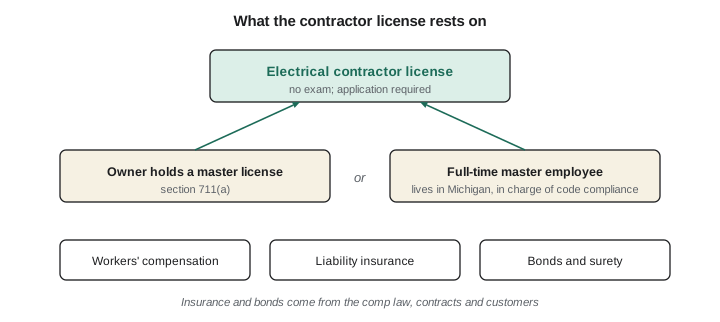
Under section 711 of the Skilled Trades Regulation Act, an electrical contractor license may be held by an individual who holds a master electrician license, or by a business that employs at least one full-time master electrician who lives in Michigan and is actively in charge of code compliance on all its installations. The bureau's page states that there is no test to become an electrical contractor, but the license still requires an application. The application identifies the business, its owners and officers, and the master electrician who qualifies it, along with the general information required by Article 2 of the act.
Because the contractor license rests on a master license, the two must stay linked. If the master's license expires, is suspended or is revoked, or if the master leaves, the contractor no longer meets the requirement. The company must replace the master and update its license before contracting for more electrical work. Contractor licenses are renewed on their own cycle, separate from individual licenses; check the bureau's current renewal schedule and fees, and put the renewal date on the company calendar.
Changing the master of record
When Jamal replaced Diane as master of record, Nina filed the change with the bureau the same week, following its current process. The order mattered. Jamal could not be listed while he was associated with another contractor, and the company could not drop Diane before Jamal was listed, or it would briefly have no qualifying master at all. Nina kept copies of the filing and the updated license, because general contractors and city permit offices sometimes asked for proof of the current master when a permit application showed a new name.
Companies that lose their master unexpectedly, through illness, death or a sudden resignation, face the hardest version of this problem. Diane's plan to have Marcus work toward his master license, and to keep her own license active, was insurance against that risk. Some companies also keep a written succession plan that names who will step in and what paperwork must be filed.
Business registrations
The electrical contractor license is only one of the registrations a Michigan electrical business needs. A corporation or limited liability company is formed and kept in good standing through LARA's Corporations Division, with an annual report. A business operating under a name other than its legal name files an assumed name. The company registers with the Michigan Department of Treasury for tax purposes and with the federal government for an employer identification number. It needs unemployment insurance registration if it has employees. These requirements are general business law rather than electrical law, but missing one can stop a contract or a bid.
Local licensing and registration
Licensing is mainly a state matter in Michigan, but some cities add their own requirements. The bureau notes that Detroit issues its own electrical licenses locally, and other cities require contractors to register before they can pull permits. Before Cedar River bid a medical office in Detroit, Nina called the city's buildings department to confirm what it required of an outside electrical contractor and its master, how long registration took and what it cost, and added that time to the schedule. A contractor that finds out about local licensing after signing the contract may not be able to pull a permit on time.
Workers' compensation
Michigan's Workers' Disability Compensation Act requires many employers to carry workers' compensation insurance or be approved to self-insure. According to the state's Workers' Disability Compensation Agency, a private employer must provide coverage if it regularly employs three or more employees at one time, counting part-time workers, or if it employs at least one person for 35 or more hours a week for 13 or more weeks during the preceding 52 weeks. In practice, almost every electrical contractor with a crew falls under the act, and general contractors usually require proof of coverage before a subcontractor starts work.
| Michigan employer | Workers' compensation required? |
|---|---|
| Three or more employees at one time, including part-time | Yes |
| One employee working 35 or more hours a week for 13 or more weeks in the last 52 | Yes |
| Two part-time employees, each under 35 hours a week | Usually no under these tests, but check with the agency or an agent |
| Sole owner with no employees | Not required for the owner under these tests; customers may still ask for coverage |
Workers' compensation premiums depend on payroll, the classification codes for the work and the company's experience modification rate, which reflects its own claims history. Electrical work carries a higher rate than office work, so classifying office staff correctly matters. A low experience modification rate saves money and wins bids, because many owners use it to screen contractors. Lesson 10 connects workers' compensation to safety and injury records.
Liability insurance
Commercial general liability insurance covers claims that the contractor's work caused injury or property damage to others, including claims that arise after the job is finished. Customers, general contractors and public owners usually set minimum limits in their contracts and ask to be named as additional insureds. Before signing a contract, Nina compared its insurance requirements with the company's policies, because a contract that requires higher limits or special endorsements can mean a call to the agent and an added cost that should be in the bid. Vehicle insurance, equipment coverage and, for design-build work, professional liability round out the coverage most electrical contractors carry.
Bonds
A bond is a promise by a surety company to pay if the contractor fails to meet an obligation. Bid bonds guarantee that a bidder will sign the contract if awarded. Performance bonds guarantee that the work will be completed. Payment bonds guarantee that subcontractors and suppliers will be paid. Michigan law requires performance and payment bonds on many public construction contracts above a dollar threshold, and private owners sometimes require them on large jobs. On bonded public jobs, payment bond claims take the place of construction liens, because public property generally cannot be liened.
A surety qualifies a contractor much as a bank qualifies a borrower: by looking at financial statements, work history, the owners' personal finances and the company's management. Bonding capacity limits how much bonded work a company can take on at once. Cedar River's surety capped its single-job limit at 1.5 million dollars and its total bonded backlog at 4 million dollars, illustrative figures that would grow as the company's equity grew.
# Does this employer need Michigan workers' compensation? (study aid based on the agency's FAQ tests)
def needs_coverage(employees_at_once, weeks_full_time_last_52):
    # weeks_full_time_last_52: longest stretch any one worker worked 35+ hours a week
    return employees_at_once >= 3 or weeks_full_time_last_52 >= 13

cases = [
    ("Cedar River, 18 employees", 18, 52),
    ("New shop: 1 helper full time for 10 weeks", 1, 10),
    ("Same shop after 14 weeks", 1, 14),
    ("Two part-timers, 20 hours each", 2, 0),
]
for name, n, wk in cases:
print(f"{name:40} -> {'required' if needs_coverage(n, wk) else 'not required by these tests'}")Cedar River, 18 employees -> required New shop: 1 helper full time for 10 weeks -> not required by these tests Same shop after 14 weeks -> required Two part-timers, 20 hours each -> not required by these tests
The study aid applies the two tests in the agency's FAQ. The new shop with one full-time helper crosses the line in its fourteenth week, which is why new contractors arrange coverage before hiring rather than after. The two part-time employees fall outside both tests, but any general contractor will still ask for a certificate, and coverage protects the owner too.
Worked problem
Preparing a prequalification package
A hospital system asks Cedar River to prequalify for a renovation. The form asks for the license number and master of record, general liability limits of 2 million dollars per occurrence, workers' compensation coverage, an experience modification rate, and bonding capacity of at least 2 million dollars for a single job. Cedar River carries 1 million dollars per occurrence with a 5 million dollar umbrella. What should Nina do?
Show solution
- Confirm the contractor license lists Jamal as the current master of record.
- Ask the insurance agent whether the umbrella policy satisfies the per-occurrence requirement and what the hospital needs as an additional insured.
- Provide the workers' compensation certificate and the experience modification rate from the carrier.
- Check the surety: the single-job limit of 1.5 million dollars is below the 2 million requested, so ask whether the surety will increase it for this project.
- Price any added insurance or bond cost into the bid.
Answer: Update the license record, confirm insurance with the agent, supply comp records, and ask the surety about a higher single-job limit before bidding.
Reading a certificate of insurance
General contractors and owners usually ask for a certificate of insurance before a subcontractor starts work. The certificate is a summary prepared by the agent; it lists the insurer, policy numbers, policy dates, coverage types and limits, and the certificate holder. It does not change the policy. If a contract requires the customer to be an additional insured, or requires a waiver of subrogation or primary and noncontributory wording, the policy itself needs the matching endorsement, and the agent should confirm it in writing.
Nina checked three things on every certificate before sending it: the dates covered the whole job, the limits met the contract, and the endorsements the contract required were actually on the policy. She also kept a list of certificates Cedar River had collected from its own lower-tier subcontractors, such as a fire alarm installer and a trenching company, because a subcontractor without coverage can leave the hiring contractor exposed to claims and to higher workers' compensation premiums at audit.
Nina renewed certificates before they expired, not after a general contractor complained, because an expired certificate can stop payment on an otherwise finished job.
Common mistakes
MistakeThinking the contractor license needs an exam.
InsteadIt needs an application and a qualifying master electrician, not an exam.
MistakeDropping the old master before the new one is listed.
InsteadFile the change so the company always has a qualifying master on its license.
MistakeSkipping workers' compensation for a single full-time helper.
InsteadOne worker at 35 or more hours a week for 13 weeks in the last 52 triggers the requirement.
MistakeAssuming you can lien a public school.
InsteadPublic projects generally use payment bonds instead of liens.
Summary and key terms
- An electrical contractor license needs an application and a master electrician owner or a full-time, Michigan-resident master employee, but no exam.
- The contractor license must be updated when the master changes, without leaving a gap or listing a master on two licenses.
- Business registrations, local licensing in cities like Detroit and tax registrations sit alongside the state license.
- Workers' compensation is required for employers with three or more employees at once, or one employee at 35 or more hours a week for 13 weeks in the last 52.
- Liability insurance limits and bonds come mainly from contracts and public bonding law, and surety capacity limits bonded work.
- Electrical contractor license
- The state license that allows a person or business to contract for electrical work.
- Additional insured
- A party added to the contractor's liability policy at a customer's request.
- Experience modification rate
- A factor that adjusts workers' compensation premiums based on a company's claims history.
- Payment bond
- A surety's promise that subcontractors and suppliers will be paid.
- Bonding capacity
- The amount of bonded work a surety will support for a contractor.
Practice problems
Work each problem on paper first, then reveal the answer to check.
Does Michigan require an exam for an electrical contractor license?
Show answer
No. It requires an application and a qualifying master electrician.
A new contractor has two employees and plans to hire a third next week. When must it have workers' compensation?
Show answer
As soon as it regularly employs three people at once, so before the third employee starts.
Why do public projects usually use payment bonds instead of liens?
Show answer
Public property generally cannot be liened, so payment bonds protect subcontractors and suppliers.
What should a contractor check before bidding a job in Detroit?
Show answer
Whether the city requires a local electrical license or registration, how long it takes and what it costs.
Lesson quiz · 5 questions
Score 60% or more to complete this lesson.
Create a free account to save your progress, take quizzes and earn a certificate.