
MELU-222 · Lesson 1 of 12 · 19 min
How electrical licensing works in Michigan
▶ Video coming soon A video version of this lesson is on the way.
Diane Kowalski started Cedar River Electric in Lansing in 1991 with a used pickup, a ladder rack and the master electrician license she had earned the year before. Thirty-five years later the company employs eighteen electricians and apprentices, runs four service vans, and keeps a steady mix of medical office fit-outs, school renovations, farm shops in the townships west of town and a growing list of electric vehicle chargers and panel upgrades in Okemos and East Lansing. On a gray Monday in February, Diane asked her lead journeyman, Jamal Carter, to stay after the morning meeting. "I'm sixty-three," she said. "Our contractor license rides on my master license. When I step back, this company needs a master electrician on the payroll who lives in Michigan and is actually in charge of the work. I want that to be you." She slid a printout of the state's master electrician application and the testing company's candidate bulletin across the desk.
Jamal had started as a registered apprentice in 2015, finished his apprenticeship and passed the journeyman exam in early 2023, and had run crews for Cedar River on commercial jobs ever since. He had worked through the master electrician core courses on the National Electrical Code, load calculations, grounding, motors and transformers, special occupancies, and business and law. This course takes that preparation and applies it to Michigan: who licenses electricians and contractors, how the master exam works, which code is enforced, how permits and inspections are handled, and the Michigan law on contracts, construction liens, workplace safety, workers' compensation and renewal that a master electrician has to know.
The agency and the board
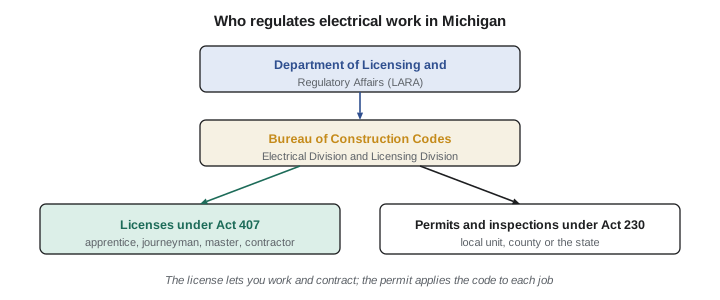
Michigan licenses electricians and electrical contractors through the Department of Licensing and Regulatory Affairs, usually shortened to LARA. Within LARA, the Bureau of Construction Codes, or BCC, runs the electrical program: its Licensing Division processes applications and renewals, and its Electrical Division writes and interprets the electrical code rules and performs inspections in places where the state is the enforcing agency. An Electrical Administrative Board, made up mostly of people from the trade, advises the bureau, approves code update courses and hears disciplinary matters under the licensing law.
The licensing law itself is the Skilled Trades Regulation Act, 2016 Public Act 407. Before 2016 Michigan had a separate Electrical Administrative Act along with separate acts for plumbing, mechanical work and other trades. Act 407 pulled those trades into one statute with shared general rules in its early articles and a separate article for each trade. Article 7 covers electrical licensing. When an older textbook or a retired electrician talks about the Electrical Administrative Act, they are describing rules that now live, in revised form, in Act 407.
The license types
Michigan's electrical licenses form a ladder. A person starts as a registered electrical apprentice working under licensed supervision, becomes an electrical journeyman after enough hours and an exam, and can then become a master electrician after more experience and a second exam. Separate licenses cover fire alarm work and sign work. On the business side, an electrical contractor license allows a person or company to contract for electrical work, and parallel contractor licenses exist for fire alarm and sign specialty contractors.
| License | What it allows | Exam |
|---|---|---|
| Electrical apprentice (registration) | Work under the supervision of a licensed electrician | None |
| Electrical journeyman | Perform electrical work under an electrical contractor | Yes, through PSI |
| Master electrician | Plan and supervise installations; qualify an electrical contractor | Yes, through PSI |
| Fire alarm specialty technician | Fire alarm work | Yes |
| Sign specialist | Electrical sign work | Yes |
| Electrical contractor | Contract for electrical work through a licensed master electrician | None, but an application is required |
According to the bureau, there is no exam to become an electrical contractor, but you still have to apply for and hold the license. The contractor license depends on a master electrician: either the applicant holds a master license, or the business employs a full-time master electrician who lives in Michigan and is actively in charge of and responsible for code compliance of all the company's installations. The bureau also states that a master electrician can be associated with only one electrical contractor at a time. That single rule explains a lot about how Michigan electrical companies are organized, and Lessons 7 and 8 come back to it.
No statewide reciprocity
Some states let a licensed electrician from another state skip an exam through a reciprocity agreement. The bureau's licensing page says plainly that Michigan does not hold reciprocity with any other state or country. An electrician moving to Michigan from Ohio, Indiana or Wisconsin has to meet Michigan's experience requirements and pass the Michigan exam. Experience earned elsewhere may count toward the hours if it can be documented and verified, but the license itself does not transfer.
The state code and local enforcement
Michigan has a single state construction code, created under the Stille-DeRossett-Hale Single State Construction Code Act, 1972 Public Act 230. For electrical work, the code is the Michigan Electrical Code, which consists of the National Electrical Code as adopted and amended by the Part 8 rules. Cities, villages, townships and counties do not write their own electrical codes. A local unit may choose to administer and enforce the state code itself, through its own building department and electrical inspectors, or it may leave enforcement to the county or to the state. Where no local agency has taken on enforcement, the Bureau of Construction Codes issues permits and performs inspections.
This split matters every day. Cedar River's Lansing jobs are permitted and inspected by the city's building department. Its farm shop jobs in a small township in Ionia County may be permitted through the county or through the state, depending on who has accepted responsibility there. The code is the same in both places; the office that issues the permit and the inspector who shows up are different. Lesson 6 covers how to find the right enforcing agency for an address.
Local licensing in a few cities
Licensing is mainly a state matter in Michigan, but a few large cities add local requirements on top of the state license. The bureau's licensing page notes that Detroit issues its own electrical licenses locally, and some other cities require contractors to register before pulling permits. A contractor that takes a job in Detroit, or in another city with registration, checks those local rules before bidding. The state license is still required; the local registration or license is an extra step, not a substitute.
Unlicensed work
Performing or contracting for electrical work without the required license violates Act 407 and can lead to fines, criminal penalties and orders to stop work. An enforcing agency will not issue a permit to an unlicensed contractor, and an unlicensed contractor may have trouble enforcing a contract or a construction lien. Licensed contractors also put their own licenses at risk if they pull permits for work they do not supervise or let someone else use their license number. Diane told Jamal about a house in Holt where a handyman ran a new circuit to a hot tub with indoor cable laid in the yard. The homeowner paid twice: once for the handyman, and again for Cedar River to tear it out and do it right under a permit.
# Which Michigan license covers each role? (simplified study aid)
roles = [
    ("Pull wire under a journeyman's supervision", "apprentice"),
    ("Install a 200 A residential service for an electrical contractor", "journeyman"),
    ("Be the master in charge of code compliance for a company", "master"),
    ("Install and test fire alarm devices", "fire alarm specialty technician"),
    ("Sign a contract with a client to do electrical work", "electrical contractor"),
]
needs_exam = {"apprentice": False, "journeyman": True, "master": True,
              "fire alarm specialty technician": True, "electrical contractor": False}
for role, lic in roles:
    tag = "exam required" if needs_exam[lic] else "no exam, application only"
    print(role)
print(" license:", lic, "-", tag)Pull wire under a journeyman's supervision license: apprentice - no exam, application only Install a 200 A residential service for an electrical contractor license: journeyman - exam required Be the master in charge of code compliance for a company license: master - exam required Install and test fire alarm devices license: fire alarm specialty technician - exam required Sign a contract with a client to do electrical work license: electrical contractor - no exam, application only
The output shows a point that surprises many people from other states: the business license has no exam in Michigan, because the knowledge test sits with the master electrician the business relies on. The contractor license is about who is responsible; the master license is about what that person knows.
Worked problem
Mapping a company to the license rules
A company in Kalamazoo has two owners, neither of them electricians, and wants to start doing commercial electrical contracting. It plans to hire a master electrician who lives in Indiana and is also the master of record for his own small electrical company. What problems does this plan have?
Show solution
- The owners do not need electrical licenses themselves, but the company needs an electrical contractor license.
- Without an owner who holds a master license, the company must employ a full-time master electrician.
- That master must live in Michigan and be actively in charge of code compliance for all installations.
- A master electrician can be associated with only one electrical contractor at a time.
- The Indiana master fails the residency rule and is already tied to his own company.
Answer: The plan fails on residency and on the one-contractor rule; the company needs a different master electrician who lives in Michigan and works for it full time.
Where the rules live
Michigan electrical contractors work under several layers of law, and the exam expects candidates to know which layer answers which question. Act 407 sets licensing requirements, exam eligibility, renewal and discipline. Act 230 creates the single state construction code and sets up permits, enforcing agencies, inspections and appeals. The Part 8 rules adopt the NEC with Michigan amendments. The Construction Lien Act governs liens, notices and sworn statements. The Michigan Occupational Safety and Health Act, enforced by MIOSHA, covers workplace safety. The Workers' Disability Compensation Act covers workers' compensation. The PSI candidate bulletin explains exam logistics. When a question comes up on a job or the exam, start by asking which layer it belongs to.
Those layers also tell you who to call. A question about whether your hours count goes to the bureau's Licensing Division. A question about whether a receptacle needs ground-fault protection goes to the local electrical inspector or the bureau's Electrical Division. A question about whether you can still file a lien goes to a construction lawyer. Knowing the right office saves days of phone tag and keeps you from relying on a friend's guess.
Common mistakes
MistakeAssuming a business needs an exam to get an electrical contractor license.
InsteadThe contractor license has no exam; it depends on a licensed master electrician who owns or works for the company.
MistakeThinking an out-of-state license transfers to Michigan.
InsteadMichigan has no reciprocity; you must meet Michigan's requirements and pass the Michigan exam.
MistakeBelieving each city writes its own electrical code.
InsteadMichigan has one state code; local units only choose whether to enforce it.
MistakeTreating a Detroit license or registration as optional.
InsteadSome cities add local licensing or registration on top of the state license; check before you bid.
Summary and key terms
- Michigan licenses electricians and electrical contractors through LARA's Bureau of Construction Codes under the Skilled Trades Regulation Act, 2016 PA 407.
- The ladder runs from registered apprentice to journeyman to master electrician, with separate fire alarm and sign licenses.
- An electrical contractor license has no exam but requires a master electrician owner or a full-time, Michigan-resident master employee, and a master can serve only one contractor.
- Michigan has no reciprocity with other states.
- Michigan has one state construction code under 1972 PA 230; local units decide only whether they or the county or state enforce it.
- LARA
- The Department of Licensing and Regulatory Affairs, the state agency that houses the Bureau of Construction Codes.
- BCC
- The Bureau of Construction Codes, which licenses electricians and administers the state electrical code.
- Act 407
- The Skilled Trades Regulation Act of 2016, which governs electrical licensing.
- Act 230
- The Stille-DeRossett-Hale Single State Construction Code Act of 1972, which creates the single state code.
- Enforcing agency
- The local, county or state office that issues permits and performs inspections for an address.
Practice problems
Work each problem on paper first, then reveal the answer to check.
Which article of Act 407 covers electrical licensing?
Show answer
Article 7.
Does an electrical contractor applicant take an exam in Michigan?
Show answer
No. The contractor license requires an application and a qualifying master electrician, but no exam.
A licensed master electrician from Wisconsin moves to Grand Rapids. Can he use his Wisconsin license?
Show answer
No. Michigan has no reciprocity, so he must qualify for and pass the Michigan exam.
Who issues permits in a township that has not taken on code enforcement?
Show answer
The county, if it enforces, or otherwise the state Bureau of Construction Codes.
Lesson quiz · 5 questions
Score 60% or more to complete this lesson.
Create a free account to save your progress, take quizzes and earn a certificate.