
MELU-221 · Lesson 9 of 12 · 19 min
Contracts and mechanics' liens in Massachusetts
▶ Video coming soon A video version of this lesson is on the way.
In October, Kim brought a problem to the Monday meeting. Quabbin had finished the electrical work on a dental office in Framingham as a subcontractor to a general contractor, Metrowest Builders. The last invoice, 38,400 dollars including two approved change orders, was sixty days old. The general contractor's project manager said the owner was slow paying and that Quabbin would be paid "when we get paid." Frank looked at Ana. "You'll be the one deciding this next year," he said. "Do we wait, or do we protect our lien rights? And how long do we have?"
This lesson covers the contract basics a master electrician deals with, payment terms and change orders, the Massachusetts mechanics' lien law in chapter 254 with its notices and deadlines, how lien rights work for subcontractors and lower tiers, and why public projects use bonds instead of liens.
Contract basics
Every electrical job runs on a contract, whether it is a two-page proposal signed by a homeowner or a fifty-page subcontract from a general contractor. A good contract identifies the parties, the property and the scope of work, the price and how it can change, the payment schedule, retainage, the schedule, insurance and indemnity requirements, warranty terms and how disputes are resolved. The NASCLA guide on Part II covers these topics in general; Massachusetts adds its own rules for liens, home improvement contracts and prompt payment on larger projects.
Change orders are where many disputes start. A change order is a written agreement, signed before the extra work is done, that describes the change, its price and its effect on the schedule. Quabbin's rule was no signed change order, no extra work, except in a true emergency, and then a written confirmation the same day. The two change orders on the Framingham job were signed by the general contractor, which made them part of the contract amount Quabbin could claim.
Payment terms deserve a careful read. A pay-when-paid clause usually sets the timing of payment to a subcontractor; a pay-if-paid clause tries to make payment depend entirely on the owner paying. Massachusetts has a prompt payment law for larger private construction projects, in chapter 149 section 29E, that sets timelines for payment applications and limits some of these clauses. A smaller job like the Framingham dental office may fall below its threshold, so the contract terms and the lien law matter even more.
What a mechanics' lien does
A mechanics' lien is a claim against the owner's real estate for the value of labor and materials furnished to improve it. Under chapter 254, a contractor, subcontractor or lower-tier subcontractor who furnishes labor or materials to a private project can establish a lien by recording the right documents at the registry of deeds for the county or district where the land lies, within strict deadlines, and then suing to enforce it. A lien gives the owner a strong reason to see that the contractor is paid, because the property cannot be sold or refinanced cleanly while it is in place.
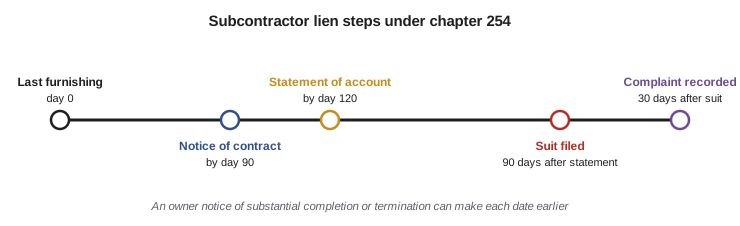
Step one: the notice of contract
The first step is recording a notice of contract in the statutory form at the registry of deeds. For a subcontractor, the deadline is the earliest of three dates: 60 days after the owner and contractor record a notice of substantial completion, 90 days after the owner records a notice of termination, or 90 days after the subcontractor last furnished labor or materials. That earliest-date rule matters. An owner who records a notice of substantial completion can shorten the time a subcontractor has to act, which is one reason contractors should check the registry for those owner notices.
Step two: the statement of account
After recording the notice of contract, the claimant records a statement of account showing the amount due. Its deadline is also the earliest of three dates: 90 days after the owner records a notice of substantial completion, 120 days after a notice of termination is recorded, or 120 days after the last furnishing of labor or materials. The amount claimed should be accurate and supportable; an inflated statement can cause serious problems.
Step three: suit and recording the complaint
The claimant must then file suit to enforce the lien within 90 days after recording the statement of account. If suit is not filed in time, the lien is dissolved automatically. Within 30 days after filing the complaint, the claimant records an attested copy of it at the registry of deeds. At each step, the clock is short and does not wait for settlement talks.
| Step | Deadline for a subcontractor: the earliest of |
|---|---|
| The notice of contract | 60 days after a recorded notice of substantial completion; 90 days after a recorded notice of termination; 90 days after last furnishing |
| Statement of account | 90 days after a recorded notice of substantial completion; 120 days after a recorded notice of termination; 120 days after last furnishing |
| Lawsuit | 90 days after recording the statement of account |
| Record the complaint | 30 days after filing suit |
from datetime import date, timedelta

def lien_dates(last_furnish, subst_completion=None, termination=None):
    nc = [last_furnish + timedelta(days=90)]
    sa = [last_furnish + timedelta(days=120)]
    if subst_completion:
        nc.append(subst_completion + timedelta(days=60)); sa.append(subst_completion + timedelta(days=90))
    if termination:
        nc.append(termination + timedelta(days=90)); sa.append(termination + timedelta(days=120))
    statement = min(sa)
    return min(nc), statement, statement + timedelta(days=90)

last = date(2026, 8, 21)
for label, sc in [("No owner notice recorded", None),
                  ("Owner recorded substantial completion Aug 28", date(2026, 8, 28))]:
    nc, sa, suit = lien_dates(last, sc)
    print(label)
    print("   notice of contract by", nc, "| statement of account by", sa,
"| suit by", suit, "if the statement is recorded on its last day")No owner notice recorded notice of contract by 2026-11-19 | statement of account by 2026-12-19 | suit by 2027-03-19 if the statement is recorded on its last day Owner recorded substantial completion Aug 28 notice of contract by 2026-10-27 | statement of account by 2026-11-26 | suit by 2027-02-24 if the statement is recorded on its last day
Quabbin last furnished labor on August 21, 2026. If no owner notice has been recorded, the notice of contract is due by November 19 and the statement of account by December 19. But the owner recorded a notice of substantial completion on August 28. That moves the notice of contract deadline to October 27 and the statement of account to November 26. Kim's discovery in mid-October meant Quabbin had less than two weeks, not a month, to record the first document.
Lower tiers and the notice of identification
A sub-subcontractor, such as a supplier or a second-tier subcontractor hired by Quabbin, has an extra step. Within 30 days after starting work, it should send the original general contractor a notice of identification in the statutory form by certified mail, return receipt requested. Without that notice, its lien may be capped at the amount due under the contract between the general contractor and the subcontractor above it as of the date its notice of contract is filed. Lien recovery for personal labor alone is limited to no more than 30 days of work actually performed.
Public projects
Mechanics' liens do not attach to property owned by the Commonwealth or a city or town. A subcontractor on a public school renovation cannot record a lien against the school. Instead, Massachusetts public construction law generally requires the general contractor to furnish a payment bond, and subcontractors and suppliers claim against that bond, following the notice and suit deadlines in the statute and the bond. Quabbin's two school jobs each came with a copy of the payment bond in the subcontract package, and Kim noted the claim deadlines on the inside of the folder.
Lien waivers and releases
Owners, lenders and general contractors often ask for lien waivers or releases as a condition of payment. A waiver given in exchange for a payment that has actually been received is normal practice. A waiver given before payment, or a broad waiver of future rights, can give up the very protection the lien law provides. Chapter 254 includes provisions on waivers and statutory forms, and generally limits waivers of lien rights given in advance. Read every waiver before signing, make sure it covers only the amount actually paid, and ask a lawyer about anything that goes further.
Kim kept a rule for waivers: no waiver until the check clears, and every waiver states the payment amount and the period it covers. When Metrowest Builders sent a waiver that released all claims through the end of the job in exchange for a partial payment, she sent it back with the amount and dates corrected.
Keeping lien rights alive in practice
Lien rights depend on information gathered at the start of a job: the owner's legal name, the property address and registry book and page, the general contractor's details, the contract amount and the dates of first and last work. Quabbin's job information sheet captured all of it before the first day on site. Kim also logged the last date Quabbin furnished labor or materials on each job, because many deadlines run from that date, and checked the registry for owner notices on any job where payment was slow.
| Job information sheet | Why it matters for liens |
|---|---|
| Owner's legal name | Lien documents name the owner |
| Registry book and page or document number | Identifies the property in the records |
| General contractor's name and address | Needed for notices and the notice of contract |
| Contract amount and change orders | Supports the statement of account |
| First and last dates of work | Deadlines run from these dates |
None of this replaces a lawyer when a lien is actually needed, but it lets the lawyer act quickly. On the Framingham job, Kim had everything in the job file, so the notice of contract was drafted and recorded in two days.
The same discipline applies to public jobs: calendar the bond claim deadlines at the start, keep the job file complete and act early when payment slows down.
Worked problem
Deciding what to do on the Framingham job
It is October 19, 2026. Quabbin is owed 38,400 dollars. The owner recorded a notice of substantial completion on August 28. Should Quabbin wait for the general contractor to pay?
Show solution
- The notice of contract deadline is the earliest of the possible dates: here, 60 days after August 28, which is October 27.
- Waiting past October 27 would lose the right to record the notice of contract.
- Recording the notice of contract keeps the lien right alive while payment talks continue.
- Quabbin should call its construction lawyer now and prepare the statutory form.
Answer: Record the notice of contract before October 27, then continue to press for payment; the statement of account is due by November 26.
Common mistakes
MistakeWaiting for payment before thinking about lien deadlines.
InsteadCalendar the deadlines from the start; owner notices can shorten them.
MistakeIgnoring a recorded notice of substantial completion.
InsteadIt can move the notice of contract deadline to 60 days after it was recorded.
MistakeTrying to lien a public building.
InsteadLiens do not attach to public property; claim against the payment bond.
MistakeLetting a sub-subcontractor skip the notice of identification.
InsteadSend it within 30 days of starting work to avoid a capped lien.
Summary and key terms
- Contracts should cover scope, price, changes, payment, retainage, insurance and disputes; change orders should be signed before the work.
- Chapter 254 lets those who furnish labor or materials to private property establish a lien by recording documents at the registry of deeds.
- For a subcontractor, the notice of contract is due by the earliest of 60 days after a recorded substantial completion notice, 90 days after a termination notice, or 90 days after last furnishing.
- The statement of account follows by the earliest of 90, 120 or 120 days; suit within 90 days of recording it; the complaint recorded within 30 days of filing.
- Liens do not attach to public property; public jobs use payment bonds.
- Mechanics' lien
- A claim against real estate for labor or materials furnished to improve it.
- Lien notice of contract
- The first lien document recorded at the registry of deeds under chapter 254.
- Statement of account
- The recorded statement of the amount due on a lien.
- Owner's notice of substantial completion
- An owner's recorded notice that can shorten lien deadlines.
- Lower-tier notice of identification
- A lower-tier subcontractor's notice to the general contractor within 30 days of starting work.
Practice problems
Work each problem on paper first, then reveal the answer to check.
A subcontractor last furnished on May 1 and no owner notice is recorded. When is the notice of contract due?
Show answer
By July 30, 90 days after last furnishing.
The statement of account was recorded on December 1. When must suit be filed?
Show answer
By March 1, 90 days later.
Can a subcontractor record a lien against a town library?
Show answer
No; liens do not attach to municipal property.
Who sends a notice of identification, and to whom?
Show answer
A lower-tier subcontractor, to the original general contractor, within 30 days of starting work.
Lesson quiz · 5 questions
Score 60% or more to complete this lesson.
Create a free account to save your progress, take quizzes and earn a certificate.