
MELU-221 · Lesson 6 of 12 · 18 min
Permits, inspections and the inspection authority
▶ Video coming soon A video version of this lesson is on the way.
On a Monday in March, Ana pulled the permit for a service upgrade in a Worcester three-decker on Vernon Hill: three meters, a new 400 A service to replace a tired 100 A setup, new feeders to each unit and a heat pump for the first floor. By Thursday the crew had the meter bank and the house panels set, and the feeders were run through the basement and up an old chase. Ana called the inspector of wires' office to schedule the rough inspection before the drywall crew closed the chase. Paul Sheehan, the inspector who covered that part of the city, came out on Friday afternoon, looked at the work, pointed out one bonding jumper that was not yet installed at the water service and signed off once the crew fixed it while he waited.
This lesson explains who issues electrical permits in Massachusetts, what the permit application requires, how and when inspections happen, what an inspector does about hazards and disagreements, and how the permit is closed out.
The inspector of wires
Every city and town in Massachusetts has an inspector of wires, sometimes called a wire inspector or electrical inspector, who enforces the electrical code locally. Large cities have several inspectors and an office with clerks; small towns may share an inspector or have one who works part time. The Board's guidance calls the inspector of wires the authority having jurisdiction for permits and recommends that licensees consult that office about local procedures. The code is the same statewide, but the inspector decides whether an installation complies on that job.
The inspector is a municipal official, not an employee of the electricians' Board. When an inspector's decision seems wrong, the licensee can talk it through, ask for the specific rule, request a formal interpretation from the Board of Fire Prevention Regulations, or use the appeal process described in the Board's forms. Arguing on site rarely helps; asking for the rule number usually does.
The permit application
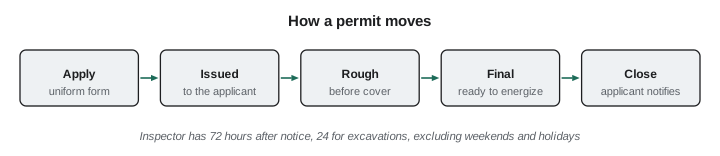
The administrative rules in 527 CMR 12.00 require permit applications to be made on a uniform state form, and electronic submission is allowed. Many cities now use online permitting portals that collect the same information. The application identifies the property, the owner, the licensed person or business doing the work, their license numbers and a description of the work. The Board's guidance says the application requires that the persons or firms doing the work be licensed in Massachusetts. The permit is issued to the applicant, who becomes responsible for the work under that permit.
Chapter 141 section 8 adds an insurance requirement. A city or town may not issue a permit for electrical work unless the licensee shows liability insurance that includes completed operations coverage from an insurer licensed in Massachusetts, or a bond or similar indemnity with substantially similar protection. As an alternative, the permit authority may accept the owner's or agent's signature on the uniform application in place of proof of insurance. Lesson 8 covers insurance in more detail.
| Permit item | What the rules say (summary) |
|---|---|
| Form | Uniform state application; electronic submission allowed |
| Who may apply | Licensed persons or firms doing the work |
| Insurance | Liability insurance with completed operations coverage, a bond, or the owner's signature in its place |
| To whom issued | The applicant, who notifies the inspector when the work is complete |
| Abandonment | May be treated as abandoned after 12 months without progress; extensions for reasonable cause |
Inspections before work is covered
The central inspection rule is simple: work may not be concealed until the inspector of wires has inspected it. Once the electrician gives notice that work is ready, the rules give the inspector a set time to inspect: 72 hours for most installations and 24 hours for excavations, with weekends and holidays excluded. If the inspector does not come within that time, the rules address what happens next, but a careful contractor treats the timing as a planning tool, not a loophole. Calling for the rough inspection the morning the drywall crew arrives is a schedule failure, not an inspector failure.
from datetime import date, timedelta

def deadline(notice_day, hours, holidays=()):
    # Count business days only: 72 hours = 3 business days, 24 hours = 1
    days = hours // 24
    d = notice_day
    while days > 0:
        d += timedelta(days=1)
        if d.weekday() < 5 and d not in holidays:
            days -= 1
    return d

hol = {date(2026, 4, 20)}          # Patriots' Day, a Massachusetts holiday
for what, notice, hrs in [("Rough, three-decker", date(2026, 3, 12), 72),
                          ("Trench for barn feeder", date(2026, 4, 17), 24),
                          ("Rough, dental office", date(2026, 4, 16), 72)]:
print(f"{what:24} notice {notice} -> inspect by {deadline(notice, hrs, hol)}")Rough, three-decker notice 2026-03-12 -> inspect by 2026-03-17 Trench for barn feeder notice 2026-04-17 -> inspect by 2026-04-21 Rough, dental office notice 2026-04-16 -> inspect by 2026-04-22
The trench notice on Friday, April 17, runs past the weekend and past Patriots' Day on Monday, April 20, so the inspection is due by Tuesday the 21st. The dental office rough notice on Thursday, April 16, also skips the weekend and the holiday. Ana used the same logic to set the drywall dates in her schedule.
Typical inspections
Most jobs have at least two inspections. The rough inspection happens after boxes, wiring and raceways are installed but before insulation and wall coverings go on. A service or trench inspection happens when a service is set or underground work is exposed. The final inspection happens when devices, fixtures and equipment are installed and the system is ready to energize. Large jobs may have many partial inspections as areas are finished. The serving utility usually needs confirmation from the inspector before it connects a new or upgraded service.
Solar installations add a utility step. The Board's guidance notes that the inspector of wires is not required to sign the utility's certificate of completion for a solar photovoltaic system; that document is between the customer and the utility. The inspector still inspects the electrical installation under the permit.
Hazards and corrections
If an inspector finds an actual hazard, the administrative rules require written notice to the property owner identifying the specific hazard and the rule violated. On new work, most problems are simple corrections that the electrician fixes and the inspector rechecks, as Paul did with the missing bonding jumper. A written hazard notice is more serious; it tells the owner that the condition must be corrected and gives everyone a record.
Completion and closing out
When the work is complete, the permit holder notifies the inspector. The inspector then performs the final inspection and closes the permit. A permit that shows no progress for 12 months may be treated as abandoned, although the rules allow extensions for reasonable cause. Open permits are a business risk: a buyer's lawyer finds them, a new inspector asks about them and, as Lesson 8 explains, a new licensee of record has to take responsibility for them when a master leaves a business. Kim kept a spreadsheet of every open permit with its date and the last inspection, and Frank reviewed it on the first Monday of every month.
Working well with inspectors
An inspector is not an adversary. A good working relationship saves time on every job: inspections scheduled when work is actually ready, plans and load calculations available on site, the permit posted where the inspector expects it, and someone there who knows the job. Paul Sheehan told Ana that most of his failed inspections were not code arguments but work that was not finished when the electrician called. A failed inspection costs a return trip for both sides and can push the schedule back by days.
When an inspector asks for a change, the professional response is to understand the rule, fix the work and, if there is real disagreement, ask for the specific section and use the interpretation or appeal process. Keeping a record of what was asked and when protects everyone. Ana started keeping a short note in the job file after each inspection: date, inspector, result, corrections and when they were made.
| Before calling for inspection | Why |
|---|---|
| Work in that area is complete | Partial work fails and wastes a trip |
| Permit and plans on site | The inspector checks scope against the permit |
| Access clear to boxes, panels and grounding | Concealed or blocked work cannot be checked |
| Someone on site who knows the job | Questions get answered on the spot |
| Corrections from last time finished | Repeat items delay approval |
Special installations
Some installations add steps beyond a standard permit. Solar photovoltaic systems and battery storage involve the utility's interconnection process as well as the electrical permit. Standby generators involve transfer equipment and coordination with the utility. Fire alarm work involves the fire department as well as the inspector of wires, which is one reason NFPA 72 is a Part I reference. Signs, swimming pools and work in health care facilities often involve other agencies or extra inspections. A master planning such a job calls the inspector early to ask what the city or town will want to see.
The Sturbridge barn was a good example. The farmer wanted a standby generator, a new feeder to the milking parlor and lighting in the hayloft. Ana called the Sturbridge inspector before pricing it and learned which inspections he wanted and in what order, which went straight into the schedule and the bid.
Fees and scheduling vary from one city or town to the next. Some offices take permit applications online and schedule inspections through the same portal; others still want a phone call to the inspector's office in the morning. Some charge by the number of devices or the size of the service; others use a flat fee for small jobs. Kim kept a one-page sheet for each city and town where Quabbin worked regularly, listing how to apply, how to pay, how to schedule and any local habits the inspector had, and she updated it whenever something changed.
Worked problem
Planning inspections on a schedule
The Vernon Hill crew will finish the feeder rough-in on Wednesday, April 15, 2026. The drywall crew is booked for Monday, April 20, which is Patriots' Day, and the owner wants to keep that date. Ana gives notice for the rough inspection on Wednesday. Is the drywall date safe?
Show solution
- The rough inspection must happen before the chase is covered.
- With notice on Wednesday the 15th, three business days run Thursday, Friday and Tuesday the 21st, because the weekend and Patriots' Day are excluded.
- The inspector may come earlier, but the rules allow until Tuesday, April 21.
- Covering the chase on Monday the 20th without inspection would violate the rules.
Answer: No. Book the drywall for Wednesday, April 22, or confirm an earlier inspection before closing the chase.
Common mistakes
MistakeCovering wiring before the inspector has seen it.
InsteadWork may not be concealed until it is inspected.
MistakeForgetting the insurance requirement at the permit counter.
InsteadShow liability insurance with completed operations coverage, or use the owner-signature alternative where accepted.
MistakeLeaving permits open for years.
InsteadNotify the inspector at completion and track open permits; a stalled permit may be treated as abandoned.
MistakeArguing with the inspector without a rule.
InsteadAsk for the specific rule, then use interpretations or appeals if needed.
Summary and key terms
- Each city and town's inspector of wires issues electrical permits and inspects work.
- Permits use a uniform state form, may be filed electronically and are issued to the licensed applicant.
- Chapter 141 section 8 requires proof of liability insurance with completed operations coverage, a bond, or the owner's signature, before a permit is issued.
- Work may not be concealed until inspected; the inspector has 72 hours after notice, 24 for excavations, excluding weekends and holidays.
- The permit holder notifies the inspector when the work is complete; stalled permits may be treated as abandoned after 12 months.
- Inspector of wires
- The municipal official who issues electrical permits and inspects electrical work.
- Uniform application
- The state permit form used in every city and town.
- Completed operations coverage
- Liability insurance for claims arising after the work is finished.
- Rough inspection
- Inspection of wiring before it is concealed.
- Abandoned permit
- A permit with no progress for 12 months, which may be treated as void unless extended.
Practice problems
Work each problem on paper first, then reveal the answer to check.
Who is the authority having jurisdiction for an electrical permit in Fall River?
Show answer
Fall River's inspector of wires.
How long does the inspector have after notice for an excavation inspection?
Show answer
24 hours, excluding weekends and holidays.
What insurance must be shown to get a permit under chapter 141 section 8?
Show answer
Liability insurance with completed operations coverage from a Massachusetts-licensed insurer, or a bond or the owner's signature as an alternative.
Who must notify the inspector when the work is complete?
Show answer
The permit holder.
Lesson quiz · 5 questions
Score 60% or more to complete this lesson.
Create a free account to save your progress, take quizzes and earn a certificate.