
MELU-221 · Lesson 7 of 12 · 18 min
Duties and responsibilities of the Master Electrician (Class A) License holder
▶ Video coming soon A video version of this lesson is on the way.
In April, Frank took Ana through the file he kept in the bottom drawer of his desk: the business license certificate for Quabbin Electric Co., the corporate officer list filed with the Board naming him as licensee of record, copies of the insurance certificates the company sent to inspectors and general contractors, the apprentice registrations, a binder of open permits and a folder of letters from inspectors over the years. "Passing the exam gets you the license," he said. "This drawer is the job. Once your name is on that officer list, every permit this company pulls is your responsibility, whether you were on the job or not."
This lesson covers what a master electrician is responsible for as an individual license holder, what changes when the master becomes a business's licensee of record, how supervision of apprentices and journeymen works, how the licensee of record changes, and what can lead to discipline.
Duties as an individual licensee
A master license lets the holder perform electrical work in the holder's own name and supervise others. With it come basic duties that apply whether or not the master runs a business: do the work in compliance with the Massachusetts Electrical Code, pull the required permits, call for inspections before work is concealed, keep the license current, complete continuing education, carry the license and show it when asked, and never let another person use the license number to pull permits or claim the work. A master who signs a permit application is telling the inspector that the work will be done by or under that master's supervision and to code.
The individual duties do not disappear when the master works for a company. If Ana installs a feeder wrong as a Quabbin employee, the inspector deals with Quabbin as the permit holder, but the Board can still look at Ana's own license if she knowingly did unsafe or unlawful work.
The licensee of record
A business entity that contracts for electrical work must hold the electrical business license, called the A1 license, and must name a master electrician as its licensee of record. Under 237 CMR 16.00, the application for the business license is completed and attested under the pains and penalties of perjury by the master who will serve as licensee of record. The entity's filings with the Board name that master and describe the master's responsibilities: for a corporation, the clerk-certified list of officers and the bylaws or an agreement; for a limited liability company, the list of managers and an agreement form; for a partnership, a partnership agreement form. The regulation makes the licensee of record responsible for the entity's compliance with the law.
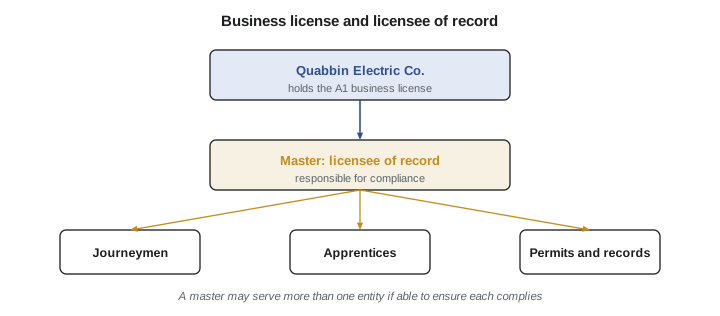
In practice, that responsibility covers the things in Frank's drawer. The licensee of record makes sure the business applies for permits through licensed people, maintains the insurance that chapter 141 section 8 requires, keeps apprentices properly registered and supervised, calls for inspections, corrects violations, closes out permits and keeps records that show who did what. The licensee of record does not have to be on every job, but must have the authority and the systems to make sure the work is done right.
| Responsibility | What it looks like at Quabbin |
|---|---|
| Code compliance on permitted work | Ana reviews job plans and spot-checks crews before inspections |
| Permits and inspections | Permits pulled only by licensed staff; rough inspections called before cover |
| Insurance | Certificates with completed operations coverage on file and sent with permits |
| Apprentices | Registrations current and supervision ratios kept on every crew |
| Records | Open-permit log, inspection results and job files kept and reviewed monthly |
| Honest dealing with the Board | Filing notices on time, accurate applications and renewals |
More than one business
Unlike some states, Massachusetts does not limit a master to serving one business. The regulation says a licensed master or systems contractor may serve as licensee of record for more than one business entity, and that the Board may require evidence that the master can ensure each entity fully complies with the rules. A master who tries to lend a name to several companies without actually controlling their work is taking a serious risk with the license, because the responsibility for each entity's compliance stays with the master.
Supervision of apprentices and journeymen
Apprentices in Massachusetts must be registered and must work under the supervision of a licensed journeyman or master. The Board's regulations set the supervision requirements, including how many apprentices a licensed electrician may supervise on a job, and those limits change from time to time, so a master checks the current rule before setting crew sizes. Journeymen do not need supervision to perform work, but a journeyman cannot contract through a business entity, so on a company's jobs the journeyman works under the business license and its licensee of record.
# Check each crew against a supervision limit (illustrative limit: confirm the current rule)
LIMIT = 1   # illustrative: apprentices allowed per licensed electrician on the job

crews = {"Vernon Hill three-decker": {"licensed": 2, "apprentices": 2},
         "Shrewsbury dental office": {"licensed": 1, "apprentices": 2},
         "Sturbridge barn": {"licensed": 1, "apprentices": 0}}
for job, c in crews.items():
    ok = c["apprentices"] <= LIMIT * c["licensed"]
    print(f"{job:26} licensed {c['licensed']}  apprentices {c['apprentices']}  ->",
"ok" if ok else "add a licensed electrician or move an apprentice")Vernon Hill three-decker licensed 2 apprentices 2 -> ok Shrewsbury dental office licensed 1 apprentices 2 -> add a licensed electrician or move an apprentice Sturbridge barn licensed 1 apprentices 0 -> ok
With the illustrative limit, the dental office crew is out of balance. Ana's fix was to move Devon Price, the second-year apprentice, to the three-decker job for the week. The point of the exercise is not the number, which the Board sets and may change, but the habit of checking crews every week as people move between jobs.
Changing the licensee of record
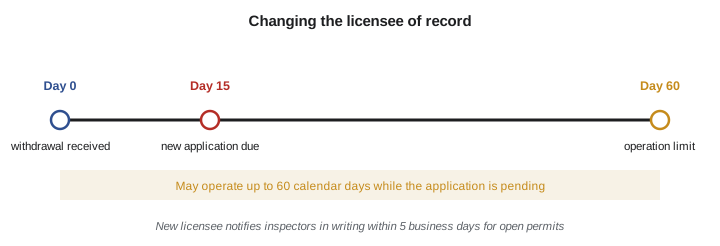
Masters retire, change jobs and sometimes die, and 237 CMR 16.00 sets out what happens. A licensee of record who wants to step down files a Board-approved withdrawal form and remains responsible until the Board receives it. If the licensee's license expires, the expiration date counts as the withdrawal date. If the licensee dies, the business must notify the Board in writing within 15 calendar days. In each case, the business must have a new application, naming a new licensee of record, received by the Board within 15 calendar days of the withdrawal. The business may continue operating for up to 60 calendar days while that application is pending, unless the Board extends the time in writing.
Open permits do not vanish when a master leaves. The new licensee of record must notify the inspector in each affected city or town, in writing, within five business days, and assume responsibility for the existing permits. That is why Frank wanted Ana to review the open-permit binder before her name went on the paperwork.
Records a licensee of record keeps
Records are how a licensee of record proves that responsibility was exercised. A sensible set includes the business license and the officer or manager list filed with the Board, every journeyman license and apprentice registration with expiration dates, the open-permit log, inspection results and correction notes, insurance certificates sent to inspectors and customers, continuing education records, safety training records and any letters from inspectors or the Board. Records should be easy to find and kept long enough to answer questions about finished jobs, which can come years later.
Frank's drawer was paper. Ana planned to move it to a shared drive with one folder per job and one folder per person, and to keep the open-permit log as a spreadsheet that Kim updated after every inspection. The format matters less than the habit of keeping it current and reviewing it every month.
| Record | Reviewed |
|---|---|
| Open-permit log | Monthly |
| Licenses and registrations | Monthly, with reminders 90 days before expiration |
| Insurance certificates | At each renewal and before each new permit |
| Continuing education | Each spring of a renewal year |
| Inspection notes | After every inspection |
Dealing honestly with customers
A master's duties also run to customers. Accurate proposals, clear change orders, honest explanations of what the code requires and why, and permits pulled in the company's name rather than the customer's are all part of professional practice. Massachusetts consumer protection law in chapter 93A prohibits unfair and deceptive acts in trade, and home improvement work for owner-occupied homes may involve additional rules. A licensee of record who lets crews skip permits to win a low bid is putting both the license and the business at risk.
Frank's rule was simple: if a customer asks Quabbin to do work without a permit, Quabbin explains why it will not and walks away if necessary. Ana intended to keep that rule.
Discipline cases often start small. A customer complaint about a job left unfinished, an inspector's report of work done without a permit or a missed continuing education deadline can each lead to a letter from the Board. A licensee of record who answers promptly, explains what happened and shows what was done to fix it is in a far better position than one who ignores the letter. Frank kept every letter he had received over 35 years, along with his replies, and told Ana that the replies mattered more than the letters.
Worked problem
Handing over the license
Frank files his withdrawal form, and the Board receives it on Monday, June 1, 2026. What are the key deadlines?
Show solution
- Frank remains responsible until the Board receives the withdrawal on June 1.
- Quabbin must have a new application naming Ana received within 15 calendar days, by June 16.
- Quabbin may operate up to 60 calendar days while the application is pending, until July 31, unless extended.
- Ana must notify each affected inspector in writing within five business days of taking responsibility.
Answer: New application by June 16; operation allowed through July 31 while pending; written notice to inspectors within five business days of taking over.
Discipline
The Board can discipline licensees who violate chapter 141 or its regulations. Common problems include working without a permit, letting unlicensed people work without supervision, false statements on applications, allowing others to use a license number, failing to correct violations and failing to complete continuing education. Penalties can include fines, required education, suspension and revocation. The best protection is the system in Frank's drawer: a record that shows the licensee of record knew what the business was doing and acted on problems.
Common mistakes
MistakeThinking the licensee of record is responsible only for jobs he personally visits.
InsteadThe licensee of record is responsible for the entity's compliance on all its work.
MistakeAssuming a master may serve only one business in Massachusetts.
InsteadA master may serve more than one entity, but must be able to ensure each one complies.
MistakeMissing the 15-day deadline after a master leaves.
InsteadA new licensee application must be received within 15 calendar days of withdrawal.
MistakeForgetting open permits when taking over.
InsteadNotify each affected inspector in writing within five business days and assume the permits.
Summary and key terms
- A master must work to code, pull permits, call inspections, renew on time and never lend the license number.
- A business needs an A1 license naming a master as licensee of record, who is responsible for the entity's compliance.
- A master may be licensee of record for more than one entity if the master can ensure each complies.
- Apprentices must be registered and supervised under the Board's current limits.
- When the licensee changes: a new application within 15 calendar days, operation up to 60 days, and written notice to inspectors within five business days for open permits.
- Licensee of record
- The master named by a business as responsible for its compliance with electrical licensing law.
- A1 license
- The electrical business license held by a business entity.
- Withdrawal form
- The Board form a licensee of record files to step down.
- Open permit
- A permit that has not been finally inspected and closed.
- Supervision
- A licensed electrician directing and checking an apprentice's work on the job.
Practice problems
Work each problem on paper first, then reveal the answer to check.
Within how many calendar days must a business notify the Board after its licensee of record dies?
Show answer
15 calendar days.
How long may a business keep operating while a new licensee application is pending?
Show answer
Up to 60 calendar days, unless the Board extends it in writing.
Can a Massachusetts master be licensee of record for two companies?
Show answer
Yes, if the master can ensure each fully complies; the Board may ask for evidence.
What must a new licensee of record do about open permits?
Show answer
Notify each affected inspector in writing within five business days and assume responsibility for them.
Lesson quiz · 5 questions
Score 60% or more to complete this lesson.
Create a free account to save your progress, take quizzes and earn a certificate.