
MELU-221 · Lesson 12 of 12 · 18 min
Practice exam review and test-day strategy
▶ Video coming soon A video version of this lesson is on the way.
Two weeks before her exam date in mid-March, Ana sat at the kitchen table with a timed practice set, her tabbed code book, the bound copy of 527 CMR 12.00 and a pad of scratch paper. Her friend Marco had failed Part I the year before with 53, three short of the 56 he needed. "I knew the material," he told her. "I ran out of time on the calculations and guessed the last twelve." Ana's plan for the last two weeks was built around not repeating that.
This lesson pulls the course together into a final review plan: how to use practice exams, how to keep and use a miss log, how to pace the two parts, how to read questions carefully, how to use the code book and the Part II references quickly, and how to handle test day itself.
What the exam looks like, one more time
The master exam has two parts. Part I is the code part, with 80 questions in 240 minutes, using the NEC, NFPA 72 and the Massachusetts amendments in 527 CMR 12.00. Part II covers business and law, with 50 questions in 120 minutes, using the NASCLA guide and the Massachusetts laws and regulations named in the bulletin. Each part is scored separately, and each requires 70 out of 100 correct to pass: 56 on Part I and 35 on Part II. A candidate who passes one part and fails the other retakes only the part not passed, within the time limits in the bulletin.
| Part | Questions | Time | Correct needed | Average time per question |
|---|---|---|---|---|
| Part I: code | 80 | 240 minutes | 56 | 3.0 minutes |
| Part II: business and law | 50 | 120 minutes | 35 | 2.4 minutes |
Using practice exams
A practice exam is a measuring tool, not a study method. Ana took a full timed practice set for each part at the start of her final month, scored it and then sorted every miss by cause. She took a second full set ten days later and a third, shorter set three days before the exam. Between them, she studied the topics the misses pointed to. Practice sets from different providers vary in quality, and none of them is the real exam, so the score matters less than the pattern of misses.
The miss log
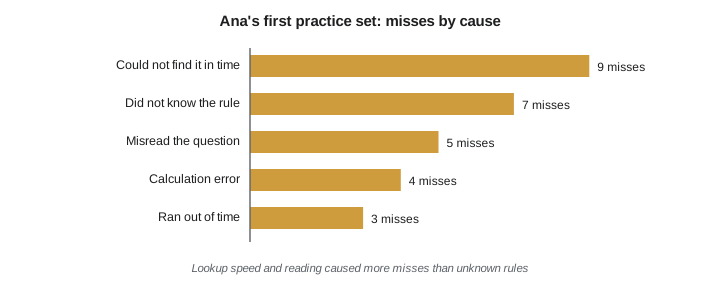
Every missed question goes in the log with four facts: the topic, the reference and section where the answer is found, why it was missed and what to do about it. Most misses fall into a few causes: did not know the rule, could not find it in time, misread the question, made a calculation error or ran out of time. Each cause has a different fix. Not knowing a rule means study. Not finding it means better tabs and more lookup practice. Misreading means slowing down on key words. Calculation errors mean working problems in a standard layout. Running out of time means pacing.
misses = [("Part I", "find"), ("Part I", "find"), ("Part I", "know"), ("Part I", "misread"),
          ("Part I", "calc"), ("Part I", "find"), ("Part I", "time"), ("Part II", "know"),
          ("Part II", "misread"), ("Part II", "know"), ("Part I", "calc"), ("Part II", "find")]
fixes = {"find": "retab and drill lookups", "know": "study the rule",
         "misread": "underline key words", "calc": "use one layout", "time": "pace by checkpoints"}
count = {}
for part, cause in misses:
    count[cause] = count.get(cause, 0) + 1
for cause, n in sorted(count.items(), key=lambda kv: -kv[1]):
print(f"{cause:8} {n:2} -> {fixes[cause]}")find 4 -> retab and drill lookups know 3 -> study the rule misread 2 -> underline key words calc 2 -> use one layout time 1 -> pace by checkpoints
Ana's log showed that lookup speed, not knowledge, was her biggest problem on Part I. She spent the next week drilling lookups: twenty random topics a night, each found in the index and then in the article, timed. Her average lookup time fell from about two and a half minutes to under a minute, which on an 80-question exam is the difference between finishing and guessing.
Pacing
Part I allows an average of three minutes a question, but the questions are not equal. A direct rule question takes thirty seconds if you know where it is; a load calculation can take six minutes. The two-pass method handles this. On the first pass, answer every question you can do quickly and mark the rest. On the second pass, go back to the marked questions with the time that is left. Set checkpoints: on Part I, about 25 questions answered by the one-hour mark on the first pass, and the first pass finished with at least an hour to spare. Never leave a question blank; the score is the number answered correctly, so a blank can only cost a point.
def checkpoints(questions, minutes, marks=4):
    per = minutes / questions
    for k in range(1, marks + 1):
        t = minutes * k / marks
        print(f"   at {t:5.0f} min: about {t / per:3.0f} questions done")

for name, q, m in [("Part I", 80, 240), ("Part II", 50, 120)]:
    print(name, f"({m / q:.1f} min per question on average)")
checkpoints(q, m)Part I (3.0 min per question on average) at 60 min: about 20 questions done at 120 min: about 40 questions done at 180 min: about 60 questions done at 240 min: about 80 questions done Part II (2.4 min per question on average) at 30 min: about 12 questions done at 60 min: about 25 questions done at 90 min: about 38 questions done at 120 min: about 50 questions done
Reading the question
Many misses come from reading too fast. Key words change the answer: minimum or maximum, shall or may, dwelling or commercial, copper or aluminum, continuous or noncontinuous, indoors or outdoors, the 2023 or 2026 edition. Ana underlined those words in every practice question until it became a habit. For Massachusetts questions, she asked a second question each time: has the state amended this section? A Part I question about ground-fault protection near a kitchen sink is exactly where the Massachusetts amendment can change the answer from the base NEC.
Using the references fast
The bulletin allows highlighting and underlining in the references but no handwritten notes, and allows formulas to be written on blank pages provided they meet the bulletin's rules. Permanent tabs are generally allowed if they are not written notes; check the bulletin's exact wording and what PSI staff will check at the door. For Part II, Ana made sure she could find each statute and regulation quickly: chapter 141, the 237 CMR regulations on licensing and business licensure, chapters 151 and 152, the lien provisions of chapter 254, the unemployment employer guide and the OSHA excerpts. Many Part II questions are direct lookups if you know which document holds the answer.
| Part II topic | Where Ana looked first |
|---|---|
| License classes, permits, insurance for permits | Chapter 141 and 237 CMR |
| Business license and licensee of record | 237 CMR 16.00 |
| Workers' compensation | Chapter 152 |
| Wages and hours | Chapter 151 |
| Liens | Chapter 254 |
| Unemployment insurance | The state employer guide |
| Safety | OSHA 1926 excerpts |
| Estimating, accounting, contracts | The NASCLA guide |
Test day
Ana's test-day plan was simple. The night before, she packed the references, checked them against the bulletin's list, removed loose papers and put her two forms of identification in the bag. She slept, ate breakfast and arrived at the Worcester test center 30 minutes early. During the exam she used the two-pass method, checked the clock at each checkpoint and took one short break in Part I to stretch. When a question rattled her, she marked it and moved on instead of letting it eat ten minutes.
If the score report shows a fail on one part, the bulletin's rules set the next steps: a waiting period before rescheduling, limits on the number of attempts and the time allowed to pass both parts, and further education after repeated failures under 237 CMR 14.00. A failing score report shows performance by area, which is exactly what the next miss log needs.
The final two weeks
Ana's last two weeks were structured, not frantic. She stopped learning new topics with five days left and spent the remaining time on lookups, her miss log and two short timed sets. She reviewed the Massachusetts amendments once more, re-read her one-page list of formulas and checked every reference against the bulletin's list. She also drove to the Worcester test center one evening to check the route, the parking and how long the trip took at the time of day she would travel.
| Days before the exam | Focus |
|---|---|
| 14 to 10 | Second full timed set for each part; update the miss log |
| 9 to 6 | Study the top causes in the log; lookup drills nightly |
| 5 to 3 | Short timed set; review amendments and formulas |
| 2 | Check references against the bulletin; pack the bag |
| 1 | Light review only; sleep |
After the exam
A candidate who passes both parts pays the license fee and receives the license as the bulletin and the Board describe, then has a new set of responsibilities. For Ana that meant planning her first master renewal, as Lesson 11 describes, and preparing to become Quabbin's licensee of record, as Lesson 7 describes. A candidate who passes one part keeps that score for the period the bulletin allows and focuses on the other.
A candidate who fails should treat the score report as data. Performance by area shows where the misses came from, and the miss log method applies again. Marco did exactly that after his 53: he found that most of his misses were in load calculations and grounding, drilled those for a month, and passed Part I on his second attempt with time to spare. The difference was not that he knew more code; it was that he found it faster and finished the exam.
Finally, Ana kept her expectations steady. She knew some questions would be unfamiliar and that a few would feel unfair. The plan did not depend on knowing every answer; it depended on answering the ones she knew quickly, finding the ones she could look up and making sensible choices on the rest.
Worked problem
Rescuing a slow first pass
At the two-hour mark of Part I, Ana has answered 34 questions on her first pass and marked 9 others. Her plan called for about 40 answered by now. What should she do?
Show solution
- Two hours is half of 240 minutes, so the plan expected about half the 80 questions handled.
- She has handled 43 questions, 34 answered and 9 marked, so she is close to pace on the first pass.
- She should keep moving, mark anything longer than about three minutes and not reopen marked questions until the first pass is done.
- She keeps the last hour for the 9 marked questions and any new ones.
Answer: Stay on the two-pass plan, mark long questions quickly, and finish the first pass with at least an hour left.
Common mistakes
MistakeTreating a practice score as a prediction.
InsteadUse practice sets to find causes of misses and fix them.
MistakeSpending ten minutes on one hard question.
InsteadMark it, move on and return on the second pass.
MistakeLeaving answers blank.
InsteadAnswer everything; the score counts correct answers, so a blank can only cost a point.
MistakeForgetting the Massachusetts amendments on code questions.
InsteadAsk whether 527 CMR 12.00 changes the section before answering.
Summary and key terms
- Part I has 80 questions in 240 minutes and needs 56; Part II has 50 in 120 minutes and needs 35.
- Use timed practice sets to build a miss log sorted by cause, then fix each cause in its own way.
- Drill lookups until each one takes less than a minute.
- Use two passes with checkpoints, answer every question and leave time for marked questions.
- Read key words carefully and check the Massachusetts amendments on every code question.
- Miss log
- A record of practice misses with topic, reference, cause and fix.
- Two-pass method
- Answering quick questions first and returning to marked ones with the remaining time.
- Checkpoint
- A planned number of questions done by a set time.
- Lookup drill
- Timed practice finding topics in the references.
- Score report
- PSI's report of the result, with performance by area on a fail.
Practice problems
Work each problem on paper first, then reveal the answer to check.
How many correct answers are needed on Part II?
Show answer
35 of 50.
What is the average time per question on Part I?
Show answer
3 minutes.
What should you do with a question that will take a long time?
Show answer
Mark it and return to it on the second pass.
What is the most useful part of a failing score report?
Show answer
The performance by area, which shows what to study.
Lesson quiz · 5 questions
Score 60% or more to complete this lesson.
Create a free account to save your progress, take quizzes and earn a certificate.