
MELU-221 · Lesson 3 of 12 · 18 min
Applying, approval and booking the exam
▶ Video coming soon A video version of this lesson is on the way.
Ana sat down with Kim Tran, Quabbin's office manager, on a Saturday morning in late January with a coffee, her scanned documents and the candidate bulletin. Kim had walked two other electricians through the process over the years. "The form is the easy part," Kim said. "The mistakes people make are in the dates and the money. They miss the window, or they show up on the wrong day, or they forget that the clock starts when the application is approved."
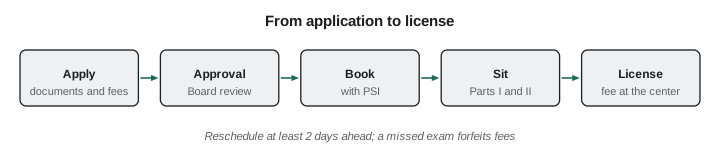
This lesson follows the steps from the application through approval, booking with the testing company, the exam day, the score report and the license, along with the fees, the rescheduling rules, the attempt limits and the time windows that a candidate has to manage.
Who does what
Three parties handle a master exam application in Massachusetts. The Board decides eligibility and issues the license. PSI, the testing company under contract with the state, receives the application and fees, forwards the application for review, schedules the exam and runs the test centers. The candidate is responsible for a complete application, correct documentation, booking on time and showing up with the right identification and references.
The application
The application for examination asks for the candidate's identity, contact details, license number as a journeyman, the exam being requested and the supporting documents described in Lesson 2: proof of at least one year as a Massachusetts journeyman actively engaged in electrical work, and proof of 150 hours of approved master education. The candidate signs the application under the pains and penalties of perjury, which means a false statement is not just a reason for denial but can lead to discipline and other consequences later.
Massachusetts also requires applicants for professional licenses to be in good standing with their state taxes and child support obligations. The Board's guidance explains that a hold from the Department of Revenue can block a license or renewal, and that it is cleared by requesting a certificate of good standing through MassTaxConnect. A candidate who has a tax problem should fix it before applying rather than after passing the exam.
The fees
The bulletin posted by the Board lists the master application fee as a total of 276 dollars. That total is made up of a PSI processing fee of 75 dollars, a trade exam administration fee of 80 dollars, a business exam administration fee of 55 dollars and a Massachusetts application fee of 66 dollars. Approved veterans, active military members and their spouses may have the Massachusetts portion waived, which brings the total to 210 dollars. When the candidate passes, the license fee of 155 dollars is paid at the test center. Fees are not refundable.
| Fee (bulletin posted by the Board) | Amount in dollars | When paid |
|---|---|---|
| PSI processing fee | 75 | With the application |
| Trade exam (Part I) administration | 80 | With the application |
| Business and law exam (Part II) administration | 55 | With the application |
| Massachusetts application fee | 66 (may be waived for eligible veterans and military) | With the application |
| Total application | 276 (210 with the waiver) | With the application |
| Master license fee | 155 | At the test center after passing |
fees = {"PSI processing": 75, "Part I administration": 80,
        "Part II administration": 55, "MA application": 66}
total = sum(fees.values())
print("Application total:", total, "dollars")
print("With the MA fee waived:", total - fees["MA application"], "dollars")
license_fee = 155
print("Total if she passes on the first try:", total + license_fee, "dollars")Application total: 276 dollars With the MA fee waived: 210 dollars Total if she passes on the first try: 431 dollars
Approval and the twelve-month window
After the Board approves the application, PSI notifies the candidate that they are eligible to schedule. The bulletin says both parts must be passed within twelve months of the date the application was accepted. A candidate who does not pass both parts in that time must submit a new application, with new fees, and take both parts again. Scores are valid for twelve months, so a candidate who passes Part II in March and keeps failing Part I needs to finish within the window or lose the Part II pass.
Kim's rule was simple: book the first sitting within a month of approval. A candidate who waits until month ten to try for the first time has left no room to recover from a bad day, a snowstorm or an illness.
Booking, rescheduling and missed exams
Candidates book through PSI online or by phone and choose a test center and date. The bulletin posted by the Board says a candidate may cancel or reschedule without penalty if PSI is contacted at least two days before the exam, and that a voicemail is not an acceptable way to cancel. A candidate who misses a scheduled exam without proper notice forfeits the fees paid. PSI may accept a letter from a doctor or hospital for an illness, and if severe weather closes a test center, PSI contacts candidates to reschedule.
Part I and Part II can be taken on the same day or on different days. On a same-day booking, the candidate finishes one part before starting the other and cannot go back to the first part once the second has begun.
Attempt limits
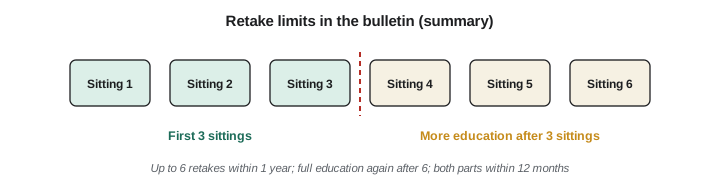
Massachusetts allows several tries, but each try is counted. The bulletin posted by the Board says a candidate may retake a failed part up to six times within one year of the application approval date. After three sittings, the candidate must complete additional education under 237 CMR 14.00 before trying again. After six attempts, the candidate must repeat the full education required for licensure under 237 CMR 13.00, which for the master means another 150 hours. A failed candidate must wait at least 24 clock hours before rescheduling and cannot retest on the same day.
Getting the paperwork right the first time
Applications that bounce back usually do so for simple reasons: a missing signature, an employer letter that does not state dates of employment, a course certificate without the provider's approval number, a name that does not match the identification the candidate will bring to the test center, or a fee paid to the wrong place. Kim's advice to Ana was to make a checklist from the Board's current application instructions, gather every document before starting, scan each one and keep a copy of the full packet. If the Board asks a question, a candidate who can answer the same day saves weeks.
The name on the application matters more than most candidates expect. PSI checks identification at the door against the name on the booking, and the booking comes from the Board's approval. A candidate who married, uses a middle name or has a hyphenated name should make sure the same name appears on the application, the approval and the identification. The bulletin describes the identification PSI accepts; read it before booking.
| Item | What Kim checked before Ana mailed the packet |
|---|---|
| Application form | Current version, every field complete, signed and dated |
| Journeyman license | Number and issue date match the Board's records |
| Experience letter | On company letterhead, with dates and duties |
| Course certificate | Approved provider, 150 hours, completion date |
| Fees | Paid to the right party, receipt saved |
| Name | Same on the application and on both pieces of identification |
Accommodations and special arrangements
Candidates who need testing accommodations for a disability, or who have religious or other reasons to request special arrangements, must ask well ahead. The bulletin explains the process; requests usually need documentation and time to approve, and they are generally arranged before the exam is booked rather than on the day. Candidates whose first language is not English should also read the bulletin's rules about dictionaries and translation aids, which are generally restricted.
Ana did not need accommodations, but her friend Marco, who has dyslexia, asked for extra time after his first attempt. He found that the paperwork took several weeks and wished he had started it before his first sitting. Planning for accommodations is part of planning the twelve-month window.
Timing the application is its own small project. The Board needs time to review the packet, PSI needs time to process the approval and open booking, and the most convenient test dates at the nearest center fill up first, especially in late winter and spring. Ana mailed her packet in early January, planned for approval within about six weeks, and had a backup date at a second test center in mind in case Worcester was full. She also told Frank which weeks she wanted to keep free of overtime so she could study in the final stretch.
Keep copies of everything that comes back, too. The approval letter, the PSI booking confirmation and the receipts for each fee belong in the same folder as the application. If a date has to change, or if a question comes up after the exam about which fees were paid, the paper trail answers it quickly. Kim kept Ana's folder next to the license files for the rest of the staff, because the same records would be needed again when Ana renewed.
Worked problem
Planning around the window
Ana's application is approved on February 10, 2026. She takes both parts on March 14 and passes Part II but scores 52 of 80 on Part I. She retakes Part I on April 18 and scores 55. What should she plan next?
Show solution
- Part I requires 56 correct out of 80.
- She has used two sittings on Part I; the additional education requirement applies after three.
- Her Part II pass is valid for twelve months, and both parts must be passed within twelve months of approval.
- Her deadline to pass Part I is February 10, 2027, but she should retake soon, using her score report to target weak areas.
Answer: Retake Part I after studying her weakest sections, well before the third sitting and long before February 2027.
Exam day and the score report
On exam day the candidate brings the identification described in the bulletin, arrives early and brings only the references allowed for that part, which Lesson 4 lists. The exams are given on computer, and the candidate receives a printed score report at the end. A failing report shows the overall score and the number correct in each major content area, which is the best study guide available for the next attempt. A passing report does not show the breakdown. If the report cannot be printed at the center, it is mailed.
Ana booked a Saturday in mid-March at the Worcester test center for both parts, Part II in the morning and Part I in the afternoon. She planned to bring a sandwich and leave her phone in the car.
Common mistakes
MistakeWaiting months after approval before the first attempt.
InsteadBoth parts must be passed within twelve months of approval; book early.
MistakeCanceling by voicemail the night before.
InsteadContact PSI at least two days ahead by an accepted method, or forfeit the fees.
MistakeIgnoring the failing score report.
InsteadUse the section breakdown to target the next round of study.
MistakeForgetting the attempt rules.
InsteadAdditional education is required after three sittings and the full education after six.
Summary and key terms
- The Board decides eligibility and issues the license; PSI receives applications, schedules and runs the exams.
- The bulletin posted by the Board lists a 276-dollar master application total and a 155-dollar license fee paid at the test center.
- Both parts must be passed within twelve months of application approval, and scores are valid for twelve months.
- Cancel or reschedule at least two days ahead; missing an exam forfeits the fees.
- Retakes are limited: extra education after three sittings and the full education requirement after six.
- PSI
- The testing company that receives applications and schedules and runs the Massachusetts electrician exams.
- Score report
- The printed result given at the end of the exam, with section counts for failing candidates.
- Twelve-month window
- The period after approval in which both parts must be passed.
- 237 CMR 14.00
- The Board's rule requiring additional education before further re-examination.
- Certificate of good standing
- A Department of Revenue document that clears a tax hold on a license.
Practice problems
Work each problem on paper first, then reveal the answer to check.
How many days before the exam must a candidate contact PSI to reschedule without penalty?
Show answer
At least two days.
What happens if both parts are not passed within twelve months of approval?
Show answer
The candidate must reapply and retake both parts.
When is additional education required before another attempt?
Show answer
After three sittings.
Where is the master license fee paid?
Show answer
At the test center after passing.
Lesson quiz · 5 questions
Score 60% or more to complete this lesson.
Create a free account to save your progress, take quizzes and earn a certificate.