
MELU-221 · Lesson 5 of 12 · 18 min
The NEC as adopted in Massachusetts and state amendments
▶ Video coming soon A video version of this lesson is on the way.
In February, Quabbin bid a kitchen renovation in a West Boylston colonial: new range, dishwasher, garbage disposal, an island with two receptacles and a wall oven. Ana did the takeoff and assumed the same ground-fault rules she had used for years. Frank looked over the bid and asked one question: "When will the permit be issued?" The homeowner wanted to start in May. "Then it's under the new code," Frank said. "The 2026 edition with our amendments. Go read the GFCI section again, and read what Massachusetts did to it."
This lesson explains how Massachusetts adopts the National Electrical Code, which edition applies to a given job, how the Massachusetts amendments are organized, the administrative rules that live in the state code and a few of the amendments a master electrician needs to know cold.
Who adopts the code
In Massachusetts the electrical code is part of the state fire safety code. The Board of Fire Prevention Regulations, supported by the Department of Fire Services, adopts it as 527 CMR 12.00, the Massachusetts Electrical Code. The method is simple: the board adopts the current edition of NFPA 70, the National Electrical Code, by reference, and publishes a set of Massachusetts amendments that add, delete or change particular sections. The adopted NEC plus the amendments together are the code. The electricians' licensing Board does not write the code, although electricians sit on the code committees and comment on proposals.
The Board of Fire Prevention Regulations also issues advisories and, when something urgent comes up, emergency amendments. In 2023, for example, it issued an emergency amendment and advisory on ground-fault protection for certain permanently connected and cord-and-plug connected appliances after the new edition caused problems with equipment in the field. A master electrician watches for those notices because they can change what an inspector expects on a job that was bid under the published text.
Which edition applies
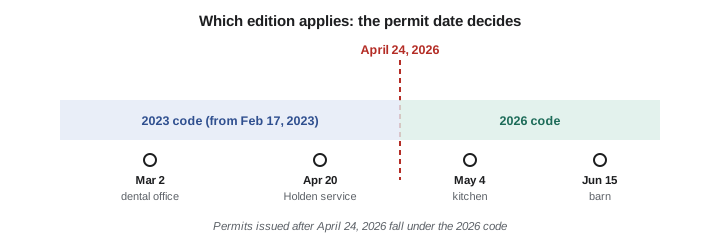
Massachusetts tends to adopt each new edition of the NEC fairly quickly. The 2023 edition, with Massachusetts amendments, took effect on February 17, 2023. The 2026 edition, based on the 2026 NEC released by NFPA in August 2025, applies to installations whose permits are issued after April 24, 2026. The trigger is the permit date. A job permitted on April 20, 2026 stays under the 2023 code for its whole life; a job permitted on May 4, 2026 is under the 2026 code even if it was bid in March.
from datetime import date

CHANGE = date(2026, 4, 24)   # 2026 code applies to permits issued after this date

def edition(permit_issued):
    return "2026 code" if permit_issued > CHANGE else "2023 code"

jobs = [("Holden service upgrade", date(2026, 4, 20)),
        ("West Boylston kitchen", date(2026, 5, 4)),
        ("Framingham dental office", date(2026, 3, 2)),
        ("Sturbridge barn", date(2026, 6, 15))]
for name, issued in jobs:
print(f"{name:26} permit {issued} -> {edition(issued)}")Holden service upgrade permit 2026-04-20 -> 2023 code West Boylston kitchen permit 2026-05-04 -> 2026 code Framingham dental office permit 2026-03-02 -> 2023 code Sturbridge barn permit 2026-06-15 -> 2026 code
The West Boylston kitchen will be permitted in May, so it falls under the 2026 code. That matters for a candidate as well as a contractor. The exam tests the edition named in the bulletin, and when a new edition takes effect, the bulletin and the exam may change after a delay. Ana checked the current bulletin to see which edition she should bring to the test center and which edition she should be designing her May jobs to. They were not necessarily the same book.
How the amendments are organized
The Massachusetts amendments do two kinds of things. First, they add administrative rules that the NEC leaves to each jurisdiction: how permits are applied for and issued, when inspections must happen, what an inspector does about hazards, how to ask for an interpretation and how the code applies to existing buildings. Second, they modify particular NEC sections, changing a requirement, adding an exception or deleting text that the board decided not to adopt. When you look up an NEC section for a Massachusetts job, you look in two places: the NEC itself and the amendments, to see whether that section was changed.
| Part of 527 CMR 12.00 | What it covers (summary) |
|---|---|
| Administrative rules (numbered rules) | Permits, notification, inspections, hazards, appeals and related administration |
| Section 90.6 amendment | Formal interpretations requested from the Board of Fire Prevention Regulations in yes-or-no form |
| Section 210.8 amendments | How distances to receptacles are measured for ground-fault protection, and a temporary exception for certain cooking equipment |
| Rule 11 | Inspection and documentation of equipment that is not compatible with available ground-fault devices (temporary) |
| Other modified sections | Changes, additions and deletions throughout the NEC chapters |
Ground-fault protection in the 2026 code
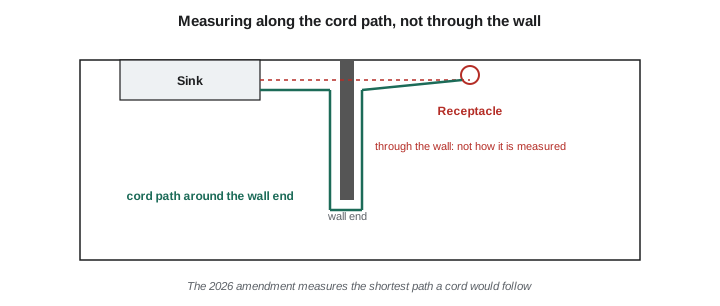
Ground-fault protection has been one of the busiest areas of recent NEC editions and of the Massachusetts amendments. The 2026 Massachusetts code addresses how the distance from a receptacle to a sink or other wet location is measured: along the shortest path a cord would follow, without passing through walls, floors, doors or windows. It covers receptacles within six feet of a sink. It also contains a temporary exception for listed cooking equipment that cannot work with the ground-fault devices currently available. That equipment may be installed without ground-fault protection if it is inspected and documented under Rule 11, with the location reported to the Department of Fire Services for a central registry. The exception and Rule 11 both expire on January 1, 2029.
For Ana's kitchen, that meant checking every receptacle near the sink and the island against the measurement rule, checking which appliances were required to have ground-fault protection under the adopted section, and checking with the range manufacturer whether the new induction range worked with the protective devices on the market. If it did not, the Rule 11 path required an inspection and paperwork, not just a note on the invoice.
Hazards, interpretations and existing buildings
The administrative rules also tell an inspector what to do about a hazard. If an actual hazard exists, the owner is notified in writing, with the specific hazard and the rule violated identified. That gives the owner something concrete to act on and gives the electrician a clear description of what must be fixed. When a code question cannot be settled locally, section 90.6 as amended lets anyone ask the Board of Fire Prevention Regulations for a formal interpretation, framed as a question that can be answered yes or no. The interpretations committee publishes agendas and answers, and those answers are worth reading because they show how the state reads a section.
The code applies to new work and to alterations. Existing installations are generally not required to be brought up to the new edition unless they are being altered, extended or found to be hazardous. When Quabbin replaces a panel in a 1920s three-decker, the new work must meet the current code, the inspector looks at what the work touches, and an obvious hazard elsewhere can still lead to a written notice.
The 2026 NEC itself
The 2026 NEC was a large reorganization. Among other changes, load calculation rules moved from Article 220 to Article 120, material on energy management moved to a new article, and some medium-voltage and limited-energy material was regrouped. A master candidate who learned on the 2020 or 2023 edition needs to retab the book and relearn where things are. The core courses in this program note the 2026 renumbering where it matters. For a Massachusetts master, the habit to build is to look up the NEC section first, then check the amendments for the same section number.
Reading the amendments efficiently
The amendments are short compared with the NEC, but they are easy to overlook in a hurry. A useful habit is to mark the NEC itself wherever Massachusetts has amended a section, using highlighting or a permanent tab as the bulletin allows, so you see the flag when you open to that page. Then the amendment is a quick second lookup, not something you remember only after you have answered. Ana went through the amendments page by page and highlighted each amended section number in her NEC, which took one evening and saved her time on every practice set afterward.
When reading an amendment, ask three questions. Does it replace the NEC text, add to it or delete it? Does it apply to every occupancy or only some? Does it have an effective or expiration date of its own, like the cooking-equipment exception? A Part I question can turn on any of the three.
Keeping up after the exam
Passing the exam is not the end of code study. The Department of Fire Services posts the current code, advisories and emergency amendments; the Board of Fire Prevention Regulations publishes interpretations; and a new NEC edition arrives every three years. Continuing education, covered in Lesson 11, is built around the current Massachusetts code. A master who runs a business also has to make sure the crews know about changes. Frank's habit was a fifteen-minute talk at the Monday meeting whenever a new advisory appeared, with a printed copy pinned in the shop.
Ana planned to do the same, and to keep a short list of the amended sections that mattered most for Quabbin's work: ground-fault protection in kitchens and basements, services on three-deckers, and anything touching heat pumps and solar. The list fit on one page and lived in every truck.
| Source | What it provides |
|---|---|
| Department of Fire Services | The current 527 CMR 12.00 text and amendments |
| Board of Fire Prevention Regulations | Adoption, emergency amendments and advisories |
| Interpretations committee | Yes-or-no answers under section 90.6 as amended |
| NFPA | The NEC itself, a new edition every three years |
| Continuing education providers | Courses on the current code and its changes |
For the exam, the same habit applies in miniature: find the NEC section, glance at the highlighted flag, and if it is there, open the amendments before choosing an answer. That one extra step catches the questions written to test whether a candidate knows Massachusetts practice and not just the base code.
Worked problem
Deciding which rules apply
Quabbin's permit for a Shrewsbury dental office was issued on March 2, 2026. In June the owner adds two operatories, and the inspector of wires issues a new permit on June 10 for that added work. Which code applies to each permit?
Show solution
- The 2026 code applies to permits issued after April 24, 2026.
- The original permit was issued March 2, 2026, before that date.
- The new permit was issued June 10, 2026, after that date.
- Each permit carries the edition in effect when it was issued.
Answer: The original work stays under the 2023 code; the June addition is under the 2026 code.
Common mistakes
MistakeUsing the date the job was bid to pick the code edition.
InsteadThe permit issue date decides; permits issued after April 24, 2026 use the 2026 code.
MistakeLooking up an NEC section without checking the Massachusetts amendments.
InsteadAlways check 527 CMR 12.00 for changes to the same section.
MistakeAssuming the exam always tests the newest edition.
InsteadThe exam tests the edition named in the current bulletin.
MistakeTreating the cooking-equipment exception as permanent.
InsteadThe exception and Rule 11 expire January 1, 2029.
Summary and key terms
- The Board of Fire Prevention Regulations adopts the NEC by reference with Massachusetts amendments as 527 CMR 12.00.
- The 2023 edition took effect February 17, 2023; the 2026 edition applies to permits issued after April 24, 2026.
- The amendments add administrative rules on permits, inspections and hazards and modify particular NEC sections.
- The 2026 amendments measure ground-fault distances along a cord's path and include a temporary cooking-equipment exception with Rule 11 inspections until January 1, 2029.
- Formal interpretations can be requested under section 90.6 in yes-or-no form.
- 527 CMR 12.00
- The Massachusetts Electrical Code: the adopted NEC plus state amendments.
- Board of Fire Prevention Regulations
- The state board that adopts the Massachusetts fire and electrical codes.
- Emergency amendment
- A quick change to the code adopted to deal with an urgent problem.
- Rule 11
- The temporary rule for inspecting and documenting equipment incompatible with available ground-fault devices.
- Interpretation
- A formal answer from the Board of Fire Prevention Regulations to a yes-or-no code question.
Practice problems
Work each problem on paper first, then reveal the answer to check.
A permit is issued on April 24, 2026. Which code applies?
Show answer
The 2023 code, because the 2026 code applies to permits issued after April 24, 2026.
Where do you look after finding an NEC section for a Massachusetts job?
Show answer
In the 527 CMR 12.00 amendments, for changes to that section.
When does the temporary cooking-equipment exception expire?
Show answer
January 1, 2029.
How must a request for a formal interpretation be framed?
Show answer
As a question that can be answered yes or no.
Lesson quiz · 5 questions
Score 60% or more to complete this lesson.
Create a free account to save your progress, take quizzes and earn a certificate.