
MELU-221 · Lesson 11 of 12 · 18 min
Renewal and continuing education
▶ Video coming soon A video version of this lesson is on the way.
In August, Kim pulled up the Board's license lookup on her screen and turned it toward Ana. Frank's master license, Quabbin's business license and three journeyman licenses all showed the same expiration date, July 31, in a year ending in the same three-year cycle. "When you pass," Kim said, "your master license will start a new clock. I need one system that tells me every license, every expiration date and every hour of continuing education, for everybody, so nobody shows up at the permit counter with a lapsed license."
This lesson covers how Massachusetts electrical licenses renew, the continuing education requirement and what it contains, what happens when a license lapses, the tax and child-support checks tied to renewal, and how a master who is licensee of record keeps a whole company current.
The renewal cycle
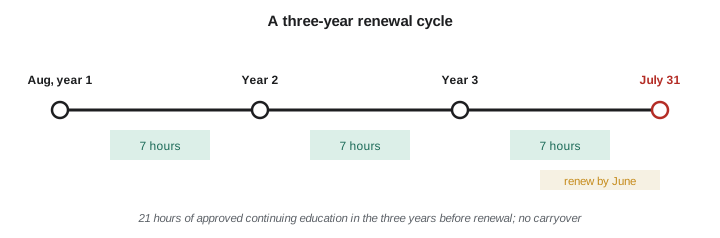
Chapter 141 section 3 sets the basic cycle: electrical licenses expire on July 31 every third year. The Board issues licenses on a fixed statewide cycle rather than on each holder's birthday or issue date, so a new master licensed midway through a cycle renews on the same July 31 as everyone else in that cycle and holds the first license for less than a full three years. Renewal is done through the Division of Occupational Licensure's online system, with a fee and a statement that the continuing education requirement has been met.
A business license follows the licensee of record. If the master's license lapses, the business has no valid licensee of record, and the Lesson 7 rules on withdrawal apply: the expiration date of the master's license is treated as the withdrawal date, and the business has 15 calendar days to get a new application to the Board. That is one of the strongest reasons a licensee of record renews early.
Continuing education
The Board's continuing education guidance requires electricians to complete 21 hours of approved continuing education within the three years before renewal. Courses must be taken from providers and courses approved by the Board, and the content is built around the current Massachusetts Electrical Code. Secondary sources describe the 21 hours as including 15 hours on the Massachusetts Electrical Code and its changes, with the rest on related subjects such as Board regulations and laws; check the Board's current breakdown before choosing courses. Hours are not carried over from one cycle to the next.
The requirement applies to masters and journeymen alike, and a person with both a master and a journeyman license does not need two sets of hours for the same cycle. Approved providers report completions, but the licensee should keep certificates in case of an audit. A course on a code edition that is no longer current may not count, so a cycle that spans a code change, like the 2026 adoption, should include a course on the new edition.
| Item | Rule (summary) |
|---|---|
| Expiration | July 31 every third year, on the statewide cycle |
| Continuing education | 21 hours of Board-approved courses in the three years before renewal |
| Content | Built around the current Massachusetts Electrical Code, with related laws and regulations |
| Carryover | Not allowed between cycles |
| Records | Keep certificates; the Board may audit |
| Lapsed license | No work under it until renewed; extra education may be required for missed cycles |
When a license lapses
A license that is not renewed by July 31 expires, and its holder may not do electrical work under it, pull permits or serve as licensee of record. Secondary sources say a person who misses one or more cycles must make up the missed education, for example an additional 21-hour course for each delinquent cycle, along with fees, before the Board will restore the license; after a long lapse the Board may require more. The cost of reinstatement is small next to the cost of the business stopping work.
from datetime import date

def next_expiry(today, cycle_anchor=2026):
    # Licenses expire July 31 every third year; this is a study aid, not the Board's cycle table.
    y = cycle_anchor
    while date(y, 7, 31) < today:
        y += 3
    return date(y, 7, 31)

staff = {"Frank Moreau (master)": 12, "Ana Ribeiro (journeyman)": 6,
         "Kim's list: journeyman 2": 21, "Kim's list: journeyman 3": 0}
today = date(2026, 8, 17)
exp = next_expiry(today)
months_left = (exp.year - today.year) * 12 + exp.month - today.month
for name, hours in staff.items():
    need = max(0, 21 - hours)
    pace = need / months_left
print(f"{name:28} done {hours:2} need {need:2} about {pace:.2f} hours a month to {exp}")Frank Moreau (master) done 12 need 9 about 0.26 hours a month to 2029-07-31 Ana Ribeiro (journeyman) done 6 need 15 about 0.43 hours a month to 2029-07-31 Kim's list: journeyman 2 done 21 need 0 about 0.00 hours a month to 2029-07-31 Kim's list: journeyman 3 done 0 need 21 about 0.60 hours a month to 2029-07-31
Ana's own hours deserve a note. The 150-hour master course counts toward her eligibility under 237 CMR 13.01, not toward continuing education. Her journeyman continuing education runs on the cycle of her journeyman license, and when she is issued a master license, she should ask the Board how her current hours apply to the new license so she does not come up short at its first renewal.
Tax and support checks
Massachusetts conditions professional license renewal on good standing with taxes and, under separate law, with child support obligations. If the Department of Revenue reports a tax problem, the renewal can be held until it is resolved. The Board's guidance points licensees to MassTaxConnect to clear a tax hold. For a business, the corporation's own tax standing matters too, and a lapse in the corporation's filings with the Secretary of the Commonwealth can cause trouble with the business license.
A company-wide renewal system
A licensee of record needs one list that covers every license the company depends on: the master's own license, the business license, every journeyman license, apprentice registrations, the insurance certificates, the workers' compensation policy and any local registrations. Each item needs an expiration date, a person responsible and a reminder set well ahead. Kim's system used three reminders: one at the start of each cycle to plan education, one in March of the renewal year to check hours, and one on June 1 to renew. Nobody waited for July.
What counts as an approved course
Only Board-approved courses from approved providers count toward renewal. Approval is specific: a provider may be approved for some courses and not others, and an online course must be approved for online delivery. Before paying for a course, check that it is listed as approved for the license and the cycle. Manufacturer seminars, trade-show sessions and in-house training are valuable, but they generally do not count unless the Board has approved them as continuing education.
Courses are offered by trade schools, community colleges, union training centers and private providers, in classrooms and online. Spreading them out has a practical benefit beyond avoiding the June rush: a course on a new code edition is more useful while you are actually applying that edition on jobs.
| Before you enroll | Check |
|---|---|
| Provider | Approved by the Board |
| Course | Approved for your license class and the current cycle |
| Format | Online or classroom delivery approved |
| Content | Current Massachusetts Electrical Code |
| Certificate | Issued at completion and saved |
Audits and record keeping
The Board may audit renewals to confirm that continuing education was completed. A licensee who attested to completing the hours must be able to show certificates. Keep every certificate for at least the cycle it covers and the next one, in a place that survives a lost phone or a crashed laptop. Kim scanned each certificate into the person's folder on the shared drive and kept the paper in a binder.
The business side of renewal
A business license depends on the licensee of record's license, but it also needs its own attention. The entity's filings with the Secretary of the Commonwealth must stay current, the officer or manager list on file with the Board must match reality, and changes such as a new address or a new officer should be reported as the Board's rules require. Insurance and workers' compensation policies renew on their own cycles, usually annually, and permits cannot be pulled without proof of the right insurance.
Kim's tracker covered all of these. Each row had an item, an owner, an expiration date and a reminder date, and Frank and Ana reviewed it together on the first Monday of every month.
Renewal also brings a chance to check everything else at once. When Kim sent the renewal reminders each spring, she attached a short checklist: confirm the address on file with the Board, confirm that continuing education certificates are uploaded, confirm that the Department of Revenue shows no open issue, and confirm that the person's license appears correctly on the Board's lookup after renewal. The last step matters because inspectors and general contractors check the lookup, and a renewal that has not posted can cause a delay at the permit counter even when the fee has been paid.
For the business, Kim added three more items: the entity's annual report with the Secretary of the Commonwealth, the insurance renewal dates and the workers' compensation policy number shown on the state's coverage lookup. Each of those could stop work if it lapsed, and none of them depended on the electricians remembering it. The system worked because one person owned it and the licensee of record checked it.
Ana noticed one more benefit of the tracker. When a journeyman was close to finishing his hours early in the cycle, she could suggest a course on a topic Quabbin needed, such as fire alarm systems or solar, instead of whatever was cheapest in June. Continuing education became part of planning the company's skills, not just a box to tick before July 31.
A licensee who is away from the trade for a while, for illness, military service or another job, should still keep the license renewed if there is any chance of returning. Renewing on time with the required hours is far simpler than restoring a lapsed license later, and the Board's rules for reinstatement after several missed cycles can require more education than the 21 hours a normal renewal needs. If renewal truly is not possible, ask the Board what options exist before July 31, not after.
Worked problem
Planning Ana's first master renewal
Ana passes both parts in March 2027 and is issued a master license. Assume, for the example, that her master license falls on a cycle expiring July 31, 2029. She will become Quabbin's licensee of record. What should her plan include?
Show solution
- Confirm the expiration date shown for the new license; it may not be a full three years away.
- Plan 21 hours of approved continuing education before July 31, 2029, including a course on the code edition then in effect.
- Renew early, by June, so the business license is never without a valid licensee of record.
- Keep tax standing clear for herself and the corporation.
Answer: Confirm the date, spread the 21 hours across the cycle, renew by June and keep tax standing clear.
Common mistakes
MistakeWaiting until July to take the 21 hours.
InsteadSpread courses across the cycle and finish by spring of the renewal year.
MistakeAssuming hours carry over to the next cycle.
InsteadHours do not carry over.
MistakeCounting the 150-hour master course as continuing education.
InsteadThat course is for eligibility under 237 CMR 13.01, not renewal.
MistakeLetting the master's license lapse.
InsteadThe business loses its licensee of record and must replace it within 15 days.
Summary and key terms
- Massachusetts electrical licenses expire July 31 every third year on a statewide cycle.
- Renewal requires 21 hours of Board-approved continuing education in the three years before renewal, centered on the current code.
- A lapsed license cannot be used; missed cycles require extra education and fees.
- Tax and child support standing are checked at renewal; a tax hold is cleared through MassTaxConnect.
- A licensee of record keeps one tracker for every license, policy and registration the company depends on.
- Renewal cycle
- The three-year period ending July 31 on which licenses expire.
- Continuing education
- Approved courses required to renew a license.
- Delinquent cycle
- A renewal cycle in which the license was not renewed.
- Approved provider
- A school or organization the Board has approved to offer continuing education.
- Tax hold
- A block on renewal because of an unresolved tax issue with the Department of Revenue.
Practice problems
Work each problem on paper first, then reveal the answer to check.
On what date do Massachusetts electrical licenses expire?
Show answer
July 31 every third year.
How many hours of continuing education are required for renewal?
Show answer
21 hours in the three years before renewal.
Can extra hours from one cycle be used in the next?
Show answer
No.
What happens to a business license when the licensee of record's license expires?
Show answer
The expiration counts as withdrawal, and a new licensee application is due within 15 calendar days.
Lesson quiz · 5 questions
Score 60% or more to complete this lesson.
Create a free account to save your progress, take quizzes and earn a certificate.