
MELU-221 · Lesson 4 of 12 · 18 min
The exam format and the references allowed
▶ Video coming soon A video version of this lesson is on the way.
Two weeks after her application was approved, Ana spread three books on the kitchen table: the National Electrical Code, a copy of the Massachusetts amendments and the NASCLA contractor's guide. Next to them sat a stack of tabs and a highlighter. Frank stopped by with a printout of the content outline. "It's open book," he said, "but that doesn't make it easy. Four hours goes fast when you're flipping pages. You need to know where things are, not just that they exist."
This lesson describes the two parts of the master exam, the content outline, the passing score, the references allowed in the exam room and the rules for marking them, and a pacing plan for both parts.
Two parts, scored separately
The Massachusetts master exam has two parts. Part I is the trade exam: 80 questions in 240 minutes on the electrical code, calculations and installation rules. Part II is the business and law exam: 50 questions in 120 minutes on Massachusetts licensing law, contracting, business management, labor law, liens and safety. Both parts are open book and given on computer. Each part is scored on its own, and the candidate must pass both to be licensed. The passing score on each part is 70 out of 100, which means 56 correct on Part I and 35 correct on Part II.
| Part I: Trade | Part II: Business and law | |
|---|---|---|
| Questions | 80 | 50 |
| Time | 240 minutes | 120 minutes |
| Average time per question | 3 minutes | 2.4 minutes |
| Correct answers needed | 56 (70 out of 100) | 35 (70 out of 100) |
| Format | Open book, computer | Open book, computer |
The Part I content outline
The bulletin lists the content areas for Part I and the number of questions from each. The largest areas are wiring methods and devices, services, special occupancies and equipment, and grounding and bonding. Together those four account for well over half the exam. Smaller areas include general knowledge, overcurrent protection, motors, alarm systems, state-specific requirements, low-voltage distribution, lighting and transformers.
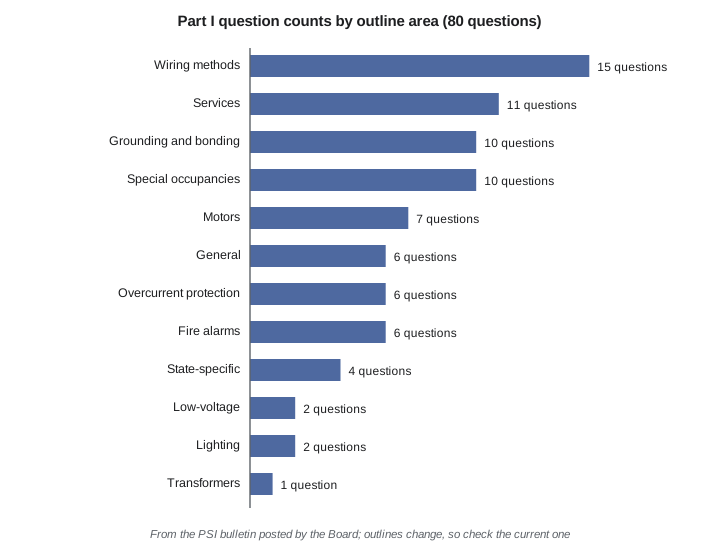
Two items in that outline are worth noticing. The alarm systems questions come largely from NFPA 72, the fire alarm code, which is a separate reference from the NEC. The state-specific questions come from the Massachusetts amendments in 527 CMR 12.00. Candidates from other states who studied only the NEC lose points in both places.
The references for each part
Each part has its own list of references allowed in the exam room. For Part I the bulletin lists the National Electrical Code, NFPA 72 and the Massachusetts Electrical Code amendments, 527 CMR 12.00. For Part II it lists the NASCLA Contractor's Guide to Business, Law and Project Management, the Board's regulations at 237 CMR 12.00 through 23.00, chapter 141 of the General Laws, listed sections of chapters 143 and 254, chapters 151 and 152, the Massachusetts unemployment insurance employer guide and excerpts from the federal construction safety standards in 29 CFR Part 1926. The bulletin names the edition of each book accepted, and only that edition may be brought in.
| Part | References listed in the posted bulletin |
|---|---|
| Part I | NEC (NFPA 70); NFPA 72; Massachusetts Electrical Code amendments, 527 CMR 12.00 |
| Part II | NASCLA contractor's guide; 237 CMR 12.00 to 23.00; G.L. c.141; listed sections of c.143 and c.254; c.151; c.152; Massachusetts unemployment employer guide; 29 CFR 1926 excerpts |
Marking your books
The bulletin allows highlighting and underlining of the printed text and permanent tabs. Handwritten notes in the books are not allowed, with one exception the posted bulletin describes: formulas may be written on blank pages of the code book before the exam. Loose papers, sticky notes with writing on them, photocopied pages inserted into a book and handbooks with commentary are not allowed. A proctor checks the books at the start, and a book that does not meet the rules is held until the exam is over, which can turn a passing candidate into a failing one.
Ana tabbed her NEC by article, color-coded the tabs by chapter and highlighted the first line of each table she used often. In 527 CMR 12.00 she tabbed the administrative rules on permits and inspections and each amended NEC section. In the NASCLA guide she tabbed the chapters on contracts, financial statements, payroll and liens. She wrote the voltage drop and three-phase power formulas on the blank page inside the back cover of the NEC, as the posted bulletin allows, and planned to confirm that rule against the current bulletin.
Pacing
Part I allows three minutes per question on average, which sounds generous until a calculation question takes eight minutes. The two-pass method helps: on the first pass, answer every question you can answer quickly, mark the rest and move on. On the second pass, work the marked questions in order of how close you think you are to the answer. Never leave a question blank, because there is no penalty for a wrong answer.
def pace(questions, minutes, reserve):
    work = minutes - reserve            # minutes kept back for review
    per_q = work / questions
    marks = [round(per_q * n) for n in (questions // 4, questions // 2, 3 * questions // 4)]
    return round(per_q, 2), marks

for name, q, m, r in [("Part I", 80, 240, 30), ("Part II", 50, 120, 15)]:
    per_q, marks = pace(q, m, r)
    print(name, "| minutes per question:", per_q,
          "| checkpoints at questions", q // 4, q // 2, 3 * q // 4,
"-> minutes", marks)Part I | minutes per question: 2.62 | checkpoints at questions 20 40 60 -> minutes [52, 105, 158] Part II | minutes per question: 2.1 | checkpoints at questions 12 25 37 -> minutes [25, 52, 78]
With 30 minutes held back for review on Part I, Ana should be at question 20 by about the 52-minute mark, question 40 by 105 minutes and question 60 by about 158 minutes. On Part II, with 15 minutes held back, she should reach question 25 at about 52 minutes. If she is well behind a checkpoint, she is spending too long on hard questions and should mark them and move on.
Scoring and veterans' credit
Scores are reported as the share of questions answered correctly on each part, out of 100. The posted bulletin says eligible veterans receive a credit on each part, but it describes the credit in two ways in different places. A candidate who expects that credit should confirm the exact amount with PSI or the Board and should not count on it when planning how many questions they need right.
What Part II covers
Part II is the business and law part. Its references tell you what it covers: the NASCLA contractor's guide for business topics such as estimating, bidding, contracts, project management, financial management, tax basics and employment; chapter 141 and the Board's regulations in 237 CMR for licensing, business licensure, supervision and discipline; chapters 151 and 152 for wages and workers' compensation; the lien sections of chapter 254; the state's unemployment insurance employer guide; and excerpts from OSHA's construction standards. Many Part II questions are direct lookups if you know which document to open, and some require simple calculations such as markup, margin, payroll or interest.
Candidates often study less for Part II because it seems easier than the code part, and some fail it for that reason. The two parts are scored separately, and a strong Part I score does not carry a weak Part II. Ana gave Part II roughly a third of her study time and practiced finding answers in each reference as hard as she practiced the code.
Calculation questions
Part I includes calculations: dwelling and commercial load calculations, conductor ampacity with adjustment and correction, voltage drop, box and conduit fill, motor circuits and transformer sizing. The code gives the rules and tables; the exam expects you to know which rule applies and to work the arithmetic correctly under time pressure. Part II calculations are business arithmetic. In both parts, a standard layout helps: write the knowns, the rule or formula, the work and the answer with units, so a check takes seconds.
Markup and margin trip up many candidates. A markup is added to cost; a margin is the share of the selling price that is profit. A job that costs 10,000 dollars sold with a 25 in 100 markup sells for 12,500 dollars, but its margin is 2,500 divided by 12,500, or 20 in 100. Ana wrote the two formulas on the blank page at the start of Part II, which the bulletin allows for formulas.
| Calculation type | Part | What to know cold |
|---|---|---|
| Dwelling load calculation | I | Which method applies and the order of steps |
| Conductor sizing with adjustment and correction | I | Where each factor comes from |
| Voltage drop | I | The formula and the conductor resistance source |
| Box and conduit fill | I | How each item is counted |
| Markup and margin | II | The difference between the two |
| Payroll and overtime | II | Overtime basis under the wage law |
The reference rules are worth reading slowly, more than once. The bulletin lists the editions allowed for each part, what may be written or highlighted in them, whether tabs are permitted and what happens if a book does not meet the rules. A candidate who arrives with a reference that has handwritten notes in the margins may have it taken away for the exam, which is a disaster on a part built around lookups. Ana bought clean copies of each Part II reference, highlighted them herself and left the margins blank, and she checked the bulletin's edition list against the copyright page of each book.
Before the exam, she also practiced with the exact books she would bring. Lookup speed depends on knowing where things are on the page, and a different printing or a borrowed copy with different tabs slows you down. Her last three practice sets were all done with the test-day books, the same calculator model the bulletin allows and a blank pad, so nothing on the day felt new.
Worked problem
Reading a failing score report
Ana's friend Marco failed Part I with 53 correct. His report showed 9 of 15 on wiring methods, 5 of 11 on services, 6 of 10 on grounding and bonding, 4 of 10 on special occupancies and full or near-full marks elsewhere. Where should he focus?
Show solution
- He needs 3 more correct answers to reach 56.
- Services and special occupancies are both large areas where he scored under half.
- Improving those two areas by a few questions each would pass the exam.
- He should drill service calculations and the special occupancy articles, with timed lookups.
Answer: Services and special occupancies, where the most points are available.
Common mistakes
MistakeBringing a different edition of a reference than the bulletin lists.
InsteadOnly the editions named in the current bulletin are allowed.
MistakeWriting notes in the margins of the code book.
InsteadHighlighting, underlining and tabs are allowed; handwritten notes are not, except as the bulletin specifically allows.
MistakeStudying only the NEC for Part I.
InsteadNFPA 72 and the Massachusetts amendments are also tested.
MistakeSpending ten minutes on one calculation on the first pass.
InsteadMark hard questions, finish the easy ones and come back.
Summary and key terms
- Part I has 80 trade questions in 240 minutes; Part II has 50 business and law questions in 120 minutes.
- Each part is open book, scored separately, and requires 70 out of 100: 56 and 35 correct answers.
- Part I references are the NEC, NFPA 72 and 527 CMR 12.00; Part II references include the NASCLA guide, 237 CMR, chapter 141 and other listed statutes.
- Books may be highlighted, underlined and tabbed; handwritten notes are limited to what the bulletin allows.
- Use a two-pass method with checkpoints, and never leave a question blank.
- Part I
- The trade exam on the code, calculations and installation rules.
- Part II
- The business and law exam on licensing, contracting, labor law, liens and safety.
- NFPA 72
- The National Fire Alarm and Signaling Code, a Part I reference.
- NASCLA guide
- The contractor's guide to business, law and project management used for Part II.
- Two-pass method
- Answering quick questions first, marking hard ones and returning to them.
Practice problems
Work each problem on paper first, then reveal the answer to check.
How many correct answers are needed to pass Part I?
Show answer
56 of 80.
Which fire alarm code is a Part I reference?
Show answer
NFPA 72.
Can you write notes in the margins of your NEC?
Show answer
No; only highlighting, underlining, tabs and what the bulletin specifically allows.
With 120 minutes and 15 held back, about how many minutes per question does Part II allow?
Show answer
About 2.1 minutes.
Lesson quiz · 5 questions
Score 60% or more to complete this lesson.
Create a free account to save your progress, take quizzes and earn a certificate.