
MELU-221 · Lesson 10 of 12 · 18 min
Workplace safety law and OSHA for electrical contractors
▶ Video coming soon A video version of this lesson is on the way.
In July, a Quabbin apprentice took a shock on a Sturbridge barn job. He was pulling a new feeder into a panel that the farmer had said was off; one circuit was back-fed from a portable generator in the milking parlor. He was not badly hurt, but he went to the emergency room and was kept overnight for monitoring. That evening Frank and Ana sat in the office with the safety binder open. "Two questions," Frank said. "What do we have to report, and to whom, by when? And what do we change so it does not happen again?"
This lesson covers who enforces workplace safety law for Massachusetts electrical contractors, the OSHA construction standards that matter most to electricians, NFPA 70E and electrically safe work conditions, injury reporting and record keeping, incident rates and how to build a safety program that actually changes behavior on the job.
Who enforces safety law in Massachusetts
Massachusetts does not run a state plan for private employers. Federal OSHA, through its area offices in the state, enforces the Occupational Safety and Health Act for private-sector employers, including electrical contractors. The state's Department of Labor Standards runs a program for public-sector employees, such as city and town workers, and offers free consultation services to smaller private businesses that want help without the risk of a citation. A contractor working for a town on a school project is still a private employer as far as its own crews are concerned, so federal OSHA rules apply to its workers.
The construction standards in 29 CFR 1926 are the main rules on a job site. Excerpts from them are among the Part II references in the exam bulletin, so a candidate should be comfortable finding subparts quickly. The general industry standards in 29 CFR 1910 can apply to maintenance work in existing facilities. Lesson 4 covered how those references are used in the exam.
| OSHA 1926 subpart | What it covers for electricians (summary) |
|---|---|
| Subpart C | General safety and health provisions, including training |
| Subpart E | Personal protective equipment |
| Subpart K | Electrical: installation safety, ground-fault protection on job sites, lockout and tagging |
| Subpart L | Scaffolds |
| Subpart M | Fall protection |
| Subpart P | Excavations and trenches |
| Subpart V | Electric power transmission and distribution |
| Subpart X | Stairways and ladders |
Electrical hazards on construction sites
Electrocution is consistently one of the leading causes of death in construction, alongside falls, struck-by and caught-in or between incidents. For electricians the main hazards are contact with energized parts, arc flash and arc blast, contact with overhead power lines, falls from ladders and lifts, and trench collapse on underground work. Subpart K requires ground-fault protection for temporary wiring and cords used by employees on construction sites, either through GFCI protection or an assured equipment grounding conductor program, and requires that circuits be deenergized and tagged before work where workers could contact them.
Overhead lines deserve special attention on farm and residential jobs. Cranes, boom trucks, aerial lifts, ladders and even long pieces of conduit can contact overhead distribution lines. The OSHA cranes standard in subpart CC sets minimum clearances and procedures for equipment near power lines, and the utility can often de-energize or cover lines when asked ahead of time. The Sturbridge barn had a 13.8 kV line crossing the yard; Ana's job plan included calling the utility before the boom truck arrived.
NFPA 70E and electrically safe work conditions
NFPA 70E, Standard for Electrical Safety in the Workplace, is a consensus standard, not a regulation, but OSHA treats it as a recognized way to meet the general duty to protect workers from electrical hazards. Its central idea is the electrically safe work condition: identify all sources, open the disconnecting means, verify visible breaks where possible, apply lockout and tagout devices, test for absence of voltage with a properly rated tester that is checked before and after, and ground where induced voltage or stored energy could be present. Energized work is the exception and needs justification, an energized work permit, a risk assessment and the right PPE.
The barn incident fit a familiar pattern. The worker trusted the customer's statement that the panel was off. A test for absence of voltage on each conductor would have found the back-fed circuit from the generator. Ana's fix had three parts: never accept anyone's word that equipment is off, test every conductor before touching it, and treat any building with a portable generator as having a second source until proven otherwise.
Reporting injuries and keeping records
Federal OSHA requires an employer to report a work-related fatality within 8 hours of learning of it, and an in-patient hospitalization, an amputation or the loss of an eye within 24 hours. In-patient hospitalization means formal admission to a hospital for care or treatment; an overnight stay only for observation or diagnostic testing is generally not treated as an admission. Employers with more than 10 employees in most industries, including construction, keep the OSHA 300 log, the 301 incident report and the 300A annual summary, and post the summary from February 1 to April 30. Massachusetts workers' compensation law also requires the employer to report lost-time injuries to the Department of Industrial Accidents and its insurer within set time limits; the exam may ask about those timelines, so read the chapter 152 references in the bulletin.
For the barn case, Ana confirmed with the hospital that the apprentice had been kept for observation and not formally admitted. That meant no 24-hour OSHA report was required, but the case was still recordable on the 300 log because he received medical evaluation beyond first aid, and the company notified its workers' compensation insurer the next morning.
def trir(cases, hours):
    return cases * 200_000 / hours

def dart(days_away_cases, hours):
    return days_away_cases * 200_000 / hours

years = {2024: (2, 1, 31_500), 2025: (1, 0, 33_200), 2026: (3, 1, 34_800)}
for y, (rec, dart_cases, hrs) in years.items():
print(f"{y}: hours {hrs:,} TRIR {trir(rec, hrs):.1f} DART {dart(dart_cases, hrs):.1f}")2024: hours 31,500 TRIR 12.7 DART 6.3 2025: hours 33,200 TRIR 6.0 DART 0.0 2026: hours 34,800 TRIR 17.2 DART 5.7
The 2026 numbers jump because of three recordable cases in a year with about 34,800 hours. General contractors and public owners often ask for these rates in prequalification forms, and a high rate can cost a contractor work. The better reason to track them is that they show whether the safety program is working.
Building a safety program
A written safety program is only the start. A working program includes a named person responsible for safety, a written lockout and tagout procedure for the company's work, job hazard analysis on each job, regular toolbox talks, training records, inspection of tools, cords and ladders, a ground-fault protection program for temporary power, and a habit of investigating near misses and injuries to find the cause rather than the person to blame. The licensee of record is not legally the safety officer, but a master who runs the company sets the culture.
Ladders, lifts and falls
Falls remain a leading cause of death in construction, and electricians spend much of their day on ladders and lifts. Subpart X covers ladders: the right type and rating for the job, inspection before use, setup angle and extension above the landing, and nonconductive side rails for electrical work. Aerial lifts and scaffolds have their own rules, including fall protection in lifts. Ana's toolbox talks rotated through ladders every month because the barn, the three-decker and the dental office all had ceiling work.
Metal ladders are a particular hazard for electricians because they conduct. Fiberglass ladders are the standard choice near electrical work, and a damaged ladder is tagged and removed from service rather than used one more day.
Trenches and underground work
Underground feeders and services put electricians in trenches. Subpart P requires a protective system for trenches 5 feet deep or more unless the excavation is in stable rock, inspection by a competent person, a safe way out within a set distance of workers and spoil kept back from the edge. Before digging, Massachusetts law requires notice to the one-call underground utility locating system, Dig Safe, a set number of business days ahead, and the excavator must respect the marks. The barn feeder trench was shallow, but it crossed a buried water line and a telephone cable, both marked before the backhoe arrived.
| Hazard | Main control |
|---|---|
| Energized parts | Electrically safe work condition and testing |
| Overhead lines | Clearance, utility coordination, spotters |
| Falls | Right ladder or lift, fall protection where required |
| Trench collapse | Protective system and competent person |
| Temporary power | GFCI or an assured grounding program |
Training and toolbox talks
OSHA requires employers to train workers to recognize and avoid hazards on their jobs, and many standards add specific training. Short weekly toolbox talks on the hazards actually present that week work better than long annual sessions. Ana kept a sign-in sheet for each talk in the safety binder, which also served as the training record.
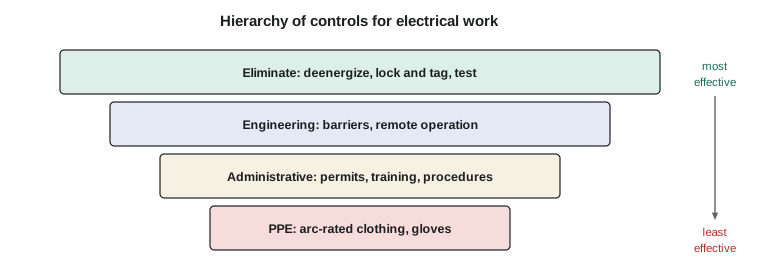
Personal protective equipment is the last line of defense, not the first. When energized work is justified, NFPA 70E describes how to select arc-rated clothing, voltage-rated gloves with leather protectors, face and eye protection and hearing protection based on a risk assessment or the standard's tables. PPE must be inspected, stored properly and replaced when damaged. Rubber insulating gloves need periodic electrical testing, and their test dates belong in the safety records. A crew that relies on PPE instead of deenergizing is accepting a risk the hierarchy of controls is meant to remove.
After the barn incident, Ana also changed how Quabbin handled customer-owned generators. The job hazard analysis for any farm, home or small business now asks whether there is a portable or standby generator on site, how it connects and whether a transfer switch or interlock is installed. If the answer is unclear, the crew treats the building as having a second source until it has been found and isolated. That one question would have prevented the July shock, and it costs nothing to ask.
Good safety records also help when an inspector or a customer asks how the company works.
Worked problem
Reporting the barn injury
The apprentice was shocked on Tuesday at 2 p.m., taken to the emergency room and held overnight for observation only. He returns to work Thursday on light duty. What must Quabbin do under OSHA?
Show solution
- A fatality would need a report within 8 hours; this was not a fatality.
- A 24-hour report is needed for in-patient hospitalization, amputation or loss of an eye; observation only is generally not in-patient admission.
- The case is recordable because it involved medical evaluation beyond first aid and restricted work.
- Quabbin records it on the 300 log and completes a 301 report within 7 calendar days.
Answer: No 24-hour report, but the case goes on the OSHA 300 log with a 301 report, and the insurer is notified.
Common mistakes
MistakeAssuming Massachusetts runs its own OSHA plan for private contractors.
InsteadFederal OSHA covers private employers; the state program covers public employees.
MistakeTrusting the customer that the power is off.
InsteadTest for absence of voltage on every conductor before touching it.
MistakeTreating an overnight observation stay as a hospitalization report.
InsteadFormal admission triggers the 24-hour report; observation alone generally does not.
MistakeForgetting temporary power protection.
InsteadSubpart K requires GFCI or an assured equipment grounding program on job sites.
Summary and key terms
- Federal OSHA enforces safety for private employers in Massachusetts; the state program covers public employees and offers consultation.
- 29 CFR 1926 subparts K, M, P, X and CC cover the hazards electricians meet most; excerpts are Part II references.
- NFPA 70E defines the electrically safe work condition: isolate, lock and tag, test for absence of voltage and ground where needed.
- Report fatalities within 8 hours and in-patient hospitalization, amputation or loss of an eye within 24 hours.
- Track recordable and DART rates with 200,000 hours as the base, and run a program that investigates causes.
- OSHA 300 log
- The log of work-related recordable injuries and illnesses.
- Electrically safe work condition
- Equipment isolated, locked and tagged, tested for absence of voltage and grounded if needed.
- Assured equipment grounding conductor program
- An alternative to GFCI protection for temporary job site power.
- TRIR
- Total recordable incident rate per 200,000 hours worked.
- Arc flash
- The release of heat and light from an electric arc, a major burn hazard.
Practice problems
Work each problem on paper first, then reveal the answer to check.
Within how many hours must a work-related fatality be reported to OSHA?
Show answer
8 hours.
Who enforces safety rules for a private electrical contractor in Worcester?
Show answer
Federal OSHA.
What is the TRIR for 2 recordable cases in 40,000 hours?
Show answer
2 × 200,000 ÷ 40,000 = 10.0.
What must happen before touching conductors that were switched off?
Show answer
Test for absence of voltage with a verified tester.
Lesson quiz · 5 questions
Score 60% or more to complete this lesson.
Create a free account to save your progress, take quizzes and earn a certificate.