
MELU-221 · Lesson 1 of 12 · 19 min
How electrical licensing works in Massachusetts
▶ Video coming soon A video version of this lesson is on the way.
Frank Moreau opened Quabbin Electric Co. in a two-bay garage in Worcester in 1989, the year he passed the master electrician exam. Thirty-seven years later the company has sixteen electricians and apprentices, five vans, a small office on Grove Street and a steady mix of triple-decker service upgrades, dental and medical fit-outs in Framingham and Shrewsbury, school renovation work as a subcontractor, barns and farm stands out toward Sturbridge, and a growing list of heat pumps, solar tie-ins and electric vehicle chargers. On a cold Tuesday in January, Frank asked his lead journeyman, Ana Ribeiro, to stay after the morning meeting. "I'm sixty-four," he said. "Our business license names me as the master on record. When I step back, Quabbin needs another master electrician to take that responsibility. I'd like it to be you." He handed her a printout of the state's application for the master exam and a copy of the candidate bulletin from the testing company.
Ana had started as an apprentice in 2018, passed the journeyman exam in the spring of 2024 and had been running crews ever since. She had worked through the master electrician core courses on the National Electrical Code, load calculations, grounding and bonding, motors and transformers, special occupancies, and business and law. This course takes that preparation and applies it to Massachusetts: who licenses electricians and electrical businesses, how the master exam works, which edition of the code is enforced and how the state amends it, how permits and inspections run through each city's inspector of wires, and the Massachusetts law on contracts, mechanics' liens, workers' compensation, workplace safety and license renewal that a master electrician is expected to know.
The board and the division
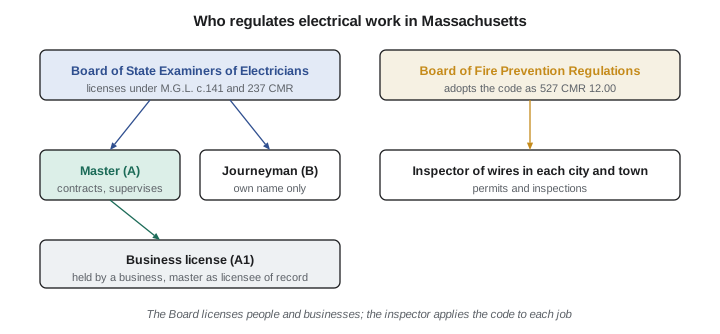
Massachusetts licenses electricians through the Board of State Examiners of Electricians. The Board is one of the licensing boards supported by the Division of Occupational Licensure, a state agency that handles applications, renewals, complaints and the administrative side of many trades. The Board itself is made up mostly of people from the trade, along with public members. It sets the eligibility rules, approves the courses that count toward initial and continuing education, decides which applicants may sit for an exam, and disciplines licensees who break the rules.
The licensing law is chapter 141 of the General Laws. Section 1A says who must be licensed to do electrical work and lists the narrow exceptions. Section 3 creates the master license, called certificate A in the statute, and the journeyman license, certificate B. Section 8 deals with the liability insurance a licensee must show to get a permit. The Board fills in the details through its regulations in Title 237 of the Code of Massachusetts Regulations, usually shortened to 237 CMR. Chapters 12 through 23 of those regulations cover definitions, eligibility for each exam, re-examination, licensure without examination, business licensing, continuing education, discipline and approved education.
The license types
Massachusetts electrical licenses form a ladder. A person starts as a registered apprentice working under the supervision of a licensed electrician. After the required hours of work and classroom instruction, the apprentice can take the journeyman exam and become a journeyman electrician, the B license. After at least a year as a licensed journeyman and another round of classroom hours, the journeyman can take the master exam and become a master electrician, the A license. Separate licenses cover systems work: a systems technician and a systems contractor can install fire warning, security and other limited-energy systems within their scope.
| License | What it allows | Exam |
|---|---|---|
| Apprentice (registration) | Work under the supervision of a licensed electrician | None |
| Journeyman electrician (B) | Perform electrical work in the licensee's own name | Yes, through PSI |
| Master electrician (A) | Perform and supervise electrical work; serve as licensee of record for a business | Yes, through PSI, two parts |
| Electrical business (A1) | Lets a business entity contract for electrical work through a master licensee of record | None, but an application is required |
| Systems technician and systems contractor | Limited-energy and systems work within their scope | Yes |
The Board's frequently asked questions make a point that surprises electricians from other states. A journeyman can perform electrical work, but only in the name on the license. A journeyman working alone cannot set up a corporation, a limited liability company or a business name and contract through it. Only a master electrician can obtain the electrical business license, the A1 license, which names the master as the licensee of record for the business. That is the reason Quabbin Electric needs a master on record and cannot simply rely on its senior journeymen.
Who must be licensed
Section 1A of chapter 141 requires a license for anyone who installs, repairs or maintains wires, conduits, apparatus, devices, fixtures and similar equipment that carry or use electricity for light, heat or power. The exceptions are narrow and specific, such as certain work by utilities on their own systems and some work by employees on equipment owned by their employer. Low-voltage work is not automatically exempt. The Board's guidance says that whether a low-voltage installation needs a license depends on what the system does, and fire alarm, security and similar systems usually fall under the systems licenses. When in doubt, the safe answer for a contractor is that the work needs a licensed person and a permit.
Reciprocity and transfers
Some states let an electrician licensed elsewhere skip an exam. Massachusetts has a provision for licensure without examination in 237 CMR 15.00, and common summaries list a reciprocal arrangement with New Hampshire. For most out-of-state electricians, though, the path into Massachusetts is the same as for anyone else: show qualifying experience and education, get Board approval and pass the Massachusetts exam. The Board may count documented education or experience from another place toward the requirements, but the license itself does not simply transfer. Anyone relying on reciprocity should confirm the current terms directly with the Board before taking work.
The code and the inspector of wires
The electrical code in Massachusetts is not written by the electricians' Board. It is adopted by the Board of Fire Prevention Regulations, which works with the Department of Fire Services, as 527 CMR 12.00, the Massachusetts Electrical Code. That code consists of the National Electrical Code with a set of Massachusetts amendments. A 2026 edition based on the 2026 NEC applies to installations whose permits are issued after April 24, 2026. Lesson 5 covers the code in detail.
Enforcement is local. Every city and town has an inspector of wires who issues electrical permits and inspects the work. The Board's guidance calls the local inspector the authority having jurisdiction for permits and recommends that licensees talk to that inspector about local procedures. The code is the same statewide, so a receptacle rule in Worcester is the same as in Pittsfield, but the forms, scheduling and practical habits of each inspector's office differ. Lesson 6 explains the permit and inspection process.
Unlicensed work
Doing electrical work that requires a license without holding one breaks chapter 141 and can lead to fines, criminal charges and orders to stop. A permit application must show that the person or business doing the work is licensed in Massachusetts, so unlicensed work usually means unpermitted work as well, and an insurer may refuse a claim on a fire that started in unpermitted wiring. Licensed electricians put their own licenses at risk if they pull permits for work they do not perform or supervise, or let someone else use their license number. Frank told Ana about a house in Auburn where a handyman added a subpanel in a finished basement. The homeowner paid twice: once for the handyman, and again for Quabbin to rip it out and redo it under a permit after the buyer's home inspector flagged it.
# Which Massachusetts license covers each role? (simplified study aid)
roles = [
    ("Pull wire under a journeyman's supervision", "apprentice"),
    ("Install a 200 A service in your own name", "journeyman (B)"),
    ("Be the licensee of record for a company", "master (A)"),
    ("Let a corporation contract for electrical work", "electrical business (A1)"),
    ("Install a building security system", "systems license"),
]
exam = {"apprentice": False, "journeyman (B)": True, "master (A)": True,
        "electrical business (A1)": False, "systems license": True}
for role, lic in roles:
    tag = "exam required" if exam[lic] else "no exam, application only"
    print(role)
print(" license:", lic, "-", tag)Pull wire under a journeyman's supervision license: apprentice - no exam, application only Install a 200 A service in your own name license: journeyman (B) - exam required Be the licensee of record for a company license: master (A) - exam required Let a corporation contract for electrical work license: electrical business (A1) - no exam, application only Install a building security system license: systems license - exam required
The output shows the structure the exam expects you to understand. The business license has no exam of its own, because the knowledge test sits with the master electrician the business names as its licensee of record. The A1 license is about which company may contract and who is responsible; the A license is about what that person knows.
Worked problem
Mapping a company to the license rules
Two brothers in Springfield form an LLC to do commercial electrical work. One holds a journeyman license and the other is a project manager with no license. They plan to pull permits in the LLC's name using the journeyman's license number. What is wrong with this plan?
Show solution
- A business entity that contracts for electrical work needs an electrical business license in its own name.
- Only a master electrician can obtain that business license and serve as its licensee of record.
- A journeyman can work only in the name on the license and cannot contract through a business entity.
- Permits must list licensed persons or firms doing the work, so the LLC cannot pull them as planned.
Answer: The LLC needs an A1 business license with a master electrician as licensee of record; until then the journeyman can work only in his own name.
Where the rules live
Massachusetts electrical contractors work under several layers of law, and Part II of the master exam expects candidates to know which layer answers which question. Chapter 141 and 237 CMR set licensing, eligibility, business licensing, renewal and discipline. 527 CMR 12.00 sets the installation rules and the administrative rules for permits and inspections. Chapter 254 governs mechanics' liens on private projects. Chapter 152 covers workers' compensation, chapter 151 covers wage rules and chapter 151A covers unemployment insurance. Federal OSHA rules in 29 CFR Part 1926 cover safety on construction sites. The PSI candidate bulletin explains exam logistics. When a question comes up on a job or the exam, start by asking which layer it belongs to.
Those layers also tell you who to call. A question about whether your hours count goes to the Board. A question about whether a dishwasher needs ground-fault protection goes to the local inspector of wires, and a formal code interpretation can be requested from the Board of Fire Prevention Regulations. A question about whether you can still record a lien goes to a construction lawyer. Knowing the right office saves days of phone tag and keeps you from relying on a friend's guess.
Common mistakes
MistakeAssuming a journeyman can run a company under a business name.
InsteadOnly a master can obtain the A1 business license; a journeyman alone works only in the name on the license.
MistakeThinking the electricians' Board writes the electrical code.
InsteadThe Board of Fire Prevention Regulations adopts 527 CMR 12.00; the electricians' Board licenses people and businesses.
MistakeBelieving an out-of-state license transfers automatically.
InsteadExcept for any current reciprocal arrangement, you must qualify for and pass the Massachusetts exam.
MistakeTreating low-voltage work as always exempt.
InsteadLow-voltage work may need a license depending on what the system does; check with the Board.
Summary and key terms
- The Board of State Examiners of Electricians, supported by the Division of Occupational Licensure, licenses electricians under chapter 141 and 237 CMR.
- The ladder runs from apprentice to journeyman (B) to master (A), with separate systems licenses.
- Only a master can obtain the A1 electrical business license and serve as its licensee of record; a journeyman alone works only in the name on the license.
- The Board of Fire Prevention Regulations adopts the Massachusetts Electrical Code, 527 CMR 12.00, which is the NEC with state amendments.
- Each city and town's inspector of wires issues permits and inspects electrical work.
- Board of State Examiners of Electricians
- The licensing board for electricians and electrical businesses in Massachusetts.
- Chapter 141
- The Massachusetts statute that requires and governs electrical licenses.
- 237 CMR
- The Board's regulations on eligibility, exams, business licensing, continuing education and discipline.
- 527 CMR 12.00
- The Massachusetts Electrical Code, adopted by the Board of Fire Prevention Regulations.
- Inspector of wires
- The municipal official who issues electrical permits and inspects electrical work in a city or town.
Practice problems
Work each problem on paper first, then reveal the answer to check.
Which section of chapter 141 creates the master license?
Show answer
Section 3, which calls it certificate A.
Can a journeyman working alone contract through an LLC?
Show answer
No. A journeyman works only in the name on the license; only a master can obtain the A1 business license.
Who adopts the Massachusetts Electrical Code?
Show answer
The Board of Fire Prevention Regulations, as 527 CMR 12.00.
Who issues the electrical permit for a job in Lowell?
Show answer
Lowell's inspector of wires.
Lesson quiz · 5 questions
Score 60% or more to complete this lesson.
Create a free account to save your progress, take quizzes and earn a certificate.