
MELU-221 · Lesson 8 of 12 · 19 min
Contractor licensing, insurance and bonding
▶ Video coming soon A video version of this lesson is on the way.
Kim kept a yellow folder labeled "Paper" on her desk, and in May she went through it with Ana: the business license, the Secretary of State's annual report for the corporation, the certificate of liability insurance, the commercial auto policy, the workers' compensation policy, the unemployment insurance account, the payroll records, two payment bond riders from school jobs and a stack of insurance certificates requested by general contractors. "None of this is wiring," Kim said, "but if any one of these lapses, we can't pull a permit, or we get a stop work order, or a school district won't pay us."
This lesson covers the electrical business license and what goes with it, the insurance a Massachusetts electrical contractor must carry, workers' compensation and its penalties, unemployment insurance and wage law, and bonds on public and private work.
The business license
Under 237 CMR 16.00, a business entity regulated by the Secretary of the Commonwealth, such as a corporation, limited liability company or partnership, must hold an electrical business license in the entity's own name to do electrical work. A sole proprietor working under his or her own real name, or under a properly filed business certificate, is not treated as a business entity for this purpose. The application must be attested under the pains and penalties of perjury by the master who will be licensee of record, all principals must be of good moral character, and a non-refundable fee is required.
| Entity type | Documents for the business license application (summary of 237 CMR 16.00) |
|---|---|
| Corporation | Stamped articles of organization, clerk-certified list of officers, bylaws or agreement naming the licensee of record |
| Limited liability company | Stamped certificate of organization, clerk-certified list of managers, LLC agreement form, operating agreement if any |
| Partnership | Partnership agreement form signed by all partners, plus the notarized agreement or filed partnership certificate |
| Sole proprietor under own name | Not a business entity for this rule; works under the master's individual license |
A new company forms its entity with the Secretary of the Commonwealth first, then applies to the Board for the business license, then registers with the Department of Revenue for taxes, with the Department of Unemployment Assistance for unemployment insurance and buys workers' compensation coverage before hiring anyone. A sole proprietor who uses a trade name instead of his or her own name files a business certificate with the city or town clerk.
Liability insurance and the permit counter
Chapter 141 section 8 ties insurance to permits. A city or town may not issue an electrical permit unless the licensee shows liability insurance that includes completed operations coverage, issued by an insurer licensed in Massachusetts, or a bond or similar indemnity giving substantially similar protection. The statute allows one alternative: the permit authority may accept the signature of the owner or the owner's agent on the uniform permit application in place of proof of insurance. The statute does not set a minimum amount; general contractors, owners and public agencies usually set the limits they require in their contracts.
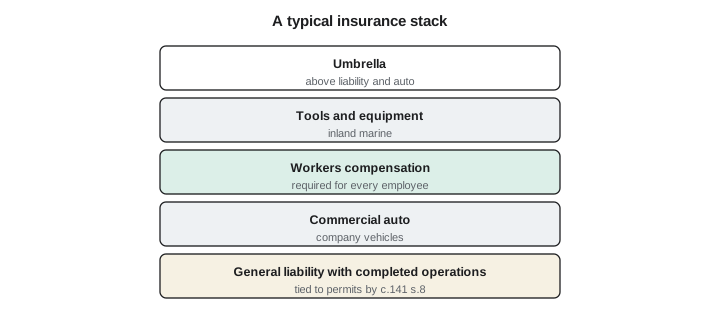
Completed operations coverage matters for electricians because many claims come after the job is finished: a fire months later in a panel the contractor installed, or a shock from a miswired receptacle. A general liability policy without that coverage would leave the contractor exposed for exactly the kind of claim electrical work tends to produce. Beyond the statutory minimum, a typical electrical contractor also carries commercial auto insurance on its vehicles, an umbrella policy above the general liability and auto limits, and sometimes inland marine coverage for tools and equipment.
Workers' compensation
Massachusetts requires every employer to carry workers' compensation insurance for its employees, regardless of the number of employees or the hours they work, under chapter 152. The only exception the state's guidance lists for the number of hours is for domestic workers. Sole proprietors, members of limited liability companies and partners in limited liability partnerships are not required to cover themselves, but any employees they hire must be covered. Corporate officers who own at least a quarter of the corporation may request an exemption for themselves.
The penalties for not carrying coverage are severe. The Department of Industrial Accidents' Office of Investigations issues stop work orders to uninsured employers. Fines start at 100 dollars a day, including weekends and holidays, from the date of the order until coverage starts and the fine is paid. An employer that does not appeal must stop work immediately. An employer that appeals may keep working, but the fine rises to 250 dollars a day. Criminal penalties can include up to a year in jail and a fine of up to 1,500 dollars, and an uninsured employer can be barred from public contracts for three years.
from datetime import date

def swo_fine(order_day, covered_day, appealed):
    days = (covered_day - order_day).days      # every calendar day counts
    rate = 250 if appealed else 100
    return days, days * rate

order = date(2026, 3, 2)
for label, covered, appealed in [("No appeal, coverage in 9 days", date(2026, 3, 11), False),
                                 ("Appealed, coverage in 21 days", date(2026, 3, 23), True)]:
    d, f = swo_fine(order, covered, appealed)
print(f"{label:32} {d} days -> fine {f:,} dollars")No appeal, coverage in 9 days 9 days -> fine 900 dollars Appealed, coverage in 21 days 21 days -> fine 5,250 dollars
The arithmetic makes the point quickly: an employer that appeals and drags its feet for three weeks owes more than five thousand dollars, on top of the cost of the policy it should have bought in the first place. A missing workers' compensation policy can also void a contract with a general contractor, who is generally exposed for an uninsured subcontractor's employees.
Unemployment insurance and wages
Employers must also register with the Department of Unemployment Assistance and pay unemployment insurance contributions under chapter 151A; the state's employer guide is one of the Part II references. Wage rules under chapter 151 set minimum wage, overtime and record keeping, and chapter 151 is also a Part II reference. Public construction projects in Massachusetts generally require payment of prevailing wages set for each trade and location, with certified payroll records. Workers who are paid as independent contractors but are really employees create tax, insurance and wage problems; Massachusetts has a strict test for independent contractor status, and an electrician who works under a contractor's direction on its jobs is very likely an employee.
Bonds
Bonds protect owners and others when a contractor fails to perform or pay. A performance bond guarantees that the work will be completed; a payment bond guarantees that subcontractors and suppliers will be paid. On public projects in Massachusetts, mechanics' liens do not attach to public property, so state law instead generally requires general contractors to provide payment bonds that subcontractors and suppliers can claim against, and public bidding laws may require bid bonds. On private projects, bonds are a matter of contract. The bond amount and claim deadlines are set by the statute or the bond itself, and a subcontractor that wants to claim on a payment bond must follow those deadlines closely. Lesson 9 compares lien rights on private jobs with bond rights on public jobs.
This course found no separate license bond for electricians in the Board's materials reviewed; the insurance requirement in chapter 141 section 8 is the main financial requirement tied to permits. Check with the Board and the city or town in case local rules or contract terms add a bond.
Reading insurance certificates
General contractors, owners and public agencies ask for certificates of insurance before a subcontractor starts work. A certificate summarizes the policies, limits and dates, but it is not the policy. Contracts often require the contractor to name the customer as an additional insured, to provide a waiver of subrogation, or to carry limits higher than the contractor normally buys. Kim's process was to compare every contract's insurance section with the current policies before signing and to send the agent any requirement that did not match. A certificate that lists a coverage the policy does not actually provide can create a serious problem when a claim comes in.
Certificates also expire with the policies. A certificate sent with a permit in March may show a policy that renews in July. Inspectors and customers may ask for an updated certificate, and the licensee of record should make sure the renewal happens before the old policy lapses.
| Contract insurance term | What it means (general) |
|---|---|
| Additional insured | The customer is covered under the contractor's policy for claims from the contractor's work |
| Waiver of subrogation | The insurer gives up the right to recover from the customer after paying a claim |
| Primary and noncontributory | The contractor's policy pays before the customer's own policy |
| Completed operations | Coverage for claims after the work is finished |
Taxes and registrations
A new electrical business registers with the Department of Revenue for withholding and, where it applies, sales and use tax on materials. The Department of Revenue's records also matter at renewal, because tax problems can hold up a license, as Lesson 11 explains. Federal registrations, such as an employer identification number, come first for any business with employees. An accountant who works with contractors can set up the accounts correctly from the start, which is much cheaper than fixing them after an audit.
Sean's first-year mistakes at Blackstone Electric were typical: he registered the LLC but put off the unemployment account, paid his journeyman as an independent contractor for two months and bought insurance without completed operations coverage. Each was fixable, but each cost money and time that a checklist would have saved.
Bonding capacity is also a business asset. A surety looks at the contractor's financial statements, work history and character before writing payment and performance bonds, and sets a limit on how much bonded work it will support. A contractor that wants to bid larger public jobs needs clean books, a good relationship with a surety agent and a record of finishing work and paying suppliers on time.
Worked problem
Checking a new company's paper
Ana's friend Sean, a master electrician, forms Blackstone Electric LLC with his brother, who is not licensed. They have one employee, a journeyman. Sean plans to pull permits next week using his individual license and a general liability policy without completed operations coverage, and to skip workers' compensation because they have only one employee. What needs fixing?
Show solution
- The LLC needs an electrical business license naming Sean as licensee of record.
- Permits require liability insurance with completed operations coverage, a bond, or the owner's signature in its place.
- Massachusetts requires workers' compensation for every employee, even one.
- They also need unemployment insurance registration and tax registrations before payroll starts.
Answer: Business license, completed operations coverage, workers' compensation for the journeyman, and the employer registrations, all before work starts.
Common mistakes
MistakeUsing an LLC without an electrical business license.
InsteadA business entity needs the A1 license in its own name with a master as licensee of record.
MistakeBuying general liability without completed operations coverage.
InsteadChapter 141 section 8 requires completed operations coverage, a bond, or the owner's signature, to get a permit.
MistakeSkipping workers' compensation for one employee.
InsteadMassachusetts requires coverage for every employee; stop work orders and daily fines follow.
MistakeExpecting a lien on a public school job.
InsteadLiens do not attach to public property; use the payment bond and its deadlines.
Summary and key terms
- Business entities need an electrical business license in their own name, attested by the master licensee of record.
- Chapter 141 section 8 requires liability insurance with completed operations coverage, a bond, or the owner's signature, before a permit is issued.
- Workers' compensation is required for every employee; stop work orders bring daily fines of 100 dollars, or 250 if appealed.
- Employers register for unemployment insurance, follow wage law and pay prevailing wages on public projects.
- Payment and performance bonds protect owners and subcontractors, especially on public projects where liens do not attach.
- Completed operations coverage
- Liability insurance for claims that arise after the work is finished.
- Stop work order
- An order from the Department of Industrial Accidents closing an uninsured employer's work.
- Payment bond
- A surety's guarantee that subcontractors and suppliers will be paid.
- Performance bond
- A surety's guarantee that the work will be completed.
- Prevailing wage
- The minimum wage rates set for each trade on public construction projects.
Practice problems
Work each problem on paper first, then reveal the answer to check.
What does chapter 141 section 8 require before a permit is issued?
Show answer
Liability insurance with completed operations coverage, a bond or similar indemnity, or the owner's signature on the application.
Does a Massachusetts employer with one part-time employee need workers' compensation?
Show answer
Yes.
What is the daily fine under a stop work order if the employer appeals?
Show answer
250 dollars a day, per the state's guidance.
Why do subcontractors on public projects rely on payment bonds?
Show answer
Because mechanics' liens do not attach to public property.
Lesson quiz · 5 questions
Score 60% or more to complete this lesson.
Create a free account to save your progress, take quizzes and earn a certificate.