
MELU-217 · Lesson 9 of 12 · 18 min
Contracts and mechanics' liens in Kentucky
▶ Video coming soon A video version of this lesson is on the way.
In late August 2026 Limestone Ridge finished the electrical work on a new restaurant in Glasgow. It had worked as a subcontractor to a general contractor from Nashville, under a written subcontract for 148,000 dollars. By October the general contractor had paid 96,000 dollars and stopped answering calls. Earl had seen this before. He pulled the job file, found the date of the last day his crew worked on site, and wrote it at the top of a legal pad. "Everything starts from that date," he told Dana. "If we miss a deadline, we lose the lien, and the lien is the only thing that makes them call back."
This lesson covers the contract terms that protect an electrical contractor and the Kentucky mechanics' lien law in KRS chapter 376: who can claim a lien, the notice that subcontractors must give, the lien statement and its filing deadline, and the time limit to enforce it. The contractor exam tests these figures, and a contractor's cash flow depends on them.
Contracts first
Most payment disputes are won or lost when the contract is signed. A good electrical contract or subcontract describes the scope of work clearly, including what is excluded; states the price and how it may change; describes the payment schedule, retainage and conditions for payment; explains how change orders are requested, priced and approved; sets the schedule and what happens if others delay it; and states the warranty. It also says who pulls permits, who pays inspection fees and who is responsible for code changes adopted after signing, an issue that mattered to Limestone Ridge in July 2026, as lesson 5 describes.
Change orders are the most common source of disputes. A general contractor who asks the crew to add six circuits for a walk-in cooler is asking for extra work. If the contract requires written change orders and the crew does the work on a verbal request, the contractor may struggle to be paid for it. Limestone Ridge's rule is that a lead may start extra work only after Rhonda sends a written change order and receives a signed or emailed approval, except in an emergency affecting safety.
Kentucky also has statutes on payment in private construction, often called the Fairness in Construction Act, which address matters such as prompt payment and retainage, and contract clauses that conflict with them may be unenforceable. A contractor should know these rules exist and have a lawyer review its standard subcontract terms against them.
Who may claim a lien
A mechanics' lien gives a person who furnished labor or materials to improve real property a security interest in that property for the unpaid amount. In Kentucky, KRS 376.010 extends lien rights to contractors, subcontractors, suppliers and laborers who improve property under a contract with the owner or with someone working for the owner. Because the lien attaches to the property, it gives the claimant leverage even when the person who owes the money, such as a general contractor, has disappeared. The owner, who wants clear title, has a strong reason to see that the claim is resolved.
Liens on public property are different. A contractor generally cannot place a lien on a public building, and instead looks to payment bonds and the statutes that govern public works. This lesson covers private property.
The notice of intent for those who did not contract with the owner
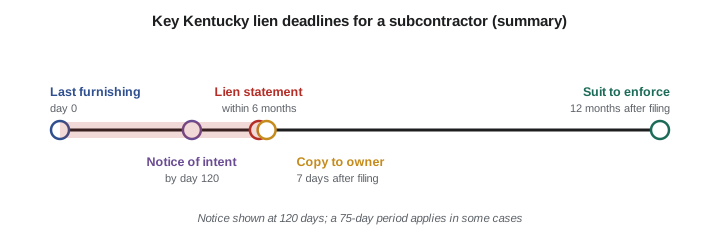
A subcontractor or supplier who did not contract directly with the owner must give the owner written notice of its intent to claim a lien. Under KRS 376.010, as the law firm summary describes it, the notice is generally due within 120 days after the claimant last furnished labor or materials. For some claims, including certain claims on owner-occupied residential property and smaller claims, the statute sets a shorter period of 75 days. The notice tells the owner that the claimant has not been paid and intends to claim a lien, which allows the owner to withhold payment from the general contractor until the claim is resolved.
A contractor who contracts directly with the owner does not need the notice of intent, because the owner already knows who it is. Limestone Ridge, as a subcontractor on the Glasgow restaurant, needed it. Earl's legal pad showed that the crew last worked on site on August 20, 2026, so the 120-day notice was due by December 18, 2026.
The lien statement
To create the lien, the claimant files a lien statement in the office of the county clerk where the property is located. Under KRS 376.080 the statement must be filed within six months after the claimant last furnished labor or materials, and it must contain the amount claimed, the name of the owner, a description of the property and a statement sworn by the claimant. Within seven days after filing, the claimant must send a copy of the statement to the owner as the statute directs. A lien statement that is filed late, that inflates the amount, or that describes the wrong property may fail.
| Step | Deadline or requirement (summary) | Glasgow restaurant (last furnishing Aug. 20, 2026) |
|---|---|---|
| Owner notice of intent (claimant without owner contract) | Within 120 days after last furnishing; 75 days in some cases | By December 18, 2026 |
| Lien statement filed with the county clerk | Within 6 months after last furnishing | By February 20, 2027 |
| Copy of the statement sent to the owner | Within 7 days after filing | Within 7 days of the filing date |
| Action to enforce the lien | Within 12 months after filing | Twelve months from the filing date |
# Lien calendar for the Glasgow restaurant (illustrative; confirm every date with counsel)
from datetime import date, timedelta

def add_months(d, m):
    y, mo = divmod(d.month - 1 + m, 12)
    return date(d.year + y, mo + 1, min(d.day, 28))

last_furnished = date(2026, 8, 20)
notice_by = last_furnished + timedelta(days=120)
statement_by = add_months(last_furnished, 6)
filed = date(2026, 10, 26)                 # the date Earl actually filed
print("Owner notice due by:", notice_by)
print("Lien statement due by:", statement_by)
print("Copy to owner due by:", filed + timedelta(days=7))
print("Enforcement suit due by about:", add_months(filed, 12))Owner notice due by: 2026-12-18 Lien statement due by: 2027-02-20 Copy to owner due by: 2026-11-02 Enforcement suit due by about: 2027-10-26
Earl did not wait for the last possible day. He sent the notice of intent to the restaurant's owner in September and, when the general contractor still did not pay, filed the lien statement with the Barren County clerk on October 26, 2026, well inside six months. The copy went to the owner by certified mail the same week. Filing early has costs, because it can sour a relationship, but waiting has a bigger risk: a missed deadline cannot be fixed.
What counts as the last furnishing
Every deadline runs from the last day the claimant furnished labor or materials under the contract. That date is not always obvious. Coming back to replace a faulty fixture under warranty, or to fix a punch-list item, may not extend the date if the work was really complete. Courts look at whether the later work was part of the original contract work or a trivial return. The safest practice is to calculate from the last day of substantial contract work and to treat any later date with suspicion.
Good daily records make this easy. Limestone Ridge's job logs record who was on site each day and what they did, and its delivery tickets record materials delivered. When Earl needed the last furnishing date for the Glasgow job, the log showed it in a minute.
Enforcing the lien
A lien statement is not a payment. It is security. If the owner and general contractor do not resolve the claim, the claimant must enforce the lien by filing a lawsuit within twelve months after filing the statement, as the law firm summary describes the statute. A lien that is not enforced in time expires. In practice, many liens are resolved before suit, when an owner who wants to sell, refinance or obtain an occupancy-related loan pays the claim or posts a bond to release the property.
Lien waivers and releases
Owners and general contractors often ask subcontractors to sign lien waivers in exchange for payments. A conditional waiver gives up lien rights only when the payment is actually received; an unconditional waiver gives them up immediately. Signing an unconditional waiver before the check clears can leave a contractor with neither the money nor the lien. Limestone Ridge signs conditional waivers for progress payments and unconditional waivers only after funds are in its account. When a lien claim is paid, the claimant should file a release in the county clerk's office so the owner's title is clear.
Residential work and homeowners
Much of Limestone Ridge's work is for homeowners and home builders, and lien rules there need extra care. A homeowner who has paid a builder in full may still face a lien from an unpaid electrical subcontractor, which feels unfair to the homeowner and can damage the subcontractor's reputation in a small community. The shorter notice period that applies to some residential claims means the owner hears of an unpaid subcontractor sooner, ideally before paying the builder everything. A subcontractor working on owner-occupied residential property should identify the notice period that applies at the start of the job and calendar it from the first day.
When Limestone Ridge contracts directly with a homeowner, for a service upgrade or a remodel, it is the prime contractor and needs no notice of intent, but the six-month filing period and the twelve-month enforcement period still apply if the homeowner does not pay. In practice, Earl prefers to solve residential payment problems with a conversation and a payment plan. A lien on a family home is a last resort, and he has filed only two in twenty-eight years.
Clear paperwork helps on residential jobs too. A short written contract with the scope, the price, the payment schedule and a line about changes protects the homeowner as much as the contractor. Customers who know what they agreed to pay rarely dispute the bill.
Avoiding the problem
The best lien is the one never filed. Before signing, Limestone Ridge checks the general contractor's payment history with suppliers and other subcontractors, asks who the owner is and whether the project has financing, and limits how far it will run ahead of payment. During the job it invoices on schedule, follows up on late payments within days, and documents every change order. Lien rights are the backstop, not the business plan.
Worked problem
Working the calendar for a supplier
An electrical supply house sold switchgear for the Glasgow restaurant to the general contractor and was not paid. Its last delivery was July 30, 2026. It did not contract with the owner. When was its notice of intent due, and by when must it file a lien statement?
Show solution
- The supplier did not contract with the owner, so it needs a notice of intent.
- 120 days after July 30, 2026 is November 27, 2026.
- The lien statement is due within six months after last furnishing, by January 30, 2027.
- A copy must go to the owner within seven days after filing, and suit must follow within twelve months of filing if unresolved.
Answer: Owner notice of intent by November 27, 2026; lien statement by January 30, 2027.
Common mistakes
MistakeDoing extra work on a verbal request.
InsteadGet a written change order approved before starting, except in an emergency.
MistakeCounting deadlines from the date of the last invoice.
InsteadDeadlines run from the last day labor or materials were furnished.
MistakeSigning an unconditional lien waiver before payment clears.
InsteadUse conditional waivers until funds are received.
MistakeFiling a lien statement and then waiting.
InsteadEnforce the lien by suit within twelve months of filing, or it expires.
Summary and key terms
- Clear contracts, written change orders and prompt invoicing prevent most payment problems.
- Claimants who did not contract with the owner give notice of intent, generally within 120 days after last furnishing (75 days in some cases).
- The lien statement is filed with the county clerk within six months after last furnishing.
- A copy goes to the owner within seven days after filing.
- Suit to enforce must be filed within twelve months after filing the statement.
- Mechanics' lien
- A security interest in real property for unpaid labor or materials.
- Owner notice of intent
- Written notice to the owner from a claimant without a direct contract that it intends to claim a lien.
- Lien statement
- The sworn statement filed with the county clerk to create the lien.
- Last furnishing
- The last day labor or materials were provided under the contract.
- Conditional waiver
- A waiver of lien rights effective only when payment is received.
Practice problems
Work each problem on paper first, then reveal the answer to check.
Where is a Kentucky lien statement filed?
Show answer
In the office of the county clerk where the property is located.
Within what period after last furnishing must the lien statement be filed?
Show answer
Six months.
Within how many days after filing must a copy go to the owner?
Show answer
Seven days.
Lesson quiz · 5 questions
Score 60% or more to complete this lesson.
Create a free account to save your progress, take quizzes and earn a certificate.