
MELU-217 · Lesson 5 of 12 · 18 min
The NEC as adopted in Kentucky and state amendments
▶ Video coming soon A video version of this lesson is on the way.
In late July 2026 a homeowner in Smiths Grove called Limestone Ridge with a question her builder could not answer. A friend in another state had been told that new houses need a surge protective device at the service. Did hers? Dana knew the answer had changed only days before. The department's memo effective July 15, 2026 had made the dwelling surge protection requirement enforceable in Kentucky, and Limestone Ridge had already added a line for it to its residential estimates.
This lesson explains how the National Electrical Code becomes law in Kentucky, which edition is in force, how Kentucky delays or modifies particular sections, how the residential and building codes divide the work, and how to tell which rules apply to a job that straddles a change. The exam assumes you know the adopted edition; the job assumes you know the Kentucky exceptions.
From model code to Kentucky law
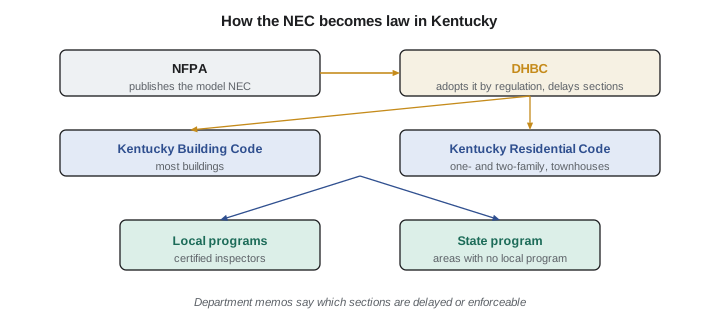
The NEC is a model code published by the National Fire Protection Association on a three-year cycle. It has no legal force on its own. It becomes law in Kentucky when the department adopts it by administrative regulation, under its authority in KRS chapters 198B and 227A. The adopting regulation names the edition and lists any Kentucky changes. Because adoption is statewide, local governments do not choose their own edition. A city inspector in Bowling Green and a state inspector in rural Butler County enforce the same adopted code.
Kentucky's adoption has also been tied to its building codes. The Kentucky Building Code governs most buildings, and the Kentucky Residential Code governs one- and two-family dwellings and townhouses. Both refer to the NEC for electrical work, but delays and changes may apply to one and not the other. A delay that applies to residential work under the Residential Code may not apply to a commercial job under the Building Code, so the first question about any delayed section is which code governs the building.
The 2023 NEC in Kentucky
The department announced that the 2023 edition of the NEC would be Kentucky's electrical code beginning January 1, 2025. Kentucky did not adopt every provision at once. The announcement delayed enforcement of several sections that had drawn concern from builders and electricians, mostly provisions that added cost to new dwellings. Until a delayed section became enforceable, inspectors did not cite work for failing to meet it, though a contractor could always choose to meet it.
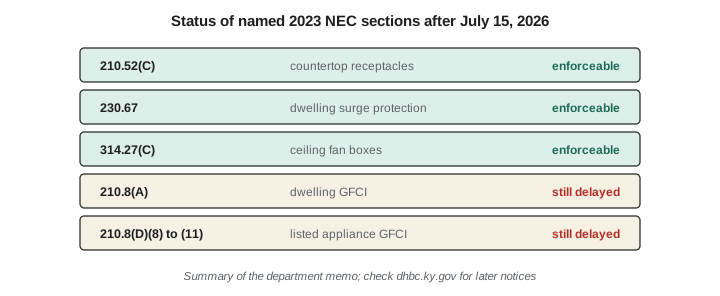
The department's memo effective July 15, 2026 revised that list. It made three sections enforceable from that date: 210.52(C), on receptacle outlets serving countertops and work surfaces; 230.67, on surge protection for services supplying dwelling units; and 314.27(C), on boxes at outlets for ceiling-suspended fans. It left other provisions delayed, including the dwelling unit ground-fault protection rules in 210.8(A) and items (8) through (11) of 210.8(D), part of the list of specific appliances that need ground-fault protection. The memo also explained how jobs already under way would be treated.
| Section (2023 NEC) | Subject (paraphrased) | Kentucky status after July 15, 2026 |
|---|---|---|
| 210.52(C) | Countertop and work surface receptacle outlets | Enforceable from July 15, 2026 |
| 230.67 | Surge protection for dwelling unit services | Enforceable from July 15, 2026 |
| 314.27(C) | Boxes at ceiling-suspended fan outlets | Enforceable from July 15, 2026 |
| 210.8(A) | GFCI protection in dwelling units | Still delayed |
| 210.8(D)(8) to (11) | GFCI for certain listed appliances | Still delayed |
Applying a delay correctly
A delay does not mean the older edition applies to that subject. It means Kentucky is not enforcing that particular section of the adopted edition for now. For a delayed GFCI provision, for example, the installer still follows the rest of the 2023 NEC, and the inspector enforces everything else in 210.8 that is not delayed. Candidates sometimes answer exam questions as if a delayed section had been replaced by the 2020 text. It has not; it simply is not enforced until the department says otherwise.
A delay also does not forbid compliance. Many contractors, Limestone Ridge included, install ground-fault protection where the adopted edition would require it even while enforcement is delayed, because it is safer, because customers ask for it, and because it avoids rework when the delay ends. Whether to exceed the enforced minimum is a business and safety judgment, not a code question.
Exam edition versus job edition
The exam may be written to a particular edition named in the candidate bulletin, and that edition is not always the one being enforced on job sites. National exam vendors update their question banks on their own schedule. A candidate should study the edition the bulletin names, and a master on the job should apply the edition and delays the department enforces. Dana confirmed that her December 2026 exam would use the 2023 edition, which matched what Limestone Ridge was installing.
# Which version of a delayed section applies to a job? (simplified decision aid)
from datetime import date

ENFORCEABLE_JULY_2026 = {"210.52(C)", "230.67", "314.27(C)"}
STILL_DELAYED = {"210.8(A)", "210.8(D)(8)-(11)"}
MEMO_DATE = date(2026, 7, 15)

def status(section, permit_date):
    if section in STILL_DELAYED:
        return "delayed: not enforced, compliance optional"
    if section in ENFORCEABLE_JULY_2026:
        return "enforced" if permit_date >= MEMO_DATE else "check the memo's transition rule"
    return "enforced as part of the adopted 2023 NEC"

for sec, d in [("230.67", date(2026, 8, 3)), ("230.67", date(2026, 6, 20)),
               ("210.8(A)", date(2026, 9, 1)), ("250.50", date(2026, 9, 1))]:
print(f"{sec:18s} permit {d} -> {status(sec, d)}")230.67 permit 2026-08-03 -> enforced 230.67 permit 2026-06-20 -> check the memo's transition rule 210.8(A) permit 2026-09-01 -> delayed: not enforced, compliance optional 250.50 permit 2026-09-01 -> enforced as part of the adopted 2023 NEC
The decision aid is deliberately cautious about jobs permitted before the memo date. The memo sets out how work begun before July 15, 2026 is treated, and the right answer for a real job comes from the memo and the inspector, not from a script. The aid is useful for study because it forces the three questions in order: is the section delayed, is it newly enforceable, and when was the job permitted?
Interpretations and bulletins
Between editions, the department answers questions through memos, frequently asked questions and inspector guidance. These do not change the adopted code, but they explain how inspectors will apply it, and a master who reads them avoids surprises at rough-in. Local inspection programs may also issue their own guidance on how they apply the state code, within the limits of the adopted code. When an inspector's reading differs from yours, ask which section and which guidance the inspector is relying on, and ask the department if the question is one of statewide importance.
The NFPA publishes its own interpretations, handbooks and commentary. These are useful for understanding the purpose of a rule, but they are not part of Kentucky law. Only the adopted code, the adopting regulation and the department's notices bind a Kentucky job.
Why some sections are delayed
Each new NEC edition adds requirements, and some of them add cost or create practical problems before the industry has caught up. Ground-fault protection rules that extend to new locations, for example, have at times caused nuisance tripping with certain appliances, and surge protection and new receptacle rules add material and labor to every new house. States that adopt a new edition often weigh those concerns, and Kentucky's practice has been to adopt the edition as a whole while delaying particular sections until the department is satisfied they can be applied fairly.
For a master, the reasons matter less than the result, but understanding them helps when talking with builders and customers. A builder who asks why a requirement suddenly appeared on a September estimate deserves a clear answer: the department made it enforceable in July, and here is the memo. A customer who asks why the crew installed ground-fault protection that the inspector did not require deserves an equally clear answer: the adopted edition calls for it, Kentucky has not yet enforced it, and Limestone Ridge installs it because it protects people.
Code changes and the estimate
Code changes reach the business first through the estimate. When the July 2026 memo took effect, Limestone Ridge had three new-house bids outstanding that did not include surge protection, because they had been priced under the earlier list of delays. Rhonda checked each one. Two had not yet been accepted, so the estimator revised them. The third had been signed in June with a permit to be pulled in August, so the price had to be discussed with the builder. That conversation was easier because the contract included a clause allowing price changes for code changes adopted after signing.
The lesson for a master is to treat code notices as business events. Each one may affect bids, material orders, crew training and inspection checklists. A short written summary of each change, kept with the estimating templates, saves time and money, and it gives the crew a single place to check when they are unsure.
Other codes that touch electrical work
The NEC is not the only code that matters on an electrical job. The Kentucky Building Code and Residential Code contain their own provisions on smoke alarms, energy use and fire-resistance-rated assemblies that affect where and how electrical equipment is installed. The fire code governs fire alarm systems in many occupancies. The serving utility has its own service requirements for meter locations, service entrance equipment and clearances, and those are not part of the NEC at all. A master coordinates all of these, and inspectors will expect the electrical work to fit with them.
Staying current
Code adoption is a moving target. The NFPA has published the 2026 NEC, and Kentucky will decide on its own schedule when to adopt it and what to delay. A master should subscribe to the department's announcements, read every new memo the week it appears, and pass the changes on to the crews and the estimator. Limestone Ridge reviews code notices at its Monday morning meeting, and Rhonda updates the estimating templates the same week.
Continuing education helps with this. Kentucky's continuing education rules, covered in lesson 11, require masters and electricians to take code-related courses, and providers usually build their courses around the edition Kentucky has adopted and its delays. A master who takes those courses seriously rarely gets caught by a change.
Back to Smiths Grove
For the homeowner in Smiths Grove, Dana's answer depended on dates. The house's permit had been issued in early August 2026, after the memo took effect, so the surge protection requirement in 230.67 applied, and the builder's electrician needed to include it. Had the permit been issued in June, Dana would have read the memo's transition language and asked the inspection authority how it would treat the job. Either way, she told the homeowner, a surge protective device was worth having.
Worked problem
Sorting four questions about a new dwelling
A Limestone Ridge crew is wiring a new single-family house permitted in September 2026. The lead asks four questions: Must the service have surge protection? Must the kitchen island have a receptacle arrangement under 210.52(C)? Must every dwelling receptacle listed in 210.8(A) be GFCI protected? Must the ceiling fan box in the bedroom meet 314.27(C)?
Show solution
- The permit date is after July 15, 2026.
- 230.67, 210.52(C) and 314.27(C) became enforceable on that date, so they apply.
- 210.8(A) remains delayed, so it is not enforced, though the crew may comply.
- Everything else in the 2023 NEC applies as adopted.
Answer: Surge protection, the countertop receptacle rule and the fan box rule apply; 210.8(A) is not enforced, but compliance is allowed and often wise.
Common mistakes
MistakeTreating a delayed section as if the previous edition's text applied.
InsteadA delayed section is simply not enforced; the rest of the adopted edition still applies.
MistakeAssuming each city adopts its own NEC edition.
InsteadKentucky adopts the NEC statewide by regulation.
MistakeApplying a residential delay to a commercial building.
InsteadCheck whether the Residential Code or the Building Code governs.
MistakeRelying on last year's list of delays.
InsteadRead the latest department memo; the list changed in July 2026.
Summary and key terms
- The NEC becomes law in Kentucky when the department adopts it by regulation; the adoption is statewide.
- The 2023 NEC took effect January 1, 2025, with some sections delayed.
- From July 15, 2026, 210.52(C), 230.67 and 314.27(C) are enforceable.
- 210.8(A) and 210.8(D)(8) to (11) remain delayed under the July 2026 memo.
- Study the edition the exam bulletin names; build to the edition and delays the department enforces.
- Model code
- A code published for adoption by governments, such as the NEC.
- Adopting regulation
- The administrative regulation that makes a code edition law in Kentucky.
- Delayed section
- A section of the adopted edition that Kentucky is not yet enforcing.
- Kentucky Residential Code
- The code for one- and two-family dwellings and townhouses.
- Kentucky Building Code
- The code for most other buildings.
Practice problems
Work each problem on paper first, then reveal the answer to check.
When did the 2023 NEC take effect in Kentucky?
Show answer
January 1, 2025, with some sections delayed.
Name the three sections made enforceable on July 15, 2026.
Show answer
210.52(C), 230.67 and 314.27(C).
Does a delayed section mean the 2020 NEC text applies?
Show answer
No. The section is simply not enforced; the rest of the 2023 NEC applies.
Lesson quiz · 5 questions
Score 60% or more to complete this lesson.
Create a free account to save your progress, take quizzes and earn a certificate.