
MELU-217 · Lesson 1 of 12 · 19 min
How electrical licensing works in Kentucky
▶ Video coming soon A video version of this lesson is on the way.
Limestone Ridge Electric has wired houses, tobacco barns, poultry houses and small commercial buildings around Bowling Green for twenty-eight years. Its founder, Earl Whitfield, holds a Kentucky master electrician license and an electrical contractor license, and he has been the company's designated master since the business opened. In the summer of 2026 Earl told his crew that he planned to retire in the spring of 2027. He asked Dana Pruitt, a licensed electrician who has run his larger jobs for three years, whether she would sit for the master exam so the company could keep its contractor license when he stepped away.
This course follows Dana from that conversation to the day she holds a master electrician license and can stand behind Limestone Ridge's contractor license. It builds on the master electrician core courses (MELU-101 onward), which teach the National Electrical Code and the business topics shared by every state. Here the focus is Kentucky: who licenses electricians, how the license ladder is built, what the exam asks, how permits and inspections work in different parts of the state, and what a master and a contractor owe the public once licensed. Limestone Ridge, Earl, Dana and every other person and job in the course are invented for teaching.
The agency
Electrical licensing in Kentucky sits with the Department of Housing, Buildings and Construction, usually shortened to DHBC or simply the department. The department is part of the Public Protection Cabinet. Its Division of Electrical licenses electricians and electrical contractors, certifies electrical inspectors, administers the state electrical inspection program, and carries out the regulations that adopt the electrical code. Other divisions of the same department handle building codes, plumbing, fire protection and manufactured housing, which matters to an electrical contractor because a commercial job often involves several of them at once.
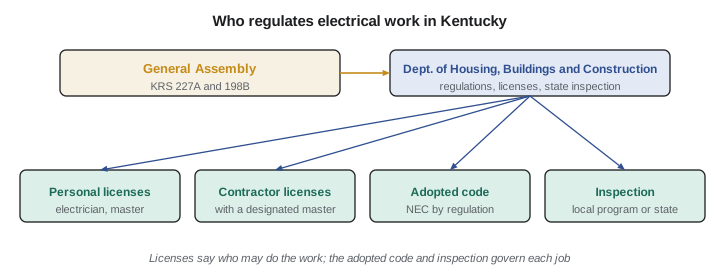
The legal structure is easiest to remember in three layers. The General Assembly writes the statutes: chapter 227A covers electrician and electrical contractor licensing, while chapter 198B covers the state building code and lets local governments run their own inspection programs. The department writes regulations under that authority, and those regulations set the details: forms, fees, exam passing scores, insurance proof, inspection procedures and continuing education. Finally, the department publishes announcements and memos that explain how it is applying those rules, such as which sections of a new code edition are being delayed. A good candidate knows which layer a rule comes from, because the exam's law questions are written from the statute and regulations rather than from the department's web pages.
Personal licenses and the contractor license
Kentucky separates two questions that are easy to blur together. The first is whether a person is qualified to do electrical work. That question is answered by personal licenses held by individuals: the electrician license and the master electrician license. The second is whether a business may offer electrical work to the public for pay. That question is answered by the electrical contractor license, which depends on insurance and on having a licensed master electrician designated to the business. A master electrician who works for a hospital maintenance department needs no contractor license. A business that bids wiring jobs needs one, and it needs a master standing behind it.
The personal licenses form a short ladder. People who have not yet earned a license work under the supervision of licensed electricians while they build experience; how that supervision is arranged on a particular job is covered in lesson 7. The electrician license, which many other states call a journeyman license, requires documented experience of 8,000 hours under the 2024 version of KRS 227A.060 and a passing exam score. The master electrician license requires 16,000 hours of experience, with credit available for some training and education, and a passing score on the master exam. Lesson 2 works through those eligibility rules in detail.
The contractor license sits beside the personal licenses rather than above them. Under KRS 227A.060 an applicant for the contractor license must carry general liability insurance of at least one million dollars, comply with workers' compensation and unemployment insurance law, and pass the contractor examination, which covers business and law. Under 815 KAR 35:060 the business designates a master electrician to the contractor license, and that designee must be an owner, officer, director or full-time employee. When Earl retires, Limestone Ridge has to designate a new master, and that is the reason Dana is studying.
| License | What it allows (summary) | Basis of eligibility (summary, 2026) |
|---|---|---|
| Electrician | Electrical work as a licensed individual | 8,000 hours of experience and a passing exam score |
| Master electrician | All of the above; may be designated to an electrical contractor | 16,000 hours, with credit for some training and education, and the master exam |
| Electrical contractor (business) | Offer and perform electrical work for others | General liability of at least 1,000,000 dollars, workers' comp and unemployment compliance, contractor exam, designated master |
| Electrical inspector (certification) | Inspect electrical work for the state or a local program | Certification under the department's inspector rules |
Statewide licenses, mixed inspection
Kentucky licenses are statewide. Before the current licensing law, some cities and counties licensed electricians themselves, and older electricians still talk about the days when a city card was what mattered. Today the state license is good throughout Kentucky, and local governments do not issue competing electrician licenses. Licensing is the part of the system that is uniform everywhere in the Commonwealth.
Inspection is not uniform in the same way. Under KRS 198B.060 a city, county or urban county government may run its own building and electrical inspection program with certified inspectors, and many of the larger jurisdictions do. Where no local program exists, the department's electrical inspectors, or inspectors certified to work in that area, handle the job. That means the first question on any new job is not only which code applies but who the inspection authority is. Limestone Ridge works in Warren, Barren, Butler, Edmonson, Logan and Simpson counties, and its office manager, Rhonda Mattingly, keeps a sheet showing where each job's permit is filed. Lesson 6 explains how to find the right authority and how a permit moves from filing to final inspection.
One code, adopted by regulation
Kentucky adopts the National Electrical Code by regulation through the department rather than letting each city choose an edition. The department announced the 2023 NEC as Kentucky's electrical code beginning January 1, 2025, with some provisions delayed, and its memo effective July 15, 2026 made several of those delayed provisions enforceable while leaving others delayed. A contractor working anywhere in Kentucky is therefore working to the same adopted edition and the same list of delayed sections, whether the inspector is a state employee or a city inspector. Lesson 5 covers the adoption, the delayed sections and the transition rule.
# Which part of the system answers which question? (study aid)
roles = {
    "Who may do electrical work": "Personal license: electrician or master electrician (KRS 227A)",
    "Who may sell electrical work": "Electrical contractor license with a designated master (KRS 227A, 815 KAR 35:060)",
    "Which code edition applies": "NEC as adopted by DHBC regulation, with delayed sections",
    "Who inspects this job": "Local program under KRS 198B.060, or state inspection where none exists",
    "How licenses are renewed": "Every two years with continuing education (KRS 227A.100, 815 KAR 2:010)",
}
for question, answer in roles.items():
print(f"{question:30s} -> {answer}")Who may do electrical work -> Personal license: electrician or master electrician (KRS 227A) Who may sell electrical work -> Electrical contractor license with a designated master (KRS 227A, 815 KAR 35:060) Which code edition applies -> NEC as adopted by DHBC regulation, with delayed sections Who inspects this job -> Local program under KRS 198B.060, or state inspection where none exists How licenses are renewed -> Every two years with continuing education (KRS 227A.100, 815 KAR 2:010)
The map in the code example is the quickest way to answer an exam question that starts with a situation and asks which rule applies. If the question is about a person's qualifications, think of chapter 227A and the licensing regulation. If it is about a business, think of the contractor license and its insurance and designee rules. If it is about a particular installation, think of the adopted code. If it is about who signs off on that installation, think of the inspection authority.
What the master license means at Limestone Ridge
For Dana the license is partly a credential and partly a responsibility. As a licensed electrician she already works without the supervision of another licensee, and she supervises the unlicensed workers on her crews. As a master she becomes eligible to be designated to a contractor license. Once Limestone Ridge designates her, she is the licensed individual whose license the contractor license rests on. If she leaves the company or her master license lapses, the company has a limited time under the regulation to designate another master before its contractor license is in trouble.
Earl puts it in practical terms. "The contractor license is the company's," he told Dana, "but it hangs on your license. If your license lapses because you forgot continuing education, the company can't take work. If something goes badly wrong on a job, the department will want to talk to both of us." That is why this course spends as much time on renewal, permits, insurance and records as it does on the exam itself.
The parts of the exam
The master electrician exam tests the National Electrical Code as adopted in Kentucky and electrical theory and calculations. A separate contractor exam on business and law applies to contractor applicants. Department bulletins from recent years described an open-book master exam of about 100 questions with a passing score of 70 percent, and Kentucky also accepts the national NASCLA electrical contractor and master electrician exam. The department changes exam vendors and formats from time to time, so lesson 4 explains how to find the current candidate information and how to prepare for whichever format applies when you test.
Exam preparation courses that are not specific to Kentucky often say little about Kentucky's own rules. The questions that most often surprise candidates are the state ones: the hours of experience and how training credit works, the contractor insurance amount, the designee rules, the renewal cycle and continuing education hours, the lien deadlines and the inspection system. This course is built around those state topics.
Reading this course
Each lesson follows the same pattern as the core courses: a short scene at Limestone Ridge, the rules, a worked example, common mistakes and a summary. The quizzes include typed questions such as true or false, numbers, ordering and matching, because the real exam rewards exact knowledge of figures and sequences. Where the course gives a fee, a time limit or an exam detail that comes from an older bulletin or a secondary source, it says so, and you should treat it as a starting point for checking rather than as a final answer.
Dana's own plan has three parts. She will confirm her eligibility and apply in August 2026, study the adopted NEC and the Kentucky licensing law through the late summer and early fall, and test at the end of October so that she can be designated before Earl's planned retirement. Along the way she will learn how Limestone Ridge files permits in each county, what insurance certificates the department expects, how the company protects its lien rights and how it reports injuries. Those are the subjects of the lessons that follow.
Worked problem
Sorting a question by its source
A practice question asks: "A business wants to bid electrical work in Bowling Green. It employs two licensed electricians but no master. What does it need before it can contract for electrical work?" Which part of the system answers this, and what is the answer?
Show solution
- The question is about a business selling electrical work, so it is a contractor license question.
- The contractor license requires a designated master electrician who is an owner, officer, director or full-time employee.
- It also requires general liability insurance of at least one million dollars, workers' compensation and unemployment compliance, and a passing contractor exam.
- Two licensed electricians cannot substitute for the designated master.
Answer: The business needs an electrical contractor license, which requires a designated master electrician plus the insurance and exam requirements.
Common mistakes
MistakeThinking a city license is still what allows an electrician to work in a Kentucky city.
InsteadElectrician licenses are issued by the state and are valid statewide.
MistakeAssuming the state inspects every job.
InsteadLocal governments may run their own inspection programs; state inspection covers areas without one.
MistakeTreating the master license and the contractor license as the same thing.
InsteadThe master license is personal; the contractor license is a business license that depends on a designated master.
MistakeReading department web pages as the law.
InsteadStatutes and regulations are the law; department announcements explain how they are applied.
Summary and key terms
- The Department of Housing, Buildings and Construction licenses electricians and contractors and runs state electrical inspection.
- KRS 227A sets the license types and eligibility; 815 KAR 35 sets forms, fees, exam scores and inspection procedure.
- Personal licenses are the electrician and master electrician licenses; the contractor license is a business license with a designated master.
- Licenses are statewide, but inspection may be local or state depending on the jurisdiction.
- The NEC is adopted statewide by regulation, with some sections delayed by department memo.
- DHBC
- The Kentucky Department of Housing, Buildings and Construction.
- KRS 227A
- The Kentucky statute on electrician and electrical contractor licensing.
- 815 KAR 35
- The chapter of Kentucky regulations on electrical licensing and inspection.
- Designated master
- The master electrician designated to a contractor license.
- Inspection authority
- The local program or state inspection office responsible for a job.
Practice problems
Work each problem on paper first, then reveal the answer to check.
Which department licenses electricians in Kentucky?
Show answer
The Department of Housing, Buildings and Construction, through its Division of Electrical.
May a Kentucky city issue its own electrician license?
Show answer
No. Electrician licenses are issued by the state and are valid statewide.
What statute lets local governments run their own inspection programs?
Show answer
KRS 198B.060.
Lesson quiz · 5 questions
Score 60% or more to complete this lesson.
Create a free account to save your progress, take quizzes and earn a certificate.