
MELU-217 · Lesson 3 of 12 · 18 min
Applying, approval and booking the exam
▶ Video coming soon A video version of this lesson is on the way.
On a Monday in early August 2026, Dana sat at the Limestone Ridge office with Rhonda Mattingly and a folder that had taken three weeks to assemble: her experience verification signed by Earl, the certificate from her evening training program, a copy of her electrician license and her identification. "Read every page before you sign it," Rhonda said. "The department is good about telling you what's missing, but every missing piece is another couple of weeks."
This lesson follows the application from the first form to the day the exam is booked: what goes into the application, how the department reviews it, what happens when something is missing or the application is denied, how the exam is scheduled, and what happens after a pass or a fail. The general sequence is stable even when vendors and forms change.
Preparing the application
The master electrician application asks for the applicant's identifying information, license history, the basis of eligibility and the supporting proof described in lesson 2. The licensing regulation incorporates the department's application forms by reference, including forms in the EL series, and the department publishes the current versions on its website. Applicants should always download the current form rather than reusing an old copy, because the department updates forms when the statute changes, as it did after the 2024 amendments.
The application fee is paid with the application. KRS 227A.060 allows the department to set the application fee at up to 100 dollars. This fee covers the review of the application. The exam itself may carry a separate fee paid to the testing vendor, and the license fee is paid after passing. Treat the three as separate payments and budget for all of them.
For Dana the application was straightforward because all of her experience was with one employer. Earl signed the experience verification as her employer and attached a summary of her yearly hours from Rhonda's binder. Dana attached the training certificate so the reviewer could see the 4,000-hour credit even though she did not need it. Earl advised attaching a short cover letter listing each enclosure, which makes it easier for a reviewer to see that the file is complete.
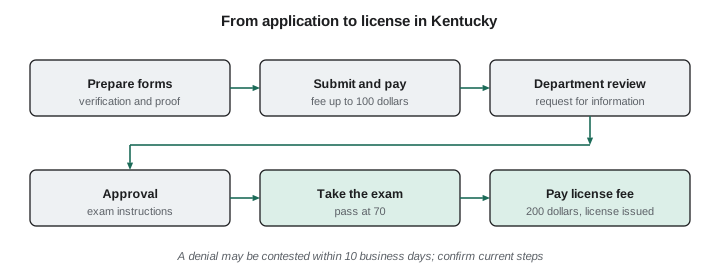
Review, deficiencies and denial
The department reviews each application against the statute and regulation. Reviewers check that the claimed hours reach 16,000, that substitutions are supported by proof, that employer verifications are signed and consistent, and that the applicant's history raises no other issue. If something is missing, the department asks for it. The common gaps are an unsigned verification, hours that do not add up to the total claimed, a training certificate without dates, and out-of-state experience without verification.
A request for more information is not a denial. It is the department asking for evidence, and the fastest response is to answer exactly what was asked, with documents. A denial is different: it means the department has concluded that the applicant does not qualify. Under 815 KAR 35:060 an applicant who wants to contest a denial must request a hearing within ten business days after receiving notice of the decision. That is a short window, and missing it usually means starting over with a new application. Any candidate who receives a denial should read it the day it arrives.
| Step | Who acts | What to watch |
|---|---|---|
| Prepare forms and proof | Applicant and employers | Current form version; signatures; hours that add up |
| Submit and pay application fee | Applicant | Fee of up to 100 dollars under the statute |
| Review | Department Division of Electrical | Requests for more information; respond with documents |
| Approval or denial | Department | A denial may be contested within 10 business days |
| Book and take the exam | Applicant with the testing vendor | Follow the approval instructions; bring required ID |
| License fee and issuance | Applicant, then department | Score valid three years; pay the license fee to receive the license |
Approval and booking
Once the department approves the application, it notifies the applicant that he or she is eligible to test and explains how to schedule. In recent years the department has used a national testing company for its electrical exams, and its 2020 candidate bulletin described scheduling through the vendor's website or by phone at commercial test centers. Kentucky also accepts the national NASCLA electrical contractor and master electrician exam, which is given by NASCLA's own testing vendor. Which path applies, and how to book it, depends on the instructions current when you are approved.
Booking well matters. Test centers in different Kentucky cities and in neighboring states may have different seat availability, and the busiest periods are often late in the year and before license deadlines. Candidates should book as soon as they are approved, choose a center they can reach without a long drive on exam morning, and read the vendor's rescheduling and cancellation rules before choosing a date. Vendors commonly require notice several days ahead to reschedule without losing the fee.
# Planning backward from a target exam date (illustrative allowances)
from datetime import date, timedelta

target_exam = date(2026, 10, 29)
review_allowance = timedelta(weeks=5)    # department review plus one request for information
booking_lead = timedelta(weeks=3)        # time between approval and an open seat

apply_by = target_exam - booking_lead - review_allowance
print("Target exam date:", target_exam.isoformat())
print("Apply no later than:", apply_by.isoformat())
print("Weeks between applying and testing:", (target_exam - apply_by).days // 7)Target exam date: 2026-10-29 Apply no later than: 2026-09-03 Weeks between applying and testing: 8
The allowances in the example are Limestone Ridge's own rule of thumb, not department figures. Review time varies with the season and with how complete the application is. Dana applied on August 3, 2026, comfortably ahead of the date the example produces, and received approval in early September. She booked a seat at a test center within an hour's drive for October 29, 2026.
Choosing when to test
Timing is a strategic decision. The biggest factor in Kentucky in 2026 was the code edition. The department adopted the 2023 NEC effective January 1, 2025, and its July 2026 memo changed which delayed sections are enforced. Exams are written to an edition named in the candidate information, so a candidate should confirm which edition the exam uses and study that edition. Dana confirmed that her exam would use the edition stated in her approval instructions and studied from it.
Personal timing matters too. Construction in south-central Kentucky is busy from spring through fall, and many candidates find it easier to study in the winter. Dana chose the end of October because it gave her about twelve weeks of study after applying, left time for a retake before Earl's retirement if she needed one, and fell as Limestone Ridge's busiest season was winding down.
Test-day logistics
The approval instructions and the vendor's bulletin list what to bring. Expect to need current government-issued photo identification whose name matches the application exactly; a name change after marriage, with an old name on the electrician license, is a classic way to be turned away. Open-book exams allow certain references, and the bulletin says which ones and how they may be marked. Phones and other electronic devices are normally not allowed in the testing room, and lockers may be provided. Lesson 4 covers the format and references in detail.
Plan the trip as carefully as the study. Arrive early enough to check in calmly, bring the approved references in the condition the bulletin requires, and dress in layers. A candidate who arrives flustered from a late start loses the first part of a long exam to nerves.
Working with the Division of Electrical
The department's licensing staff answer questions by phone and email, and they handle a steady stream of applications from electricians, masters and contractors. Questions get the best answers when they are specific. Give your name as it appears on your license, your license number, the date you applied and the exact question, such as whether hours worked as an in-house electrician at a manufacturing plant in Indiana will count. Vague questions get general answers that may not fit your case.
Keep a record of every contact: the date, the name of the person you spoke with and what was said. If an answer affects your eligibility, ask for it in writing or follow the call with an email that summarizes what you were told. Rhonda keeps a single folder for each employee's application with copies of every page sent and every letter received, and she has twice used that folder to show that a document the department said was missing had in fact been sent.
It also helps to know what the department cannot do for you. Staff can explain the rules and the status of an application, but they cannot tell you how to pass the exam, they cannot waive statutory hours, and they cannot backdate a license. If the application is complete and accurate, the review is usually routine. Most delays come from incomplete files, not from the department.
Special arrangements
Testing vendors offer accommodations for candidates with disabilities under federal law, such as extra time or a separate room, but they usually require a request with documentation well before the exam date. A candidate who needs an accommodation should ask when booking, not at the test center.
After the exam
A candidate who passes receives a score report. Under 815 KAR 35:060 the passing score is 70, and a passing score is valid for three years. The candidate then completes licensing by paying the license fee; the regulation sets a fee of 200 dollars for the two-year master license. The department issues the license, which expires on the last day of the holder's birth month at the end of its term, as lesson 11 explains.
A candidate who fails receives a score report that usually breaks results into content areas. That breakdown is valuable. Before booking a retake, list the areas that scored lowest and the questions that felt slow, and make those the core of the next study plan. Retake rules, waiting periods and fees are set by the vendor and department, so read them on the score report or in the bulletin. A fail does not erase eligibility, but each new attempt costs time and money.
Linking the new license to the company
Passing the exam and receiving the master license does not by itself change Limestone Ridge's contractor license. The company must designate Dana as its master on the contractor license with the department. Under 815 KAR 35:060, if a contractor's designated master leaves, the contractor has 30 days to designate a replacement. Earl and Dana planned the changeover for the spring of 2027, with Dana designated before Earl's last day so there would be no gap. Lesson 8 covers the contractor license and lesson 7 the master's duties.
Worked problem
Answering a request for more information
Two weeks after applying, Caleb receives a letter saying his employer verification from a former employer in Tennessee is unsigned and that his transcript is a copy, not an official transcript. What should he do?
Show solution
- The letter is a request for information, not a denial.
- He should ask the Tennessee employer to sign and return a new verification.
- He should request an official transcript from his college be sent as the department directs.
- He should respond with exactly those two items and keep copies of everything sent.
Answer: Send a signed verification and an official transcript, exactly as requested, and keep copies.
Common mistakes
MistakeWaiting until the last minute to apply for a target exam date.
InsteadAllow time for review and at least one request for more information.
MistakeMissing the deadline to contest a denial.
InsteadUnder 815 KAR 35:060 a hearing request is due within 10 business days of notice.
MistakeBringing references the bulletin does not allow, or marking them improperly.
InsteadFollow the bulletin's rules for references exactly; see lesson 4.
MistakeExpecting the contractor license to update automatically when you pass.
InsteadThe contractor must designate the new master with the department.
Summary and key terms
- Applications use the department's current forms with employer verification and proof of any credit.
- The statute caps the application fee at 100 dollars; exam and license fees are separate.
- A request for information is not a denial; a denial may be contested within 10 business days.
- After approval, candidates book through the testing vendor named in their instructions.
- The passing score is 70, a passing score is valid three years, and the two-year master license fee is 200 dollars.
- Request for information
- A department letter asking for missing or corrected documents.
- Denial
- A decision that an applicant does not qualify.
- Hearing request
- The applicant's request to contest a denial, due within 10 business days.
- Testing vendor
- The company that schedules and delivers the exam.
- Score report
- The result of an exam, often broken down by content area.
Practice problems
Work each problem on paper first, then reveal the answer to check.
What is the passing score on the Kentucky master exam under 815 KAR 35:060?
Show answer
70.
How long does an applicant have to contest a denial?
Show answer
Ten business days after notice of the decision.
What must a contractor do after its new master is licensed?
Show answer
Designate the new master on the contractor license with the department.
Lesson quiz · 5 questions
Score 60% or more to complete this lesson.
Create a free account to save your progress, take quizzes and earn a certificate.