
MELU-217 · Lesson 10 of 12 · 18 min
Workplace safety law and OSHA for electrical contractors
▶ Video coming soon A video version of this lesson is on the way.
On a cool morning in mid-September 2026, a trainee named Trey was pulling a feeder into the new panel at the Smiths Grove farm shop when he reached past the temporary service disconnect to steady the conduit. The disconnect was off, but the line side of the temporary service was still energized, and his sleeve brushed a lug that had been left uncovered. He felt nothing and saw nothing happen, but Dana, who was ten feet away, stopped the work immediately. That afternoon the whole crew gathered at the truck for a talk none of them forgot.
This lesson covers the safety and injury laws that apply to a Kentucky electrical contractor: the Kentucky Occupational Safety and Health program, the federal construction standards it enforces, electrical safe work practices under NFPA 70E, the reporting of serious injuries, and the workers' compensation duties that follow an injury. The contractor exam tests the law; the crew's health depends on the practice.
Kentucky OSH: a state plan
Kentucky runs its own occupational safety and health program under a plan approved by federal OSHA, so on most private job sites in Kentucky the safety inspector who arrives is from the state program, not federal OSHA. The Kentucky Occupational Safety and Health program, usually called Kentucky OSH or KOSH, sits within the state's labor cabinet. It enforces standards that must be at least as effective as the federal ones, and Kentucky has adopted the federal construction standards in 29 CFR part 1926, including the electrical provisions, along with some state-specific rules. It also offers free consultation services to employers who want help without the risk of citations.
For an electrical contractor the practical meaning is that the federal construction standards apply, enforced and sometimes supplemented by the state. The general duty to keep the workplace free of recognized hazards that are likely to cause death or serious harm applies too. Electrical hazards are among the most recognized hazards there are, so a contractor who allows energized work without justification and protection has little defense.
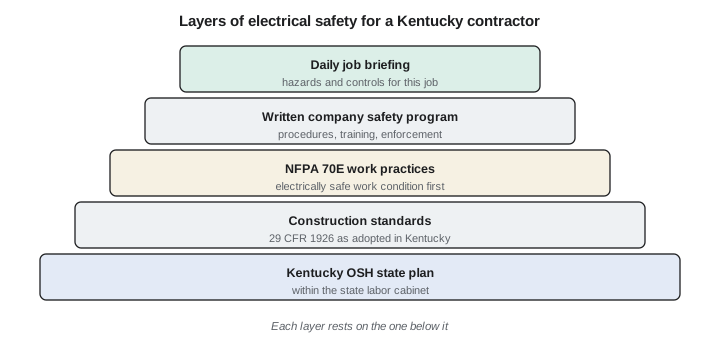
Working on or near energized equipment
The federal construction standards and NFPA 70E start from the same principle: electrical work should be done with the equipment de-energized and placed in an electrically safe work condition whenever possible. That means identifying the sources, opening the disconnects, applying locks and tags, and testing for absence of voltage with a properly rated tester that has been checked on a known source. Energized work is justified only where de-energizing would create a greater hazard or is infeasible, and then it requires an energized work permit, a shock and arc flash risk assessment, appropriate protective equipment and qualified workers.
NFPA 70E is a consensus standard rather than a regulation, but safety inspectors use it as evidence of what a reasonable employer should do, and insurers and general contractors often require compliance with it in their contracts. Limestone Ridge trains every employee on its 70E program when hired and every year after.
Trey's near miss shows a common trap. Opening a disconnect de-energizes the load side, not the line side. The temporary service's line terminals stayed energized from the utility, and the open lug was a shock hazard whether or not the switch was on. The fix was simple: an insulating cover over the line side, a barrier, and a rule that nobody reaches past a disconnect without testing what is behind it.
| Layer | What it requires (summary) | Who enforces or relies on it |
|---|---|---|
| Kentucky OSH state plan | Standards at least as effective as federal OSHA; general duty | Kentucky OSH compliance officers |
| 29 CFR 1926 construction standards | Electrical safety, lockout, ladders, trenching, fall protection | Kentucky OSH, as adopted |
| NFPA 70E | Electrically safe work condition, risk assessment, protective equipment | Employers, insurers and contracts; used as evidence |
| Company safety program | Written procedures, training and discipline | The contractor and its designated master |
| Daily job briefing | Hazards and controls for today's tasks | The crew lead |
Reporting serious injuries
Employers must report certain serious injuries to Kentucky OSH. Under the state's reporting regulation as amended in 2020, as a law firm summary described it, an employer must report an in-patient hospitalization of three or more employees within eight hours and an in-patient hospitalization of fewer than three employees within 72 hours. Work-related fatalities must be reported, and Kentucky's rule does not limit fatality reporting to deaths within 30 days of the incident, as the federal rule does. Amputations and the loss of an eye must also be reported. The summary gave the program's compliance division phone line for reports and federal OSHA's line after hours.
These reporting periods are short, and they run from when the employer learns of the event. The contractor's office should keep the reporting numbers and the steps posted where the person who answers the phone can find them. When an injury happens on a job, the crew lead's first job is care for the injured worker; the second is calling the office so the reporting clock does not run out while everyone is at the hospital.
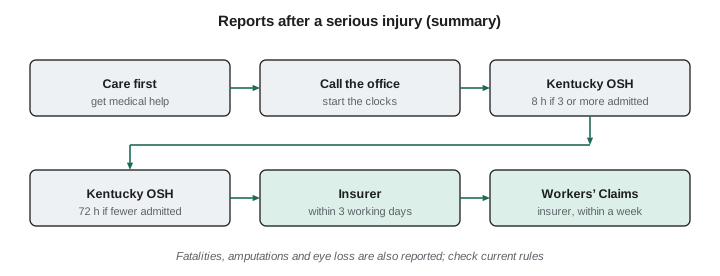
# Which reports are due after an incident? (illustrative; check the current rules)
def reports_due(hospitalized, fatality, lost_days):
    due = []
    if fatality:
        due.append("Kentucky OSH: report the fatality promptly")
    if hospitalized >= 3:
        due.append("Kentucky OSH: within 8 hours (3 or more hospitalized)")
    elif hospitalized > 0:
        due.append("Kentucky OSH: within 72 hours (fewer than 3 hospitalized)")
    due.append("Workers' comp insurer: within 3 working days of notice")
    if lost_days >= 1:
        due.append("Insurer reports to Department of Workers' Claims within one week")
    return due

for case in [(0, False, 0), (1, False, 4)]:
    print(case, "->")
    for r in reports_due(*case):
print(" ", r)(0, False, 0) ->
Workers' comp insurer: within 3 working days of notice
(1, False, 4) ->
Kentucky OSH: within 72 hours (fewer than 3 hospitalized)
Workers' comp insurer: within 3 working days of notice
Insurer reports to Department of Workers' Claims within one weekWorkers' compensation after an injury
Kentucky's workers' compensation law requires every employer with one or more employees covered by the law to secure its liability for benefits, either by buying a policy from an insurer authorized to write workers' compensation in Kentucky or by qualifying as a self-insured employer with the approval of the state. The premium may not be deducted from employees' wages. Every employer must post a notice of coverage where employees customarily report for payroll and personnel matters, with the insurer's name, the policy number, how to get medical care for a work injury, and the employee's duty to report accidents.
When an injury occurs, the employer must keep a record and report each incident or alleged incident to its workers' compensation insurer within three working days of receiving notice. If the injury causes the employee to miss one or more days of work, the insurer must report it to the Department of Workers' Claims within one week of learning of it. The report includes the employer's name, location and business, the employee's name, age, sex, wages and occupation, the date and time of the injury, and its nature and cause.
The employee has duties too, chiefly to report the accident to the employer promptly. A contractor's safety training should explain to every worker how to report an injury and how to get medical care, so that small injuries are reported and treated before they become large ones.
Recordkeeping and inspections
Employers above certain size thresholds and in certain industries must keep injury and illness logs and post an annual summary. Construction contractors generally fall within the recordkeeping rules once they have more than a small number of employees. The details are in the state's adopted recordkeeping regulation, and a contractor should check whether it is covered.
Kentucky OSH may inspect a job site after a complaint, a reported injury, a referral or as part of a targeted program. A contractor should have a plan: who speaks to the compliance officer, which documents are kept on the truck (the safety program, training records, the job's energized work permits if any), and how employees are told about their right to speak to the inspector. Treating an inspection as a cooperative review rather than a confrontation usually produces a better result.
Multi-employer job sites
On a commercial job such as the Bowling Green dental office, several employers share one site: the general contractor, the electrical contractor, the mechanical contractor, drywall and ceiling crews and others. Safety inspectors apply a multi-employer approach, under which an employer may be responsible for a hazard it created, a hazard its own workers are exposed to, a hazard it is responsible for correcting, or a hazard on a site it controls. An electrical contractor that leaves an open panel in a corridor used by other trades has created a hazard for everyone, not just its own crew.
Coordination solves most multi-employer problems. Dana attends the general contractor's weekly coordination meeting on commercial jobs and raises electrical hazards there: temporary lighting, energized circuits in areas being demolished, and the order in which ceilings will be closed. She also makes sure the other trades know which panels are energized and who to call before working near them. A short conversation at the meeting is far cheaper than an injury or a citation.
The company safety program
A written safety program is the contractor's own rulebook. Limestone Ridge's program covers lockout and tagout, testing for absence of voltage, energized work permits, arc flash and shock protective equipment, ladders and fall protection, trenching for underground feeders, temporary power and ground-fault protection for workers' tools, vehicle safety and injury reporting. Each item names who is responsible. The designated master signs off on the program and is expected to enforce it.
Programs fail when they live only in a binder. The daily job briefing is where the program meets the work: a few minutes at the start of each shift to name the day's tasks, the hazards, the controls and who is responsible. After Trey's near miss, Dana added a line to the briefing form: list every energized source on the job, including line sides of open disconnects.
After the near miss
Nobody was hurt at Smiths Grove, so no report to Kentucky OSH or the insurer was required. Dana still wrote it up as a near miss in the company log, explained the hazard at the next Monday meeting, and asked the crew how it could have been prevented. Trey suggested the insulating cover; Caleb suggested that the person who sets a temporary service should cover line terminals before leaving. Both went into the program. Near misses are free lessons, and a master who collects them prevents the injuries that would otherwise follow.
Worked problem
Two injuries, two sets of reports
In one month, Limestone Ridge has two injuries. A helper cuts a hand, gets stitches at urgent care and returns to work the next day without missing a shift. A licensed electrician falls from a ladder, is admitted to the hospital overnight and misses two weeks of work. What reports are due?
Show solution
- Both injuries must be reported to the workers' compensation insurer within three working days of notice.
- The cut hand involves no lost days and no hospital admission, so no Kentucky OSH report is required.
- The fall involves an in-patient hospitalization of one employee, so a report to Kentucky OSH is due within 72 hours.
- Because the electrician misses days of work, the insurer must report to the Department of Workers' Claims within one week.
Answer: Both go to the insurer within three working days; the fall also needs a Kentucky OSH report within 72 hours and an insurer report to the Department of Workers' Claims.
Common mistakes
MistakeTreating an open disconnect as making everything behind it safe.
InsteadLine terminals stay energized; test before touching and cover line sides.
MistakeThinking federal OSHA inspects most Kentucky job sites.
InsteadKentucky runs its own state plan, Kentucky OSH.
MistakeWaiting until the injured worker is home to call the office.
InsteadReporting periods are short; call the office as soon as care is arranged.
MistakeDeducting workers' comp premium from wages.
InsteadKentucky law forbids it.
Summary and key terms
- Kentucky OSH is a state plan that enforces construction standards at least as effective as federal OSHA.
- Electrical work should be done in an electrically safe work condition; energized work needs justification, a permit and protection.
- Report in-patient hospitalization of three or more within 8 hours and fewer than three within 72 hours; report fatalities, amputations and eye loss.
- Report every incident to the workers' comp insurer within three working days of notice.
- Post the notice of coverage, and never deduct the premium from wages.
- Kentucky OSH
- Kentucky's state occupational safety and health program.
- State plan
- A state safety program approved by federal OSHA.
- Electrically safe work condition
- Equipment de-energized, locked out and tested for absence of voltage.
- Near miss
- An event that could have caused injury but did not.
- Department of Workers' Claims
- The Kentucky agency that administers workers' compensation claims.
Practice problems
Work each problem on paper first, then reveal the answer to check.
Who usually inspects safety on a private Kentucky job site?
Show answer
Kentucky OSH, the state plan.
Within how many working days must an employer report an incident to its workers' comp insurer?
Show answer
Three working days of notice.
Within how many hours must an in-patient hospitalization of three or more employees be reported?
Show answer
Eight hours.
Lesson quiz · 5 questions
Score 60% or more to complete this lesson.
Create a free account to save your progress, take quizzes and earn a certificate.