
MELU-217 · Lesson 2 of 12 · 18 min
Eligibility for the Master Electrician License
▶ Video coming soon A video version of this lesson is on the way.
Before Dana filled in a single form, Earl sat her down with a legal pad and asked her to write out her working history. She had started at Limestone Ridge in June 2017 as a helper, pulling wire and setting boxes. From 2017 to 2021 she attended an evening electrical training program run by a trade association while working full time. She earned her Kentucky electrician license in May 2021 and has worked full time for Limestone Ridge ever since. "Now add it up the way the department will," Earl said, "not the way you remember it."
This lesson explains who is eligible to take the Kentucky master electrician exam. The rules sit in KRS 227A.060, as amended effective July 15, 2024, and in the licensing regulation, 815 KAR 35:060. The core idea is simple: the master license is built on hours of documented experience, and the statute lets certain training and education substitute for part of those hours. The details are where candidates trip.
The basic requirement: 16,000 hours
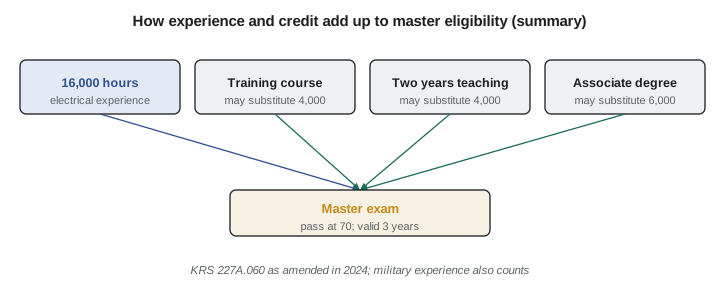
An applicant for the master electrician license must show at least 16,000 hours of experience in the electrical trade. At a full-time schedule of about 2,000 hours a year, that is roughly eight years of work. The statute counts experience gained from age 16 onward, so hours worked as a teenager helper on a family job before that age do not count. The electrician license, by comparison, requires 8,000 hours, roughly four years. A licensed electrician therefore usually needs about four more years of experience to reach master eligibility, unless training or education credit closes part of the gap.
The experience must be in electrical work of the kind the license covers: installing, altering and repairing electrical wiring and equipment. Time spent driving a delivery truck for an electrical supply house, selling fixtures, or doing general carpentry on a job site is not electrical experience, even if it happens around electricians. An applicant who did mixed work should count only the hours that were truly electrical and be ready to describe them.
Substitutions for part of the hours
KRS 227A.060 allows several kinds of training and education to stand in for part of the 16,000 hours. Successful completion of an approved electrical training course may substitute for 4,000 hours. Two years of teaching electrical courses at an accredited institution may also substitute for 4,000 hours. An associate degree in an electrical field may substitute for 6,000 hours. The statute also directs that relevant military experience be counted. These substitutions reduce the hours of field work needed, but they do not remove the need for real field experience.
The substitutions are not unlimited and do not simply stack without question. An applicant who completed a training course and also holds an associate degree should ask the department how the two will be combined, rather than assuming the full value of both. The application form asks for proof of each credit: a certificate of completion for the training course, a letter from the institution for teaching, or a transcript for the degree.
| Credit (KRS 227A.060, 2024) | Hours it may substitute | Typical proof |
|---|---|---|
| Approved electrical training course | 4,000 | Certificate of completion from the program |
| Two years teaching electrical courses | 4,000 | Letter from the accredited institution |
| Associate degree in an electrical field | 6,000 | Official transcript |
| Military electrical experience | Counted as experience | Service records describing the duties |
| Field experience in the trade | Hour for hour | Employer verification of hours |
Documenting the hours
Experience is shown with the department's forms and with verification from employers. Each employer for whom the applicant claims hours is asked to confirm the dates and the kind of work. For a long career that may mean tracking down several former employers. The department may ask for supporting records, such as payroll summaries or tax forms, when an employer has closed or a claim looks inconsistent. A self-employed applicant should expect to provide more support, such as permits pulled, invoices and tax records, because nobody else can vouch for the hours.
Rhonda Mattingly, Limestone Ridge's office manager, keeps a binder of hours for every employee because she has seen applications stall. "People remember years," she told Dana, "but the form wants dates and hours. And if you worked for someone who went out of business, you want copies of your old pay stubs." For Dana the paperwork was simple: one employer, Limestone Ridge, for the whole period, plus the certificate from her evening training program.
# Dana's master eligibility, counted the way the application asks (illustrative)
required = 16_000
field_years = {2017: 1_050, 2018: 2_080, 2019: 2_080, 2020: 1_950, 2021: 2_080,
               2022: 2_080, 2023: 2_080, 2024: 2_080, 2025: 2_080, 2026: 1_400}
field = sum(field_years.values())
training_credit = 4_000          # completed approved training course
total_with_credit = field + training_credit
print("Field hours:", field)
print("Meets 16,000 on field hours alone:", field >= required)
print("Field hours plus training credit:", total_with_credit)
print("Margin over requirement:", total_with_credit - required)Field hours: 18960 Meets 16,000 on field hours alone: True Field hours plus training credit: 22960 Margin over requirement: 6960
The calculation shows that Dana meets the requirement on field hours alone, so the training credit is a cushion rather than a necessity. That is a strong position. If the department questions any single year, for example the partial first year or the reduced 2020 hours, she still qualifies. Earl advised her to claim the training credit anyway and attach the certificate, because it costs nothing and protects her if a reviewer reads her hours differently.
Other conditions
Beyond hours, the applicant completes the department's application, pays the application fee and passes the master exam. KRS 227A.060 caps the application fee; the 2024 text allows the department to set it at up to 100 dollars, and the licensing regulation sets the license fee itself, which lesson 11 covers. The 2024 amendments also created a provisional license for limited situations. The details of who may hold one and for how long are set by the department, so a candidate who thinks it applies should ask directly.
The exam score has a shelf life. Under 815 KAR 35:060 a passing score is valid for three years, so an applicant who passes must complete licensing within that window. A candidate who passes the exam and then waits too long to finish the application, perhaps because of a move or a job change, may have to test again.
Reciprocity
Kentucky can license an electrician or master from another state through a reciprocity agreement with that state. Under 815 KAR 35:060 the applicant must hold the equivalent license in a state with which Kentucky has an agreement and supply a letter of good standing from that state's licensing authority. The list of agreements changes. Industry summaries have described agreements covering electrician and master licenses with West Virginia and Virginia and contractor agreements with Ohio and Louisiana, but those summaries are secondary sources, and candidates should confirm the current list with the department. Where no agreement exists, the applicant qualifies by experience and exam like anyone else.
Reciprocity runs both ways in practice. A Kentucky master who expects to work across the border in another state should check that state's rules, because an agreement may cover only some license types or require extra steps such as a jurisprudence exam.
Military, self-employed and out-of-state experience
Three kinds of history need special care. Military experience counts under the 2024 statute, but the application has to show what the work was. A service member who maintained generators, wired field facilities or worked on shipboard electrical systems should gather evaluations, training records and a description of duties from the unit or from service records, because a job title alone may not tell a civilian reviewer what was done. The department can count only what it can see.
Self-employed experience is the second. An electrician who worked for years as a sole proprietor, perhaps doing service calls under someone else's contractor license or in a jurisdiction that did not license at the time, has no employer to sign a verification. The answer is records: permits pulled, invoices, tax returns showing business income from electrical work, and letters from general contractors or customers. Hours should be estimated honestly and conservatively, and the applicant should be ready to explain how they were estimated.
Out-of-state experience is the third. Hours worked in another state count as experience if they were electrical work, but the employer there must verify them just as a Kentucky employer would. If the other state has a reciprocity agreement with Kentucky and the applicant already holds a license there, the reciprocity route may be faster than counting hours from scratch. If there is no agreement, the out-of-state hours still count toward the 16,000, and the applicant takes the Kentucky exam.
Planning backward to eligibility
Many candidates first think about the master license only when an employer needs one, as Limestone Ridge does. A better habit is to track hours from the first day on the job. An electrician who keeps a simple yearly log, with the employer, dates, approximate hours and kinds of work, will never need to reconstruct a decade of history from memory. Rhonda's binder does this for everyone at Limestone Ridge, but electricians who change employers should keep their own copy.
Planning backward also helps with timing. If a candidate expects to reach 16,000 hours in the middle of a busy season, the application can be prepared in advance and filed as soon as the hours are reached. Because a passing score lasts three years, there is no advantage in testing long before the license is needed, but there is also little risk in testing as soon as eligibility is reached, provided the application is completed promptly. Dana's case shows the other side of planning: with 18,960 field hours by the fall of 2026, she could have applied a year earlier. Earl's retirement date, not her eligibility, set her timetable.
Finally, planning means reading the current statute rather than relying on older advice. The 2024 amendments to KRS 227A.060 changed how the experience requirements are stated, and some older study guides and coworkers still describe earlier rules. When an experienced electrician says the requirement is a certain number of years, ask which version of the law that number came from.
Common eligibility problems
The first common problem is counting calendar time instead of hours. Someone who worked part time for two years has not earned two years of hours. The second is counting non-electrical work: site supervision of other trades, warehouse work or estimating without installation. The third is missing proof: an employer that has closed, a training program that no longer exists, or a degree from an institution whose records are hard to obtain. Each problem has a fix, but the fix takes time, so a candidate with any of these issues should start gathering proof months before the desired exam date.
A fourth problem is assuming that an electrician license automatically counts as a set number of master hours. The electrician license proves at least 8,000 hours were documented when it was issued, but the master application still asks for the full 16,000 hours. Hours worked after the electrician license count toward the master total like any other field hours.
Worked problem
Checking another candidate
Caleb, a licensed electrician at Limestone Ridge, wants to test alongside Dana. He has 10,500 field hours and an associate degree in electrical technology. Does he qualify, and what should he confirm?
Show solution
- Start with the requirement: 16,000 hours.
- Add the degree substitution: 10,500 plus 6,000 equals 16,500 hours.
- 16,500 exceeds 16,000, so on the statute's terms he qualifies.
- He should attach an official transcript and confirm with the department that his degree is in a qualifying electrical field.
Answer: With the 6,000-hour degree credit he reaches 16,500 hours and qualifies, subject to the department accepting the degree.
Common mistakes
MistakeCounting years on the job instead of documented hours.
InsteadThe application asks for hours; part-time and partial years count only the hours actually worked.
MistakeCounting all work done on a construction site.
InsteadOnly electrical work counts as experience.
MistakeAssuming every substitution adds its full value in every combination.
InsteadAsk the department how combined credits will be counted.
MistakePassing the exam and delaying the application for years.
InsteadA passing score is valid for three years under the regulation.
Summary and key terms
- The master license requires 16,000 hours of electrical experience; the electrician license requires 8,000.
- An approved training course or two years of teaching may substitute for 4,000 hours; an associate degree for 6,000.
- Experience is documented with employer verification and, when needed, supporting records.
- A passing exam score is valid for three years.
- Reciprocity requires an agreement with the other state and a letter of good standing.
- Field hours
- Hours of hands-on electrical work counted toward eligibility.
- Substitution
- Training or education the statute accepts in place of some field hours.
- Letter of good standing
- A statement from another state's licensing authority that a license is active and unblemished.
- Reciprocity
- Licensing based on an agreement between Kentucky and another state.
- Provisional license
- A limited license created by the 2024 amendments for particular situations.
Practice problems
Work each problem on paper first, then reveal the answer to check.
How many hours of experience does the master license require?
Show answer
16,000 hours.
How many hours may an associate degree in an electrical field substitute?
Show answer
6,000 hours.
How long is a passing exam score valid under 815 KAR 35:060?
Show answer
Three years.
Lesson quiz · 5 questions
Score 60% or more to complete this lesson.
Create a free account to save your progress, take quizzes and earn a certificate.