
MELU-217 · Lesson 11 of 12 · 18 min
Renewal and continuing education
▶ Video coming soon A video version of this lesson is on the way.
Earl keeps a paper calendar on the wall of the Limestone Ridge office, and every January Rhonda marks it with the same set of dates: Earl's license expiration at the end of his birth month, the company's contractor renewal, the insurance renewal, and a note in October reading "CE done?" When Dana asked about it, Earl laughed. "I let my license lapse once, in the nineties, because I was too busy to sit in a class. Two weeks of not being able to pull a permit taught me more than the class would have."
This lesson covers how Kentucky electrical licenses are renewed, how much continuing education is required and what counts, what happens when a license is renewed late or lapses, and how a master and a contractor can keep their renewal dates from becoming emergencies. The rules come from KRS 227A.100 and two regulations: 815 KAR 35:060 for license terms and fees, and 815 KAR 2:010 for continuing education.
The renewal cycle
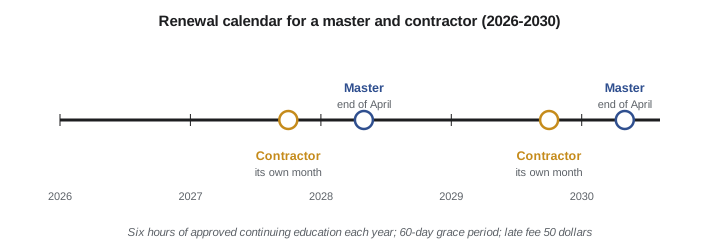
Kentucky electrical licenses are renewed every two years. Under 815 KAR 35:060 licenses expire on the last day of the licensee's birth month at the end of the term. A master whose birthday is in April renews by April 30 of each renewal year. The regulation sets the renewal fees for the two-year term: 200 dollars for a master electrician, 100 dollars for an electrician and 400 dollars for an electrical contractor. A renewal received after the expiration date carries a late fee of 50 dollars.
Because expiration is tied to the birth month, the renewal dates of a master and of the contractor to which the master is designated may fall in different months. A company should know both. For Limestone Ridge the contractor license, Earl's master license and, soon, Dana's master license each have their own dates, and Rhonda's calendar shows all three.
Continuing education
KRS 227A.100 requires continuing education for renewal: six hours each year for each license. The regulation that governs the courses, 815 KAR 2:010, sets the content. For master electricians and electricians the hours must be in courses on the electrical code or the electrical trade. For electrical contractors the hours are in business-related courses, reflecting the contractor's role. Safety courses count, but only up to two hours. Hours are counted in 50-minute class hours, so a six-hour requirement is six 50-minute units, not six 60-minute hours.
Courses must be approved and given by approved providers. The statute names organizations such as the National Electrical Contractors Association, Associated Builders and Contractors, the International Brotherhood of Electrical Workers, the Associated General Contractors, the International Association of Electrical Inspectors and the Independent Electrical Contractors Association, along with the department itself, and the department maintains the approval process. Courses from an unapproved provider, however good, do not count. Always check that a course is approved for Kentucky before paying for it.
The regulation also allows a limited carryover of extra hours into the next period, up to 12 hours in the version reviewed. A master who takes a long code update course in a year when the state adopts a new edition may be able to apply some hours later, but should confirm how the department will record them.
| License | Two-year fee (815 KAR 35:060) | Continuing education (KRS 227A.100, 815 KAR 2:010) |
|---|---|---|
| Master electrician | 200 dollars | 6 hours each year, code or trade courses; safety up to 2 hours |
| Electrician | 100 dollars | 6 hours each year, code or trade courses; safety up to 2 hours |
| Electrical contractor | 400 dollars | 6 hours each year, business-related courses |
| Any license renewed late | Plus 50 dollars late fee | Hours still required |
Late renewal, grace and reinstatement
KRS 227A.100 provides a 60-day grace period after expiration during which a license may be renewed, with the late fee. After the grace period, a license that has not been renewed may be reinstated within three years of expiration without retaking the exam, on conditions the department sets, which normally include the missed continuing education and fees. After three years the former licensee generally must qualify again, which may mean retaking the exam.
A grace period to renew is not permission to work. A license that has expired is not active, and a master should not assume that work done between expiration and late renewal is covered. If the expired license is the designee's, the contractor's ability to pull permits is also in question. Ask the department before doing any work on an expired license, and better still, renew before the expiration date.
# Building a master's renewal calendar (illustrative birth month and first term)
from datetime import date
import calendar

birth_month = 4                     # Dana's birthday is in April
first_expiration_year = 2028        # as shown on her first license (example)
ce_hours_per_year = 6

for year in range(first_expiration_year, first_expiration_year + 5, 2):
    last = calendar.monthrange(year, birth_month)[1]
    exp = date(year, birth_month, last)
print(f"Expires {exp} | CE needed this term: {ce_hours_per_year * 2} hours | remind on {date(year, birth_month - 2, 1)}")Expires 2028-04-30 | CE needed this term: 12 hours | remind on 2028-02-01 Expires 2030-04-30 | CE needed this term: 12 hours | remind on 2030-02-01 Expires 2032-04-30 | CE needed this term: 12 hours | remind on 2032-02-01
The calendar sets a reminder two months before each expiration, which is Limestone Ridge's rule for every license and insurance policy. Two months is enough time to finish missing hours, gather a current insurance certificate and send the renewal without paying the late fee.
Inactive status
The licensing regulation allows a license to be placed on inactive status. A licensee who is stepping away from the trade for a while, perhaps for health reasons or a different job, may prefer inactive status to letting the license lapse, because it keeps the license in the system and avoids requalifying later. The holder of an inactive license may not perform the work the license covers. Returning to active status requires meeting the department's conditions, which usually include current continuing education.
For Earl, inactive status may be the right step after retirement. He does not want to give up a license he has held for decades, and he may want to help Dana with an occasional inspection question or teach a class. Keeping the license inactive preserves that option without the cost and obligations of an active license. If he wants to keep doing any electrical work himself, he will need an active license and the continuing education that goes with it.
Planning continuing education well
Continuing education is most useful when it is planned around what is coming. In a year when the department adopts a new code edition or issues a significant memo, a code update course is the obvious choice. In a year when the company is moving into new work, such as solar or energy storage installations, a course on that subject builds skill and counts toward the requirement. Contractors can use their business hours on topics they actually need, such as contracts, lien law or estimating.
Keep the certificates. The provider usually reports attendance to the department, but mistakes happen, and a certificate in the license file settles any question. Rhonda scans each employee's certificates into a folder named for the license and year.
Tracking a whole company
A contractor with a dozen licensed electricians has a dozen renewal dates spread across the year, each tied to a birth month, plus the master's and the contractor's own. Each one matters to the company, because an electrician whose license has lapsed should not be leading a crew or supervising trainees. Rhonda keeps a single list with every license, its number, its expiration date, the hours completed this year and the date of the last reminder. Every month she sends a short note to anyone whose date is within three months and whose hours are not done.
Limestone Ridge also pays for approved courses and counts class time as paid time. Earl's view is that continuing education protects the company as much as the employee, and paying for it removes the excuse for putting it off. Approved providers commonly offer evening, weekend and online classes, which makes scheduling easier in the busy season. Before enrolling anyone in an online course, Rhonda checks that the online format is approved for Kentucky credit, because approval may differ between a provider's classroom and online versions of the same course, and she keeps the approval confirmation with the certificate.
When a new electrician is hired, Rhonda adds the license to the list on the first day, checks it against the department's license lookup, and asks for the employee's current continuing education certificates. She has twice found that a new hire's license had lapsed without the employee realizing it. In both cases the employee renewed before starting work.
Licenses in more than one state
Masters who work near state lines often hold licenses in neighboring states. Each state has its own renewal cycle, fees and continuing education rules, and course approvals do not automatically transfer. A course approved in Tennessee may or may not count in Kentucky. A master with several licenses should keep a separate list for each state and ask each provider which states have approved the course. Reciprocity agreements, discussed in lesson 2, usually require the license in the home state to remain active and in good standing, so a lapse in one state can affect another.
Why the hours matter
It is easy to treat continuing education as a box to check. The better view is that it is the one regular time a busy master steps back from jobs to learn what has changed. Between 2023 and 2026 Kentucky adopted a new NEC edition, delayed several sections and then made three of them enforceable, and the 2024 amendments changed how licensing eligibility is stated. A master who sat through good update courses heard about each of those changes before an inspector or a customer brought them up.
Changes to report between renewals
Renewal is not the only time the department needs to hear from a licensee. A change of address, a change of employer for a designee, a change of name, or any change in the contractor's insurance or designee should be reported when it happens. A department letter sent to an old address and never answered can turn a simple matter into a disciplinary one.
Dana's first term
When Dana's master license is issued, it will show its first expiration date, set under the regulation's birth-month rule. She will then need six hours of approved code or trade continuing education each year of her term to renew it, and as designee she will also watch the contractor's renewal and its business hours, which the company's officer completes. She plans to keep her electrician license history in the same file, because the experience it records may matter if she ever applies for reciprocity in another state.
Worked problem
Counting class hours
Caleb took an approved four-hour code update class (four 50-minute units), a two-hour approved safety class and a three-hour approved class on photovoltaic systems this year. How many hours count toward his six-hour requirement as an electrician, and is he done?
Show solution
- The code update class counts for 4 hours.
- The safety class counts, but safety is capped at 2 hours; it counts for 2.
- The photovoltaic class is a trade course and counts for 3 hours.
- Total is 9 hours; he exceeds 6, and some excess may carry over within the regulation's limit.
Answer: He has 9 countable hours and has met the 6-hour requirement.
Common mistakes
MistakeAssuming renewal is due on the original license anniversary date.
InsteadLicenses expire on the last day of the birth month at the end of the term.
MistakeCounting 60-minute hours.
InsteadContinuing education hours are 50-minute class hours.
MistakeTaking an unapproved course.
InsteadOnly approved courses from approved providers count.
MistakeWorking during the grace period as if the license were active.
InsteadAsk the department; renew before expiration.
Summary and key terms
- Kentucky electrical licenses renew every two years and expire on the last day of the birth month.
- Two-year fees: master 200 dollars, electrician 100 dollars, contractor 400 dollars; late fee 50 dollars.
- Six hours of approved continuing education are required each year, in 50-minute class hours.
- Masters and electricians take code or trade courses (safety up to 2 hours); contractors take business courses.
- There is a 60-day grace period to renew, and reinstatement without an exam is possible within three years.
- Renewal
- Keeping a license active for another two-year term.
- Continuing education
- Approved courses required for renewal.
- Class hour
- A 50-minute unit of instruction for continuing education.
- Grace period
- The 60-day period after expiration during which a license may still be renewed.
- Reinstatement
- Restoring an expired license within three years without retaking the exam.
Practice problems
Work each problem on paper first, then reveal the answer to check.
When does a Kentucky master license expire?
Show answer
On the last day of the holder's birth month at the end of the two-year term.
How many hours of continuing education are required each year?
Show answer
Six hours.
How long is a class hour for Kentucky continuing education?
Show answer
50 minutes.
Lesson quiz · 5 questions
Score 60% or more to complete this lesson.
Create a free account to save your progress, take quizzes and earn a certificate.