
MELU-217 · Lesson 6 of 12 · 18 min
Permits, inspections and the inspection authority
▶ Video coming soon A video version of this lesson is on the way.
Limestone Ridge had two new jobs on the board for September 2026: a dental office remodel inside Bowling Green and a 60 by 100 foot farm shop with a welder circuit and a small office on a farm outside Smiths Grove. Rhonda pulled up her county sheet before she touched either permit. "Two jobs, two different offices," she said. "The dental office goes to the city program. The farm shop goes wherever that county's electrical inspection is handled. If we file in the wrong place, nobody inspects anything and the customer waits."
This lesson explains how Kentucky divides inspection between local programs and the state, how to identify the authority for a job, how an electrical permit is filed, how inspections are requested and recorded, and what happens when an inspector finds a problem. The procedures come mainly from 815 KAR 35:020, the department's electrical inspection regulation, and KRS 198B.060, which allows local inspection programs.
Who inspects: local program or state
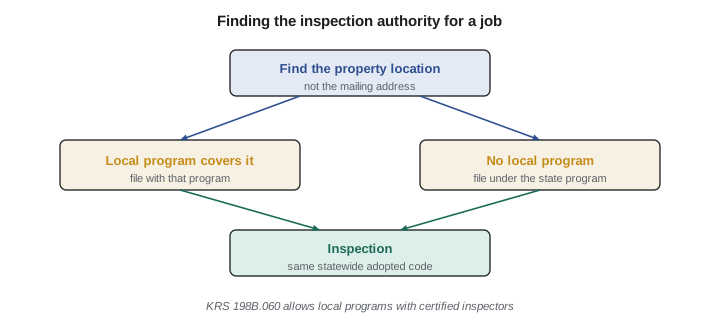
Under KRS 198B.060 a city, county, urban county government or consolidated local government may establish its own building inspection program, and that program may include electrical inspection by inspectors certified by the department. Where a local government runs an electrical inspection program, permits are filed with that program and its certified inspectors do the inspections. Where it does not, electrical inspection is handled at the state level by the department's inspectors or by certified electrical inspectors working under the department's program for that area.
Because both arrangements exist side by side, the authority can change at a city limit or a county line. A job on one side of a street may be inspected by a city program and a job on the other by the state's program. Mailing addresses mislead, because a rural route address may carry the name of a nearby city that has no authority over the property. The safest practice is to confirm the authority for each new job address with the department or the local building office.
Rhonda's county sheet records, for each county and city where Limestone Ridge works, who handles electrical inspection, where permits are filed, how inspections are requested and what the current fees are. She updates it whenever a permit is returned or an inspector mentions a change. Local programs sometimes begin or end, or merge with a neighboring county's program, and a sheet that was correct two years ago may not be correct today.
Filing the permit
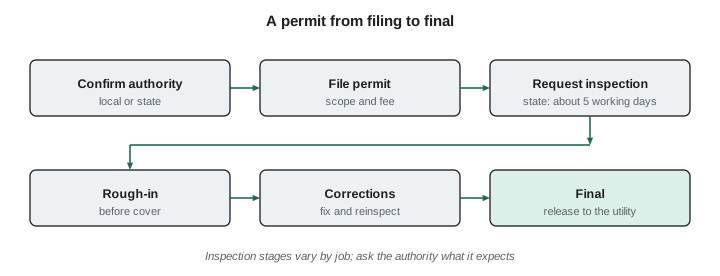
An electrical permit is required before most electrical work begins. Under the state program, the permit is filed on the department's electrical permit form, which 815 KAR 35:020 incorporates (form EL-13 in the version reviewed), with the inspection fee set by the regulation's fee schedule. Local programs use their own forms and fees, within the limits of state law. The permit identifies the job location, the owner, the electrical contractor and its license number, the scope of work, and the size of the service.
The regulation's fee schedule depends on the type of work and its size or value, with separate fees for items such as new services, temporary services and additional inspections. Because the schedule is detailed and changes, Limestone Ridge prices permit fees from the current schedule for each job rather than from a remembered figure. A permit filed with the wrong scope can lead to an extra fee or a re-filing, so the scope should be complete: a new 400-ampere farm service, branch circuits for the shop and office, and the welder outlet all belong on the farm shop permit.
The regulation also says who may obtain a permit. In general the licensed electrical contractor performing the work files it, which is why the contractor license number appears on the form. Limited exceptions, such as certain work by a homeowner on the homeowner's own dwelling, are set out in law and in local rules, and they come with conditions. A master should never pull a permit for work the company will not actually perform.
| Job | Authority (course example) | Permit filed with | Inspections expected |
|---|---|---|---|
| Dental office remodel, Bowling Green | Local program | City electrical inspection office | Rough-in, above-ceiling, final |
| Farm shop near Smiths Grove | State program for that area | Department, on the state permit form | Service, rough-in, final |
| Temporary service for a new house | Depends on location | The authority for that address | Temporary service inspection |
Requesting inspections
Inspections are requested by the contractor when work reaches a stage that must be seen before it is covered or energized. Typical stages are the service (and any temporary service), rough-in before walls or ceilings are closed, and final. Commercial jobs may add above-ceiling inspections before a suspended ceiling is closed, and agricultural jobs may need an inspection of underground feeders before trenches are backfilled. Under 815 KAR 35:020 the state program aims to make an inspection within five working days after a request, so schedules should allow for that window. Local programs set their own response times.
The inspector records the result at the site, commonly with a sticker or tag in a color the regulation describes, and in the program's records. An approval at rough-in lets the job proceed to cover. A rejection lists the items to correct. Once the final inspection passes, the inspector releases the service for connection, and the serving utility will not energize a new permanent service without that release.
# Counting five working days after an inspection request (weekends skipped; holidays not modeled)
from datetime import date, timedelta

def add_working_days(start, n):
    d = start
    while n > 0:
        d += timedelta(days=1)
        if d.weekday() < 5:
            n -= 1
    return d

requests = {"Farm shop rough-in": date(2026, 9, 17), "Farm shop final": date(2026, 10, 9)}
for stage, asked in requests.items():
print(f"{stage}: requested {asked} ({asked:%a}), expect by {add_working_days(asked, 5)}")Farm shop rough-in: requested 2026-09-17 (Thu), expect by 2026-09-24 Farm shop final: requested 2026-10-09 (Fri), expect by 2026-10-16
The farm shop rough-in request on Thursday, September 17, 2026 produces an expected inspection by the following Thursday. Limestone Ridge schedules the insulation and drywall crews no earlier than that date. The final request on Friday, October 9 produces an expected date of Friday, October 16, which is the earliest date the customer can expect the utility to connect the permanent service. A state holiday inside either window would push the date later, which the simple script does not model.
Preparing for an inspection
An inspection goes best when the inspector can see everything quickly. Before calling for rough-in, Dana walks the job with the lead and checks a short list: every box is accessible and properly supported, cables are secured and protected where required, grounding and bonding connections are made up, the panel is labeled in pencil at least, and nothing is hidden behind insulation or a ceiling. She also makes sure the permit card is posted where the inspector expects it and that someone who knows the job is on site or reachable by phone.
The farm shop shows why this matters. The underground feeder from the new service pole to the shop ran 180 feet across a field, and the trench needed to be inspected before backfill. Dana arranged for the trench to stay open and marked, with the conduit and burial depth visible along its length, and she scheduled the inspection request so the backfill crew would arrive after the inspection window. An inspector who arrives at a half-backfilled trench cannot approve what is buried, and the cost of digging it back up falls on the contractor.
Inspectors work across large areas, and a rural inspector may drive an hour between jobs. Respecting that time earns goodwill. A job that is not ready when the inspector arrives may be charged a reinspection fee and, more importantly, pushes the next inspection days later. When a job is not ready, cancel the request as early as the authority allows.
Temporary services and farm work
Temporary services for construction power are common on Limestone Ridge's new-house and farm jobs. They need their own inspection before the utility will connect them, and the inspector checks the same essentials as a permanent service: support, grounding, ground-fault protection for receptacles used by workers, and weather protection. A temporary service is often the first thing an inspector sees from a contractor on a new job, and a clean one sets the tone.
Agricultural buildings bring their own considerations under the adopted code, including the treatment of livestock areas, dust and moisture, and the equipotential planes required in some animal confinement areas. The inspection sequence is the same, but inspectors in farm counties tend to pay close attention to these items, and a master working in south-central Kentucky should know the agricultural articles of the code well.
Corrections and disagreements
When an inspector rejects work, the correction notice lists each item with a reference to the code or rule. The contractor corrects the items and requests a reinspection, which may carry a fee. Good practice is to correct everything on the list, take photographs, and confirm the correction to the inspector before asking for reinspection. Disputes are best handled with the code in hand: ask the inspector which section is relied on and explain your reading calmly. Most disagreements end at the job site.
If a disagreement cannot be resolved with the inspector, the contractor may raise it with the inspector's supervisor in the local program or with the department. Kentucky's building code statutes provide for appeals of code decisions, and the details depend on whether the decision came from a local program or the state. A master should know where the appeal goes before needing it, but should use it rarely; an inspector who sees the same contractor every week remembers how disputes were handled.
Health and other releases
Some jobs need releases from other authorities before the electrical work can be finished or the building occupied. A new house on a septic system may need a health department approval for the site before other permits are issued. A commercial occupancy needs a building final and, in many cases, a fire marshal's approval. These are not electrical inspections, but they can hold up the electrical final, so the master should know what other approvals the job needs and how they fit the schedule.
Records
Rhonda keeps a simple log for every open permit: the job, the authority, the permit number, the date each inspection was requested, the date it happened and the result. Once a week she checks the log for inspections that are overdue, permits that have sat with no activity, and finals that have not been called. An open permit that is forgotten can expire under the authority's rules, and a customer who sells the property years later may discover that the work was never finaled. Closing every permit is part of finishing a job.
Each job's file should hold the permit, the fee receipt, each inspection result and correction notice, photographs of work before it was covered, and the final release. These records protect the contractor when questions arise years later, such as when a house is sold and a buyer's inspector asks whether a service upgrade was permitted. They also support lien claims, which depend on proving when work was done, as lesson 9 explains.
Worked problem
Choosing where to file
Limestone Ridge is asked to add a 200-ampere service to a barn on a farm in Butler County. The customer's mailing address names a nearby city. How should Rhonda decide where to file?
Show solution
- The mailing address does not decide authority; the property location does.
- She should check whether a local government with an electrical inspection program covers the property.
- If one does, she files with that program; if not, she files under the state program for that area.
- She records the authority in the job file so the inspection requests go to the right place.
Answer: Find the authority for the property's location, not its mailing address, then file with that authority.
Common mistakes
MistakeFiling by mailing address.
InsteadConfirm the inspection authority for the job's actual location.
MistakeCovering work before the rough-in inspection.
InsteadRequest the inspection and wait for approval before closing walls or backfilling.
MistakeScheduling the next trade the day after an inspection request.
InsteadAllow for the inspection window, up to five working days under the state program.
MistakeArguing with an inspector without the code in hand.
InsteadAsk which section applies and discuss the text; appeal only when needed.
Summary and key terms
- Local governments may run electrical inspection programs under KRS 198B.060; the state program covers other areas.
- Confirm the inspection authority by the job's location, not its mailing address.
- State permits use the form and fee schedule in 815 KAR 35:020; local programs set their own.
- The state program aims to inspect within five working days of a request.
- Final approval releases the service to the utility; keep every inspection record.
- Inspection authority
- The local program or state program responsible for inspecting a job.
- Local program
- A local government's inspection program with department-certified inspectors.
- Rough-in inspection
- An inspection of wiring before it is covered.
- Correction notice
- A list of items an inspector found that must be fixed.
- Release
- The inspector's approval that allows the utility to connect a service.
Practice problems
Work each problem on paper first, then reveal the answer to check.
What statute allows Kentucky local governments to run inspection programs?
Show answer
KRS 198B.060.
Within how many working days does the state program aim to inspect after a request?
Show answer
Five working days.
What must happen before a utility connects a new permanent service?
Show answer
The final inspection must pass and the inspector must release the service.
Lesson quiz · 5 questions
Score 60% or more to complete this lesson.
Create a free account to save your progress, take quizzes and earn a certificate.