
MELU-217 · Lesson 4 of 12 · 18 min
The exam format and the references allowed
▶ Video coming soon A video version of this lesson is on the way.
A week after her approval arrived, Dana opened the candidate bulletin on the office computer and read it twice. Earl, who took his own master exam on paper in a church fellowship hall decades ago, read over her shoulder. "In my day you brought a suitcase of books," he said. "Read what they let you bring now, and practice with exactly that. The book is only useful if you can find things in it fast."
This lesson explains what is known about the Kentucky master electrician exam's format and allowed references, how to find the current details, and how to build a pacing plan. Kentucky has changed exam vendors more than once, and the department also accepts the national NASCLA exam, so this lesson teaches you to read a bulletin carefully as much as it teaches any single set of numbers.
What the exam covers
The master electrician exam tests whether a candidate can apply the National Electrical Code as adopted in Kentucky and solve the calculations a master is responsible for. Typical content areas include general wiring methods and materials, services and feeders, branch circuits, grounding and bonding, overcurrent protection, motors and controls, special occupancies, special equipment, hazardous locations, and calculations such as dwelling and commercial service loads, voltage drop, conductor ampacity adjustments, box and conduit fill, and motor circuit sizing. Theory questions on Ohm's law, power, and transformer and three-phase relationships also appear.
The contractor exam is a separate test on business and law: contracts, liens, insurance, employment and tax rules, safety law, licensing law and project management. A master who wants to be designated to a contractor need not be the person who passes the contractor exam, but in a small company like Limestone Ridge the same person often takes both. Dana planned to take only the master exam, because Earl's son-in-law, who manages the business side, had passed the contractor business and law exam years earlier. Lesson 8 explains how the contractor license fits together.
Format: what the bulletins have said
The department's 2020 candidate bulletin, issued with its testing vendor at the time, described the master electrician exam as 100 questions with a four-hour time limit and the contractor business and law exam as 40 questions in an hour and a half. It described both as open book with listed references, and it gave a passing score of 70 percent, matching the regulation. NASCLA's information on its national electrical contractor and master electrician exam, which Kentucky accepts as of 2025, describes a 100-question exam with a longer time limit and NASCLA's own passing standard. If you take the NASCLA exam, its bulletin controls.
Two consequences follow. First, you should never rely on a number heard from a coworker or an online forum; the format may have changed since that person tested. Second, you should practice to whichever format applies. A candidate who practices 100 questions in four hours is well prepared for a longer time limit, but not the other way around.
| Exam (source) | Questions | Time | Passing standard |
|---|---|---|---|
| Master electrician (2020 DHBC bulletin) | 100 | 4 hours | 70 percent |
| Contractor business and law (2020 DHBC bulletin) | 40 | 1.5 hours | 70 percent |
| NASCLA electrical contractor and master (NASCLA, 2025) | 100 | Longer than 4 hours | Set by NASCLA |
| Score validity (815 KAR 35:060) | - | - | Passing score valid 3 years |
The references
An open-book exam allows the candidate to bring specified references, and the bulletin lists them. The NEC in the adopted edition is the central reference. Bulletins have also listed references such as an electrical calculations text or a code handbook, and for the contractor exam a business and law reference. Only the listed editions are allowed, and the bulletin says so plainly. An older edition, even a well-loved one, may be refused at check-in.
The rules on marking are as important as the list. The 2020 bulletin allowed tabs only if they were permanently attached and allowed highlighting and underlining, but it did not allow removable notes, loose papers or handwritten notes in the margins. Testing staff inspect references at check-in, and a book that does not meet the rules is not admitted. Many candidates buy a fresh copy for the exam and tab it carefully, rather than bring a working copy full of notes.
Because the NEC is a copyrighted publication, this course does not reproduce its text or tables. You will need your own copy of the adopted edition to study and to bring to the exam. The skill this lesson teaches is not memorizing the code but finding the right article fast.
Pacing
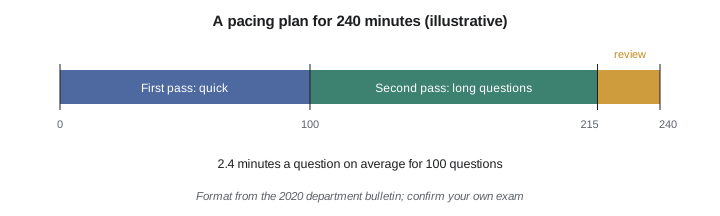
On a 100-question, four-hour exam the average time per question is 2.4 minutes. That average hides a wide spread. A question asking which article covers a particular type of installation may take thirty seconds for a candidate who knows the index. A dwelling service calculation may take eight minutes. A pacing plan prevents the long questions from consuming the time needed for the short ones.
The plan Dana used has three passes. On the first pass she answers every question she can answer quickly and marks the rest; she aims to finish the first pass in about 100 minutes. On the second pass she works the marked calculation and lookup questions. In the last 25 minutes she reviews marked questions, makes sure every question has an answer, and checks the arithmetic on any calculation she rushed. Because unanswered questions are scored as wrong, a reasoned guess is always better than a blank.
# Pacing for a 100-question, 240-minute exam (illustrative)
questions, minutes = 100, 240
first_pass, review = 100, 25
second_pass = minutes - first_pass - review
avg = minutes / questions
print(f"Average per question: {avg:.1f} min")
print(f"First pass: {first_pass} min, second pass: {second_pass} min, review: {review} min")
quick = 65                          # questions answered on the first pass
print(f"Time per question on the second pass: {second_pass / (questions - quick):.1f} min")Average per question: 2.4 min First pass: 100 min, second pass: 115 min, review: 25 min Time per question on the second pass: 3.3 min
The calculation shows why the first pass matters. If Dana answers 65 questions quickly, the remaining 35 get more than three minutes each on the second pass, which is enough for most calculations. If she answers only 40 on the first pass, the remaining 60 get less than two minutes each, and the hardest calculations become a gamble.
Tabbing and finding
Good tabs follow the structure of the code rather than a candidate's memory of favorite pages. A common approach is one tab per chapter, a second color for the most used articles (such as those on branch circuits, feeders, services, grounding and bonding, overcurrent protection, wiring methods, conductors, motors and hazardous locations), and a third color for the tables used in calculations. The index deserves its own tab, because many questions are fastest to answer by looking up a keyword.
Practice must use the same book with the same tabs. A candidate who studies from a digital copy and tests with a paper copy has practiced a different skill. Dana tabbed her exam copy in August and used it for every practice session after that, so that by late October her hands knew where the tables were.
Reading questions carefully
Exam questions are short, and a single word changes the answer. Read for the occupancy (dwelling, commercial, industrial), the condition (wet location, damp location, hazardous classification), the conductor material and insulation, the ambient temperature, and whether the question asks for a minimum, a maximum or a standard size. Many wrong answers are correct answers to a slightly different question. On calculation questions, note what the answer choices look like before starting; if every choice is a standard conductor size, the final step is choosing a size, not reporting a raw number.
State law questions on the master exam, if any appear in your version, tend to ask for exact figures: hours of experience, the passing score, the validity of a score, renewal periods and continuing education. The contractor exam asks more of these. Lessons 2, 3, 8, 9 and 11 give the figures, and the end-of-course exam tests them.
Calculators, scratch paper and the screen
Bulletins usually allow a silent, non-programmable calculator and forbid calculators that store text or connect to anything. Some vendors provide an on-screen calculator instead. Whichever applies, practice with the same kind. A candidate who has done every practice calculation on a phone will be slower on an unfamiliar desk calculator, and minutes lost to finding the square root key add up over a long exam.
Scratch paper or an erasable board is normally provided and collected at the end. Use it in a consistent way: write the question number at the top of each calculation, so that when you return on the second pass you can find your partial work. For a service calculation, write each step on its own line with its result, which makes it easy to check when a result does not match any of the answer choices.
Computer-based exams also have their own habits. Learn how the testing software marks a question for review, how it shows unanswered questions, and how much time is left. Most vendors offer a short tutorial before the timed exam begins; use it rather than skipping it, because it does not count against the exam time.
A practice session at Limestone Ridge
Dana's weekly practice session in September followed the same pattern every Thursday evening. She set a timer for 60 minutes and worked 25 questions from a practice book with her tabbed exam copy, no phone and the calculator she planned to use. When the timer ended she scored the set and wrote each miss in her log with its cause: could not find it, misread the question, arithmetic error, or did not know the rule. Then she spent 30 minutes fixing the causes, adding a tab where a lookup had been slow and reworking every calculation she had missed.
After four weeks the pattern in her log was clear. Lookups were improving quickly, but she was still missing calculation questions where the conditions of use changed the answer, such as ambient temperature corrections and the number of current-carrying conductors in a raceway. She shifted two of her weekly study hours to those adjustments. That is the purpose of practice: not to rehearse what you already know, but to find out what you do not.
Earl added a habit of his own. Once a week he asked her one question out loud at the end of the workday, about something on that day's job, and she had to find the governing article in under two minutes. It made the code feel like a working tool rather than an exam subject, which is how a master should use it.
Before test day
In the last two weeks, take at least two full timed practice exams under test conditions: the same book, the same calculator type if the bulletin specifies one, no phone, and a strict time limit. Score them, sort the misses by cause, and fix the causes. Lesson 12 describes a miss log that works well for this. Then rest the day before the exam. The exam rewards a calm reader with a well-tabbed book more than a tired one who stayed up memorizing tables.
Worked problem
Pacing a slow start
Halfway through the first hour of her practice exam, Dana has answered 15 questions and marked 10. Is she on pace for a 100-minute first pass, and what should she change?
Show solution
- Thirty minutes into a 100-minute first pass, she has covered 25 questions.
- At that rate she covers about 83 questions in 100 minutes, short of 100.
- She should skip faster: mark any question that needs more than a short lookup and move on.
- The marked questions will get their time on the second pass.
Answer: She is slightly behind; she should mark long questions sooner so the first pass reaches every question.
Common mistakes
MistakeRelying on a coworker's description of the exam format.
InsteadRead the current bulletin; formats and vendors change.
MistakeBringing a reference with removable notes or handwriting.
InsteadFollow the bulletin's marking rules; nonconforming books are refused.
MistakeLeaving questions blank.
InsteadUnanswered questions count as wrong; always answer.
MistakeStudying from one copy of the code and testing with another.
InsteadPractice with the exact book and tabs you will bring.
Summary and key terms
- The master exam tests the adopted NEC and electrical calculations; the contractor exam tests business and law.
- The 2020 DHBC bulletin described 100 master questions in four hours, open book, with a 70 percent pass mark.
- Kentucky also accepts the NASCLA electrical contractor and master exam, which has its own bulletin.
- Only the listed references are allowed, marked only as the bulletin permits.
- A three-pass pacing plan protects time for long calculations.
- Candidate bulletin
- The vendor's document listing exam content, format, references and rules.
- Open book
- An exam that allows specified references in the testing room.
- Permanent tab
- A tab attached so it cannot be removed, as some bulletins require.
- First pass
- A quick run through the exam answering easy questions and marking the rest.
- NASCLA
- The National Association of State Contractors Licensing Agencies, which offers a national exam.
Practice problems
Work each problem on paper first, then reveal the answer to check.
What is the average time per question on a 100-question, four-hour exam?
Show answer
2.4 minutes.
Which document controls the references you may bring?
Show answer
The candidate bulletin in effect when you test.
Why answer every question?
Show answer
Unanswered questions are scored as wrong, so a reasoned guess can only help.
Lesson quiz · 5 questions
Score 60% or more to complete this lesson.
Create a free account to save your progress, take quizzes and earn a certificate.