
MELU-217 · Lesson 7 of 12 · 18 min
Duties and responsibilities of the Master Electrician License holder
▶ Video coming soon A video version of this lesson is on the way.
On a rainy afternoon in early October 2026, Earl took Dana to the dental office remodel and walked her through it as if she were already the company's designated master. He opened the panel cover, read the directory, looked above two ceiling tiles and checked the permit card on the wall. Then he asked the crew lead, Caleb, who on the crew was licensed and who was still working toward a license. "When the license is yours," Earl told Dana, "these are your questions. You won't be on every job, but every job is on you."
This lesson explains what a Kentucky master electrician is responsible for once licensed, and what changes when that master is designated to an electrical contractor. Some duties come from the statute and regulations; others are the practical habits that keep a master and a company out of trouble. The exam tests the first kind. A career depends on both.
Duties of any licensee
Every Kentucky electrical licensee, electrician or master, must do electrical work in compliance with the adopted code and the licensing law. That means installing to the code as adopted and enforced, working only within the scope of the license held, keeping the license active and renewed, completing the required continuing education, and notifying the department of changes such as a new address. Electrical work requires a permit and inspection where the law calls for them, and a licensee who knowingly skips them puts the license at risk.
Licensing laws such as KRS 227A list grounds on which the department may refuse, suspend or revoke a license or impose other discipline. Grounds of this kind typically include obtaining a license by fraud, violating the code or the licensing law, gross negligence or incompetence, and helping unlicensed persons evade the law. A master should read the current list in the statute once a year. Discipline follows the licensee, and a master's discipline can affect the contractor to which the master is designated.
The designated master
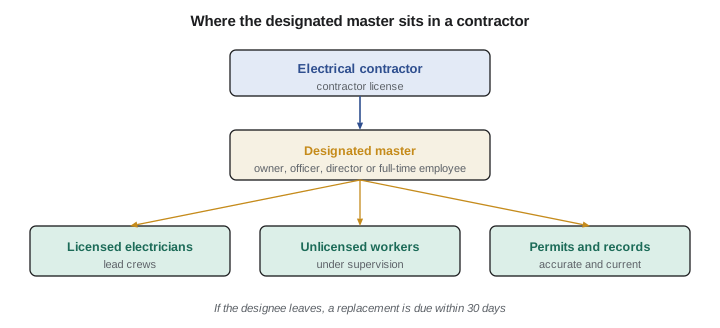
When a master is designated to an electrical contractor license, the master's license becomes the basis on which the department allows the business to offer electrical work. Under 815 KAR 35:060 the designee must be an owner, officer, director or full-time employee of the contractor. A master who is none of these, such as a retired master who rents his license to a business he does not work for, cannot properly be designated. The point of the rule is that the master must be genuinely part of the business, in a position to see and control its electrical work.
A master's daily responsibilities as designee are the practical side of that rule. The master sees that permits are pulled for the company's jobs, that inspections are requested and passed, that crews are properly licensed and supervised, that the company's work meets the code, and that the company's records are accurate. In a small company like Limestone Ridge the designee is also the person inspectors and the department call when there is a question about a job.
| Event | What the rule requires (815 KAR 35:060, summary) | Practical step |
|---|---|---|
| Designee leaves the company | Designate a replacement master within 30 days | Plan the succession before the departure |
| Death of the license holder the business depends on | Notify the department within 10 days; an interim period of up to 180 days may apply | Keep the department's contact and the contractor file current |
| Change of address or business details | Notify the department | Update when it happens, not at renewal |
| Designee's license lapses | The contractor no longer has an active designee | Track renewal and continuing education dates for the designee |
When a designee leaves
A designee may retire, change jobs, become ill or simply decide to stop. Under 815 KAR 35:060 the contractor must designate a replacement master within 30 days after the designee leaves. Thirty days is not long if the company has no other master on staff, and it is not enough time to train and license a new one. That is why Limestone Ridge started Dana's licensing a full season before Earl's planned retirement. Companies with one master should have a written succession plan.
The regulation also addresses the death of a licensee on whom a business depends. In that case the department must be notified within ten days, and the regulation allows an interim period of up to 180 days for the business to complete pending work and arrange a replacement under conditions the department sets. A family business should know this rule, because the people who must act on it are often grieving relatives with no electrical background.
Supervision of unlicensed workers
Most electrical crews include people who are not yet licensed: helpers, apprentices and trainees building the hours they will one day claim on their own applications. Kentucky's law allows unlicensed workers to do electrical work under the supervision of licensed electricians, and it holds the licensed people responsible for that work. The statute and regulations set the details, including any limit on how many unlicensed workers one licensed electrician may supervise. Because those details have changed with recent amendments, this course does not give a number; check the current rule.
Good supervision is more than a ratio. A licensed electrician who is two jobs away does not supervise anyone. The master's job is to see that each crew has a licensed electrician present and engaged in the work, that trainees are given tasks they can do safely, and that their work is checked before it is covered. It is also to keep accurate hours for each trainee, because those hours will become their future applications.
# Checking crew assignments against a supervision limit (the limit is a placeholder, not Kentucky's rule)
SUPERVISION_LIMIT = 2   # replace with the current figure from KRS 227A / 815 KAR 35

crews = {
    "Dental office": {"licensed": ["Caleb"], "unlicensed": ["Jesse", "Marisol"]},
    "Farm shop": {"licensed": ["Dana"], "unlicensed": ["Trey", "Owen", "Wes"]},
    "Service call": {"licensed": [], "unlicensed": ["Jesse"]},
}
for job, c in crews.items():
    lic, unl = len(c["licensed"]), len(c["unlicensed"])
    ok = lic > 0 and unl <= lic * SUPERVISION_LIMIT
print(f"{job:14s} licensed={lic} unlicensed={unl} -> {'OK' if ok else 'FIX'}")Dental office licensed=1 unlicensed=2 -> OK Farm shop licensed=1 unlicensed=3 -> FIX Service call licensed=0 unlicensed=1 -> FIX
The script flags two problems, whatever limit applies. The service call sends an unlicensed worker alone, which no supervision rule allows. The farm shop has more trainees than the placeholder limit for one licensed electrician. Rhonda runs a similar check every Monday when she prints the week's assignments, using the current rule, and Dana fixes any crew that fails before the trucks leave.
Permits and inspections
A designated master answers for whether the company's jobs were permitted and inspected. That includes the small ones: a replacement panel in a house, a new circuit for a hot tub, a meter base swap after a storm. Unpermitted small jobs are the most common way contractors get into trouble, because they seem too minor to bother with and they are often done by the crew without the office knowing. Limestone Ridge's rule is simple: no job goes on the schedule without a permit number or a written note from Dana explaining why none is required.
The master also sees that corrections are made properly. A correction notice is a record that something was wrong, and an inspector who sees repeated corrections of the same kind from the same company will look harder at its work. Dana reviews every correction notice at the Monday meeting and asks whether it reveals a training need.
Records and honesty
The master's name and license number appear on permits, applications and insurance documents. Each one should be accurate. A permit that understates the scope to save a fee, an experience verification that inflates a former employee's hours, or a certificate of insurance that shows coverage the company no longer has can all lead to discipline. When Earl signs an experience verification for a departing employee, he signs only what Rhonda's binder supports, even when the employee was a friend.
Training the next generation
A master is also a teacher, whether or not the title says so. The trainees on a crew learn their habits from the licensed electricians around them, and those habits become the company's reputation. Earl's practice was to give every trainee one task a week that stretched them, such as making up a panel or laying out a small service, and to check it with them before the inspector saw it. Dana plans to keep that practice and to add a short monthly session on code changes for the whole crew.
Training also has a paperwork side. Trainees who are building toward their own electrician license need accurate records of their hours and the kinds of work they did. When a trainee leaves, the master signs an experience verification that the department will rely on. Keeping the records current as the work happens is far easier, and far more accurate, than reconstructing them years later.
Working with inspectors and the department
A designated master is the company's face to the inspection authorities. Inspectors remember contractors who are ready when they arrive, who correct items promptly, and who argue only when they have a reason. They also remember contractors who cover work before inspection or who call for a final on a job that is clearly not finished. Over years, that reputation affects how smoothly every job goes.
The department sees the master from a different angle: applications, renewals, designations and complaints. A master who answers department letters promptly, keeps the contractor file current and renews early rarely hears from the department at all. Complaints from customers do reach the department, and a master who has kept good records and permits can usually answer one quickly.
Protecting the license
The simplest risks to a master's license are administrative: a renewal missed, continuing education not completed, an address change not reported so that a department letter goes unanswered. Each is easy to prevent with a calendar. Dana put her license expiration date, her continuing education deadline and Limestone Ridge's contractor renewal and insurance renewal dates on the company calendar with reminders two months ahead. Lesson 11 covers the renewal rules in detail.
Knowing the limits of the license
A master electrician license does not cover everything electrical. Some work, such as certain fire alarm, low-voltage, elevator or utility work, may be regulated separately or exempt from the electrical licensing law, and other credentials may be required. A master who is asked to take on unfamiliar work should check whether it falls within the license and whether additional permits or credentials apply before bidding.
Worked problem
A designee who is not really there
A company owner in another county offers Dana 500 dollars a month to be designated to his contractor license. She would keep working full time for Limestone Ridge and would never visit his jobs. What is wrong with this arrangement?
Show solution
- The designee must be an owner, officer, director or full-time employee of the contractor.
- Dana would be none of these for the other company; she is a full-time employee of Limestone Ridge.
- She would also have no way to see or control that company's electrical work.
- The arrangement would put her license, and Limestone Ridge's, at risk.
Answer: She cannot properly be designated; she is not an owner, officer, director or full-time employee of that company, and she would have no control over its work.
Common mistakes
MistakeTreating the designation as a paperwork formality.
InsteadThe designee must be part of the business and answers for its electrical work.
MistakeWaiting until the designee leaves to plan a replacement.
InsteadPlan succession early; the regulation allows only 30 days.
MistakeSending an unlicensed worker alone to a service call.
InsteadUnlicensed workers must work under the supervision of a licensed electrician.
MistakeSkipping permits on small jobs.
InsteadSmall jobs need permits where the law requires them, just like large ones.
Summary and key terms
- Every licensee must work to the adopted code, within the license, and keep the license active.
- A designated master must be an owner, officer, director or full-time employee of the contractor.
- If the designee leaves, the contractor must designate a replacement within 30 days.
- On the death of a licensee the business depends on, notify the department within 10 days; an interim period of up to 180 days may apply.
- Unlicensed workers need supervision by licensed electricians; check the current rule for any ratio.
- Designee
- The master electrician designated to a contractor license.
- Succession plan
- A plan for replacing a designee before the need arises.
- Supervision
- A licensed electrician present and responsible for an unlicensed worker's electrical work.
- Discipline
- Action by the department against a license, such as suspension or revocation.
- Interim period
- The time the regulation may allow a business to continue after a licensee's death.
Practice problems
Work each problem on paper first, then reveal the answer to check.
Who may be a contractor's designated master?
Show answer
A master electrician who is an owner, officer, director or full-time employee of the contractor.
How long does a contractor have to replace a designee who leaves?
Show answer
30 days.
Within how many days must the department be notified of the death of a licensee the business depends on?
Show answer
10 days.
Lesson quiz · 5 questions
Score 60% or more to complete this lesson.
Create a free account to save your progress, take quizzes and earn a certificate.