
MELU-217 · Lesson 12 of 12 · 23 min
Practice exam review and test-day strategy
▶ Video coming soon A video version of this lesson is on the way.
Twelve days before her exam, Dana sat at the Limestone Ridge break table on a Saturday morning with her tabbed copy of the 2023 NEC, a calculator, a timer and a 100-question practice exam. Earl had agreed to proctor. He took her phone, set the timer for four hours, and went back to his paperwork. When the timer went off she had answered every question and scored 78. "Good," he said. "Now let's find out why you missed the other 22."
This last lesson pulls the course together into a study plan, a review of the Kentucky facts most likely to be tested, a method for learning from practice exams, and a test-day routine. It assumes the technical content of the core master electrician courses and the Kentucky content of lessons 1 to 11.
A twelve-week plan
Dana's plan ran twelve weeks, from her application in early August to her exam on October 29, 2026. It had five phases. In the first two weeks she learned the layout of the 2023 NEC and tabbed her exam copy. From week 3 to week 7 she worked through the content areas, one or two a week, with untimed practice questions. Week 8 was Kentucky law: the licensing statute and regulations, the inspection rules, liens, safety and renewal. Weeks 9 to 11 were timed practice, one full or half exam each week plus targeted review. Week 12 was light review and rest.
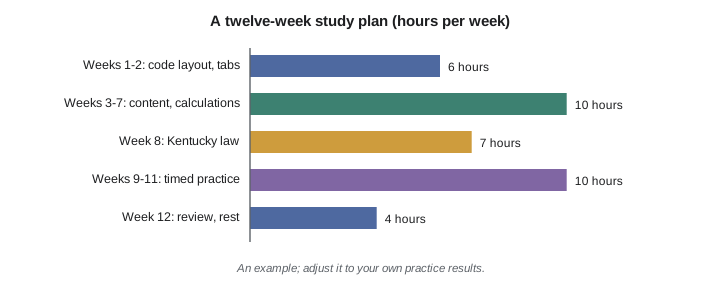
| Weeks | Focus | Output |
|---|---|---|
| 1 to 2 | Layout of the 2023 NEC, index and tabs | A tabbed exam copy and an index habit |
| 3 to 7 | Content areas and calculations | Untimed practice sets with a miss log |
| 8 | Kentucky law and rules | A one-page sheet of Kentucky figures |
| 9 to 11 | Timed practice exams | Scores, miss causes and targeted fixes |
| 12 | Light review and rest | A calm test day |
The hours matter less than the consistency. Dana studied four evenings a week for about two hours and once on the weekend. Electricians who work long days in the busy season often do better with shorter, regular sessions than with long weekend sessions they skip when a job runs late.
Technical review: the calculations that keep coming back
Certain calculations appear on nearly every master exam: dwelling and commercial service and feeder loads, conductor ampacity with temperature and bundling adjustments, voltage drop, motor branch circuit and feeder sizing, transformer currents and overcurrent protection, box and raceway fill, and three-phase power relationships. These are taught in the core courses. In the last weeks, the goal is speed and accuracy, which come from working many short problems with the tabbed book open.
# Quick practice: three-phase current and voltage drop (illustrative values)
import math
kva, volts = 75, 208
i_line = kva * 1000 / (math.sqrt(3) * volts)
print(f"75 kVA at 208 V, three-phase: {i_line:.1f} A")

# single-phase voltage drop with an assumed conductor constant K (ohm-cmil/ft)
K, amps, length, cmil = 12.9, 40, 150, 16_510
vd = 2 * K * amps * length / cmil
print(f"Voltage drop: {vd:.1f} V = {100 * vd / 240:.1f} percent of 240 V")75 kVA at 208 V, three-phase: 208.2 A Voltage drop: 9.4 V = 3.9 percent of 240 V
Neither calculation needs a code table beyond what a candidate looks up in the tabbed book, and both have answer choices that are close together. Writing each step on its own line, as the code example does, is the habit that catches slips before they become wrong answers.
Kentucky review
The Kentucky questions are the cheapest points on the exam, because they test fixed facts rather than long calculations. A candidate who knows the figures in this course can answer them in seconds and bank time for the calculations. Dana made a one-page sheet of Kentucky facts in week 8 and read it every morning for the rest of her plan.
| Topic | Source | Kentucky points from this course |
|---|---|---|
| Agency | KRS 227A, 198B | DHBC licenses and runs state inspection; local programs may inspect under KRS 198B.060 |
| Eligibility | KRS 227A.060 | Master 16,000 hours; electrician 8,000; training course or two years teaching 4,000; associate degree 6,000 |
| Exam | 815 KAR 35:060 | Pass at 70; score valid 3 years; hearing request within 10 business days of a denial |
| Code | DHBC announcements | 2023 NEC from Jan. 1, 2025; 210.52(C), 230.67, 314.27(C) enforceable July 15, 2026; 210.8(A) still delayed |
| Inspection | 815 KAR 35:020 | State program aims to inspect within 5 working days of a request |
| Contractor | KRS 227A.060, 815 KAR 35:060 | GL at least 1,000,000 dollars; department as certificate holder; designee replaced within 30 days |
| Liens | KRS 376 | Owner notice generally 120 days (75 in some cases); statement within 6 months; copy in 7 days; suit within 12 months |
| Safety and comp | Kentucky OSH; workers' claims | Hospitalization: 3 or more in 8 hours, fewer in 72; insurer told within 3 working days |
| Renewal | KRS 227A.100, 815 KAR 2:010 | Every 2 years, birth month; 6 hours a year; safety up to 2; 50-minute hours |
Worked practice questions
Worked problem
Eligibility
An applicant has 11,500 field hours and completed an approved electrical training course. Is the applicant eligible for the master exam?
Show solution
- The requirement is 16,000 hours.
- The training course may substitute for 4,000 hours.
- 11,500 plus 4,000 is 15,500 hours.
- 15,500 is less than 16,000, so the applicant needs 500 more hours or another qualifying credit.
Answer: Not yet; the applicant is 500 hours short.
Worked problem
Code status
A question asks whether, on a dwelling permitted in October 2026 in Kentucky, the service must include surge protection under 230.67.
Show solution
- 230.67 is part of the adopted 2023 NEC.
- It was delayed but became enforceable on July 15, 2026.
- The permit date is after that date.
- So the requirement applies.
Answer: Yes; 230.67 is enforced for that job.
Worked problem
Lien deadline
A supplier who sold to a subcontractor last delivered materials on March 10, 2026 and has not been paid. Ignoring the shorter period that applies in some cases, by when should its notice of intent go to the owner, and by when must the lien statement be filed?
Show solution
- The supplier did not contract with the owner, so notice of intent is needed.
- 120 days after March 10, 2026 is July 8, 2026.
- The lien statement is due within six months after last furnishing: by September 10, 2026.
- A copy goes to the owner within seven days after filing.
Answer: Owner notice by July 8, 2026; lien statement by September 10, 2026.
Worked problem
Reading the ask
A question asks for the minimum general liability insurance for a Kentucky electrical contractor license, and the choices are 500,000, 1,000,000, 2,000,000 and 300,000 dollars. A candidate who knows that many general contractors require 2,000,000 dollars picks that. Why is that wrong?
Show solution
- The question asks for the license minimum, not what customers commonly require.
- The statute sets the minimum at 1,000,000 dollars.
- Contract requirements are a different question.
- Read the exact ask before applying experience.
Answer: The answer is 1,000,000 dollars, the statutory minimum.
Reviewing a practice session
A practice exam is worth as much as the review that follows it. After each timed session Dana wrote every miss in her log with one of four causes, and then fixed the cause rather than memorizing the answer.
| Cause of miss | What it looks like | Fix |
|---|---|---|
| Could not find it | Knew the topic existed but ran out of time looking | Add or move a tab; practice index lookups |
| Misread the question | Answered a different question, such as maximum instead of minimum | Underline the ask on the scratch sheet before solving |
| Arithmetic or setup error | Right method, wrong number | Write each step on its own line; check units |
| Did not know the rule | No idea where to start | Study the topic and work five more questions on it |
# Practice session tracker (Dana's scores; causes of her misses)
sessions = [("Sep 26", 71), ("Oct 3", 74), ("Oct 10", 76), ("Oct 17", 78)]
causes = {"Could not find it": 7, "Misread the question": 6, "Arithmetic or setup": 4, "Did not know the rule": 5}
for d, score in sessions:
    print(f"{d}: {score}  {'#' * (score // 5)}")
worst = max(causes, key=causes.get)
print("Most common cause in the last session:", worst, causes[worst])
print("Margin over the 70 pass mark:", sessions[-1][1] - 70)Sep 26: 71 ############## Oct 3: 74 ############## Oct 10: 76 ############### Oct 17: 78 ############### Most common cause in the last session: Could not find it 7 Margin over the 70 pass mark: 8
Dana's scores rose steadily, and her last score left an eight-point margin over the pass mark, which is comfortable but not large. The tracker showed that lookups, not knowledge, were still her biggest cause of misses, so her final week went to index practice and two new tabs rather than to more content.
Practice exams have limits worth knowing. Commercial practice books vary in quality, and a few contain questions written to an older code edition or answers that no longer match the adopted text. When a practice answer disagrees with the book, Dana checked the code itself and trusted it, noting the question in her log as a bad item rather than a miss. Working out why a practice answer is wrong is good study in its own right, because it forces a careful reading of the rule.
The week before
In the last week, stop adding new material. Take one last half-length timed practice early in the week, review the miss log, and read the Kentucky sheet daily. Check that the book meets the bulletin's rules: allowed edition, permanent tabs only, no loose notes or handwriting. Confirm the test center address, the check-in time and the identification required, and make sure the name on the identification matches the name on the approval exactly. Plan the drive, allowing extra time for weather; late October mornings in south-central Kentucky can bring thick fog in the river valleys and slow traffic on the back roads.
Exam day
Eat a normal breakfast, arrive early and check in calmly. Use the software tutorial if one is offered. Then follow the pacing plan from lesson 4: a quick first pass answering what you can and marking the rest, a second pass on the marked calculations and lookups, and a final review that leaves no question blank. Glance at the clock at set points rather than constantly. If a question is taking far longer than it should, mark it, guess, and come back later; a single question is worth exactly as much as any other.
Stay with the book. Under time pressure, candidates start answering from memory to save time, and memory is where misreadings and outdated rules hide. The book is open for a reason. On Kentucky questions, trust the facts you studied, and do not overthink a question that asks for a simple figure.
After the exam
Dana passed on October 29, 2026 with a score in the low eighties. Her next steps followed the course: pay the 200-dollar master license fee, receive the license with its first expiration date, put that date and her continuing education on the company calendar, and work with Earl and the company's officer on the change of designee for the spring of 2027. A candidate who does not pass should take the score report's breakdown by content area, rebuild the plan around the weakest areas and the miss log, and book the retake as the rules allow. Many good masters passed on their second attempt.
Earl's last advice to Dana was not about the exam. "The license makes you responsible," he said. "The work makes you good. Keep learning both."
Common mistakes
MistakeTaking practice exams without reviewing the misses.
InsteadSort every miss by cause and fix the cause.
MistakeAdding new material in the last week.
InsteadReview, practice lookups and rest instead.
MistakeAnswering from memory under time pressure.
InsteadConfirm in the book, especially for figures and exceptions.
MistakeLeaving questions blank.
InsteadAnswer every question; mark and return if needed.
Summary and key terms
- Plan the study in phases: layout and tabs, content, Kentucky law, timed practice and rest.
- Kentucky facts are quick points; learn them from a one-page sheet.
- Review every practice session by cause of miss, and fix lookups, reading, arithmetic or knowledge.
- On exam day, follow a pacing plan and leave nothing blank.
- After passing, pay the license fee, calendar renewal and continuing education, and arrange designation.
- Miss log
- A record of every missed practice question and its cause.
- Kentucky sheet
- A one-page summary of the state figures most likely to be tested.
- First pass
- A quick run through the exam answering easy questions first.
- Margin
- The difference between a practice score and the pass mark.
- Score report
- The exam result, often broken down by content area.
Practice problems
Work each problem on paper first, then reveal the answer to check.
What should you do after each timed practice session?
Show answer
Sort each miss by cause and fix the cause.
What is the passing score on the Kentucky master exam under the regulation?
Show answer
70.
What should you avoid in the final week?
Show answer
Adding new material; review, practice lookups and rest instead.
Lesson quiz · 5 questions
Score 60% or more to complete this lesson.
Create a free account to save your progress, take quizzes and earn a certificate.