
MELU-214 · Lesson 9 of 12 · 20 min
Contracts and mechanics' liens in Indiana
▶ Video coming soon A video version of this lesson is on the way.
Electrical work is sold by contract and, when things go wrong, collected by lien. A master who will help run a company needs to understand both. This lesson covers what a good electrical contract says, the extra care needed on home improvement work, and Indiana's mechanic's lien statute, IC 32-28-3: who may claim a lien, the notices required on some homes, the deadlines for recording and for suing, the owner's demand that shortens the clock, and the rule on no-lien clauses. The Mass Ave coffee shop buildout, where the general contractor is paying slowly, is the running example.
This lesson explains the law in general terms so that a license holder can recognize deadlines and act in time. It is not legal advice. When a real claim is at stake, read the statute as it stands and talk to a lawyer, because the details decide whether a lien is valid.
Contracts: what a good one says
A construction contract defines the job and allocates its risks. A good electrical contract identifies the parties and the property, describes the scope of work clearly, often by reference to drawings and a list of exclusions, states the price and how it is paid, sets the schedule, explains how changes are priced and approved, and says what happens if either side does not perform. It says who obtains permits, who pays for utility charges and what warranty the contractor gives.
Fall Creek's work comes in three contract forms. On residential jobs such as the Irvington bungalow, the company contracts directly with the owner, using its own short form. On commercial buildouts such as the Mass Ave coffee shop, it is a subcontractor to a general contractor, usually on the general contractor's form, which Aaliyah reads closely for payment terms, indemnity, insurance requirements and clauses that make Fall Creek's payment depend on the general contractor being paid first. On small service work, it uses a signed proposal that becomes the contract when the customer accepts it.
Change orders deserve special attention because they cause most payment disputes. A change order is a written agreement to change the scope, price or schedule after the contract is signed. Fall Creek's rule is simple: no extra work without a signed change order, or at least a written direction from someone with authority, followed by a change order as soon as possible. An electrician who adds circuits because a tenant asked nicely, with no paperwork, has often done that work for free.
Home improvement contracts
Work on homes brings additional rules. Indiana has a home improvement contract law that, in general terms, requires a written contract for home improvement work above a modest dollar amount, signed by the consumer and the contractor and containing specific information, such as the contractor's name and address, a description of the work, the price and the start and completion dates. Violations can be treated as deceptive acts under Indiana consumer protection law. The exact threshold and contents should be checked in the current statute, and Fall Creek's residential form was reviewed by its lawyer to meet them.
What a mechanic's lien is
A mechanic's lien is a claim against real property that secures payment for labor or materials that improved it. If an owner, or a contractor above you, does not pay for work that went into a building, a lien lets you look to the property itself. A lien that is properly recorded and enforced can lead to a court-ordered sale of the property to pay the claim. In practice, the threat of a lien often produces payment, because owners and lenders do not want a cloud on the title.
Under IC 32-28-3, contractors, subcontractors, mechanics, laborers, suppliers and others who perform labor or furnish materials for a building can generally claim a lien. A subcontractor such as Fall Creek on the coffee shop job does not need a contract with the owner. But the statute's protection depends on strict compliance with its notices and deadlines, and courts generally hold claimants to them.
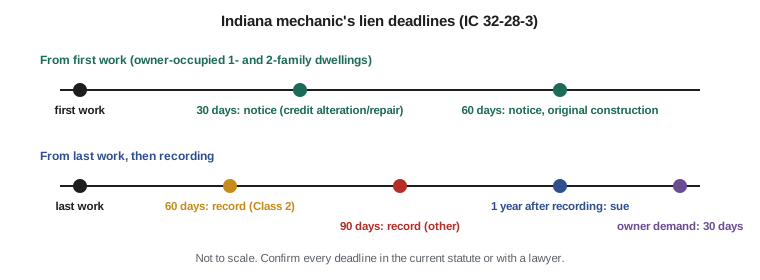
The key deadlines
Recording comes first. The lien claimant must record a sworn statement of its intention to hold a lien with the county recorder within 90 days after the last day it performed labor or furnished materials, under IC 32-28-3-3(a). For Class 2 structures, which in general terms are one- and two-family dwellings, and for certain related property, the period is 60 days under IC 32-28-3-3(b). After recording, the recorder mails a copy to the owner within three business days. The statement must contain the information the statute requires, such as the amount claimed, the claimant's and owner's names and addresses and a legal description of the property.
Some residential work needs notice before the lien. If a subcontractor or supplier furnishes labor or materials on credit to a contractor for the alteration or repair of an owner-occupied one- or two-family dwelling, it must give the owner written notice within 30 days of first furnishing, under IC 32-28-3-1(h). For original construction of a dwelling for the owner's occupancy, the notice must be given and recorded within 60 days of first furnishing, under IC 32-28-3-1(i). These pre-lien notices run from the first day, not the last. A subcontractor that waits until a residential job goes bad to think about liens may already have lost them.
Then the suit. A lien claimant must file suit to foreclose within one year after recording the lien, under IC 32-28-3-6, or the lien is void. The owner can shorten that period. Under IC 32-28-3-10, an owner may give the lienholder written notice to sue, and the lienholder must file suit within 30 days after receiving the notice, or the lien is void.
| Deadline | Who or what | Runs from | Statute |
|---|---|---|---|
| 30 days | Notice to owner for credit work altering or repairing an owner-occupied one- or two-family dwelling | First labor or materials | IC 32-28-3-1(h) |
| 60 days | Notice given and recorded for original construction of an owner-occupied dwelling | First labor or materials | IC 32-28-3-1(i) |
| 60 days | Record the lien on a Class 2 structure | Last labor or materials | IC 32-28-3-3(b) |
| 90 days | Record the lien on other property | Last labor or materials | IC 32-28-3-3(a) |
| 1 year | File suit to foreclose | Recording | IC 32-28-3-6 |
| 30 days | File suit after the owner's written demand | Receipt of the notice | IC 32-28-3-10 |
from datetime import date, timedelta

# Illustrative lien calendar for Fall Creek on the Mass Ave buildout (commercial, so 90 days)
last_day = date(2026, 9, 18)
class_2 = False

record_by = last_day + timedelta(days=60 if class_2 else 90)
recorded = date(2026, 12, 1)
print("Record the lien by:", record_by)
print("Suit to foreclose within one year of recording, by about:", recorded.replace(year=recorded.year + 1))
owner_demand_received = date(2027, 2, 3)
print("If the owner demands suit, file by:", owner_demand_received + timedelta(days=30))Record the lien by: 2026-12-17 Suit to foreclose within one year of recording, by about: 2027-12-01 If the owner demands suit, file by: 2027-03-05
The program ignores weekends, holidays and the rules courts use to count days. Treat its output as a reminder to act early, not as the last safe date. A lawyer should calculate the real deadline.
No-lien clauses and waivers
Some contracts try to take away lien rights before the work begins. Under IC 32-28-3-16, a provision in a contract for the improvement of real estate that requires a person to waive the right to a lien, or that makes payment to a subcontractor depend on the contractor first being paid, is generally void as against public policy, except on Class 2 structures and certain related work. That protects Fall Creek on the coffee shop: a clause in the general contractor's form saying Fall Creek waives its lien rights would generally be unenforceable. On a one- or two-family dwelling, the exception means such a clause may be enforceable, so read residential contracts with more care.
Waivers given in exchange for payment are different. Owners, lenders and general contractors commonly ask for lien waivers with each payment. Fall Creek's rule is to sign a partial waiver only for payments actually received, a conditional waiver when a payment is being exchanged for the waiver, and a final waiver only when the final payment has cleared. Signing a waiver for money that never arrives gives away the lien for nothing.
Documenting the dates
Because recording deadlines run from the last day of work, the date itself becomes evidence. Disputes often turn on whether a late visit counted: was it real contract work, or a trivial return trip, such as replacing a cover plate, made only to restart the clock? Courts can be skeptical of the second kind. Fall Creek's daily logs record what each crew did at each job, and the job file keeps delivery tickets for materials. When a payment dispute starts, Teresa can show the real last day of work without guessing.
Retainage and payment timing
Many commercial contracts hold back retainage, a share of each progress payment kept until the work is complete, as security for the owner. Retainage is normal, but it ties up a subcontractor's profit for months. Aaliyah reads every subcontract for the retainage share, when it will be released and whether release depends on the whole project finishing or only Fall Creek's part. Indiana has statutes on payment timing and retainage for public works, and private contracts set their own terms. Where the contract is silent or unclear, ask before signing, because a vague clause is usually read in favor of whoever is holding the money.
Payment timing also affects lien deadlines. A contractor that keeps working on a job while waiting for retainage may think it has plenty of time, but the recording period runs from the last day of real work, not from the day retainage was due. If the last crew visit was in September and the retainage is still unpaid in January, the 90-day recording period may already have run out.
Public projects
Mechanic's liens generally cannot be recorded against public property such as schools or government buildings. On Indiana public works, subcontractors and suppliers protect themselves in other ways, usually through the payment bond the prime contractor provides and through claims procedures in the public works statutes. Those procedures have their own notice deadlines. A contractor bidding public work should read the bond terms and the claim rules before starting, not after a payment is missed.
Worked problem
The slow-paying general contractor
Fall Creek finished its work as a subcontractor on the Mass Ave coffee shop on September 18, 2026. The general contractor still owes 22,000 dollars. The building is commercial, not a one- or two-family dwelling. What should Fall Creek do, and by when?
Show solution
- No pre-lien notice was needed, because the 30-day and 60-day notices apply to owner-occupied one- and two-family dwellings.
- Fall Creek must record its sworn statement with the county recorder within 90 days of September 18, 2026, which is by December 17, 2026. Its lawyer prepares the statement with the required information and a legal description of the property.
- The recorder mails a copy to the owner, which often prompts the owner to make the general contractor pay.
- If Fall Creek is still unpaid, its lawyer must file suit within one year of recording, or within 30 days if the owner serves a written demand to sue.
- Fall Creek signs a lien waiver only when the 22,000 dollars has actually been paid.
Answer: Record within 90 days of the last work, then sue within one year or within 30 days of an owner's demand. Missing either deadline loses the lien.
Common mistakes
MistakeWaiting until a home job goes bad to send the pre-lien notice.
InsteadThe 30-day and 60-day notices run from the first day of work.
MistakeUsing 90 days for a single-family house.
InsteadClass 2 structures have a 60-day recording period.
MistakeIgnoring an owner's written demand to sue.
InsteadThe lienholder must sue within 30 days of the notice or lose the lien.
MistakeAssuming a no-lien clause in a commercial subcontract is binding.
InsteadUnder IC 32-28-3-16 such clauses are generally void, except on Class 2 structures.
MistakeSigning a final waiver before the money clears.
InsteadSign waivers only for payments actually received.
Summary and key terms
- A good contract defines scope, price, payment, changes and risk; change orders should always be in writing.
- Indiana's home improvement contract law generally requires written contracts with specific content for home improvement work.
- A lien must be recorded within 90 days after the last work, or 60 days for Class 2 structures (IC 32-28-3-3).
- Pre-lien notices are required for some owner-occupied dwelling work: 30 days for credit work on alterations and repairs, 60 days for original construction.
- Suit must be filed within one year of recording, or within 30 days of an owner's written demand (IC 32-28-3-6 and 3-10).
- No-lien and pay-first clauses are generally void except on Class 2 structures (IC 32-28-3-16).
- Mechanic's lien
- A claim against real property securing payment for labor or materials that improved it.
- Sworn statement of intention
- The document a claimant records with the county recorder to create the lien.
- Class 2 structure
- In general, a one- or two-family dwelling and its accessory buildings.
- Pre-lien notice
- A written notice to the owner required before a lien on some dwelling work.
- Lien waiver
- A document giving up lien rights, usually in exchange for payment.
Practice problems
Work each problem on paper first, then reveal the answer to check.
Fall Creek's last day on a duplex alteration was May 1. By when must it record a lien?
Show answer
Within 60 days, because a duplex is a two-family dwelling, a Class 2 structure.
An owner sends Fall Creek a written notice to sue on its lien. What is the deadline?
Show answer
Fall Creek must file suit within 30 days after receiving the notice.
A general contractor's form on a warehouse job says Fall Creek waives lien rights. Is it enforceable?
Show answer
Generally not; IC 32-28-3-16 makes such clauses void except on Class 2 structures.
Can Fall Creek record a lien against a public school?
Show answer
Generally not; it relies on the payment bond and public works claim procedures.
Lesson quiz · 5 questions
Score 60% or more to complete this lesson.
Create a free account to save your progress, take quizzes and earn a certificate.