
MELU-214 · Lesson 1 of 12 · 18 min
How electrical licensing works in Indiana
▶ Video coming soon A video version of this lesson is on the way.
Aaliyah Brooks has been an electrician in Indianapolis for ten years. She started as a helper on a commercial crew at twenty-one, finished a five-year registered electrical apprenticeship in 2020, and has spent the years since as a journeyman and then a foreman at Fall Creek Electric, LLC, a nine-person contractor in the Fountain Square neighborhood. The company is invented for this course, but its situation is common. Its owner, Ron Mitchell, has held an Indianapolis master electrical license since 1996, and his license is what lets the company hold its electrical contractor license. Ron is sixty-three and wants to retire within about two years. He has asked Aaliyah to earn her own master license and take over as the company's licensed electrician. This course follows her from her first question to her first day as a license holder.
This is the Indiana course in the HSM University master electrician exam prep series. The core courses, MELU-101 through MELU-107, teach the National Electrical Code skills every master-level exam tests: navigating the code, load calculations, conductors and overcurrent protection, grounding and bonding, motors and transformers, special occupancies, and business and law. This course adds what is specific to Indiana, and the first fact is the most important one. Indiana has no statewide electrician license. Licensing is local, so this course spends most of its time on Indianapolis and Marion County, the largest licensing authority in the state, and uses a few other cities and counties as examples of how the rest of Indiana works.
Two cautions apply to every lesson. First, licensing rules change, and local rules can change with a new policy packet or ordinance. The facts in this course were checked in November 2026 against the City of Indianapolis Department of Business and Neighborhood Services, the Indianapolis Board of Electrical Examiners' published policies, other city and county pages, the Indiana Department of Homeland Security's rule documents and the Indiana Code. When a fact comes from a secondary source or could not be confirmed, the lesson says so. Before you apply, pay a fee or book an exam, read the current documents yourself. Second, electrical codes are copyrighted. This course cites code sections by number and explains them in plain words, but it never reproduces their text, tables or figures. Keep your own copy of the code your exam uses beside you.
A state without a state electrician license
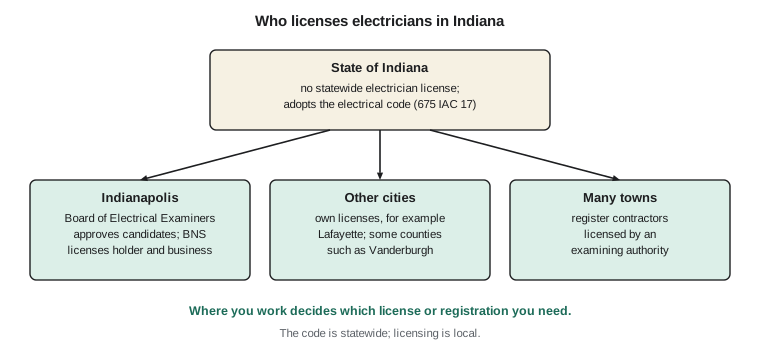
In many states, one state board licenses electricians, and a license earned in one city is good everywhere in the state. Indiana did not adopt that system for electricians. The state licenses plumbers through a state board, and it adopts building and electrical codes for the whole state, but it does not issue a license to electricians or electrical contractors as such. The Indianapolis Board of Electrical Examiners puts it plainly in its own policies: licensing is handled by the local municipality, and there is no state electrical license.
The result is a patchwork, and an electrician who works across central Indiana has to understand it. Indianapolis and Marion County run their own examining board. Other cities, such as Lafayette, issue their own licenses under their own municipal codes. Some counties license contractors for the cities and towns inside them, and some smaller places register contractors who hold a license from somewhere else, or regulate electrical work only through permits. A company that moves from a job in Indianapolis to a job in a neighboring town may have to register with that town, file insurance certificates, sometimes post a bond, and pull a permit from that town's building department. Teresa Nguyen, Fall Creek's office manager, keeps a folder for every jurisdiction where the company has worked, and Aaliyah now understands why the folder is so thick.
Where local authority comes from
Indiana gives its cities, towns and counties broad home rule powers. In general terms, a unit of local government may exercise any power it needs to conduct its affairs unless the constitution or a statute withholds it or gives it to another body. Licensing an occupation inside a city's limits is one of the powers many Indiana units have chosen to use, and electrical licensing ordinances rest on that authority. The state keeps some powers for itself. The most important one for electricians is the electrical code: the state's Fire Prevention and Building Safety Commission adopts the Indiana Electrical Code for the whole state, and local units enforce it. Lesson 5 explains how that code works and which edition is in force.
For the exam, the practical point is simpler than the legal theory. In Indiana, the license and registration rules that apply to you are the rules of the place where the work is done, while the technical rules come from the state's electrical code. Before you bid a job outside your home jurisdiction, find out what that place requires of a contractor and its license holder.
Indianapolis and Marion County: the main example
The City of Indianapolis and Marion County share a consolidated government, and its Department of Business and Neighborhood Services, usually shortened to BNS, handles contractor licensing, permits and inspections. Two kinds of license matter to Aaliyah. The first belongs to a person: an electrical license earned by passing the required examination after the Board of Electrical Examiners approves the applicant. The Board's policies describe two types. A master license is unrestricted. A residential license is limited to one- and two-family structures. The second kind of license belongs to a business: the electrical contractor license, issued by BNS to a company that has at least one electrical license holder connected to it.
BNS calls the person who backs a company's license its craft license holder. Each license holder must be connected to a business license, and the packet says a craft license holder agrees to provide direction, supervision and control over the craft work the license covers. A craft license holder may not be connected to more than one partnership, limited liability company or corporation. That rule comes from the Revised Code of Indianapolis and Marion County, which the packet cites as section 875-215. Fall Creek Electric is a limited liability company, so when Aaliyah becomes its craft license holder, she cannot also back a second company's license.
| License | Who holds it | Key point |
|---|---|---|
| Master electrical license | A person approved by the Board who passed the required exam | Unrestricted |
| Residential electrical license | A person approved by the Board who passed the residential exam | Limited to one- and two-family structures |
| Electrical contractor license | A business | Must have at least one electrical license holder connected to it |
| Craft license holder application | The license holder backing a business | One per individual; agrees to direct, supervise and control the work |
The board, the exam vendor and the code
Indianapolis does not give the written exam itself. The Board of Electrical Examiners reviews each applicant's packet, interviews the applicant at one of its monthly meetings and decides whether the applicant may sit for the exam. Approved applicants then take an International Code Council exam delivered by Prometric. Lesson 3 covers the packet, the interview and booking, and Lesson 4 covers the exam itself, including the edition of the code it tests.
The code is a separate question, and it has a twist. Indiana adopts a statewide electrical code, and at the time this course was checked, the edition formally in the Indiana Administrative Code was still the Indiana Electrical Code, 2009 Edition, which adopts the 2008 edition of the National Electrical Code with Indiana amendments. A new rule adopting the 2023 edition as the Indiana Electrical Code, 2026 Edition, had been drafted and prepared for final adoption. Meanwhile, the Board's exam policies refer to the 2023 edition. So the code you install to and the code you are tested on may differ. Lesson 5 explains how to handle that, and why you must check which edition is in force before you study.
Beyond Indianapolis
Outside Marion County, the picture varies. The City of Lafayette issues its own commercial and industrial electrical contractor licenses, residential electrical contractor licenses and electrician licenses under its municipal code, and it requires at least 250,000 dollars of general liability insurance to get or renew a contractor license. Vanderburgh County, which includes Evansville, lists electrical contractor or master electrician exams and journeyman exams delivered through a testing company that also serves several other states, with the exam taken in Evansville. Fort Wayne contractors are licensed through Allen County, according to secondary sources. Many smaller towns register contractors who hold an examined license from somewhere else and ask for insurance certificates. Lesson 2 compares eligibility rules, and Lessons 8 and 11 cover registration, insurance and working in more than one place.
This variety is why the course title talks about local electrical contractor licenses. Indianapolis uses the terms master license, residential license, electrical contractor license and craft license holder. Other places may call their licenses commercial and industrial contractor, electrician, master electrician or registered contractor, and they may attach them to a person, a business or both. When you read a city's ordinance, ask three questions: who must hold the license, what does it allow, and what does the city accept from other places.
Enforcement
Licensing would mean little without enforcement. In Indianapolis, permits are issued only to licensed contractors, inspectors can stop work that is not permitted or not done by a licensed company, and the city can act against a license under its code. Smaller towns enforce mainly through the permit process: no registration, no permit, and no permit, no legal work. Exam questions about enforcement are more likely to ask what a city can do, and who does it, than for a fine amount, and fine amounts change. Check the current ordinance before you rely on a number.
For a craft license holder, enforcement is personal. The license holder has agreed to direct, supervise and control the company's electrical work, and a company with no license holder connected to it cannot keep pulling permits. Ron has told Aaliyah that the best protection is plain paperwork: a current business license, bond and insurance certificate, workers on the payroll as employees, permits pulled before work starts, and a file for every inspection. Lesson 7 returns to these habits.
How this course is organized
The lessons follow Aaliyah's path. Lesson 2 covers eligibility in Indianapolis and elsewhere, Lesson 3 the application, interview and booking process, and Lesson 4 the exam format and references. Lesson 5 explains the state code and local amendments, and Lesson 6 permits and inspections. Lesson 7 covers the duties of the license holder, Lesson 8 contractor licensing, insurance and bonds, and Lesson 9 contracts and mechanic's liens. Lesson 10 covers IOSHA, safety and workers compensation, Lesson 11 renewal and working in other jurisdictions, and Lesson 12 a practice review with test-day strategy. Every lesson ends with a quiz that mixes multiple choice, true or false, number, ordering and matching questions, and the course ends with a final exam.
The calculator below shows the kind of planning Aaliyah does first. Ron wants to retire in about two years. She needs time to gather her letters, get her packet to the Board ten business days before a meeting, attend the interview, book and pass the exam, attend the Board's orientation, and then have the company file her craft license holder application. Change the numbers to fit your own plan.
# Aaliyah's planning check (illustrative months)
months_until_ron_retires = 24
steps = {
    "gather reference letters and records": 2,
    "packet in 10 business days before a meeting, then interview": 1,
    "book and take the exam": 2,
    "study margin for a retake within six months": 4,
    "orientation and craft license holder paperwork": 1,
}
needed = sum(steps.values())
for step, months in steps.items():
    print(f"{step}: {months} months")
print(f"Total: {needed} months; margin: {months_until_ron_retires - needed} months")gather reference letters and records: 2 months packet in 10 business days before a meeting, then interview: 1 months book and take the exam: 2 months study margin for a retake within six months: 4 months orientation and craft license holder paperwork: 1 months Total: 10 months; margin: 14 months
Common mistakes
MistakeAssuming Indiana issues a statewide electrician license.
InsteadIndiana has no statewide electrician license; licensing and registration are local.
MistakeThinking an Indianapolis license lets a company work anywhere in Indiana without further steps.
InsteadOther cities, towns and counties set their own licensing or registration rules and decide what they accept.
MistakeConfusing the code with the license.
InsteadThe state adopts the Indiana Electrical Code for everyone; local units decide who may do the work.
MistakeBelieving a web summary overrides the ordinance.
InsteadThe Revised Code and the city's current packets control; summaries, including this course, only explain them.
MistakeAssuming the edition on the exam is the edition you install to.
InsteadCheck both: the state's adopted code and the edition the exam tests can differ.
Summary and key terms
- Indiana has no statewide electrician license; cities, towns and counties license or register electrical contractors locally.
- In Indianapolis, the Board of Electrical Examiners approves applicants for master or residential exams, and BNS licenses the business.
- Each Indianapolis electrical contractor needs at least one connected craft license holder, who may back only one partnership, LLC or corporation.
- Approved Indianapolis applicants take an ICC exam delivered by Prometric.
- The state adopts the Indiana Electrical Code; the 2009 edition based on the 2008 NEC was formally in force when checked, with a 2023-based edition prepared for adoption.
- Other places, such as Lafayette and Vanderburgh County, run their own licensing; check each jurisdiction before you bid.
- Craft license holder
- The licensed person connected to an Indianapolis contractor's business license who directs, supervises and controls its craft work.
- Master license
- Indianapolis's unrestricted electrical license for a person.
- Residential license
- Indianapolis's electrical license limited to one- and two-family structures.
- BNS
- The Indianapolis Department of Business and Neighborhood Services, which licenses contractors and issues permits.
- Home rule
- The broad power Indiana gives local units to govern their affairs unless a law withholds it.
Practice problems
Work each problem on paper first, then reveal the answer to check.
A company with an Indianapolis contractor license wins a job in Lafayette. What should it check before bidding?
Show answer
Lafayette's licensing rules: which license it requires, the 250,000 dollar insurance minimum, its fees and renewal, and its permit process.
Why does Fall Creek need Aaliyah to earn a master license rather than a residential license?
Show answer
Its work includes commercial buildouts, which go beyond one- and two-family structures, so it needs an unrestricted license holder.
Who adopts the electrical code used across Indiana?
Show answer
The state's Fire Prevention and Building Safety Commission, through the Indiana Administrative Code.
Can Aaliyah be the craft license holder for Fall Creek and also for her cousin's corporation?
Show answer
No. A craft license holder may not be connected to more than one partnership, LLC or corporation.
Lesson quiz · 5 questions
Score 60% or more to complete this lesson.
Create a free account to save your progress, take quizzes and earn a certificate.