
MELU-214 · Lesson 4 of 12 · 19 min
The exam format and the references allowed
▶ Video coming soon A video version of this lesson is on the way.
Aaliyah has taken open-book code tests before, in her apprenticeship and on practice sets, but the Indianapolis master exam has rules of its own, and they come from two places. The Board of Electrical Examiners chooses the exam, the code edition and the passing score. The International Code Council, ICC, which writes the exam, and Prometric, which delivers it, set the rules about what you may bring into the room. This lesson explains what each source says, what it does not say, and how to prepare a book that is both legal and fast.
What the Board's policies say
The Board's 2025 policies state three things about the exam. It is an ICC exam delivered by Prometric. It is based on the 2023 National Electrical Code, NFPA 70. The passing score is 75. The policies also say the Board will adopt the most current test within 90 days of a new NEC edition becoming available. The 2026 edition of the NEC has since been published, so a candidate who books an exam months after approval should confirm which edition the exam is on at the time of booking. Studying the 2023 NEC for an exam that has moved to the 2026 edition would be an expensive mistake.
The 2021 version of the policies listed specific ICC catalog numbers and times, four hours for the master exam and three hours for the residential exam. The 2025 version, which this course follows, describes the exam more generally. Treat older numbers you find online as history. The ICC exam catalog and your Prometric appointment confirmation give the current question count and time limit.
Notice something that surprises many Indiana candidates. The exam tests the 2023 NEC, but the code being enforced on Indiana jobs may be the Indiana Electrical Code, 2009 Edition, which adopts the 2008 NEC with Indiana amendments. Lesson 5 explains this gap. For the exam, use the edition the exam names. For the job, use the edition the authority enforces. They are not the same book.
What ICC's rules say about references
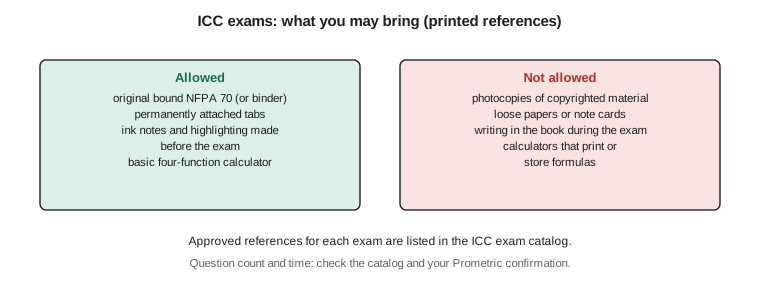
ICC publishes administrative rules for its exams. For open-book exams that use printed references, its rules say references must be bound: an original bound book, a three-ring binder or a stapled document. Photocopies of copyrighted material are not allowed. Tabs must be permanently attached, meaning they cannot be removed without destroying the page. Notes written in the book before the exam are allowed if they are written in ink or highlighted. Candidates may not bring writing instruments into the testing room, and a candidate who writes in a reference during the exam is subject to discipline.
These rules are more generous than some local exams. Chicago's exam, for example, prohibits notes and highlighting entirely. Under ICC's rules, Aaliyah may highlight key rules and write short ink notes in the margins of her NEC before test day, as long as the book is the approved reference and the notes are in the book itself, not on loose paper. Loose papers are a prohibited item. A note card tucked inside the cover is a loose paper, even if it is the size of a tab.
Which references are approved
ICC's exam catalog lists the approved references for each exam. For a master electrician exam, the core reference is NFPA 70, the National Electrical Code, in the edition the exam is based on. Some ICC electrical exams also list other references, such as a calculations guide or a handbook, and some do not. Check the catalog entry for the exam number on your approval or booking. Bringing a book that is not on the list is not a small mistake: the proctor may remove it, and you will have spent study time learning a book you cannot use.
ICC also delivers some exams online or with digital references. If your booking gives you a digital reference instead of a printed one, your highlighting and tabs will not be there. Read the confirmation carefully, and if you practiced with a printed book, ask whether the exam allows it before test day.
| Item | Allowed under ICC rules? | Why |
|---|---|---|
| Original bound NFPA 70 in the edition tested | Yes | The core approved reference |
| Permanently attached tabs | Yes | Tabs that cannot be removed without tearing the page |
| Ink notes and highlighting made before the exam | Yes | Allowed in the reference itself |
| Photocopied pages of the code | No | Photocopies of copyrighted material are not allowed |
| A loose note card inside the cover | No | Loose papers are prohibited |
| A construction calculator that stores formulas | No | Only a basic, non-programmable, non-printing calculator |
| Writing in the book during the exam | No | Subject to disciplinary action |
Calculators
ICC's rules allow a battery-operated, basic four-function calculator that is non-programmable, cannot store exam information and cannot print. Calculators that print, such as adding machines, and calculators that store formulas, such as construction calculators, are not allowed. A four-function calculator adds, subtracts, multiplies and divides. It may not have a square-root key on every model, so practice with the exact model you will bring. Three-phase calculations need the square root of three, about 1.732, and Aaliyah wrote that value in ink on the inside cover of her NEC, which ICC's rules allow as a pre-written note in the reference.
The calculator below shows the kind of arithmetic a four-function calculator must handle. Practice it by hand on your own calculator so that the steps are familiar.
# Three-phase current with a four-function calculator: I = VA / (V x 1.732)
va = 75_000          # 75 kVA transformer
volts = 208
root3 = 1.732        # written in ink inside the book cover
step1 = volts * root3
amps = va / step1
print(f"Step 1: {volts} x {root3} = {step1:.1f}")
print(f"Step 2: {va} / {step1:.1f} = {amps:.1f} A")Step 1: 208 x 1.732 = 360.3 Step 2: 75000 / 360.3 = 208.2 A
What kinds of questions to expect
Because the exam is a master electrician exam on the NEC, expect questions across the code: definitions and general requirements, wiring methods, branch circuits and feeders, services, grounding and bonding, overcurrent protection, motors and transformers, special occupancies and calculations. Load calculations, conductor sizing, voltage drop and box and raceway fill appear on most master exams. Some ICC master exams also include questions on administration and safety. This course's core courses cover the code topics. This course focuses on the local rules that wrap around the exam: who gives it, what it tests, and what happens before and after.
Do not expect the ICC exam to test Indianapolis's licensing rules, fees or the Revised Code. The Board's interview and orientation cover local expectations, and Lessons 6 to 8 of this course explain them so that you can answer the Board's questions and run a compliant business.
Preparing a legal, fast book
Under ICC's rules, a well-prepared book has three layers. The first is tabs. Tab the start of each chapter, the articles you use most, Article 100 definitions and the tables you use in calculations, such as the ampacity tables, conductor properties and the raceway fill tables in Chapter 9 and Annex C. The second is highlighting. Highlight the main rule in a section and its key exceptions, not whole pages; a page that is entirely yellow is no easier to read than a page with no highlighting at all. The third is short ink notes, such as a cross-reference to a related article or the square root of three on the cover. Keep notes brief and in the book.
Aaliyah started with more than eighty tabs and cut them to about fifty after timed practice showed which ones she never used. She highlighted only what she looked up more than once. She wrote cross-references in the margins where the NEC sends you to another article. Her book looked tidy, and that was the point: a book you can read quickly under stress.
Worked problem
Is this book legal?
Marcus shows Aaliyah the NEC he plans to use if he takes the exam. It is an original bound 2023 NEC with permanent tabs and highlighting. Inside the front cover he has taped a printed sheet of formulas. Inside the back cover he has a folded photocopy of a table from another book. He also plans to bring a construction calculator. What must change?
Show solution
- The book itself is acceptable: bound, the right edition and with permanently attached tabs and highlighting.
- The taped formula sheet is a problem. ICC's rules allow notes written in ink in the book; a separate printed sheet is closer to a loose paper. Copying the formulas by hand in ink onto the inside cover is the safe approach.
- The photocopy is not allowed. Photocopies of copyrighted material are prohibited.
- The construction calculator is not allowed because it stores formulas. He needs a basic four-function, non-programmable, non-printing calculator.
- He should check the ICC catalog for any other approved references for his exam number.
Answer: Remove the taped sheet and the photocopy, write any notes by hand in ink in the book, and bring a basic four-function calculator.
A pacing plan
Aaliyah will learn the exact question count and time limit from the ICC catalog and her Prometric confirmation. Until then she practices with a flexible plan that works for any timed open-book code exam. On the first pass she answers every question she can answer from memory or with one quick look-up, and she marks the rest. On the second pass she works the marked questions in order of how quickly she thinks she can find the answer. She saves the last few minutes to check that every question has an answer, because an unanswered question is always wrong and a guess may be right.
# Pacing plan for a timed open-book exam (enter the numbers from your confirmation)
minutes = 240        # illustrative only
questions = 80       # illustrative only
split = {"first pass": 0.50, "second pass (look-ups)": 0.40, "final check": 0.10}
print(f"Average time per question: {minutes / questions:.1f} minutes")
for phase, share in split.items():
print(f"{phase}: {round(minutes * share)} minutes")Average time per question: 3.0 minutes first pass: 120 minutes second pass (look-ups): 96 minutes final check: 24 minutes
The numbers in the program are illustrative, not the official figures for any ICC exam. The method is what matters: know your average time per question, protect time for the hard look-ups, and never spend ten minutes on one question while easy ones wait at the end. Timed practice with the real book is the only way to learn your own pace. Aaliyah did one full-length timed practice each weekend in the month before her exam and kept a log of which look-ups took longest, then added a tab or a cross-reference note for each slow one.
Other Indiana exams
Other authorities may use other exams and other book rules. Vanderburgh County's exams are delivered by a national testing company in Evansville, and that company's candidate bulletin sets the rules. Lafayette lists a passing exam as one route to its licenses; ask the city which exam it accepts. When a town registers contractors licensed elsewhere, there is no exam at all, only the license and the paperwork. Whatever the authority, ask four questions: which exam, which code edition, which references, and what pass mark.
Common mistakes
MistakeStudying the 2008 NEC because that is what Indiana enforces.
InsteadThe Indianapolis exam tests the 2023 NEC, and the Board may move to a newer edition within 90 days of its release.
MistakeBringing photocopied pages of the code.
InsteadICC prohibits photocopies of copyrighted material.
MistakeTucking a note card inside the cover.
InsteadLoose papers are prohibited; notes must be written in the book.
MistakeBringing a construction calculator.
InsteadOnly a basic, non-programmable calculator that cannot store or print is allowed.
MistakeAssuming Chicago-style rules banning all highlighting.
InsteadICC's rules allow highlighting and ink notes made before the exam.
Summary and key terms
- The Indianapolis Board uses an ICC exam delivered by Prometric, based on the 2023 NEC, with a passing score of 75.
- The Board will move to the most current test within 90 days of a new NEC edition.
- ICC requires bound references, prohibits photocopies and allows permanently attached tabs.
- Highlighting and ink notes made in the book before the exam are allowed; loose papers are not.
- Calculators must be basic, non-programmable and unable to store or print.
- The ICC exam catalog lists approved references and the current question count and time.
- ICC
- The International Code Council, which writes the exam the Indianapolis Board uses.
- Prometric
- The testing company that delivers the exam and schedules appointments.
- Approved reference
- A book the exam catalog lists as allowed in the testing room.
- Permanently attached tab
- A tab that cannot be removed without destroying the page.
- Four-function calculator
- A basic calculator that adds, subtracts, multiplies and divides.
Practice problems
Work each problem on paper first, then reveal the answer to check.
Aaliyah wants to write the square root of three inside the cover. Is that allowed under ICC's rules?
Show answer
Yes, as a note written in ink in the reference before the exam.
A candidate brings a three-ring binder of the code. Is it allowed?
Show answer
ICC lists a three-ring binder as acceptable for printed references, if the content is an approved reference and not photocopies.
Which code edition does the Indianapolis exam test under the 2025 policies?
Show answer
The 2023 NEC, unless the Board has moved to a newer test.
What score must a candidate reach?
Show answer
75.
Lesson quiz · 5 questions
Score 60% or more to complete this lesson.
Create a free account to save your progress, take quizzes and earn a certificate.