
MELU-214 · Lesson 10 of 12 · 19 min
Workplace safety law and OSHA for electrical contractors
▶ Video coming soon A video version of this lesson is on the way.
Electrical work is dangerous, and the laws that govern workplace safety apply to every job a license holder directs. This lesson covers the safety and injury laws that matter most to an Indiana electrical contractor: who enforces job safety in Indiana, the standards that address electrical hazards, NFPA 70E, recording and reporting injuries, Indiana's workers' compensation system and its seven-day reporting rule, and the habits that keep crews safe. Fall Creek's nine employees make it a small employer, and the lesson shows which rules change with size and which never do.
Who enforces safety law in Indiana
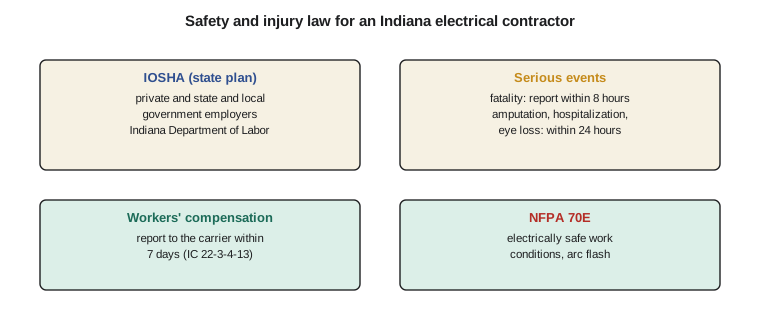
The federal Occupational Safety and Health Act lets states run their own job safety programs, called state plans, if they are at least as effective as the federal program. Indiana runs one. The Indiana Occupational Safety and Health Administration, IOSHA, is part of the Indiana Department of Labor, and its state plan covers private employers and state and local government employers in Indiana, with some exceptions that remain under federal OSHA. For a private electrical contractor such as Fall Creek, IOSHA is the agency that inspects job sites, investigates accidents and issues citations.
Indiana's plan generally adopts the federal standards, so the rules an Indiana electrician follows are, for the most part, the federal construction standards in 29 CFR 1926 and the general industry standards in 29 CFR 1910, enforced by state inspectors. The general duty principle applies too: every employer must keep its workplace free of recognized hazards likely to cause death or serious harm, even where no specific standard covers the hazard.
Electrical hazards and the standards that address them
The leading electrical hazards on construction sites are well known: contact with energized parts, contact with overhead power lines, arc flash and arc blast, faulty tools and cords, and falls from ladders and lifts while doing electrical work. The construction standards address them in Subpart K of 29 CFR 1926, which covers electrical installations and safety-related work practices on construction sites, including ground-fault protection for temporary power. Lockout and tagout of equipment in general industry settings, such as a factory where Fall Creek does maintenance, falls under 29 CFR 1910.147, and electrical safety-related work practices in general industry fall under 29 CFR 1910 Subpart S. Fall protection, ladders and scaffolds have their own subparts.
The detailed requirements, such as clearance distances and inspection intervals, are in the standards themselves and are not repeated here. A license holder should own current copies, or know where to find them, and should read the ones that govern the company's typical work.
Temporary power deserves special mention because electrical contractors usually provide it for everyone on a site. The construction standards require ground-fault protection for temporary receptacles used by employees, either through GFCI protection or, where permitted, an assured equipment grounding conductor program. When Fall Creek sets up temporary power on a buildout, every trade plugs into it, so a missing GFCI exposes plumbers and drywallers as well as electricians. Aaliyah treats temporary power as permanent work: planned, protected, labeled and checked every week.
NFPA 70E
NFPA 70E, the Standard for Electrical Safety in the Workplace, is a consensus standard published by the National Fire Protection Association. It is not itself an OSHA regulation, but OSHA and state plans treat it as describing recognized practice for meeting the general requirements of the standards, and many owners and general contractors require it in their contracts. It covers establishing an electrically safe work condition, risk assessments for shock and arc flash, approach boundaries, personal protective equipment and training. The core rule is simple and often ignored: de-energize, verify and lock out before working, and work energized only when de-energizing is not feasible or creates a greater hazard, with the analysis, permit and protective equipment the standard requires.
Recording and reporting injuries
OSHA recordkeeping rules, which Indiana follows, require many employers to keep records of serious work-related injuries and illnesses on three forms: the OSHA 300 log, the 301 incident report and the 300A annual summary, which is posted from February 1 to April 30 each year. Records are kept for five years. Employers with ten or fewer employees at all times during the previous calendar year are partially exempt from routine recordkeeping, unless the government asks them to keep records. Fall Creek, with nine employees, may be exempt today. When it grows past ten, Teresa will need to start the log.
Reporting is different. Every employer, of any size and whether or not it keeps the log, must report the most serious events. IOSHA's guidance says a work-related fatality must be reported by phone within 8 hours, and an amputation, an in-patient hospitalization or the loss of an eye within 24 hours. The clock runs from when the employer learns of the event. A small company that thinks size exempts it from reporting has confused two different rules.
| Event or task | Deadline or rule | Applies to |
|---|---|---|
| Work-related fatality | Report within 8 hours | All employers |
| Amputation, in-patient hospitalization or loss of an eye | Report within 24 hours | All employers |
| Injury needing more than first aid | Report to the workers' compensation carrier within 7 days | Indiana employers (IC 22-3-4-13) |
| 300A annual summary | Post February 1 to April 30 | Employers required to keep records |
| Records retention | Keep for five years | Employers required to keep records |
| Ten or fewer employees | Partially exempt from routine recordkeeping | Small employers; reporting still required |
# Reporting clocks for serious events (hours from when the employer learns of it)
events = [("fatality", 8), ("in-patient hospitalization", 24), ("amputation", 24), ("loss of an eye", 24)]
learned_at = 14    # 2 p.m.
for event, hours in events:
    due = learned_at + hours
    when = f"by {due}:00 the same day" if due < 24 else f"by {due - 24}:00 the next day"
    print(f"{event}: report within {hours} hours -> {when}")
print("Workers' comp carrier: within 7 days of the employer learning of the injury")fatality: report within 8 hours -> by 22:00 the same day in-patient hospitalization: report within 24 hours -> by 14:00 the next day amputation: report within 24 hours -> by 14:00 the next day loss of an eye: report within 24 hours -> by 14:00 the next day Workers' comp carrier: within 7 days of the employer learning of the injury
Indiana workers' compensation
Indiana's workers' compensation system is administered by the Workers' Compensation Board of Indiana. Employers must carry insurance or be approved to self-insure, and Lesson 8 showed that Indianapolis requires proof of coverage for contractors with employees in Marion County. Workers' compensation pays medical costs and part of lost wages for work injuries, generally without regard to fault, and in return generally limits the employee's right to sue the employer.
Indiana sets a short reporting deadline for employers. Under IC 22-3-4-13, an employer must report to its insurance carrier, or to the Board if it is self-insured, any injury that causes death or requires more than first aid, within seven days after the employer learns of it. The carrier then has its own deadline to forward the report. Failing to report as required is a Class C misdemeanor. On the employee's side, an injured worker should give the employer notice of the injury promptly, and Indiana's guidance points to 30 days. A license holder who tells crews to report every injury the same day protects both the worker and the company.
Workers' compensation connects to licensing too. Lesson 7 explained that the license holder's supervision rests on crews who are employees. A company that pays electricians as independent contractors to avoid workers' compensation premiums risks uninsured injuries, misclassification penalties and problems with its city license, which requires proof of coverage.
Worked problem
An injury at the Lafayette warehouse
At 2 p.m. on a Tuesday, Caleb is hurt when a ladder slips at the Lafayette warehouse office. The foreman calls an ambulance, and Caleb is admitted to the hospital overnight for observation.
Show solution
- The foreman secures the area, makes sure Caleb is cared for and calls Aaliyah, who notifies the general contractor at once.
- An in-patient hospitalization must be reported to IOSHA within 24 hours, by 2 p.m. Wednesday at the latest. Teresa reports it by phone on Tuesday afternoon and records the time and the person she spoke to.
- The injury needed more than first aid, so Teresa reports it to the workers' compensation carrier well within the seven-day limit under IC 22-3-4-13.
- Fall Creek has nine employees and is partially exempt from routine recordkeeping, but the reports above are still required.
- Aaliyah investigates the cause, a ladder without proper footing on a slick floor, and changes the company's ladder rules and inspection routine.
Answer: Care first, then the 24-hour IOSHA report, the carrier within seven days, and a fix that prevents a repeat.
Where the NEC and safety law meet
The electrical code and safety law overlap in useful ways. The NEC requires certain equipment to be field marked with warnings about arc flash hazards, and newer editions add information such as available fault current. Those labels help the people who will later work on the equipment, and NFPA 70E relies on them. Remember Lesson 5: an Indiana job inspected under a code based on the 2008 NEC may not require every label the 2023 NEC requires, but the information is still useful, and many contractors provide it.
Overhead lines are a second meeting point. The utility, the safety standards and the code all address clearances from different angles: the utility protects its system, the standards protect workers near energized lines, and the code governs the installation. On a service job, Aaliyah checks all three before a ladder goes up.
Training and supervision records
Safety standards and NFPA 70E both turn on training. Workers who work on or near exposed energized parts must be qualified for the task, which means trained to recognize and avoid the hazards; unqualified workers must stay outside the boundaries. Training should be documented: who was trained, on what, when and by whom. Fall Creek keeps a training file for every worker, updated after each toolbox talk and each formal course, so that if IOSHA asks, Teresa can show it.
Multi-employer job sites
On a commercial buildout, Fall Creek's crew works alongside drywall, plumbing, mechanical and fire protection crews, all employed by different companies. OSHA's approach to multi-employer sites, which state plans generally follow, can hold more than one employer responsible for a hazard: the employer that created it, the employer whose workers are exposed, the employer responsible for correcting it and the controlling employer. An electrical contractor that leaves an open panel in a corridor may be cited even if only other trades' workers walk past it.
Building a safety culture
Laws set the minimum. A company's safety record comes from daily habits: tailgate talks at the start of each week, a written lockout procedure that everyone follows, ladders and lifts inspected before use, tools and cords checked, and a rule that anyone can stop work that looks unsafe without being punished for it. Ron's rule at Fall Creek, which Aaliyah keeps, is that nobody works energized without talking to a license holder first.
Common mistakes
MistakeAssuming federal OSHA inspects Indiana private contractors.
InsteadIOSHA's state plan covers private employers in Indiana.
MistakeAssuming a small employer need not report a hospitalization.
InsteadEvery employer must report within 24 hours, whatever its size.
MistakeWaiting weeks to report an injury to the carrier.
InsteadIC 22-3-4-13 requires a report within seven days for injuries needing more than first aid.
MistakeTreating NFPA 70E as irrelevant because it is not a regulation.
InsteadIt describes recognized practice and is often required by contracts.
MistakeLeaving an open panel in a shared corridor.
InsteadOn multi-employer sites, the employer that created the hazard can be cited.
Summary and key terms
- IOSHA, in the Indiana Department of Labor, runs a state plan covering private and state and local government employers.
- Indiana generally follows the federal standards: 29 CFR 1926 Subpart K for construction electrical work and 1910 Subpart S and 1910.147 for general industry.
- Report a fatality within 8 hours, and an amputation, in-patient hospitalization or loss of an eye within 24 hours.
- Employers with ten or fewer employees are partially exempt from routine recordkeeping but must still report serious events.
- Indiana employers must report injuries needing more than first aid to their carrier within seven days (IC 22-3-4-13).
- NFPA 70E describes electrical safety work practices and is widely required.
- IOSHA
- Indiana's state occupational safety and health program in the Department of Labor.
- State plan
- A state-run job safety program approved under the federal OSH Act.
- OSHA 300 log
- The record of work-related injuries and illnesses kept by covered employers.
- Workers' Compensation Board of Indiana
- The state agency that administers workers' compensation.
- Qualified person
- A worker trained to recognize and avoid the electrical hazards of a task.
Practice problems
Work each problem on paper first, then reveal the answer to check.
Which agency investigates an accident on a private Indianapolis job site?
Show answer
IOSHA, under Indiana's state plan.
Fall Creek has nine employees. Must it keep the OSHA 300 log?
Show answer
Generally not routinely, because employers with ten or fewer employees are partially exempt, but it must still report serious events.
A worker breaks a wrist and needs a cast. By when must Fall Creek report to its carrier?
Show answer
Within seven days after learning of the injury.
An electrician loses part of a finger at 9 a.m. By when must it be reported?
Show answer
Within 24 hours, by 9 a.m. the next day.
Lesson quiz · 5 questions
Score 60% or more to complete this lesson.
Create a free account to save your progress, take quizzes and earn a certificate.