
MELU-214 · Lesson 6 of 12 · 19 min
Permits, inspections and the inspection authority
▶ Video coming soon A video version of this lesson is on the way.
A license lets Aaliyah take responsibility for electrical work. A permit lets a specific job go ahead. Permits and inspections are where the local licensing rules of Lesson 1 meet the state code of Lesson 5: the permit names the licensed contractor, and the inspector checks the work against the Indiana Electrical Code in force. This lesson explains how the inspection authority is decided in Indiana, how permits and inspections generally work in Indianapolis and elsewhere, what the state reviews before local permits are issued on some buildings, and how a contractor keeps permits under control.
Who is the inspection authority?
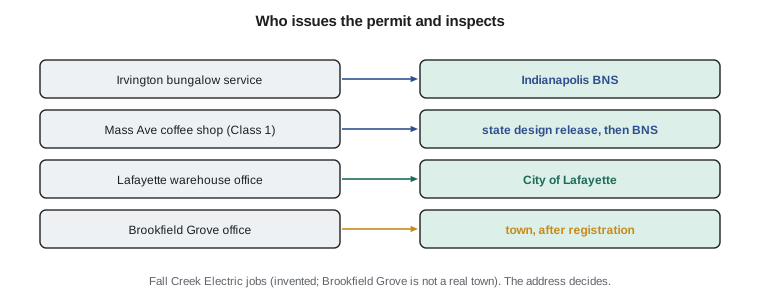
The inspection authority, often called the authority having jurisdiction, is the local building department for the place where the job is. In Indianapolis, that is the Department of Business and Neighborhood Services, BNS, which issues permits, inspects work and administers contractor licensing. Indianapolis and Marion County share a consolidated government, but a few cities inside the county, such as Beech Grove, Lawrence, Southport and Speedway, kept separate city governments when the county consolidated. Before bidding a job with a Marion County address, check which authority issues the permit for that address rather than assuming it is BNS.
Outside Marion County, the authority is usually the city or town building department, or the county building department in unincorporated areas. Some rural counties have no building department and issue no electrical permits for private work. No permit does not mean no code. The Indiana Electrical Code is a state rule, and the work must still comply with it; a fire or a lawsuit will judge it by that code, inspected or not.
State plan review for Class 1 structures
Indiana divides buildings into two classes for its building rules. Class 2 structures are, in general terms, one- and two-family dwellings and their accessory buildings. Class 1 structures are, broadly, everything else: commercial buildings, multifamily buildings, public buildings and industrial buildings. For many Class 1 projects, the state reviews construction documents before work begins and issues a design release through its building safety agency. Local building departments generally require that release before they issue local permits for the project.
For an electrical contractor, the state release usually comes through the owner's design team or the general contractor, not through the electrical contractor directly. But it affects the schedule. A coffee shop tenant buildout on Mass Ave that changes the use, the occupant load or the fire protection systems may need state review before BNS issues the local permits. Teresa asks the general contractor early whether a release is needed and whether it has been issued, so that Fall Creek's crew is not booked for a job that cannot start.
Indianapolis permits
In Indianapolis, electrical permits are generally obtained by a licensed electrical contractor, whose business license and license holder appear on the permit. Lesson 7 explains why that matters: the license holder is responsible for the direction, supervision and control of the work done under the business's permits. The city's permit pages and online system list the permit types, the information needed and the fees, which this course does not repeat because they change. Some authorities allow homeowners to obtain permits for work on the single-family home they occupy. Whether and how BNS does so is a question for BNS; do not advise a customer on it from memory.
Permits are tied to an address and a scope. A permit for a 200 ampere service upgrade does not cover rewiring the kitchen. If the scope grows, amend the permit or obtain another one. Inspectors compare what they see with what the permit describes, and work beyond the permit is work without a permit.
Inspections
Most jobs have at least a rough-in inspection, before walls and ceilings are covered, and a final inspection, when the work is complete. Services often have a service inspection before the utility connects or reconnects power. Underground work and work in slabs may need inspection before backfill or concrete. Large jobs may have several partial inspections. Inspections are requested through the authority's system, and the authority sets how much notice is needed. Work must not be covered before the required inspection; if it is, the inspector can require it to be uncovered.
| Stage | Typical purpose | Aaliyah's preparation |
|---|---|---|
| Permit | Names the business and license holder; describes the scope | Correct scope, load calculation if needed, state release on Class 1 jobs |
| Underground or slab | Raceways and grounding before backfill or concrete | Depth, supports and bonding checked; photographs |
| Rough-in | Boxes, raceways, cables and grounding before cover | Walk every room; check box fill and supports |
| Service | Service equipment and grounding before the utility connects | Labels, clearances, grounding electrode system |
| Final | Completed installation | Covers on, circuits labeled, devices tested |
The utility's role
Electric utilities are not code enforcement agencies, but they control the point where a service is connected. In Indianapolis, the electric utility is AES Indiana. Utilities generally require a release from the inspection authority, showing that the service passed inspection, before they energize a new or upgraded service, and they set their own rules for meter locations, meter sockets and service drops. Read the utility's current service requirements before laying out a service. A service that passes the city's inspection can still be refused by the utility if the meter is in the wrong place.
On the Irvington bungalow, Marcus coordinated a disconnect and reconnect with the utility, the city's service inspection and the customer's schedule. The work was planned for a single day so that the family would not spend a night without power. That kind of coordination is part of a master's job, even though no rule spells it out.
Before, during and after an inspection
A license holder's goal is to make inspections boring. Before an inspection, walk the job with the code open: boxes accessible and within fill limits, conductors identified, grounding and bonding complete, raceways supported, labels and panel directories in place and the permit posted where the authority requires it. During the inspection, have someone on site who knows the job and can answer questions. After it, record the result. A correction notice lists items to fix; fix them, check the rest of the job for the same mistake, and request reinspection.
When an inspector and a contractor disagree about a code interpretation, the first step is a calm conversation with the code open. If that does not settle it, the authority's procedures provide for review by a supervisor, and Indiana's system provides formal routes beyond that, including requests to the Commission. A contractor who wins an argument and loses the inspector's trust has not won much.
Worked problem
A failed rough-in in Indianapolis
Inspector Dana Whitlow, an invented BNS electrical inspector, fails the rough-in on the Mass Ave coffee shop. Her notice lists three items: a missing bonding jumper at a metal raceway entering the panel, two overfilled device boxes behind the espresso counter, and a junction box above a ceiling that will not be accessible once the ceiling is finished.
Show solution
- Aaliyah reads each item and finds the code section behind it, using the Indiana Electrical Code in force on the permit date.
- The crew installs the bonding jumper, replaces the two boxes with deeper ones after recalculating box fill, and relocates the junction box to an accessible spot.
- Aaliyah checks every other box on the job for fill, because the same mistake could repeat.
- Teresa requests the reinspection through the city's system and files the correction notice and the passed result in the job folder.
- Aaliyah talks to Caleb, who made up the overfilled boxes, about how to calculate fill before choosing a box.
Answer: Fix the cited items, check the job for the same mistake, request reinspection and keep the records. Use the failure to train.
Other Indiana authorities
Lafayette licenses its own electrical contractors, so Fall Creek's warehouse office job there runs under a Lafayette commercial and industrial contractor license, and the city's own pages describe its permit process and inspections. In a registering town such as Brookfield Grove, the first step is registration: the town checks the contractor's license from an examining authority and its insurance certificate before it will issue a permit. Some towns contract with private inspection agencies or neighboring jurisdictions for electrical inspections. The questions are always the same: who issues the permit, who may apply, what inspections are required and how they are requested.
Records you keep
Every job folder at Fall Creek holds the permit, any drawings and calculations submitted, the state release on Class 1 jobs, the inspection results and correction notices, the utility correspondence and photographs of the work before it was covered. Photographs are cheap insurance. When a question comes up years later, such as where a buried raceway runs, whether a bonding jumper was installed or why a box is where it is, a dated photograph answers it. Teresa asks crews to photograph each wall before drywall, each trench before backfill and each panel before the cover goes on, with a sign or note in the frame naming the job and the room.
Records also protect the license holder personally. Lesson 7 explains that the license holder is responsible for the direction, supervision and control of the work done under the company's permits. If a complaint or a fire investigation questions the work, the license holder's best defense is a file showing that the work was permitted, inspected and passed, and that corrections were made promptly. A file with gaps is hard to defend, however good the work was. Keep the records for as long as the company's lawyer and insurer advise, which is usually many years, not months.
Tracking permits
A contractor with a dozen open permits in several jurisdictions needs a system. Teresa tracks every permit: the authority, the permit number, the date issued, the code edition, the inspections required, the inspections passed and the date of the final. An open permit is a liability. If a job is finished but never gets a final inspection, the permit may expire, the owner may have trouble selling or insuring the building, and the contractor may be asked to come back years later.
# Open permits and inspections still to pass (invented jobs)
permits = [
    {"job": "Irvington service", "authority": "Indianapolis BNS", "needed": ["service", "final"], "passed": ["service", "final"]},
    {"job": "Mass Ave coffee shop", "authority": "Indianapolis BNS", "needed": ["rough-in", "final"], "passed": []},
    {"job": "Lafayette warehouse office", "authority": "Lafayette", "needed": ["rough-in", "final"], "passed": ["rough-in"]},
    {"job": "Brookfield Grove office", "authority": "Brookfield Grove", "needed": ["underground", "rough-in", "final"], "passed": ["underground"]},
]
for p in permits:
    left = [i for i in p["needed"] if i not in p["passed"]]
    status = "closed" if not left else "still to pass: " + ", ".join(left)
print(f"{p['job']} ({p['authority']}): {status}")Irvington service (Indianapolis BNS): closed Mass Ave coffee shop (Indianapolis BNS): still to pass: rough-in, final Lafayette warehouse office (Lafayette): still to pass: final Brookfield Grove office (Brookfield Grove): still to pass: rough-in, final
Common mistakes
MistakeAssuming every Marion County address is permitted by Indianapolis BNS.
InsteadSome cities in the county kept separate governments; check which authority has the address.
MistakeTreating a county with no electrical permits as having no code.
InsteadThe Indiana Electrical Code is a state rule and still applies.
MistakeStarting a Class 1 buildout before the state release.
InsteadMany Class 1 projects need a state design release before local permits are issued.
MistakeCovering work before the rough-in inspection.
InsteadWork must stay visible until it is inspected, or it may have to be uncovered.
MistakeLetting a permit expire without a final.
InsteadTrack every permit until the final inspection passes, and file the result.
Summary and key terms
- The inspection authority is the local building department for the address; in Indianapolis it is Business and Neighborhood Services.
- Some cities inside Marion County kept separate governments, so check the authority for each address.
- Many Class 1 projects need a state design release before local permits are issued.
- Permits are obtained by a licensed contractor in Indianapolis and cover a specific address and scope.
- Typical inspections include rough-in, service and final; work must not be covered before inspection.
- Utilities generally require an inspection release before energizing a service.
- Authority having jurisdiction
- The office responsible for enforcing the code at a job's address.
- Class 1 structure
- In general, an Indiana building other than a one- or two-family dwelling.
- Class 2 structure
- In general, a one- or two-family dwelling and its accessory buildings.
- Design release
- The state's approval of construction documents for certain Class 1 projects.
- Correction notice
- An inspector's list of items that must be fixed before the work passes.
Practice problems
Work each problem on paper first, then reveal the answer to check.
A customer in Speedway calls Fall Creek. What should Teresa check before applying for a permit?
Show answer
Which authority issues permits for the address, because Speedway kept its own city government.
Who usually obtains the state design release on a Class 1 project?
Show answer
The owner's design team or the general contractor.
The utility refuses to set a meter on a service that passed inspection. Why might that happen?
Show answer
The utility has its own service requirements, such as meter location, that the city does not enforce.
A job was finished a year ago but never had a final inspection. What should the contractor do?
Show answer
Request the final inspection, or ask the authority how to close or renew the permit.
Lesson quiz · 5 questions
Score 60% or more to complete this lesson.
Create a free account to save your progress, take quizzes and earn a certificate.