
MELU-214 · Lesson 7 of 12 · 19 min
Duties and responsibilities of the Local Electrical Contractor Licenses holder
▶ Video coming soon A video version of this lesson is on the way.
Passing the exam gives Aaliyah a license. Becoming Fall Creek Electric's craft license holder gives her responsibilities, and those responsibilities are what the license is really about. This lesson explains the duties Indianapolis attaches to a license holder who qualifies a business, the limit on how many businesses one holder may qualify, what happens to the business if its license holder leaves, and the everyday habits that keep a license holder out of trouble. It closes with how other Indiana authorities frame the same ideas.
Direction, supervision and control
The Indianapolis contractor licensing packet asks the craft license holder to agree to provide direction, supervision and control of the electrical work done under the business's license. The words are short, but they carry the whole job. Direction means deciding how the work will be done: the design choices, the methods and the sequence. Supervision means overseeing the people doing it, at a level that fits their skill and the risk of the task. Control means having the authority to stop work, change methods and correct mistakes. A license holder who signs for work but has no say in how it is done is not providing any of the three.
That responsibility shapes Aaliyah's day once she takes over from Ron. She will review drawings and load calculations before permits are filed, assign foremen to jobs, visit jobs at key stages, especially before inspections, check that crews understand the code points that matter on each job, and deal with inspectors when questions come up. She cannot be on every job every hour, and nobody expects that. What the city expects is that the work is genuinely under her direction, supervision and control, and that she can show it.
Connected to a business
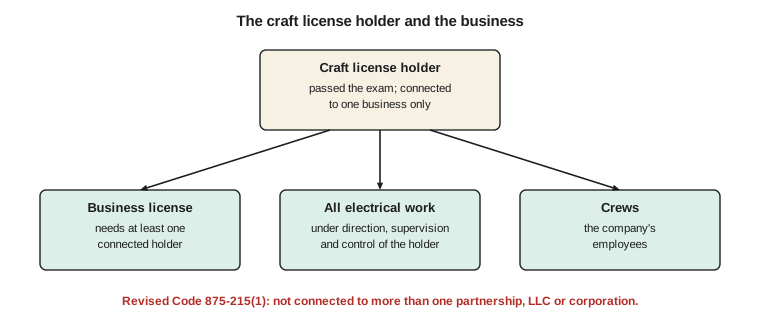
The BNS packet describes two licenses that work together. The business license belongs to the company, Fall Creek Electric, LLC. The license holder license belongs to the person who passed the exam, Ron today and Aaliyah in the future. The packet says that a business must have at least one electrical license holder who passed the required exam, and that each license holder is connected to a business license. A license holder with no business can hold the personal license but cannot, on that alone, contract for and permit electrical work as a company.
The packet also limits the connection. Citing Revised Code 875-215(1), it says a craft license holder may not be connected to more than one partnership, limited liability company or corporation. The rule keeps a license from being rented out to several companies whose work the holder could not possibly direct. For Aaliyah, it means that once she qualifies Fall Creek, she cannot also qualify a friend's start-up company on the side, however small its jobs, unless she gives up her connection to Fall Creek. A sole proprietor is a person rather than a separate company, which is why the packet treats sole proprietors' fees differently, but the principle is the same: the license holder must be able to direct the work.
When the license holder leaves
This is the risk Ron and Aaliyah are planning against. If a business's only license holder retires, dies or leaves, the business no longer meets the requirement to have at least one license holder who passed the exam. It cannot properly obtain new electrical permits until another qualified holder is connected to it. The BNS packet and the Revised Code set out the details, such as how quickly the business must notify the city and how long it has to find a replacement, and this course does not state them because they were not confirmed for this lesson. Ask BNS before a change, not after.
Fall Creek's plan avoids the gap. Aaliyah will pass the exam, complete orientation and be connected to the business while Ron is still connected. For a time, the company will have two license holders, which the packet allows, since it requires at least one. When Ron retires, Fall Creek notifies BNS and continues with Aaliyah, without a day when its permits lack a qualified holder. Companies that leave the question until the day the holder leaves can find themselves unable to permit work they have already sold.
Worked problem
Planning the handover
Ron wants to retire at the end of 2028. Aaliyah expects Board approval in January 2027 and hopes to pass the exam that spring. Lay out a handover that never leaves Fall Creek without a qualified license holder.
Show solution
- Spring 2027: Aaliyah passes the exam and schedules Board orientation well inside the two-year window from Lesson 3.
- After orientation: Fall Creek applies to connect Aaliyah as a second license holder on its business license, paying the license holder fee for the period, and Teresa keeps the confirmation.
- 2027 and 2028: Ron and Aaliyah are both connected. Aaliyah takes over permit review and inspector contact step by step, while Ron is still there to answer questions.
- December 31, 2027: both licenses and the business license come up for renewal together, because all licenses expire on December 31 of odd-numbered years.
- End of 2028: Ron retires. Teresa notifies BNS that he is no longer connected, following the city's current procedure, and Fall Creek continues under Aaliyah without a gap.
Answer: Connect the new holder first, overlap for as long as possible, and disconnect the retiring holder last. The business is never without a qualified license holder.
The plan also protects the people around Ron and Aaliyah. Customers with open warranty questions still have a licensed person who knows the work. Inspectors who have dealt with Ron for years meet Aaliyah on jobs before he leaves. And the crews learn to bring their questions to her while Ron is still around to back her up.
Employees and subcontractors
The license holder directs the work of the business's crews. That assumes the crews work for the business. A contractor that pays its electricians as independent contractors, without the control and responsibility of an employer, weakens the license holder's ability to direct them and can break employment, tax and workers' compensation rules. Indiana has rules on the misclassification of construction workers, and the federal government has its own tests. This course does not try to summarize them; the point here is that a license holder's supervision is built on an employment relationship, and a company should get advice before treating workers as independent contractors.
The same idea covers other companies' workers. If Fall Creek subcontracts part of a job to another electrical contractor, that contractor needs its own license and its own permits, under its own license holder. A contractor cannot borrow another company's license, and a license holder cannot lend one.
| Situation | Allowed? | Why |
|---|---|---|
| Aaliyah and Ron both connected to Fall Creek | Yes | A business must have at least one license holder; it may have more |
| Aaliyah also qualifying a second LLC | No | A holder may not be connected to more than one partnership, LLC or corporation |
| Fall Creek pulling permits with no connected holder | No | The business must have at least one license holder who passed the exam |
| A subcontractor working under Fall Creek's permit with its own crews | Check | The subcontractor generally needs its own license and permits |
| Aaliyah signing for a job she has never reviewed | No | She must provide direction, supervision and control |
Habits that protect the license
Most licensing trouble comes from small lapses, not dramatic misconduct. Ron's habits, which Aaliyah plans to keep, are dull on purpose. He reviews every permit application before it is filed. He or a trusted foreman visits every job before rough-in and final inspections. He keeps a current list of crew members and their status, apprentice, journeyman or licensed, so that he can match crews to jobs. He reads every correction notice and checks that the fix was made. He never lets anyone use his license number on a job he does not direct.
The last habit deserves emphasis. A request to use a license holder's name on someone else's permit is a request to take responsibility for work you do not control. It also usually breaks the one-business rule. Friends and former colleagues sometimes ask, often for small jobs. The answer is always no.
# Before filing a permit: has the license holder reviewed it?
permits = [
    {"job": "Mass Ave coffee shop", "reviewed_by_holder": True, "crew_lead": "Marcus"},
    {"job": "Fountain Square duplex", "reviewed_by_holder": False, "crew_lead": "Marcus"},
    {"job": "Irvington service", "reviewed_by_holder": True, "crew_lead": "Aaliyah"},
]
for p in permits:
    action = "file it" if p["reviewed_by_holder"] else "HOLD: license holder review first"
print(f"{p['job']} (lead {p['crew_lead']}): {action}")Mass Ave coffee shop (lead Marcus): file it Fountain Square duplex (lead Marcus): HOLD: license holder review first Irvington service (lead Aaliyah): file it
When things go wrong
The Board of Electrical Examiners and BNS can act against licenses. The Revised Code provides for discipline, which can include suspension or revocation of a license and the loss of permit privileges, through procedures that give the license holder notice and a chance to be heard. The grounds generally include doing work without permits, failing to correct violations, allowing others to use a license and misrepresenting facts to the city. The details are in the city's code, and a license holder facing a complaint should read them and get advice early.
A license holder who discovers a problem on her own job should fix it before an inspector finds it. If a crew covered work before inspection, tell the inspector and open it up. If a job was started without a permit, apply for the permit at once and expect the inspector to look closely. Honesty with the inspection authority is the cheapest policy, because the alternative is a reputation, and inspectors talk to each other.
A day in Aaliyah's future role
Aaliyah sketched what her day will look like once she is Fall Creek's license holder. At seven she reviews the day's jobs with the foremen by phone. At eight she reviews two permit applications Teresa has prepared and sends one back because the load calculation is missing. At ten she meets Inspector Whitlow at the Mass Ave coffee shop for the reinspection. After lunch she visits the Lafayette warehouse office, where the work is under the company's Lafayette license, and checks a feeder sizing question with the foreman. At four she reads the correction notices and inspection results that came in, and at five she plans the next day's crews. None of it is glamorous. All of it is what the license means.
Other Indiana authorities
Other cities and towns attach duties to their licenses in their own ordinances, but the ideas are similar. Most name a responsible person whose license qualifies the business, most expect that person to direct the work, and most limit lending a license. Lafayette's separate contractor and electrician licenses reflect the same split between the business and the people doing the work: its commercial and industrial electrician route, for example, calls for certification from a licensed contractor. A registering town such as Brookfield Grove generally relies on the license holder's home authority for the duties, and adds its own registration and insurance requirements.
Common mistakes
MistakeSigning permits for jobs you never review.
InsteadThe license holder must provide direction, supervision and control of the work.
MistakeQualifying two LLCs at once.
InsteadA craft license holder may not be connected to more than one partnership, LLC or corporation.
MistakeWaiting until the holder retires to find a replacement.
InsteadA business must have at least one license holder who passed the exam; plan the overlap.
MistakeLending a license number to a friend's company for a small job.
InsteadThat takes responsibility for work you do not control and breaks the one-business rule.
MistakeTreating employees as independent contractors to save costs.
InsteadSupervision rests on employment; misclassification can break several laws.
Summary and key terms
- The Indianapolis craft license holder agrees to provide direction, supervision and control of the work under the business license.
- A business must have at least one license holder who passed the required exam, and each holder is connected to a business license.
- A craft license holder may not be connected to more than one partnership, LLC or corporation (Revised Code 875-215(1)).
- If the only license holder leaves, the business cannot properly permit new work until a replacement is connected; plan an overlap.
- The license holder's supervision rests on crews who are the business's employees; subcontractors need their own licenses.
- Discipline can include suspension or revocation; fix problems early and be honest with inspectors.
- Craft license holder
- The licensed individual who qualifies an electrical business in Indianapolis.
- Business license
- The Indianapolis license held by the electrical contracting company.
- Direction, supervision and control
- The license holder's responsibility for how the work is planned, overseen and corrected.
- Revised Code
- The Revised Code of the Consolidated City and County, Indianapolis's code of ordinances.
- Misclassification
- Treating a worker as an independent contractor when the law treats them as an employee.
Practice problems
Work each problem on paper first, then reveal the answer to check.
Aaliyah's cousin starts an electrical LLC and asks her to be its license holder while she stays at Fall Creek. Can she?
Show answer
No. A craft license holder may not be connected to more than one partnership, LLC or corporation.
Can Fall Creek have both Ron and Aaliyah as license holders?
Show answer
Yes. The packet requires at least one license holder; a business may have more.
What should Fall Creek do before Ron retires?
Show answer
Connect Aaliyah as a license holder first and notify BNS of the change, so there is no gap.
A foreman covers a wall before the rough-in inspection. What should Aaliyah do?
Show answer
Tell the inspector and open the wall for inspection.
Lesson quiz · 5 questions
Score 60% or more to complete this lesson.
Create a free account to save your progress, take quizzes and earn a certificate.