
MELU-214 · Lesson 3 of 12 · 19 min
Applying, approval and booking the exam
▶ Video coming soon A video version of this lesson is on the way.
Once Aaliyah knew she was eligible, she faced the process. In Indianapolis the order matters more than the paperwork itself: the Board of Electrical Examiners approves a candidate before the candidate books an exam, and the Board meets once a month. A packet that arrives a day late waits a month. This lesson walks through the Indianapolis route step by step, from the packet to the license, using the Board's 2025 policies and the Business and Neighborhood Services contractor licensing packet. It then looks at how other Indiana authorities handle applications, and how a candidate plans around the dates.
Who handles what
Several parties are involved. The Board of Electrical Examiners reviews applications, interviews applicants and decides who may sit the exam. The Trade Board and Licensing Coordinator in the Department of Business and Neighborhood Services, BNS, receives the packets, puts applicants on the Board's agenda and answers procedural questions. Prometric delivers the exam, which is an International Code Council, ICC, exam chosen by the Board. BNS contractor licensing issues the license holder license and the business license after the candidate passes and completes the remaining steps. The applicant gathers the evidence, meets the deadlines, pays the fees and shows up prepared.
Knowing which party does what saves wasted calls. A question about whether your experience counts goes to the coordinator before the meeting, or to the Board at the interview. A question about exam appointments, test centers and identification goes to Prometric. A question about the business license, the bond or the insurance certificate goes to BNS contractor licensing.
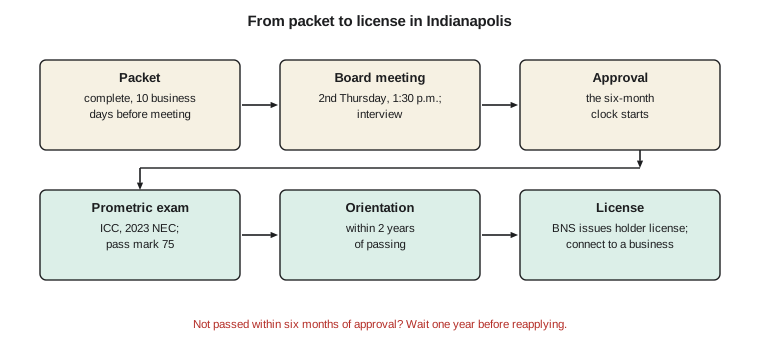
Step 1: build the packet
Lesson 2 listed what the Board wants: the application form, a notarized employer reference letter on letterhead, at least three customer reference letters, a copy of the driver's license, copies of certificates and diplomas, and, for reciprocation, an original letter from the sponsoring building official. Build the packet completely before you submit it. The Board's policies state the rule plainly: incomplete applications are not placed on the agenda. That is the most expensive mistake in the process, because the next chance is the next month's meeting.
Teresa uses a checklist for every packet that leaves Fall Creek's office. She checks that every letter is signed and dated, that the notary block on the employer letter is complete, that dates in different letters agree with each other, that the driver's license is current and that copies are legible. She keeps a scanned copy of everything. If a reviewer has a question, she can answer it the same day instead of trying to remember what was sent.
Step 2: meet the agenda deadline
The Board meets on the second Thursday of each month at 1:30 p.m. Its policies say that completed applications must be received at least ten business days before the meeting to be placed on the agenda. Ten business days is two working weeks, not ten calendar days, so weekends and holidays do not count. If a city holiday falls in those two weeks, the deadline moves earlier.
The calculator below finds the second Thursday of a month and counts back ten business days. It ignores holidays, so a careful applicant subtracts an extra day for each holiday in the window, or simply files a week early.
from datetime import date, timedelta

def second_thursday(year, month):
    d = date(year, month, 1)
    while d.weekday() != 3:          # 3 = Thursday
        d += timedelta(days=1)
    return d + timedelta(days=7)

def back_business_days(d, n):
    while n:
        d -= timedelta(days=1)
        if d.weekday() < 5:          # Monday to Friday
            n -= 1
    return d

for y, m in [(2026, 12), (2027, 1), (2027, 2)]:
    meet = second_thursday(y, m)
    due = back_business_days(meet, 10)
print(f"Meeting {meet:%a %b %d %Y} packet due by {due:%a %b %d %Y}")Meeting Thu Dec 10 2026 packet due by Thu Nov 26 2026 Meeting Thu Jan 14 2027 packet due by Thu Dec 31 2026 Meeting Thu Feb 11 2027 packet due by Thu Jan 28 2027
Aaliyah aimed for the January 2027 meeting. The deadline the program printed falls in late December, in the middle of the holidays, so she gave Teresa a target of December 18 to leave margin for the closed days. She did not want her file to wait until February because of a missing signature.
Step 3: the interview
The Board's policies call for the applicant to be interviewed by the Board. The interview is not a second exam. It is a conversation about the experience in the file: what kinds of work you have done, what you supervised, what you would do in situations a license holder faces. Board members may ask about a gap in the dates, a job title that does not obviously involve installation work, or a letter that describes your work vaguely. Answer directly and specifically. If you ran crews on commercial buildouts, say how many people, what size services and what kinds of buildings.
Bring copies of your packet and anything that supports it. Arrive early. The meeting may have several applicants and other business on its agenda, so you may wait. Aaliyah rehearsed a short description of her career with Ron: five years in a registered apprenticeship, five years as a journeyman and foreman, commercial buildouts up to 800 amperes, and responsibility for permits and inspections on her jobs.
Step 4: approval and booking the exam
If the Board approves the application, the applicant may schedule the exam with Prometric. The policies name the exam provider and the code edition: the Board uses an ICC exam delivered by Prometric, based on the 2023 National Electrical Code, with a passing score of 75. The Board has said that when a new NEC edition is published, it will adopt the most current test within 90 days of its availability, so a candidate who waits a long time after approval may find the exam has moved to a newer edition. Prometric's own instructions cover appointments, test centers, identification and rescheduling, and those instructions change more often than the Board's rules.
The policies set a time limit on the approval. An applicant who does not pass the exam within six months of the Board's approval must wait one year before reapplying. The six months run from the approval, not from the first attempt, so an applicant who books the first attempt late has less time for a retake. Aaliyah booked her first attempt for about six weeks after the January meeting. If she failed, she would still have about four months to study and try again within the six-month window.
| Rule from the Board's 2025 policies | Time | What it means in practice |
|---|---|---|
| Packet received before the meeting | 10 business days | File early; holidays shorten the window |
| Board meeting | Second Thursday, 1:30 p.m. | One chance a month to be approved |
| Pass the exam after approval | Within 6 months | Book the first attempt early to leave time for a retake |
| Not passed in time | 1-year wait | A missed window costs a year, not a month |
| Passing score | 75 | On the 2023 NEC-based ICC exam |
| Schedule orientation after passing | Within 2 years | Later than that requires an oral interview and recent work |
Step 5: orientation and the license
Passing the exam is not the last step. The policies say a passing exam is valid for two years for the purpose of scheduling Board orientation. An applicant who waits more than two years after passing must be interviewed again and must show twelve months of recent work experience. Orientation explains what the Board expects of license holders, including the duties in Lesson 7.
After orientation, the license holder license is issued through BNS contractor licensing. The 2025 contractor packet sets the fee for a new electrical license holder at 377 dollars for applications made from January to June 2026, 283 dollars from July to December 2026 and 189 dollars in 2027, because all licenses expire on December 31 of odd-numbered years and the fee is prorated over the cycle. Renewal is 247 dollars. A sole proprietor pays only the license holder fees; a company also needs a business license, which Lesson 8 covers.
# New license holder fee by application period (BNS packet, rev. 09/2025)
fees = {"Jan-Jun 2026": 377, "Jul-Dec 2026": 283, "2027": 189}
renewal = 247   # every two years; licenses expire Dec 31 of odd years
for period, fee in fees.items():
print(f"Apply {period}: {fee} dollars, then renew Dec 31, 2027 for {renewal}")Apply Jan-Jun 2026: 377 dollars, then renew Dec 31, 2027 for 247 Apply Jul-Dec 2026: 283 dollars, then renew Dec 31, 2027 for 247 Apply 2027: 189 dollars, then renew Dec 31, 2027 for 247
Aaliyah will probably apply for her license holder license in 2027, after orientation, so she expects the 189 dollar fee and a renewal at the end of 2027. The prorated schedule rewards nothing except reading the table carefully: whatever the date, the license expires on the same day as everyone else's.
Other Indiana authorities
Other cities and counties run their own processes. Lafayette's city pages describe its license types, its insurance requirement and its fees, and list a passing exam as one route to a license. Vanderburgh County accepts contractor and journeyman exams delivered by a national testing company and taken in Evansville. Many smaller towns do not run an exam at all and simply register contractors who hold a license from an examining authority. In every case the questions are the same: who receives the application, does a board approve candidates before the exam, which exam and which code edition, what is the passing score, how long does an approval or a pass remain valid, and what happens after a failed attempt. Ask those questions at the counter or by email, and keep the answer in writing.
Do not assume that a pass in one place transfers automatically to another. Lesson 11 explains reciprocity. Here the point is narrower: the application process belongs to the authority, and each authority sets its own steps.
Planning the whole timeline
Put the steps together and the Indianapolis route takes months, not weeks. A packet filed in mid-December reaches the January Board meeting. An approval in January allows a first exam attempt in February or March and a retake by July. Orientation follows a pass, and the license holder license and company paperwork follow orientation. Ron's retirement plan gave Aaliyah about two years, which is comfortable, but a candidate who starts six months before a deadline has no room for a missed agenda or a failed attempt.
Worked problem
A failed first attempt
The Board approves Aaliyah on January 14, 2027. She takes her first attempt on February 24 and scores 71. What are her options, and what is the latest she can pass without starting over?
Show solution
- Find the window. Six months from approval on January 14 ends about July 14, 2027. That date does not move because she failed; the clock started at approval.
- Check the score against the pass mark. The Board's passing score is 75, so 71 is a fail, but a close one. She should study the topic areas her score report shows as weak.
- Book the retake through Prometric, following its current rules on waiting periods and fees between attempts. Those rules are Prometric's, so she reads them rather than assuming.
- Leave margin. She books the retake for early May, which leaves time for a third attempt in June if Prometric's rules and the Board's policies allow it.
- Know the cost of missing the window. If she has not passed by July 14, she must wait one year before reapplying to the Board, then start again with a new packet.
Answer: She has until about July 14, 2027, six months from approval, and should retake early enough to allow another try. Missing the window means a one-year wait, not just a later exam date.
Common mistakes
MistakeSubmitting a packet with one letter missing and expecting a conditional hearing.
InsteadThe Board's policies say incomplete applications are not placed on the agenda.
MistakeCounting ten calendar days before the meeting.
InsteadThe rule is ten business days; weekends and holidays do not count.
MistakeWaiting several months after approval to book the first attempt.
InsteadThe six-month window runs from approval, so a late first attempt leaves little time for a retake.
MistakeTreating a pass as permanent.
InsteadA pass is valid for two years to schedule orientation; after that the applicant needs another interview and recent work.
MistakeCalling Prometric about the Board's eligibility rules.
InsteadEligibility is the Board's decision; Prometric handles exam appointments.
Summary and key terms
- The Indianapolis Board of Electrical Examiners approves candidates before they take the exam.
- Complete packets must reach the Board at least ten business days before its meeting on the second Thursday of the month at 1:30 p.m.
- Approved applicants take a Prometric-delivered ICC exam on the 2023 NEC with a passing score of 75.
- An applicant who does not pass within six months of approval waits one year to reapply.
- A pass is valid for two years to schedule orientation; then BNS issues the license holder license.
- License holder fees are prorated because all licenses expire December 31 of odd-numbered years.
- Agenda deadline
- The date a complete packet must reach the Board to be heard at a meeting.
- Board approval
- The Board's decision that an applicant may sit the exam.
- Prometric
- The testing company that delivers the ICC exam chosen by the Indianapolis Board.
- Orientation
- The Board session a passing applicant attends before the license holder license is issued.
- Prorated fee
- A fee reduced according to how much of the two-year license cycle remains.
Practice problems
Work each problem on paper first, then reveal the answer to check.
An applicant is approved on March 11. By when must she pass the exam?
Show answer
Within six months of approval, so by about September 11.
A candidate passed the exam three years ago and never attended orientation. What does the Board require?
Show answer
An oral interview and twelve months of recent work experience, because a pass is valid only two years for scheduling orientation.
What fee applies to a new license holder who applies in October 2026?
Show answer
283 dollars, under the 2025 BNS packet.
Who should answer a question about test center identification rules?
Show answer
Prometric, through its current candidate instructions.
Lesson quiz · 5 questions
Score 60% or more to complete this lesson.
Create a free account to save your progress, take quizzes and earn a certificate.