
MELU-214 · Lesson 2 of 12 · 20 min
Eligibility for the Local Electrical Contractor Licenses
▶ Video coming soon A video version of this lesson is on the way.
Aaliyah's first real question was the simplest one: am I eligible? She knew she had ten years in the trade, but she did not know how the Indianapolis Board of Electrical Examiners counts experience, what it accepts as proof, or whether her apprenticeship counts for anything extra. Ron told her to read the Board's current policy packet before she asked anyone, because the packet is what the Board applies when it reviews her file. This lesson walks through the Indianapolis requirements in detail and then compares them with the published rules of other Indiana authorities, so that you can see how much they differ and what questions to ask wherever you work.
Remember the main point of Lesson 1. Indiana has no statewide license, so there is no single Indiana eligibility rule. Each licensing authority writes its own. An exam question that asks about Indiana eligibility in general is usually testing whether you know that, or it names a specific city or county. Read the question for the jurisdiction before you read the choices.
The Indianapolis experience requirement
The Board's 2025 policies set the core requirement: at least six years of experience in electrical construction. Electrical construction here means actually performing or supervising the installation of electrical equipment, the kind of work governed by the electrical code. Time spent selling electrical supplies, designing systems from an office or maintaining equipment in a plant without doing installation work may or may not be credited, and the Board decides. If your experience is unusual, describe it carefully in your letters and be ready to explain it at the interview.
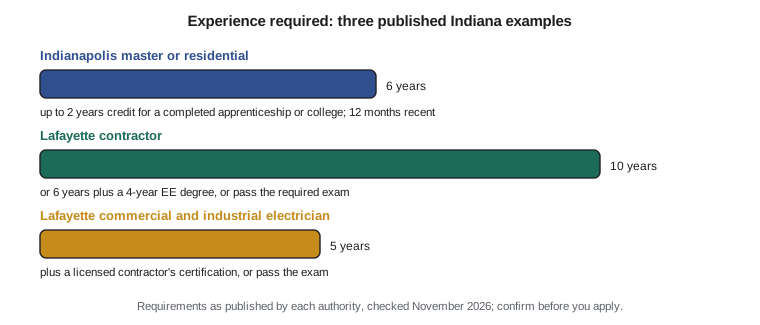
The Board may give credit for education and training. Its policies allow up to two years of credit for related courses at an accredited college, or up to two years for a completed electrical apprenticeship. Read those words carefully. The credit is up to two years, so it is not automatic, and it is for a completed apprenticeship, so an apprenticeship that was started but not finished does not earn it. Aaliyah finished a five-year registered apprenticeship in 2020, so she may ask the Board to credit up to two years toward the six. She does not need the credit, because she has ten years of field experience, but she includes her completion certificate anyway, because it shows the quality of her training.
The Board also wants recent experience. Its policies call for at least twelve months of industry work within the last two years. If current records are not available, the Board will look at documentation covering the last ten years. The purpose is simple: the Board wants to know that the applicant is still working in the trade, not someone who did electrical work long ago and has been away from it since.
How experience is proved
The Board does not accept a candidate's word. Its packet lists the documents it wants. The central item is a notarized letter from the employer, on the employer's original letterhead, giving the start and end dates of employment and describing the job duties. If an employer letter is not available, for example because the applicant was self-employed or the old employer has closed, the Board accepts three letters from supply houses or general contractors who know the applicant's work, together with business license or founding documents. W-2 forms or pay stubs may be added to support the dates.
The packet also asks for at least three signed and dated reference letters from customers who can speak to the applicant's work, a photocopy of the applicant's driver's license, and copies of any certifications, certificates and diplomas. For Aaliyah, that means a letter from Fall Creek describing her years as a journeyman and foreman, letters from her earlier employer, three customer letters from building owners she has worked for, her apprenticeship completion certificate and her driver's license. Teresa reminds her that original letterhead and notarization are required, so an email or a scanned letter without a notary stamp may delay her file.
| Document | What it shows | Common problem |
|---|---|---|
| Notarized employer letter on letterhead | Dates and duties of electrical construction work | Missing notary, missing dates or a vague job description |
| Three supply house or contractor letters (if no employer letter) | Work history for self-employed applicants | Letters that do not describe the applicant's own work |
| Three customer reference letters | Quality of the applicant's work | Unsigned or undated letters |
| Driver's license copy | Identity | Expired license |
| Certificates and diplomas | Training that may earn credit | Apprenticeship not completed |
Master or residential
The Board's policies describe two licenses for individuals. The master license is unrestricted. The residential license is limited to one- and two-family structures. An applicant chooses which exam to apply for, and the license that results follows the exam. A residential license holder who later wants unrestricted work must qualify for and pass the master exam. Fall Creek does commercial buildouts and some small industrial work, so Aaliyah needs the master license. A residential electrician who only wires houses and duplexes might reasonably choose the residential license.
Exam questions often test the scope line. A small apartment building with three or more units is not a one- or two-family structure, so work on it falls outside a residential license. A detached garage serving a single-family house is generally treated as part of that residential property. When a question describes a building, decide first whether it is a one- or two-family structure.
Reciprocation
Some applicants already hold a license from another city or state that tested them on an equivalent exam. The Indianapolis packet has a sixth item for these applicants: an original letter, on letterhead and signed by the local building official of the sponsoring city or state, sent directly to the Board. The letter must verify the details of the Prometric exam the applicant passed, the score, the passing grade, the license status and the reciprocity arrangement. Copies are not accepted. Reciprocation still goes through the Board, so the applicant still submits the other documents and attends the Board meeting. Lesson 11 returns to reciprocity in both directions.
Other Indiana authorities
The City of Lafayette publishes its own requirements, and they show how different Indiana cities can be. Lafayette issues four licenses: a commercial and industrial electrical contractor license, a commercial and industrial electrician license, a residential electrical contractor license and a residential electrician license. For either contractor license, an applicant needs ten or more years of electrical construction experience, or six or more years plus a diploma from a four-year electrical engineering program, or a passing score on the required examination. A commercial and industrial electrician needs five or more years of experience plus certification from a licensed commercial and industrial contractor, or a passing exam. A residential electrician needs four or more years plus certification from a residential contractor, or a passing exam. Lafayette counts buildings with four or more dwelling units as commercial.
Vanderburgh County, which includes Evansville, lists two electrical exams, electrical contractor or master electrician and journeyman electrician, given through a national testing company and taken in Evansville. Fort Wayne contractors are licensed through Allen County, according to secondary sources, which describe transferring a license from another jurisdiction or being sponsored to sit for an approved exam. The details for both places were not confirmed on official pages for this course, so contact the county before you rely on them.
Many towns do not examine anyone. They register contractors who hold a license from an examining authority and ask for an insurance certificate and sometimes a bond. Fall Creek's job at a distribution center in Brookfield Grove, a town invented for this course, works that way: the town registers contractors whose license holder passed an exam in another Indiana jurisdiction, so Aaliyah's Indianapolis license will matter there too.
Comparing the rules
When you compare authorities, look at five things: how much experience is required, what counts as experience, what proof is accepted, whether education or an apprenticeship earns credit, and whether passing an exam can replace experience. The last point is an Indiana oddity. Lafayette's published rules list a passing exam as one of the routes to its licenses, not as an extra step after experience. Indianapolis requires both the experience and Board approval before the exam. The calculator below compares an applicant's years with each rule.
# Compare an applicant with three published rules (years)
field_years = 10
completed_apprenticeship = True
ee_degree = False

def indianapolis(years, appr):
    credit = 2 if appr else 0          # up to 2 years; the Board decides
    return years + credit >= 6

def lafayette_contractor(years, degree):
    return years >= 10 or (degree and years >= 6)   # or pass the exam

def lafayette_ci_electrician(years):
    return years >= 5                   # plus a contractor's certification

print("Indianapolis (6 years):", indianapolis(field_years, completed_apprenticeship))
print("Lafayette contractor (10, or 6 with EE degree):", lafayette_contractor(field_years, ee_degree))
print("Lafayette C/I electrician (5):", lafayette_ci_electrician(field_years))Indianapolis (6 years): True Lafayette contractor (10, or 6 with EE degree): True Lafayette C/I electrician (5): True
Aaliyah meets every rule on experience alone, but her colleague Marcus Bell, a journeyman with six years in the field and no completed apprenticeship, would meet the Indianapolis six-year requirement only if the Board credits all six years. He would not meet Lafayette's ten-year route to a contractor license without the exam route or a degree. Exam questions like this test whether you can apply a specific rule to specific facts.
Worked problem
Counting Caleb's future experience
Caleb Roth is a second-year apprentice at Fall Creek. He plans to finish a five-year registered apprenticeship in 2029 and keep working as a journeyman. In which year could he first meet the Indianapolis six-year experience requirement, and what must his file show?
Show solution
- Count the field years. Caleb started his apprenticeship in 2025, so by the end of 2029 he has five years of electrical construction experience as an apprentice, provided the work was installation work and not shop or warehouse time.
- Add the possible credit. When the apprenticeship is completed, the Board may credit up to two years toward the six. The credit is discretionary, so Caleb should not count on the full two years.
- Work out the safe date. Without any credit, Caleb reaches six years at the end of 2030. With full credit, the Board might find him eligible earlier, but the experience he describes still has to be real installation work.
- Check the recent-work rule. Caleb will be working full time in the trade, so twelve months within the last two years is easy to show.
- List the proof. His file needs a notarized letter from Fall Creek on letterhead with his dates and duties, three customer letters, his driver's license copy and his apprenticeship completion certificate.
Answer: The end of 2030 is the date that does not depend on the Board's discretion; with apprenticeship credit the Board may accept him sooner. Either way his file must document the work in the form the Board asks for.
Notice what the example does not assume. It does not assume the Board will give the maximum credit, and it does not treat the years as interchangeable with hours worked in another trade. Candidates who plan for the conservative date are rarely disappointed. Candidates who apply on the most generous reading of the rule sometimes find their file tabled until they can provide more evidence, and the next Board meeting is a month away. Teresa keeps a simple spreadsheet for every Fall Creek apprentice with start dates, completion dates and the names of supervisors who can sign letters later, because people move and companies close, and the letters are much easier to collect while everyone is still around.
Common mistakes
MistakeCounting an unfinished apprenticeship for the two-year credit.
InsteadThe Board's credit is for a completed electrical apprenticeship, and it is up to two years at the Board's discretion.
MistakeSending an unsigned, unnotarized employer email.
InsteadThe Board asks for a notarized letter on original letterhead with dates and duties.
MistakeForgetting the recent-experience rule.
InsteadIndianapolis wants at least twelve months of industry work within the last two years.
MistakeApplying the Indianapolis rule in Lafayette.
InsteadLafayette publishes its own routes: ten years, six years plus an EE degree, or the exam.
MistakeChoosing the residential exam for commercial work.
InsteadThe residential license is limited to one- and two-family structures; commercial work needs the master license.
Summary and key terms
- Indianapolis requires at least six years of electrical construction experience, with up to two years of credit for related college courses or a completed apprenticeship.
- The Board also wants at least twelve months of industry work within the last two years.
- Proof includes a notarized employer letter on letterhead, three customer references, a driver's license copy and certificates.
- Master licenses are unrestricted; residential licenses cover one- and two-family structures.
- Reciprocation requires an original letter from the sponsoring building official sent directly to the Board.
- Other authorities, such as Lafayette, publish different experience routes, so check each one.
- Electrical construction experience
- Performing or supervising installation of electrical equipment governed by the electrical code.
- Apprenticeship credit
- Up to two years the Indianapolis Board may credit for a completed electrical apprenticeship.
- Recent experience
- At least twelve months of industry work in the last two years, under the Indianapolis policies.
- Reciprocation letter
- An original letter from another jurisdiction's building official verifying the applicant's exam and license.
- Customer reference letter
- A signed, dated letter from a customer describing the applicant's work.
Practice problems
Work each problem on paper first, then reveal the answer to check.
Marcus has six years of field experience and no completed apprenticeship. Does he meet the Indianapolis experience rule?
Show answer
Yes on the number of years, if the Board accepts all six as electrical construction experience; he also needs twelve months of recent work.
An applicant finished a four-year apprenticeship and then worked three more years. How might the Board count it?
Show answer
Three years of experience plus up to two years of credit for the completed apprenticeship, at the Board's discretion, which may or may not reach six.
Which Lafayette license fits a contractor who only wires houses?
Show answer
The residential electrical contractor license.
What makes a building commercial under Lafayette's rules even if it is residential use?
Show answer
Four or more dwelling units.
Lesson quiz · 5 questions
Score 60% or more to complete this lesson.
Create a free account to save your progress, take quizzes and earn a certificate.