
MELU-214 · Lesson 12 of 12 · 24 min
Practice exam review and test-day strategy
▶ Video coming soon A video version of this lesson is on the way.
Aaliyah's exam is close. This final lesson pulls the course together in three parts: a review of the Indiana facts a candidate and future license holder must know cold, a mixed practice set that combines those facts with code skills from the core courses, and a test-day strategy for the Prometric-delivered ICC exam. It ends with what happens after the result and a list of the traps each lesson in this course has warned about.
The Indiana facts to know cold
Start with the structure. Indiana has no statewide electrician license; licensing is local. In Indianapolis, the Board of Electrical Examiners approves candidates and Business and Neighborhood Services licenses both the license holder, who is a person, and the electrical contractor business. The Board offers a master license, which is unrestricted, and a residential license limited to one- and two-family structures. Other authorities, such as Lafayette and Vanderburgh County, set their own rules, and many towns register contractors licensed elsewhere. The technical code, by contrast, is adopted by the state's Fire Prevention and Building Safety Commission in 675 IAC 17.
Then the numbers. Indianapolis applicants need six years of electrical construction experience, with up to two years of credit for a completed apprenticeship or related college courses, and twelve months of work within the last two years. The Board meets on the second Thursday of each month at 1:30 p.m., and complete packets must arrive ten business days before. The exam is an ICC exam by Prometric on the 2023 NEC, and the passing score is 75. An applicant who does not pass within six months of approval waits a year. A pass is valid two years to schedule orientation. All licenses expire December 31 of odd-numbered years, and renewal is 247 dollars per license.
Finally the business and safety rules. The Indianapolis bond is 10,000 dollars, naming the Consolidated City of Indianapolis and/or an Unknown Third Party, and continuous bonds are not accepted. General liability is 500,000 dollars bodily injury and 100,000 property damage, or 500,000 combined, with the City-County as additional insured. A craft license holder may not be connected to more than one partnership, LLC or corporation. Liens are recorded within 90 days after last work, or 60 for Class 2 structures, and suit follows within one year, or 30 days after an owner's demand. IOSHA covers private employers; fatalities are reported in 8 hours and amputations, hospitalizations and eye losses in 24. Workers' compensation reports go to the carrier within seven days.
| Topic | Fact | Lesson |
|---|---|---|
| Statewide license | None in Indiana; licensing is local | 1 |
| Indianapolis eligibility | 6 years; up to 2 years' credit; 12 months recent | 2 |
| Board meeting | Second Thursday, 1:30 p.m.; packet 10 business days before | 3 |
| Exam | ICC by Prometric, 2023 NEC, pass 75; bound book, tabs, ink notes | 4 |
| State code | 675 IAC 17; 2009 edition on the 2008 NEC; 2026 edition proposed | 5 |
| Inspection authority | BNS in Indianapolis; check excluded cities | 6 |
| License holder | Direction, supervision and control; one business | 7 |
| Bond and insurance | 10,000 bond; 500,000 / 100,000 liability | 8 |
| Liens | 90 days (60 Class 2) to record; 1 year to sue; 30 days after demand | 9 |
| Safety | 8 hours fatality, 24 hours hospitalization; carrier in 7 days | 10 |
| Renewal | December 31 of odd years; 247 dollars | 11 |
A mixed practice set
Work these ten problems before reading the answers in the practice section at the end of the lesson. They mix the Indiana facts with code skills. For the code problems, use your own code book and the methods from the core courses.
- 1. A company wants to permit electrical work in Indianapolis. What two licenses must be in place?
- 2. The Board approves an applicant on April 8, 2027. By about what date must she pass the exam?
- 3. Which of these may a candidate bring into an ICC exam: a bound NEC with permanent tabs and ink notes, photocopied code pages, a construction calculator?
- 4. A permit for a dwelling service is issued while the Indiana Electrical Code, 2009 Edition, is in force. Which NEC edition is the code based on?
- 5. A subcontractor's last day of work on a commercial job was April 30, 2027. By when must it record its lien?
- 6. A continuous load of 32 amperes is served by a branch circuit. Using the 1.25 multiplier for continuous loads that the core courses teach, what minimum overcurrent device rating does the calculation give before rounding?
- 7. A worker is hospitalized overnight after a fall at 9 a.m. Monday. By what time must the company report to IOSHA?
- 8. Fall Creek's liability policy is 1,000,000 dollars per occurrence combined. Does it meet the Indianapolis minimum?
- 9. Aaliyah is asked to be the license holder for a second LLC while staying at Fall Creek. Can she?
- 10. A 75 kVA three-phase transformer has a 208 volt secondary. What is the full-load secondary current?
The calculator below checks the arithmetic in problems 2, 5, 6 and 10, which is the kind of quick check worth doing on scratch paper during the exam.
from datetime import date, timedelta

# Problem 2: six months after an April 8, 2027 approval
print("2) pass by about:", date(2027, 10, 8))

# Problem 5: 90 days after an April 30, 2027 last day of work
print("5) record the lien by:", date(2027, 4, 30) + timedelta(days=90))

# Problem 6: continuous load times 1.25
print("6) minimum rating before rounding:", 32 * 1.25, "amperes")

# Problem 10: I = VA / (V x 1.732)
print("10) full-load current:", round(75_000 / (208 * 1.732), 1), "amperes")2) pass by about: 2027-10-08 5) record the lien by: 2027-07-29 6) minimum rating before rounding: 40.0 amperes 10) full-load current: 208.2 amperes
Test-day strategy
The night before, pack what the ICC rules and your Prometric confirmation allow and nothing else: the identification Prometric requires, your bound, tabbed NEC in the edition the exam tests and a basic four-function calculator. No loose papers, no photocopies and no pens, because ICC's rules do not allow writing instruments in the room. Check the route and the parking, and plan to arrive early, because a late arrival can cost the appointment.
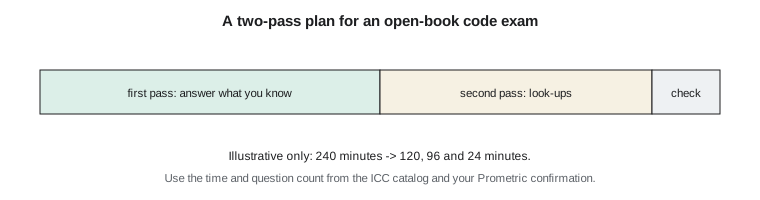
In the room, read the instructions carefully, note the time allowed and calculate your average time per question before you start. Use the two-pass plan from Lesson 4. On the first pass, answer everything you know or can find in one quick look-up, and mark the rest. On the second pass, work the marked questions from the quickest look-up to the slowest. Keep a few minutes at the end to make sure every question has an answer.
Read every question twice. Exam questions often turn on a single word: minimum or maximum, shall or may, dwelling or commercial, continuous or noncontinuous, feeder or branch circuit. Watch the units and the code edition. On the Indianapolis exam, the answer comes from the 2023 NEC, not from the Indiana amendments or the 2008 base edition you may have used on jobs.
If you panic, stop for thirty seconds, breathe, and do one easy question. Then go back to the plan. Aaliyah has practiced timed sets often enough that she knows her pace, and she knows that every candidate meets questions they cannot answer. The pass mark is 75, not 100.
After the exam
If Aaliyah passes, the next steps are Board orientation within two years, then the license holder license through BNS and the change to Fall Creek's business license that connects her as a second holder, as Lesson 7 described. If she does not pass, she checks how much of her six-month window remains, studies the weak areas on her score report, and books a retake under Prometric's current rules. If the window runs out, she waits a year and applies again with a fresh packet.
The exam is also not the only test of the local rules. The Board's interview, before approval, and its orientation, after the pass, are where an Indianapolis candidate shows that she understands the duties of a license holder, the permit process and the business requirements. This course's Indiana facts may never appear on the ICC exam, but they will come up in front of the Board, on the first permit application and on the first renewal. Treat them as part of the license, not as background.
Fall Creek's office has a habit worth copying. After every licensing step, Teresa adds one line to a running log: what was done, on what date and what the next deadline is. When Aaliyah passes, the log will already show the orientation window, the license holder fee for the period and the December 31, 2027 renewal. A license holder who runs a business this way rarely misses a date.
Worked problem
Aaliyah's final week
Seven days before the exam, Aaliyah checks her preparation against this lesson.
Show solution
- She takes one full timed practice set from the core courses in her tabbed, highlighted NEC and reviews every miss.
- She checks that her book is the 2023 edition the exam names, that every tab is permanently attached and that nothing loose is tucked inside.
- She confirms the Prometric appointment, the identification required, the travel time and the calculator model.
- She reviews the Indiana facts table in this lesson, knowing the ICC exam tests the code and the Board's interview and orientation test the local rules.
- She sleeps normally the night before instead of cramming.
Answer: The last week is for consolidation and logistics, not new material.
Common traps, lesson by lesson
Each lesson in this course has a trap that exam writers and Board members like. From Lesson 1, the trap is a statewide license that does not exist. From Lesson 2, it is counting an unfinished apprenticeship or forgetting the twelve months of recent work. From Lesson 3, it is ten calendar days instead of ten business days, or forgetting that the six months run from approval. From Lesson 4, it is a photocopy, a loose note or a construction calculator. From Lesson 5, it is confusing the exam's 2023 NEC with the 2008-based code on the job, or saying the city adopts the electrical code. From Lesson 6, it is assuming every Marion County address belongs to BNS.
The later lessons have traps of their own. From Lesson 7, the trap is a license holder connected to two companies, or a business permitting work after its only holder leaves. From Lesson 8, it is a continuous bond, a declarations page or the wrong named party. From Lesson 9, it is using 90 days on a Class 2 structure, ignoring an owner's 30-day demand or trusting a no-lien clause on a commercial job. From Lesson 10, it is assuming federal OSHA covers Indiana private employers, or that small employers need not report. From Lesson 11, it is renewing on an anniversary instead of December 31 of an odd year.
Aaliyah turned the list into flash cards: the trap on one side, the rule and the lesson number on the other. In her last week she shuffled them each evening and set aside any card she hesitated on for a second look the next morning.
Common mistakes
MistakeSpending ten minutes on one look-up early in the exam.
InsteadMark it and return on the second pass.
MistakeLeaving questions blank.
InsteadAn unanswered question is always wrong; a reasoned guess may be right.
MistakeTucking a formula card inside the book.
InsteadLoose papers are prohibited; notes must be written in the book in ink.
MistakeAnswering from the 2008 NEC because that is the Indiana base.
InsteadThe Indianapolis exam tests the 2023 NEC.
MistakeCramming the night before.
InsteadRest and logistics matter more in the final hours.
Summary and key terms
- Know the Indiana structure: local licensing, the Indianapolis Board and BNS, other authorities, and the state Commission's code.
- Know the Indianapolis numbers: six years, ten business days, the second Thursday, 75 to pass, six months, two years, December 31 of odd years.
- Know the bond, insurance, lien, safety and workers' compensation rules and their deadlines.
- Bring only what ICC and Prometric allow: a bound, tabbed NEC with ink notes, identification and a basic calculator.
- Use a two-pass plan, read every question twice and answer every question.
- After the result, schedule orientation and connect to the business, or retake within the six-month window.
- Two-pass plan
- Answer known questions first, then return to look-ups.
- Average time per question
- Total time divided by the number of questions.
- Score report
- The result Prometric gives, often showing strengths and weaknesses by topic.
- Orientation
- The Board session a passing candidate attends before licensing.
- Standard size
- A listed overcurrent device rating; calculated values are often rounded up to one.
Practice problems
Work each problem on paper first, then reveal the answer to check.
Problem 1 answer.
Show answer
A business license for the company and a license holder license for a person who passed the exam and is connected to it; then a permit for the job.
Problem 2 answer.
Show answer
About October 8, 2027, six months from approval; otherwise a one-year wait.
Problem 3 answer.
Show answer
Only the bound NEC with permanent tabs and ink notes; photocopies and construction calculators are not allowed.
Problem 4 answer.
Show answer
The 2008 NEC, with Indiana amendments.
Problem 5 answer.
Show answer
Within 90 days after April 30, 2027: by July 29, 2027.
Problem 6 answer.
Show answer
32 x 1.25 = 40 amperes before rounding; check the standard sizes and the code's rules in your book.
Problem 7 answer.
Show answer
Within 24 hours: by 9 a.m. Tuesday.
Problem 8 answer.
Show answer
Yes; 1,000,000 combined exceeds the 500,000 combined minimum, and the certificate must name the City-County as additional insured.
Problem 9 answer.
Show answer
No; a craft license holder may not be connected to more than one partnership, LLC or corporation.
Problem 10 answer.
Show answer
75,000 / (208 x 1.732) is about 208.2 amperes.
Lesson quiz · 5 questions
Score 60% or more to complete this lesson.
Create a free account to save your progress, take quizzes and earn a certificate.