
MELU-214 · Lesson 5 of 12 · 19 min
Local code adoption and amendments in Indiana
▶ Video coming soon A video version of this lesson is on the way.
Indiana licenses electricians locally, but it adopts its electrical code at the state level. That combination surprises people who come from states where the opposite is true. The city that licensed Aaliyah does not write its own electrical code; it enforces the code the state has adopted. This lesson explains how Indiana adopts building codes, which edition of the NEC the Indiana Electrical Code is based on, how a newer edition was being prepared, what local governments can and cannot change, and why the edition on the job may differ from the edition on the exam.
A state code, enforced locally
Indiana's building codes are adopted by the Fire Prevention and Building Safety Commission, a state body whose rules appear in Title 675 of the Indiana Administrative Code, IAC. The Indiana Department of Homeland Security, through its fire and building safety division, supports the Commission and publishes its rules. The electrical code is Article 17 of Title 675, usually cited as 675 IAC 17. Because the rules are state rules, the same electrical code applies across the state, in Indianapolis, in Lafayette, in Evansville and in a small town.
Enforcement is a different matter. Cities, towns and counties that have building departments issue permits and inspect work under the state rules. They adopt the state codes by local ordinance so that they can enforce them, and they add local administrative rules: permit procedures, fees, inspection scheduling and contractor licensing. In general, local governments may not adopt technical rules that conflict with the state's building rules unless the Commission approves them. The practical result is one technical code with many local administrative wrappers.
Compare that with Lesson 1. Licensing is local because Indiana has no statewide license. Code adoption is statewide because the Commission adopts the rules. An exam question that mixes the two, such as asking which agency adopts the electrical code in Indianapolis, is testing whether you keep them apart. The answer is the state Commission, not the city.
The Indiana Electrical Code, 2009 Edition
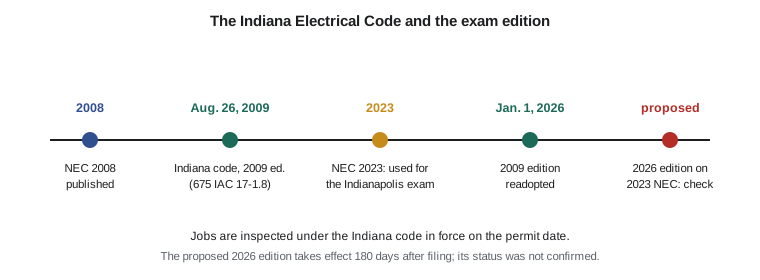
The rule in force when this course was written is 675 IAC 17-1.8, titled the Indiana Electrical Code, 2009 Edition. It adopts the 2008 edition of the National Electrical Code, NFPA 70, with Indiana amendments. It took effect on August 26, 2009. Indiana rules expire unless they are readopted, and a list of Indiana codes kept by a code consulting firm shows the electrical code readopted with an effective date of January 1, 2026. Readoption keeps the existing rule in force; it does not by itself adopt a newer NEC.
That means an Indiana job inspected under the state code may be judged by rules based on the 2008 NEC. Many requirements that electricians now take for granted, such as some of the expanded GFCI and AFCI rules, surge protection for dwelling services and outdoor emergency disconnects for one- and two-family dwellings, came into the NEC after 2008. Unless the Indiana amendments or a later rule added them, they may not be required on an Indiana job, even though they appear on the exam.
The proposed 2026 edition
The state has prepared a new electrical code. A final-rule reading draft published by the Department of Homeland Security would adopt the 2023 NEC as the Indiana Electrical Code, 2026 Edition, with Indiana amendments, and would take effect 180 days after it is filed. The draft seen for this course had a blank filing number, so this course could not confirm whether, or when, the new edition took effect. Before you rely on either edition, check the Commission's rules page or ask the local building department which edition it enforces on the date of your permit.
The draft also shows the kinds of changes Indiana makes when it adopts an NEC edition. Its amendments include rules on enforcement, tying Article 90 to Indiana law and the Commission's administrative rules; changes to the GFCI requirements in 210.8(A); a rule on foyer receptacles in 210.52(I); deletion of the feeder surge protection rule in 215.18 and the dwelling emergency disconnect rule in 230.85; a change to ground rod diameter in 250.52(A)(5); separation of wiring from corrugated stainless steel tubing gas piping in 300.3(D); limits on extending knob-and-tube wiring in 394.10; and changes to pool bonding in 680.26 and to battery storage in 706.1. The final text may differ from the draft, so treat this list as an illustration of Indiana's approach, not as the rules in force.
| Edition | Based on | Status as checked for this course | Where it matters |
|---|---|---|---|
| Indiana Electrical Code, 2009 Edition (675 IAC 17-1.8) | 2008 NEC with Indiana amendments | In force; readopted effective January 1, 2026 | Permits and inspections on Indiana jobs |
| Indiana Electrical Code, 2026 Edition (proposed) | 2023 NEC with Indiana amendments | Final-rule draft; effective 180 days after filing; status not confirmed | Future permits once in force |
| 2023 NEC (unamended) | NFPA 70 | Named in the Indianapolis Board's 2025 policies | The licensing exam |
How a new edition becomes law
Adopting a new code edition in Indiana is a rulemaking, not a vote of a city council. In general terms, the Commission publishes notice of the proposed rule in the Indiana Register, takes public comment and holds a hearing, adopts the final text, and sends it for legal review by the Attorney General and approval by the Governor before it is filed. The rule takes effect on the date the rule states, which for the electrical code draft is 180 days after filing. The delay gives designers, contractors and inspectors time to buy the new book and learn the changes before permits are judged by it.
Two practical points follow. First, a published draft is not law. Contractors sometimes hear that the state has adopted a new edition when it has only proposed one, and they change their designs too early or tell a customer something that is not yet true. Second, the effective date usually applies to permits applied for on or after that date. A job permitted the day before stays under the old edition, even if it is inspected months later. That is why Teresa records the permit date with each job, and why an inspector's first question about an unusual installation is often when the permit was issued.
Why the gap matters
The exam and the job use different books. The Indianapolis exam tests the 2023 NEC as published by NFPA, without Indiana amendments. The job is inspected under the Indiana Electrical Code. A licensed master must be able to do both: answer exam questions from the 2023 NEC, and design and install work that passes inspection under the state's adopted edition with its amendments.
In practice, many contractors install to the newer NEC where it is stricter, because it reflects current safety thinking and because a customer may later ask why a newer protection was not provided. That is a business decision. What the contractor may not do is install to an older or weaker rule than the adopted code requires, or skip an Indiana amendment because the newer NEC does not contain it. Where the adopted code is stricter, the adopted code governs.
Worked problem
Which rule governs?
Fall Creek is replacing the service on the Irvington bungalow. Caleb asks whether the job needs a surge protective device and an outdoor emergency disconnect, because his apprenticeship classes covered both from the 2023 NEC.
Show solution
- Identify the adopted code. Teresa checks the permit and the city's adopted code page. If the job is permitted under the Indiana Electrical Code, 2009 Edition, the base is the 2008 NEC.
- Check whether the requirement exists in the adopted edition. The dwelling surge protection rule and the outdoor emergency disconnect rule were added to the NEC after 2008, so they are not in the 2008 base unless an Indiana amendment added them.
- Check the proposed edition. The 2026 Indiana draft would delete the emergency disconnect rule in 230.85 and the feeder surge rule in 215.18. The dwelling service surge rule in 230.67 is not on the deletion list summarized in this lesson, so under the newer edition it may well apply. Teresa notes the question for the inspector.
- Decide with the customer. Fall Creek may offer a surge protective device as an option, and many owners choose it. The decision is recorded in the proposal.
- Answer the exam differently. On the 2023 NEC exam, the answer to a question about dwelling surge protection comes from the 2023 NEC, where the requirement exists.
Answer: The job follows the adopted Indiana code on the permit date; the exam follows the 2023 NEC. Know both, and do not mix them.
What local governments add
Cities and counties cannot rewrite the technical rules on their own, but they control a great deal: whether a permit is needed for a particular job, how permits are applied for, what plans must be submitted, when and how inspections are scheduled, what fees are charged and who may pull permits. Lesson 6 covers permits and inspections. The local rules are found in each authority's code of ordinances and on its building department pages. In Indianapolis, the Revised Code of the Consolidated City and County contains the city's licensing and permit provisions, which Business and Neighborhood Services administers.
When a local government wants a different technical rule, it generally asks the Commission. The Commission also hears requests for variances from its rules, for a specific building where strict compliance is impractical. A contractor that wants to do something the code does not allow should not rely on an inspector's informal agreement. The formal route is a variance, applied for in the manner the Commission sets.
Questions to ask a building department
When Teresa sets up a new town in Fall Creek's job reference, she asks the same questions by email so that she has the answers in writing. Which edition of the Indiana Electrical Code do you enforce today, and is the 2026 edition in effect? Do you require a permit for this type of work? Who may apply for the permit: only a licensed or registered contractor, or also a homeowner? How are inspections requested, and how much notice is needed? Are there local requirements for contractor registration, insurance or bonds? Is there a fee schedule? Who is the electrical inspector? The last answer is often the most useful one, because a short conversation with the inspector before a job can settle an interpretation that would otherwise surface as a failed inspection.
# Which book for which question?
situations = [
    ("Exam question on dwelling surge protection", "2023 NEC (exam edition)"),
    ("Permit inspection of a 2026 service change", "Indiana Electrical Code in force on the permit date"),
    ("Who adopts the electrical code in Indianapolis?", "Fire Prevention and Building Safety Commission (675 IAC 17)"),
    ("Who issues the electrical permit in Indianapolis?", "Business and Neighborhood Services"),
]
for question, source in situations:
print(f"{question}\n -> {source}")Exam question on dwelling surge protection -> 2023 NEC (exam edition) Permit inspection of a 2026 service change -> Indiana Electrical Code in force on the permit date Who adopts the electrical code in Indianapolis? -> Fire Prevention and Building Safety Commission (675 IAC 17) Who issues the electrical permit in Indianapolis? -> Business and Neighborhood Services
Common mistakes
MistakeSaying Indianapolis adopts its own electrical code.
InsteadThe Fire Prevention and Building Safety Commission adopts the Indiana Electrical Code in 675 IAC 17; the city enforces it.
MistakeAssuming the 2023 NEC is the code on Indiana jobs because the exam uses it.
InsteadThe 2009 Indiana Electrical Code, based on the 2008 NEC, was in force unless the 2026 edition has taken effect.
MistakeTreating readoption as adoption of a newer NEC.
InsteadReadoption keeps the existing rule in force; a new edition needs a new rule.
MistakeRelying on the draft's amendment list as final law.
InsteadThe final text may differ; check the rule as filed.
MistakeRelying on an inspector's informal permission to depart from the code.
InsteadDepartures need a variance through the Commission's process.
Summary and key terms
- Indiana's Fire Prevention and Building Safety Commission adopts building codes statewide in Title 675 IAC; the electrical code is 675 IAC 17.
- The Indiana Electrical Code, 2009 Edition, adopts the 2008 NEC with Indiana amendments, effective August 26, 2009, and was readopted effective January 1, 2026.
- A final-rule draft would adopt the 2023 NEC as the 2026 Edition, effective 180 days after filing; check whether it is in force.
- Local governments enforce the state code and set administrative rules, but generally cannot change technical rules without the Commission.
- The Indianapolis exam tests the 2023 NEC, so the exam edition and the job edition may differ.
- Departures from the code for a specific building require a variance.
- Fire Prevention and Building Safety Commission
- The Indiana state body that adopts building and fire codes.
- 675 IAC 17
- The article of the Indiana Administrative Code containing the Indiana Electrical Code.
- Readoption
- Renewing an existing rule so it does not expire, without changing its content.
- Indiana amendment
- A change the state makes to the NEC when it adopts it.
- Variance
- Permission from the Commission to depart from a rule for a specific building.
Practice problems
Work each problem on paper first, then reveal the answer to check.
Which NEC edition does the Indiana Electrical Code, 2009 Edition, adopt?
Show answer
The 2008 NEC, with Indiana amendments.
Who adopts the electrical code that applies in Lafayette?
Show answer
The state's Fire Prevention and Building Safety Commission; Lafayette enforces it.
A town wants a stricter receptacle rule. What does it generally need?
Show answer
Approval from the Commission, because local governments generally cannot change the state's technical rules on their own.
How long after filing would the proposed 2026 edition take effect?
Show answer
180 days, according to the draft.
Lesson quiz · 5 questions
Score 60% or more to complete this lesson.
Create a free account to save your progress, take quizzes and earn a certificate.