
MELU-214 · Lesson 8 of 12 · 19 min
Contractor licensing, insurance and bonding
▶ Video coming soon A video version of this lesson is on the way.
A master license qualifies a person. A business also needs its own license, insurance and, in many places, a bond before it can permit work. This lesson covers the business side of licensing in Indianapolis in detail, from the business license and its fees to the bond form, the liability certificate and workers' compensation, and then compares Lafayette and other Indiana authorities. It finishes with the coverage a careful contractor carries beyond the minimums and the business registrations that sit alongside the licenses.
The Indianapolis electrical contractor business license
Business and Neighborhood Services licenses electrical contractor businesses through its contractor licensing packet. The packet requires that the business have at least one electrical license holder who passed the required exam, and that each license holder be connected to the business license, as Lesson 7 explained. The business submits the application with the bond, the insurance certificates and the fees, by email or by mail, and the packet warns that incomplete packets are returned. Returned packets cost time, and a business cannot permit work while it waits.
All Indianapolis contractor licenses expire on December 31 of odd-numbered years and are renewed every two years, so fees for new licenses are prorated by when the application is made. Under the packet revised in September 2025, a new business license costs 247 dollars from January to June 2026, 185 dollars from July to December 2026 and 124 dollars in 2027. Renewal is 247 dollars. A new license holder license costs 377, 283 or 189 dollars over the same periods, and renewal is 247 dollars. A business may list authorized agents, and the packet charges 63 dollars for each agent beyond five. Sole proprietors pay only the license holder fees, not a separate business fee.
# Fall Creek's 2027 renewal cost (BNS packet, rev. 09/2025)
business_renewal = 247
holder_renewal = 247
holders = 2            # Ron and Aaliyah during the overlap
agents = 6             # people authorized to act for the business
extra_agent_fee = 63   # each agent beyond five
total = business_renewal + holders * holder_renewal + max(0, agents - 5) * extra_agent_fee
print(f"Business {business_renewal} + holders {holders * holder_renewal} + extra agents {max(0, agents - 5) * extra_agent_fee}")
print(f"Total due by December 31, 2027: {total} dollars")Business 247 + holders 494 + extra agents 63 Total due by December 31, 2027: 804 dollars
The bond
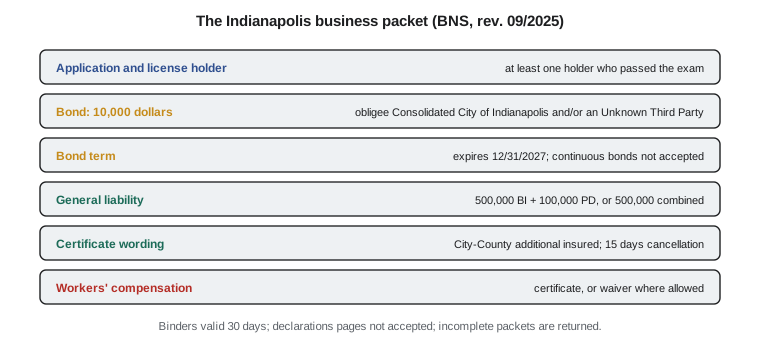
The packet requires a 10,000 dollar license bond, on the city's form, with a specific obligee: the Consolidated City of Indianapolis and/or an Unknown Third Party. The obligee is the party the bond protects. Naming an unknown third party means the bond can protect members of the public harmed by the contractor's failure to follow the city's rules, not only the city itself. The packet also requires the bond to run to a specific expiration date, December 31, 2027 for the current cycle, matching the license, and says continuous bonds are not accepted. A bond with the wrong obligee, a different amount or a continuous term will be returned.
A license bond is not insurance for the contractor. If a surety pays a claim on the bond, it expects the contractor to repay it. The bond is a promise by the surety that the contractor will comply with the law, backed by the contractor's own promise to make the surety whole. Contractors buy bonds from surety companies, usually through insurance agents, and pay a premium that depends on the bond amount and the contractor's credit.
General liability insurance
The packet sets minimum general liability limits of 500,000 dollars per occurrence for bodily injury and 100,000 dollars for property damage, or 500,000 dollars combined single limit. The certificate must name the City-County as an additional insured and must provide 15 days' notice of cancellation. The packet accepts insurance binders for only 30 days and does not accept declarations pages in place of a certificate. These details are where packets fail. An agent who sends a declarations page, forgets the additional insured wording or leaves off the cancellation notice has sent something the city will not accept.
General liability insurance covers claims by third parties for bodily injury and property damage caused by the contractor's operations or completed work. It does not cover injuries to the contractor's own employees, which workers' compensation covers, and it generally does not cover the cost of redoing faulty work itself, as opposed to damage the faulty work causes. A contractor should read the policy's exclusions with the agent, not just the limits.
Workers' compensation
The packet requires workers' compensation coverage for businesses with employees working in Marion County. A business with no employees may qualify for a waiver: the packet describes waivers for sole proprietors, partnerships and LLCs with no employees, and says corporations must cover the owner or provide an exemption clearance. Fall Creek has nine employees, so it needs a workers' compensation policy and a certificate showing it. Lesson 10 explains how Indiana's workers' compensation system works when someone is hurt.
| Item | Indianapolis requirement (BNS packet, rev. 09/2025) | Common reason a packet is returned |
|---|---|---|
| License bond | 10,000 dollars; obligee Consolidated City of Indianapolis and/or an Unknown Third Party; expires 12/31/2027 | Continuous bond or wrong obligee |
| General liability | 500,000 bodily injury and 100,000 property damage, or 500,000 combined | Limits too low or declarations page sent |
| Additional insured | City-County named on the certificate | Missing endorsement wording |
| Cancellation notice | 15 days | Not shown on the certificate |
| Binder | Accepted for 30 days only | Binder not replaced by a certificate |
| Workers' compensation | Required for employees in Marion County; waivers for some owners | No certificate and no waiver |
Lafayette
Lafayette's city pages require its electrical contractors to carry general liability insurance of at least 250,000 dollars to get and to renew a license. The page lists fees of 200 and 100 dollars for the commercial and industrial electrical contractor license and 150 and 75 dollars for the residential contractor license, which we read as the new and renewal fees, with smaller fees for the electrician licenses. Lafayette licenses renew annually, and the page lists a 25 dollar late fee. Fall Creek holds a Lafayette commercial and industrial contractor license for its warehouse office job, so Teresa keeps two renewal calendars: the city of Lafayette every year, and Indianapolis every odd-numbered year.
Other authorities
Outside Indianapolis and Lafayette, requirements vary. Secondary sources describe contractors in Fort Wayne being licensed through Allen County and generally carrying a bond, but this course did not confirm the amount on an official page. Many towns that register contractors licensed elsewhere ask for a certificate of insurance naming the town and sometimes a bond. The pattern is the same everywhere: a bond on the authority's form or terms, a liability certificate with the authority's wording, and proof of workers' compensation. Read each authority's current packet and send exactly what it asks for.
Worked problem
Registering in Brookfield Grove
Brookfield Grove, the invented town, asks Fall Creek for proof of an examining authority license, a certificate of general liability insurance naming the town as certificate holder and additional insured, proof of workers' compensation and a registration fee. Teresa has the certificates the Indianapolis packet required. What must she change?
Show solution
- She sends a copy of the Indianapolis business license and Ron's license holder license as proof of the examining authority license.
- She asks the insurance agent for a new certificate naming Brookfield Grove, because the Indianapolis certificate names the City-County, not the town.
- She checks that the liability limits meet the town's minimums, which may differ from Indianapolis's.
- She sends the workers' compensation certificate, which can be issued to the town as certificate holder.
- She adds the town's registration expiry date to the renewal calendar.
Answer: Each authority needs its own certificate naming it. The coverage can be the same policy; the paperwork must be specific to the town.
When a claim comes in
It helps to see how the bond and the insurance respond to different problems. Suppose a Fall Creek crew drills through a water line while installing a ceiling box at the Mass Ave coffee shop, and the water ruins the tenant's new flooring. That is property damage to a third party caused by the contractor's operations, the classic general liability claim. Teresa reports it to the agent at once, before anyone agrees to pay anything, because policies require prompt notice and give the insurer the right to handle the claim.
Suppose instead that Caleb cuts his hand badly on the same job. That is an injury to an employee, so workers' compensation responds, not general liability, and Lesson 10 explains the reporting deadlines. Suppose, finally, that a customer complains to the city that Fall Creek took a deposit for a job it never permitted or performed, in breach of the city's rules. That is the kind of situation a license bond exists for. If the surety pays, Fall Creek must repay the surety, and BNS may also act against the licenses.
| What happened | What usually responds | First step |
|---|---|---|
| Crew damages a tenant's flooring | General liability | Notify the agent and insurer promptly |
| Apprentice cuts his hand | Workers' compensation | First aid or treatment, then report to the carrier |
| Customer claims the contractor broke licensing rules | License bond (surety may seek repayment) | Notify the surety and get advice |
| Van rear-ends a car on the way to a job | Commercial auto | Report to the auto insurer |
| Tools stolen from a job site | Inland marine or equipment coverage | Police report, then the insurer |
Keep the certificates current, too. Policies renew on their own dates, which rarely match the license cycle. When Fall Creek's liability policy renews each spring, the agent issues new certificates, and Teresa sends updated certificates to BNS, Lafayette and every town where Fall Creek is registered. An authority that holds an expired certificate may treat the contractor as uninsured, and the 15-day cancellation notice in the Indianapolis packet means the city will hear quickly if a policy is canceled.
Insurance beyond the minimums
Minimum limits are what the city requires, not what a careful contractor carries. A single serious injury or fire can produce a claim larger than 500,000 dollars. Many contractors carry higher limits and an umbrella or excess policy. Commercial auto insurance covers the vans; personal auto policies generally do not cover business vehicles. Inland marine or equipment coverage protects tools and materials on job sites and in vans. Some general contractors and owners require higher limits, additional insured endorsements and waivers of subrogation in their contracts, and Lesson 9 explains how to read those clauses. Teresa reviews coverage with Fall Creek's agent every year, before the renewal, and whenever a contract asks for something unusual.
Business registration and taxes
The licenses sit alongside the company's other registrations. An Indiana LLC is formed with the Indiana Secretary of State and must keep its business entity reports current. A company with employees registers for state withholding and unemployment insurance, and collects and remits sales tax where Indiana law requires it on materials. These obligations are not part of the electrical license, but a lapsed entity registration can cause problems with contracts, bonds and insurance. Indianapolis's packet asks for business details that must match the company's registrations exactly, so Teresa uses the legal name, Fall Creek Electric, LLC, on every form.
Common mistakes
MistakeSending a continuous bond.
InsteadThe Indianapolis packet requires a bond expiring December 31, 2027 and does not accept continuous bonds.
MistakeSending a declarations page instead of a certificate.
InsteadThe packet does not accept declarations pages.
MistakeLeaving off the City-County as additional insured.
InsteadThe certificate must name the City-County as an additional insured.
MistakeTreating a bond as insurance for the contractor.
InsteadThe surety expects the contractor to repay any claim it pays.
MistakeReusing the Indianapolis certificate in another town.
InsteadEach authority needs a certificate naming it, with its own limits.
Summary and key terms
- Indianapolis requires an electrical contractor business license connected to at least one license holder who passed the exam.
- All Indianapolis contractor licenses expire December 31 of odd-numbered years; new license fees are prorated.
- The bond is 10,000 dollars, naming the Consolidated City of Indianapolis and/or an Unknown Third Party, expiring December 31, 2027; continuous bonds are not accepted.
- General liability minimums are 500,000 bodily injury and 100,000 property damage, or 500,000 combined, with the City-County as additional insured and 15 days' cancellation notice.
- Workers' compensation is required for employees in Marion County, with waivers for some owners.
- Lafayette requires at least 250,000 dollars of general liability and annual renewal.
- License bond
- A surety's promise that a contractor will comply with licensing laws, protecting the obligee.
- Obligee
- The party a bond protects.
- Additional insured
- A party added to a liability policy's protection by endorsement.
- Certificate of insurance
- A document summarizing coverage, issued to a certificate holder.
- Binder
- Temporary proof of coverage until the policy or certificate is issued.
Practice problems
Work each problem on paper first, then reveal the answer to check.
What bond amount does the Indianapolis packet require?
Show answer
10,000 dollars, on the stated terms.
The agent sends a declarations page. What will BNS do?
Show answer
Not accept it; the packet requires a certificate.
Fall Creek renews in 2027 with two license holders and six agents. What is the total under the packet?
Show answer
247 plus 2 times 247 plus 63, which is 804 dollars.
What liability minimum does Lafayette publish?
Show answer
250,000 dollars.
Lesson quiz · 5 questions
Score 60% or more to complete this lesson.
Create a free account to save your progress, take quizzes and earn a certificate.