
MELU-213 · Lesson 9 of 12 · 19 min
Contracts and mechanics' liens in Illinois
▶ Video coming soon A video version of this lesson is on the way.
Electrical work is sold by contract and, when things go wrong, collected by lien. A supervising electrician who will help run a company needs to understand both. This lesson covers the basics of construction contracts for an Illinois electrical contractor and the Illinois Mechanics Lien Act, the state law that lets contractors and suppliers secure payment by a claim against the property they improved. The lien deadlines here come from the statute as summarized by an Illinois law firm and checked in November 2026. Lien rules are strict and technical: use this lesson to understand the system, and use the statute and an Illinois attorney for any real claim.
Contracts: what a good one says
A construction contract defines the job and allocates its risks. At minimum, a good electrical contract identifies the parties and the property, describes the scope of work clearly, often by reference to drawings and specifications, states the price and how it will be paid, sets the schedule, and explains how changes will be handled. It should also address permits, inspections and who pays for them, insurance requirements, warranties, what happens if the job is delayed or the owner stops paying, and how disputes are resolved. The more of these the contract settles in advance, the fewer arguments there are at the end.
Kedzie's work comes in three contract forms. On residential jobs, the company contracts directly with the owner, often using its own short form. On commercial buildouts, it is a subcontractor to a general contractor under the general contractor's subcontract form, which usually passes down many of the general contractor's obligations to the owner. And on some service work, it works under purchase orders or time-and-material agreements. Each form puts the company in a different position for payment and liens, as this lesson explains.
Change orders deserve special attention because they cause most payment disputes. A change order is a written agreement to change the scope, price or schedule after the contract is signed. Kevin's rule is simple: no extra work without a signed change order, except in a genuine emergency, and then a written confirmation the same day. A crew that adds outlets because the owner asked on site, without paperwork, has given away the company's money and weakened its lien rights.
Home improvement contracts
Work on homes brings additional rules. Illinois has a home repair and remodeling law that, in general terms, requires a written contract for home repair and remodeling work above a stated dollar amount and requires contractors to give homeowners a consumer information pamphlet, among other duties. The statute's thresholds and requirements change from time to time and were not checked for this course, so read the current law before relying on a figure. Chicago and other towns may add their own consumer protection rules. The practical point is that residential contracts should always be in writing, with the price, the scope and the homeowner's signature.
What a mechanics lien is
A mechanics lien is a claim against real property that secures payment for labor or materials that improved it. If an owner, or a contractor above you, does not pay for work that went into a building, a lien gives you a way to look to the property itself for payment: in the end, a court can order the property sold to pay valid lien claims. In Illinois, the right comes from the Mechanics Lien Act, found at 770 ILCS 60. Liens are powerful because owners, lenders and buyers want clear title, so a recorded lien often prompts payment without a lawsuit. They are also unforgiving: miss a deadline or a required notice, and the right can be lost.
The Act treats two kinds of claimants differently. A contractor is a party with a contract directly with the owner. A subcontractor is a party whose contract is with someone other than the owner, such as a general contractor; suppliers can fall into this group as well. Kedzie is a contractor on its residential jobs and a subcontractor on its commercial buildouts, so it must follow different notice rules on different jobs.
The key deadlines
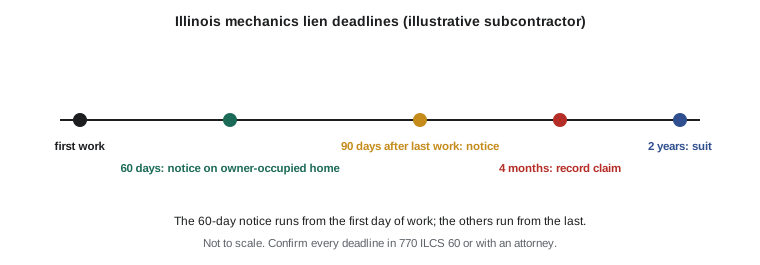
The Act's deadlines are the heart of the system. As summarized by the law firm whose article was checked for this course, a lien claim must be recorded with the county recorder within four months after the last day of work for the claim to be effective against third parties such as lenders and buyers. A subcontractor must also serve a notice on the owner within 90 days after its last day of work, by certified mail with return receipt requested or by personal service; the article notes that this notice may not be required if the general contractor's sworn statement listed the subcontractor, but recommends serving it anyway. On an owner-occupied single-family residence, a subcontractor must serve a notice within 60 days after its first day of work, with specific statutory wording, on the owner with a copy to the general contractor. A suit to foreclose the lien must be filed within two years after the last day of work. And an owner may serve a written demand requiring a claimant to sue within 30 days, after which a claimant who has not sued loses the lien.
Look at how the clocks start. The 60-day residential notice runs from the first day of work, the others from the last. A subcontractor that waits until a residential job goes bad to think about liens may already have missed the first notice. Kevin's company now treats the 60-day notice as part of starting any subcontract on an owner-occupied house.
| Deadline | Who | Runs from | What |
|---|---|---|---|
| 60 days | Subcontractor, owner-occupied single-family home | First day of work | Owner notice, copy to general contractor |
| 90 days | Subcontractor | Last day of work | Owner notice by certified mail or personal service |
| 4 months | Claimant | Last day of work | Record the lien claim to bind third parties |
| 2 years | Claimant | Last day of work | File suit to foreclose the lien |
| 30 days | Claimant | Owner's written demand | Sue or lose the lien |
from datetime import date, timedelta

# Illustrative lien calendar for a subcontractor (check the statute and a lawyer for real claims)
first_day = date(2026, 3, 2)
last_day = date(2026, 6, 19)
owner_occupied_home = True

def add_months(d, n):
    m = d.month - 1 + n
    y, m = d.year + m // 12, m % 12 + 1
    return date(y, m, min(d.day, 28))   # simplified month arithmetic

if owner_occupied_home:
    print("60-day residential notice due by:", first_day + timedelta(days=60))
print("90-day subcontractor notice due by:", last_day + timedelta(days=90))
print("Record claim within 4 months, by about:", add_months(last_day, 4))
print("Suit within 2 years, by about:", add_months(last_day, 24))60-day residential notice due by: 2026-05-01 90-day subcontractor notice due by: 2026-09-17 Record claim within 4 months, by about: 2026-10-19 Suit within 2 years, by about: 2028-06-19
The program simplifies month arithmetic and ignores weekends and holidays. Real deadlines depend on the statute's exact wording and on how courts count days; treat the output as a reminder to act early, not as a legal calculation.
Documenting the dates that start the clocks
Because most deadlines run from the last day of work, the date itself becomes evidence. Disputes often turn on whether a late visit counted: was it real contract work, or a trivial return trip, such as replacing a cover plate, made to stretch the deadline? Courts look at the substance of the work, so a contractor cannot rescue a missed deadline by sending someone back to tighten a screw. The safer path is to record the first and last days of real work as they happen. Kevin's foremen log daily what was done at each job, and the log, the time cards and the final inspection date together show when the work actually ended.
The first day of work matters for the residential notice, and it matters for planning. Beth now opens a lien calendar for every subcontract the day the crew arrives, with the notice dates already filled in. If the job pays on time, the calendar entries are simply deleted. If it does not, the company is already on track.
Sworn statements and waivers
Illinois construction payments run on paperwork. Owners and lenders commonly require a contractor's sworn statement listing every subcontractor and supplier on the job, the amount of each contract and the amounts paid and owed, and lien waivers from each party as payments flow down. A lien waiver is a document in which a claimant gives up lien rights, usually for a payment received or to be received. Waivers can be partial or final, and conditional or unconditional, and the words matter: an unconditional final waiver signed before the money arrives can give away the company's only security.
Kevin's company has a rule for waivers. It signs partial waivers for payments actually received, signs conditional waivers when a payment is being exchanged for the waiver, and signs a final waiver only when the final payment has cleared. Beth checks every waiver against the payment record before Stan signs it. On commercial jobs, she also checks that Kedzie appears correctly on the general contractor's sworn statement, because the statement affects the subcontractor's notice obligations.
Prompt payment and retainage
Illinois also has laws on how quickly payments must flow on construction projects, separate rules for public and private work, and practices on retainage, the portion of each payment held back until the job is complete. The details of these laws were not checked for this course, so they are described only in general terms: some Illinois statutes require owners and contractors to pay within set periods after approval of a payment request, provide interest on late payments, and limit or regulate retainage on some projects. Read the current statutes, and read every contract's payment and retainage clauses before signing, because those clauses decide when the company actually gets paid.
Public projects
Mechanics liens generally cannot be recorded against public property such as schools or government buildings. On public projects, subcontractors and suppliers protect themselves in other ways: through claims against the payment bond that the prime contractor usually must provide, and, under the Illinois Mechanics Lien Act's public provisions, through notices and claims against the funds held by the public body. These remedies have their own deadlines and notice rules. A company that starts public work should learn them before the first job, not after the first unpaid invoice.
Worked problem
A subcontract that goes unpaid
Kedzie finished its work as a subcontractor on a Maple Grove dental office on June 19, 2026. The general contractor has not paid the last 18,000 dollars. The building is commercial, not an owner-occupied home.
Show solution
- The 60-day residential notice does not apply, because the property is not an owner-occupied single-family residence.
- Kedzie serves the 90-day notice on the owner by certified mail, return receipt requested, by mid-September 2026.
- If not paid, Kedzie records its lien claim with the county recorder within four months of June 19, 2026.
- If still not paid, Kedzie's attorney files suit within two years of the last day of work, sooner if the owner serves a 30-day demand.
Answer: Act early: serve notices well before the deadlines and keep proof of service.
Common mistakes
MistakeWaiting to think about liens until a job goes bad.
InsteadSome notices, such as the 60-day residential notice, run from the first day of work.
MistakeSigning an unconditional final waiver before payment clears.
InsteadSign final waivers only when the final payment has been received.
MistakeDoing extra work on a verbal request.
InsteadGet a signed change order, or confirm emergency work in writing the same day.
MistakeRecording a lien against a public school.
InsteadPublic property is generally not lienable; use payment bond and public-fund remedies.
MistakeTreating the 90-day notice as optional.
InsteadServe it by the required method; it protects a subcontractor's rights.
Summary and key terms
- Good contracts define scope, price, payment, schedule, changes, insurance and disputes; use written change orders.
- Illinois' Mechanics Lien Act, 770 ILCS 60, secures payment for work that improves real property.
- Record a lien claim within four months after the last day of work to bind third parties.
- Subcontractors serve notice within 90 days after their last work; on owner-occupied single-family homes, within 60 days after their first work.
- Sue within two years after the last day of work, or within 30 days of an owner's written demand.
- Sworn statements and lien waivers move with payments; public projects use bond and public-fund remedies.
- Mechanics lien
- A claim against real property securing payment for labor or materials that improved it.
- Contractor (lien law)
- A party with a contract directly with the owner.
- Subcontractor (lien law)
- A party whose contract is with someone other than the owner.
- Lien waiver
- A document giving up lien rights, often in exchange for payment.
- Sworn statement
- A contractor's sworn list of subcontractors, suppliers, contract amounts and payments.
Practice problems
Work each problem on paper first, then reveal the answer to check.
Kedzie, as a subcontractor, starts work on an owner-occupied house on May 4. When is the residential notice due?
Show answer
Within 60 days after the first day of work: by July 3.
A subcontractor's last day of work is August 10. When must it serve the 90-day notice?
Show answer
Within 90 days: by November 8.
Can a mechanics lien be recorded against a public school?
Show answer
Generally no; use payment bond claims and the public-fund provisions instead.
When should a contractor sign an unconditional final lien waiver?
Show answer
Only after the final payment has been received and cleared.
Lesson quiz · 5 questions
Score 60% or more to complete this lesson.
Create a free account to save your progress, take quizzes and earn a certificate.