
MELU-213 · Lesson 2 of 12 · 21 min
Eligibility for the Local Master and Supervising Electrician Licenses
▶ Video coming soon A video version of this lesson is on the way.
Kevin's first real question was simple: am I eligible? In a state with one licensing board, that question has one answer. In Illinois it has as many answers as there are licensing authorities. This lesson starts with Chicago, where Kevin works and where he will sit his exam, and then compares the requirements of a few other Illinois authorities so you can see the range. The aim is not to memorize every town's list, which would be impossible and would go out of date, but to learn what kinds of requirements exist and how to read them.
As in every lesson, the facts here were checked against the published pages in November 2026. Experience rules are the details most likely to change and the details applicants most often get wrong, so read the current pages before you apply. When a page says the municipal code controls, believe it, and read the code section as well.
Chicago's supervising electrician requirements
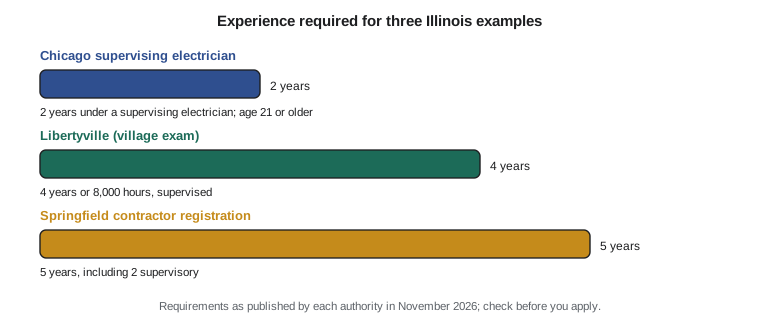
The Department of Buildings lists the qualifications for the supervising electrician license in plain terms. An applicant must be at least 21 years old. An applicant must have at least two years of experience installing, altering, repairing and maintaining electrical wires, equipment and apparatus, or equivalent experience, under the direct supervision of a supervising electrician or an equivalent person. That experience must be verified by letters from the applicant's supervisors. And the applicant must pass the written examination given by Continental Testing Services for the city. The license type, general or low voltage, matches the exam passed.
Two years may sound short compared with states that ask for six or eight years before a master exam. The comparison misleads in two ways. First, the Chicago license is a license to supervise, and in practice most candidates have many more years than the minimum by the time they pass a demanding open-book exam on a locally amended code. Second, Chicago requires much more of the workers on certain projects. For Class 1 work, which Lesson 7 explains, every worker must be a licensed supervising electrician, a graduate of a registered apprenticeship of at least 8,000 hours, or someone currently enrolled in one. Kevin's apprenticeship certificate already meets that standard; his supervising electrician license will add the authority to direct the work.
What counts as experience
The Chicago rule asks for experience installing, altering, repairing and maintaining electrical wiring and equipment. Read each word. Installing new work counts, but so does altering, repairing and maintaining existing work, which matters to electricians whose careers are mostly service work. The experience must be under the direct supervision of a supervising electrician or equivalent person. In practice that means a licensed supervising electrician in Chicago, or a person holding an equivalent license or role elsewhere. If your experience was in another city or state, read the phrase about equivalent experience carefully and ask the department or CTS how it is evaluated before you rely on it.
Experience must be verified, and the city's method is letters from supervisors. A good letter is specific. It names the employer, the supervisor and the supervisor's license, gives start and end dates, describes the kinds of work performed, and says the work was supervised. A letter that says only that Kevin is a good worker proves nothing. Stan will write one of Kevin's letters. Kevin's first employer, where he worked as a helper and apprentice, closed in 2015, so Kevin has tracked down his former foreman, now retired, who held a supervising electrician license and can describe Kevin's early work. Kevin also keeps copies of his apprenticeship completion certificate and his payroll records, which back up the dates if anyone asks.
Time spent as a helper before an apprenticeship may or may not count, depending on what the work was and who supervised it. Classroom time in an apprenticeship is part of the apprenticeship, but the experience requirement is about work on the tools. The safest approach is to describe the work honestly, let the letters show what you did, and let the city decide. An applicant who inflates experience risks more than a denial; false statements on a license application can lead to discipline later.
| Evidence | What it shows | Kevin's copy |
|---|---|---|
| Supervisor letter | Dates, work performed, supervision | From Stan, and from his first foreman |
| Apprenticeship certificate | Completion of a registered program | Issued 2017, more than 8,000 hours |
| Payroll records | Employment dates and hours | Pay stubs and annual wage statements |
| Photo identification | Identity and age | State driver's license |
Age and identity
The age rule, at least 21, matters mainly to young electricians who finished an apprenticeship early. A 20-year-old with a completed apprenticeship and two years of supervised work still has to wait. Identity matters too: applications are personal, and Chicago, Cook County and many towns ask for a copy of a driver's license or other photo identification. Use your legal name consistently on your application, your letters and your identification, so that nobody has to wonder whether the person in a letter is the person applying.
Libertyville: a village that examines
The Village of Libertyville, a Lake County suburb, gives its own electrical license exam and publishes its requirements. Applicants need at least four years, or 8,000 hours, of documented electrical experience, which may come from an apprenticeship, military training or verifiable on-the-job work, all of it supervised by a licensed electrician. Proof is brought on exam day. The village's exam is open book, requires a grade of 70 to pass, and uses the 2014 or 2017 NEC; the exam fee is 100 dollars, non-refundable, and an applicant may sit the exam twice in any 12-month period. The license renews each year by the end of December.
Libertyville is a useful example because it shows a different model from Chicago's. Its experience requirement is longer, it names the NEC rather than a locally amended code, and it runs the exam itself. The village describes its license as widely accepted, but it also notes that other towns may or may not accept a license from another municipality. That caution applies to every town's license, including Chicago's.
Springfield: registration with an exam rule
The City of Springfield, the state capital, registers electrical contractors, and its 2026 registration form shows yet another model. An applicant needs at least five years of electrical work, including two years of supervisory experience, documented with a resume and reference letters. A Springfield license is one route. For an out-of-town license, the form asks for a license issued by an Illinois municipality; a license issued before October 10, 2007 that has not lapsed can be used, but if the out-of-town license was obtained after that date, the International Code Council's master electrician exam is required. The applicant must also show proof of position in the business, such as articles of incorporation, and file a surety bond and insurance, which Lesson 8 covers.
Springfield's rule about licenses issued before and after a cutoff date is common in Illinois in one form or another. Towns that once accepted licenses from anywhere often tightened their rules over time, and they protected people who already held licenses by accepting older licenses while asking newer applicants to pass a recognized exam. When you read a town's rules, look for dates like this; they can decide whether your license counts.
Cook County: what the county accepts
Cook County does not examine electricians, but it decides what it accepts when it registers electrical contractors for work in unincorporated areas. Its registration page asks for the supervising electrician's current license from an Illinois city, town or village that has an electrical commission administering an examination, along with identification and other documents. A Chicago supervising electrician license meets the examination requirement because Chicago examines its licensees. A license from a village that registers contractors without testing them would not. Lesson 8 covers the rest of the county's registration requirements.
Worked problem
Who is eligible where?
Three electricians at Kedzie Avenue Electric ask whether they meet the published requirements in this lesson. Tamika is 29, with six years of supervised experience in Chicago. Luis is 20, a second-year apprentice. Kevin is 34, with fifteen years of experience including seven as a foreman.
Show solution
- Chicago needs age 21 and two years under a supervising electrician: Tamika and Kevin qualify on experience and age; Luis does not meet either requirement yet.
- Libertyville needs four years or 8,000 hours of supervised experience: Tamika and Kevin meet it; Luis does not.
- Springfield registration needs five years including two supervisory: Kevin's foreman years count as supervisory; Tamika has five years of work but needs two supervisory years documented.
- Every case still needs letters and records that prove the experience.
Answer: Kevin meets all three published experience rules; Tamika meets Chicago's and Libertyville's and may meet Springfield's if her supervisory time is documented; Luis must wait.
Reading any town's requirements
Because the rules vary, it helps to read every set of requirements with the same checklist. What license or registration is this, and is it for a person or a business? What experience is required, how long, under whose supervision, and how is it proved? Is there an exam, who gives it, and what code does it use? Does the town accept licenses from other places, and with what conditions or cutoff dates? What insurance, bond and fees are required? How often does it renew? The calculator below turns one part of that checklist into numbers: it compares an applicant's documented experience with several published rules.
# Compare documented experience with published rules (from this lesson)
rules = {
    "Chicago supervising electrician": {"years": 2, "supervisory": 0, "min_age": 21},
    "Libertyville village exam": {"years": 4, "supervisory": 0, "min_age": 0},
    "Springfield registration": {"years": 5, "supervisory": 2, "min_age": 0},
}
people = {
    "Kevin": {"years": 15, "supervisory": 7, "age": 34},
    "Tamika": {"years": 6, "supervisory": 0, "age": 29},
    "Luis": {"years": 2, "supervisory": 0, "age": 20},
}
for name, p in people.items():
    ok = [town for town, r in rules.items()
          if p["years"] >= r["years"] and p["supervisory"] >= r["supervisory"] and p["age"] >= r["min_age"]]
print(f"{name}: meets {len(ok)} of {len(rules)} -> {', '.join(ok) if ok else 'none yet'}")Kevin: meets 3 of 3 -> Chicago supervising electrician, Libertyville village exam, Springfield registration Tamika: meets 2 of 3 -> Chicago supervising electrician, Libertyville village exam Luis: meets 0 of 3 -> none yet
The program treats years as whole numbers and ignores the quality of the evidence, which is where real applications succeed or fail. Use it as a planning tool, then read the rule and gather the proof.
General or low voltage?
Chicago's two exam types raise an eligibility question of a different kind: which license should you seek? The low voltage license suits electricians whose careers are in fire alarm, security, data and communications, sound and building controls. The general license covers all types of electrical work, which includes low voltage work. A contractor's license type follows its supervising electrician's, so a company that wants to bid on service upgrades and power wiring needs a general supervising electrician. Tamika, who spent three of her six years on a data and security crew before joining Kedzie, asked Kevin whether she should start with the low voltage exam. Kevin's advice was to read both study guides and decide based on the work she wants to supervise, not on which exam seems easier, because the license she earns decides the company she can qualify.
The experience rule is the same for both types: two years of supervised electrical work. But the content of the exams differs, and so does the evidence that makes sense. A low voltage candidate's letters should describe low voltage systems in detail; a general candidate's letters should show power work, services, feeders and branch circuits. Matching the letters to the license helps whoever reviews the application.
Experience from somewhere else
Many Chicago-area electricians earn part of their experience outside the city: in a suburb, in Indiana or Wisconsin, in the military, or in industrial maintenance. The Chicago rule allows equivalent experience under an equivalent person, which opens the door, but it does not promise that every kind of work will count. Military electricians should keep training records and evaluations that describe the systems they worked on. Maintenance electricians should keep records that show installing and altering work, not only troubleshooting. Electricians from other states should keep copies of their licenses and of the supervisors' licenses. When in doubt, describe the work precisely and ask before applying. A rejected application usually costs time; a misunderstood one can cost an exam date.
Libertyville's rule names apprenticeship, military training and verifiable on-the-job work as acceptable sources, which is a helpful model. Springfield asks for a resume and reference letters, and its two years of supervisory experience must be documented as supervisory: running crews, laying out work and taking responsibility for it. Kevin's seven years as a foreman fit that description, and his letters say so.
Kevin's decision
Kevin meets Chicago's published requirements with a wide margin. His job now is proof: two clear supervisor letters, his apprenticeship certificate and his identification. He also notes, for later, that if Kedzie Avenue Electric keeps working in suburbs, his Chicago license will be the license those towns look at, and that some towns will accept it only because Chicago examines its licensees. A license earned by exam travels further in Illinois than one earned by registration alone.
Common mistakes
MistakeAssuming Chicago's two-year rule means any two years of electrical work.
InsteadIt must be installing, altering, repairing and maintaining electrical work under the direct supervision of a supervising electrician or equivalent person.
MistakeSending a character reference instead of an experience letter.
InsteadLetters must verify dates, the work performed and the supervision.
MistakeForgetting the age requirement.
InsteadChicago requires applicants to be at least 21.
MistakeAssuming every town accepts a license from any other town.
InsteadAcceptance varies; some towns require a license from an examining municipality or impose cutoff dates.
MistakeCounting experience from a different trade.
InsteadThe experience must be electrical work of the kinds the rule names.
Summary and key terms
- Chicago: at least 21, two years of supervised electrical experience verified by supervisor letters, and a passing exam through CTS.
- The license type, general or low voltage, matches the exam passed.
- Libertyville: four years or 8,000 hours of supervised experience and its own open-book exam with 70 to pass.
- Springfield registration: five years including two supervisory; out-of-town licenses issued after October 10, 2007 need the ICC master electrician exam.
- Cook County accepts a license from an Illinois municipality with an electrical commission that administers an exam.
- Read every town's rules with the same checklist: license, experience, exam, acceptance, insurance and bond, renewal.
- Direct supervision
- Work performed under a supervising electrician or equivalent person who directs it.
- Experience letter
- A letter from a supervisor that verifies dates, work performed and supervision.
- Reciprocity
- One authority accepting another's license, often with conditions.
- Cutoff date
- A date after which a town accepts outside licenses only with a recognized exam.
- ICC master electrician exam
- A national exam some Illinois towns accept or require.
Practice problems
Work each problem on paper first, then reveal the answer to check.
An applicant is 22 with three years of unsupervised side work. Does he meet Chicago's experience rule?
Show answer
No. The experience must be under the direct supervision of a supervising electrician or equivalent person.
What should an experience letter include?
Show answer
Employer and supervisor names, the supervisor's license, dates, the kinds of work performed, and a statement that the work was supervised.
An out-of-town license issued in 2012 is presented in Springfield. What else is needed?
Show answer
The ICC master electrician exam, because licenses obtained after October 10, 2007 need it.
Why does Cook County accept a Chicago license for registration?
Show answer
Because Chicago has an electrical commission and examines its licensees.
Lesson quiz · 5 questions
Score 60% or more to complete this lesson.
Create a free account to save your progress, take quizzes and earn a certificate.