
MELU-213 · Lesson 5 of 12 · 19 min
Local code adoption and amendments in Illinois
▶ Video coming soon A video version of this lesson is on the way.
Every electrician learns the National Electrical Code, but in Illinois the code that governs a job depends on where the job is. Chicago has its own electrical code. Suburbs adopt NEC editions on their own schedules, some with local amendments. Cook County has its own codes for unincorporated areas. And some rural areas have little or no local electrical code enforcement at all. This lesson explains how code adoption works in Illinois, what Chicago's code is and how it differs from the model code in general terms, and how a contractor working across many towns keeps track. It cites code chapters and sections by number only; keep your own copy of the code your job and your exam use.
No statewide electrical code for most private work
In many states, a state agency adopts one edition of the NEC for the whole state, and cities may amend it within limits. Illinois does not have a general statewide electrical code that applies to all private construction in the way those states do. State law gives municipalities the power to regulate electrical installations by ordinance, as Lesson 1 described, and leaves the choice of code to them. State agencies do apply codes to certain kinds of buildings within their own programs, and some state-funded or state-regulated facilities follow codes the state names. Those programs are beyond the scope of this course; the point for the exam is that, for an ordinary private building, the local authority's adopted code is the one that matters.
That arrangement puts a burden on contractors. Before bidding a job outside its home town, a contractor must find out which code edition the town has adopted, whether the town has amended it, and how the town enforces it. A rule that applies in one suburb may not apply in the next, and a practice that passes in one town may fail inspection across the street.
The Chicago Electrical Code
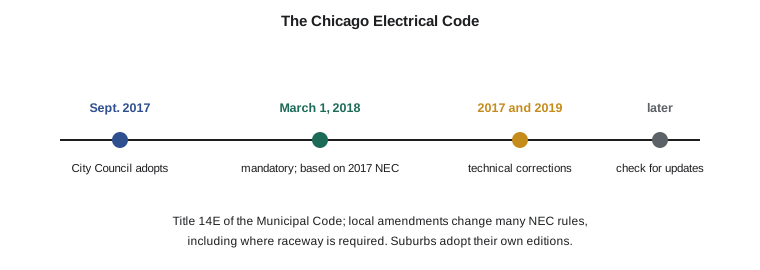
Chicago's electrical code is part of the city's Municipal Code, in Title 14E. The city rewrote its construction codes in a multi-year modernization program, and the electrical code was the first major piece. The City Council adopted the new electrical code in September 2017, it became mandatory on March 1, 2018, and it is based on the 2017 edition of the National Electrical Code with Chicago amendments. The city's code modernization page lists technical corrections to the electrical code in November 2017 and January 2019. The exam vendor describes the exam book as the 2018 edition of the Chicago Electrical Code and publishes later changes separately, as Lesson 4 explained.
The rest of Chicago's construction codes have continued to change. In mid-2026, the City Council approved updates aligning the city's construction codes with the 2024 model codes, according to a report from a building owners' association. That report did not say that the electrical code itself had been moved to a newer NEC edition, and the city's code modernization page checked for this course did not list one. Before you rely on any edition, check the city's current code and the Department of Buildings' announcements.
How the Chicago code differs, in general terms
The Chicago code follows the NEC's structure, so an electrician who knows the NEC can find most topics in the expected place. The differences are in the content of many rules. Some differences are long-standing and widely known in the trade. The best known is wiring methods: Chicago has long required wiring in metal raceway in most buildings where much of the country allows nonmetallic sheathed cable, and electricians who move to Chicago from elsewhere often find that the cable methods they used before are restricted or not allowed. Other differences concern services, high-rise and assembly buildings, and the city's own administrative rules on permits, inspections and licensing, which sit alongside the technical rules.
This course does not list Chicago's amendments rule by rule, for two reasons. First, the amended code is the city's text, and the exam tests that text, so you must learn it from the book itself. Second, amendments change, and a list in a course goes out of date. What the course can teach is a method for studying an amended code, which the next section describes.
A method for studying an amended code
Start with what you know. Work through the code's chapters in order, and for each article ask whether it matches the NEC rule you learned. Where it does, your NEC knowledge carries over. Where it does not, write the difference in your own words on a study sheet, never in the exam book. Pay special attention to wiring methods, because those differences affect almost every job, and to services and grounding, because those are heavily tested everywhere.
Next, study the changes made after the edition in your exam book. CTS publishes them, and they are likely exam material. For each change, note what the rule was, what it is now, and which kinds of installations it affects. Then practice applying both: a question may describe an installation and ask whether it complies, and the answer may depend on a recent change.
Finally, practice look-ups in the amended book. Chicago's additions may sit in places a reader of the plain NEC would not expect. Tab them, time yourself, and repeat until they come quickly.
| Step | What to do | Where the notes go |
|---|---|---|
| Compare | Read each article and compare it with the NEC rule you know | Your study sheet |
| Record | Write each difference in your own words | Your study sheet, never the exam book |
| Update | Add the post-2018 changes CTS publishes | Your study sheet |
| Practice | Answer questions that turn on the differences | Practice log |
| Tab | Tab the places you search most | The exam book (tabs only) |
Suburbs and other cities
Outside Chicago, municipalities adopt codes by ordinance. Many adopt an NEC edition, often with a short list of local amendments, and update on their own schedules, which means that neighboring towns can be on different editions at the same time. Libertyville's licensing exam, for example, uses the 2014 or 2017 NEC, which tells you something about the editions some towns still use. Other towns have adopted the 2020 or 2023 NEC. Some towns adopt the full family of International Code Council model codes for buildings and the NEC for electrical work, and some add amendments that echo Chicago's preference for raceway in certain occupancies.
The only way to know a town's code is to look it up. Most municipalities publish their codes online through code publishing services, and their building departments list the adopted editions on their permit pages. Ask the building department if the published code seems out of date; an ordinance adopting a new edition may not yet appear online.
Cook County and unincorporated areas
Unincorporated areas are outside any city or village. In Cook County, the county's Department of Building and Zoning issues permits and inspects in those areas under codes the county has adopted, and it registers the electrical contractors that work there, as Lesson 8 explains. Other counties take different approaches; some have building departments and adopted codes for unincorporated areas, and some have little or no building regulation outside towns. Where no local authority enforces a code, the work may not be inspected at all, but that does not make a poor installation safe or lawful in every sense. Owners, insurers, utilities and lenders may still expect code compliance, and a contractor's liability for a dangerous installation does not disappear because no one inspected it.
Worked problem
Which code governs?
Kedzie Avenue Electric has four jobs in one month: a three-flat rehab in Avondale, a buildout in a West Loop tower, a dental office in the invented village of Maple Grove, and a garage feed in unincorporated Cook County.
Show solution
- Avondale and the West Loop are in Chicago: the Chicago Electrical Code, Title 14E, applies, with any changes in force when the permit is issued.
- Maple Grove is a suburb: Beth checks the village's adopting ordinance and finds the NEC edition and the amendments it uses.
- The garage is in unincorporated Cook County: the county's adopted code applies, and the county issues the permit.
- Kevin's crew briefing for each job names the code that applies, because wiring methods differ.
Answer: Four jobs, three codes: the address decides which one applies.
Questions to ask a building department
When Beth sets up a new town in the company's reference, she calls or emails the building department with the same list of questions. Which edition of the NEC, or which local electrical code, is in force, and since when? Are there local amendments, and where are they published? Does the town restrict wiring methods, for example requiring raceway in commercial or multifamily buildings? Which edition applies to a job: the one in force when the permit is applied for, when it is issued, or when work starts? How does the town register electrical contractors, and what license does it accept? What inspections are required, and how are they scheduled? Who is the electrical inspector, and how can a contractor reach that person with a code question before work starts?
The last question is the most useful. A short conversation with an inspector before a job begins can settle an interpretation that would otherwise surface as a failed inspection. Kevin has learned to ask early, to write down the answer and the date, and to keep the note in the job file.
Why editions matter on the exam
Exam writers like questions where the answer depends on the edition, because they separate candidates who know the code their license covers from candidates who learned a different edition. When a rule changed between NEC editions, the Chicago exam asks about the Chicago code's version, which follows the 2017 NEC base and the city's own amendments, not the newest NEC. A candidate who studied the 2023 NEC in a suburban class can be confidently wrong. Kevin keeps his practice strictly to the Chicago book and the CTS change list for exactly this reason.
Keeping track across many towns
A contractor that works across the region needs a reference that says, for each town, which code edition and amendments apply, how to apply for permits and what the town requires of contractors. Beth keeps that reference as a spreadsheet and updates it whenever a town announces a code change. The program below shows the idea: a small table of towns and editions, and a check that flags jobs where the crew's usual practice may not match the town's code.
# Which code applies where? (Maple Grove is invented; check every real town yourself)
towns = {
    "Chicago": {"code": "Chicago Electrical Code (2017 NEC base)", "nm_cable_ok": False},
    "Maple Grove": {"code": "NEC 2020 with local amendments", "nm_cable_ok": True},
    "Unincorporated Cook County": {"code": "County-adopted code", "nm_cable_ok": None},
}
jobs = [("Avondale three-flat", "Chicago"), ("Dental office", "Maple Grove"), ("Garage feed", "Unincorporated Cook County")]
for job, town in jobs:
    t = towns[town]
    note = {True: "cable method allowed by this table", False: "raceway expected", None: "check before bidding"}[t["nm_cable_ok"]]
print(f"{job}: {t['code']} -> {note}")Avondale three-flat: Chicago Electrical Code (2017 NEC base) -> raceway expected Dental office: NEC 2020 with local amendments -> cable method allowed by this table Garage feed: County-adopted code -> check before bidding
The table in the program is illustrative. Do not rely on it for any real town; build your own from each town's published code.
Common mistakes
MistakeAssuming one NEC edition applies throughout Illinois.
InsteadIllinois leaves code adoption to local authorities for most private work; towns use different editions.
MistakeUsing cable methods in Chicago because they pass elsewhere.
InsteadChicago's code has long required raceway in most buildings; check the wiring-method rules in Title 14E.
MistakeWriting amendment notes into the exam book.
InsteadKeep notes on a study sheet; the exam book may carry tabs only.
MistakeAssuming an uninspected rural job need not meet any code.
InsteadLack of inspection does not remove safety obligations or liability.
MistakeRelying on an old list of a town's adopted code.
InsteadCheck the town's current ordinance and building department.
Summary and key terms
- Illinois leaves electrical code adoption for most private work to municipalities and counties.
- Chicago's electrical code, Title 14E, was adopted in September 2017, mandatory March 1, 2018, and is based on the 2017 NEC with local amendments.
- Chicago has long required metal raceway in most buildings; learn the city's wiring-method rules from the code itself.
- In 2026 Chicago updated its construction codes to the 2024 model codes; check whether the electrical code has changed.
- Suburbs adopt NEC editions on their own schedules, with or without amendments; neighbors can differ.
- Cook County's Department of Building and Zoning applies county codes in unincorporated areas.
- Title 14E
- The part of the Chicago Municipal Code containing the Chicago Electrical Code.
- Local amendment
- A change a city or county makes to a model code when it adopts it.
- Adopting ordinance
- The local law that puts a code edition into force in a town.
- Unincorporated area
- Land outside any city or village, governed by the county.
- Raceway
- An enclosed channel, such as conduit or tubing, for holding wires.
Practice problems
Work each problem on paper first, then reveal the answer to check.
Which NEC edition is the Chicago Electrical Code based on?
Show answer
The 2017 NEC, with Chicago amendments.
A crew used to suburban cable wiring starts a Chicago rehab. What should the foreman check first?
Show answer
The Chicago code's wiring-method rules, because the city has long required raceway in most buildings.
How do you find a suburb's adopted code?
Show answer
Read its adopting ordinance in the published municipal code and check the building department's permit pages.
Who issues permits for a garage in unincorporated Cook County?
Show answer
The Cook County Department of Building and Zoning.
Lesson quiz · 5 questions
Score 60% or more to complete this lesson.
Create a free account to save your progress, take quizzes and earn a certificate.