
MELU-213 · Lesson 3 of 12 · 20 min
Applying, approval and booking the exam
▶ Video coming soon A video version of this lesson is on the way.
Once Kevin knew he was eligible, he faced the paperwork. The Chicago process is not complicated, but it runs on fixed dates, and a missed deadline costs months. This lesson walks through the application for the Chicago supervising electrician exam step by step, from the documents to the result letter, and then looks briefly at how other Illinois authorities handle applications. The dates and fees here come from the Department of Buildings and Continental Testing Services pages as published in November 2026.
Who handles what
Three parties are involved in a Chicago application. The Department of Buildings sets the requirements, issues the license after an applicant passes, and handles renewals through its web portal. Continental Testing Services, CTS, processes applications on the department's behalf and gives the written exam. The applicant gathers the evidence, applies on time, pays the fees and shows up prepared. Knowing which party does what saves wasted calls: questions about exam dates, admission and results go to CTS; questions about the license itself, renewal and the municipal code go to the department.
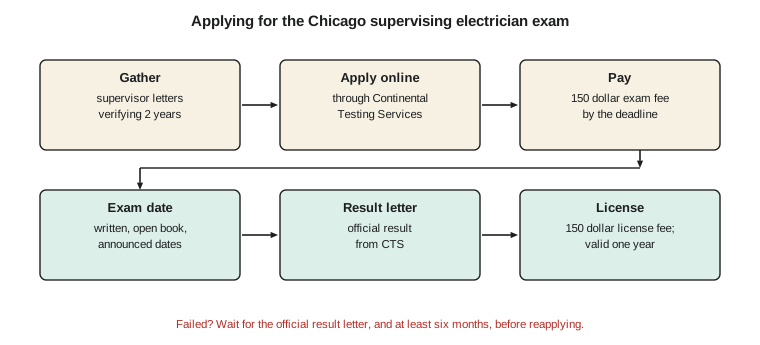
Step 1: gather the evidence
Before opening the application, gather what it will ask for. For Chicago that means letters from supervisors verifying at least two years of the required experience, identification showing that you are at least 21, and the exam fee. Lesson 2 described what a good experience letter contains. Ask for letters early. A busy supervisor may take weeks to write one, and a retired supervisor may need help finding old dates. Kevin asked Stan and his former foreman in early summer for a fall exam, which gave both of them time and gave Kevin time to check the letters against his payroll records before he applied.
Check the letters for consistency. If one letter says Kevin started in 2011 and another implies 2012, fix it before applying. Small inconsistencies are the most common reason an application gets questioned, and they are entirely avoidable.
Step 2: apply online by the deadline
Chicago applications for the supervising electrician exam are made online through the CTS website, which lists the exam as Chicago 303, Supervising Electrician. CTS publishes exam dates and a separate application deadline for each date. In November 2026, the published schedule showed exam dates of November 18, 2026, March 10, 2027, July 21, 2027 and November 17, 2027, with application deadlines several weeks before each one, starting with October 7, 2026 for the November 2026 exam. Dates beyond that will be posted later. Always check the current schedule; this course cannot predict future dates.
The deadline is a hard limit. An application received after the deadline for one date waits for the next date, which in this schedule is about four months later. Kevin wanted to sit the November 2026 exam, so he set a personal deadline two weeks before the published one. That margin covered a slow letter and a question about his apprenticeship certificate, and he still applied on time.
| Exam date | Application deadline (as published) |
|---|---|
| November 18, 2026 | October 7, 2026 |
| March 10, 2027 | See the CTS schedule |
| July 21, 2027 | See the CTS schedule |
| November 17, 2027 | October 13, 2027 |
Step 3: pay the fees
Chicago's fees are simple and were the same in every source checked. The exam fee is 150 dollars for each exam, whether it is a first attempt or a retake. The initial license fee, paid after passing, is 150 dollars. Renewal is 150 dollars each year. A duplicate license document costs 25 dollars. CTS states that testing fees are not refunded, and its page describes payment for license applications by check or money order payable to the City of Chicago. Payment methods change as systems change, so follow the instructions on the current application.
Fees are a small part of the cost of a license compared with study time and code books, but they add up for a candidate who fails and retakes. The calculator below shows Kevin's budget for one attempt, a possible retake and the first year's license.
# Kevin's fee budget for the Chicago license (fees as published November 2026)
exam_fee = 150
license_fee = 150
renewal_fee = 150
attempts = {"pass first time": 1, "one retake": 2}
for case, n in attempts.items():
    total = n * exam_fee + license_fee
    print(f"{case}: exam fees {n * exam_fee} + license {license_fee} = {total} dollars")
print(f"Each later year: renewal {renewal_fee} dollars")pass first time: exam fees 150 + license 150 = 300 dollars one retake: exam fees 300 + license 150 = 450 dollars Each later year: renewal 150 dollars
Step 4: admission and exam day
After CTS accepts an application, the candidate receives admission information for the exam date. Read it the day it arrives. It tells you where and when to report, what identification to bring, and what you may and may not bring into the room. Lesson 4 covers the book rules in detail, because they are strict: the Chicago exam allows one book, the Chicago Electrical Code, with tabs but without notes or highlighting. A candidate who brings a marked-up book can be turned away or have the book replaced, and a candidate who shows up without the right book has a much harder exam.
CTS also states rules for missed exams. A candidate who is absent from the exam, or whose exam window or authorization to test expires, must apply again. In other words, missing the date does not carry the application forward. If something unavoidable comes up, contact CTS immediately and read its current policy; do not assume the fee will roll over.
Step 5: results and reapplying
CTS sends an official result letter. If you pass, the next step is the license itself: you pay the initial license fee and the Department of Buildings issues the license, valid for one year from issuance. If you fail, the rules on reapplying matter. CTS says not to reapply until you have received your official result letter, and the Department of Buildings says that an applicant who fails must wait at least six months before reapplying. Read both rules together: wait for the letter, wait six months, then apply for the next exam date whose deadline you can meet.
Because the exam is given on a few dates a year, the six-month wait often means skipping one date and sitting the one after. Kevin built that possibility into his planning in Lesson 1. If he fails in November 2026, the six-month wait ends in May 2027, which is after the March 2027 exam, so his next realistic date is July 21, 2027, provided he applies by that exam's deadline. The program below finds the next exam a candidate can take after a failed attempt.
from datetime import date, timedelta

# Exam dates and deadlines from the CTS schedule (deadlines for the middle dates are illustrative)
exams = [
    (date(2026, 11, 18), date(2026, 10, 7)),
    (date(2027, 3, 10), date(2027, 1, 27)),
    (date(2027, 7, 21), date(2027, 6, 9)),
    (date(2027, 11, 17), date(2027, 10, 13)),
]
failed_on = date(2026, 11, 18)
letter_received = failed_on + timedelta(days=21)    # illustrative
may_reapply = failed_on + timedelta(days=183)        # at least six months

for exam_day, deadline in exams:
    if exam_day > failed_on and deadline >= max(may_reapply, letter_received):
        print("Next possible exam:", exam_day, "apply by", deadline)
breakNext possible exam: 2027-07-21 apply by 2027-06-09
The program counts six months as 183 days and uses illustrative deadlines for the two middle dates. The exact way the city measures six months, from the exam date or the result date, is a question to ask before you rely on a tight schedule.
Common application problems
Most application problems are small and preventable. The first is a letter that does not prove what the rule asks: it praises the applicant but gives no dates, or it describes work but not supervision. The second is a name mismatch, such as a nickname on a letter and a legal name on the application, or a maiden name on an apprenticeship certificate. The third is a missing signature or an unsigned scan. The fourth is a payment problem, such as a check made out to the wrong payee or a card declined after the deadline. The fifth is applying for the wrong exam type, general or low voltage, which decides the license you can earn.
Each of these problems has the same fix: read the application instructions twice, prepare everything before you start, and check your submission against the instructions before you send it. Kevin printed the CTS instructions, made a checklist of every item and initialed each one as he gathered it. Beth, who has handled the company's paperwork for twenty years, reviewed the package before he submitted it and caught one letter that gave a year but no month for his start date. Kevin's former foreman rewrote it the same week.
Using the waiting time
Between applying and exam day there are usually six weeks or more. Use them. Order the correct edition of the Chicago Electrical Code if you do not already own it, because the exam allows only that book. Download the code changes made after the 2018 edition from CTS and read them, because CTS says questions on those changes appear on the exam. Place permanent tabs on the chapters and articles you use most, following the book rules in Lesson 4. Work through practice questions from the core courses in this series, and time yourself. And plan the day itself: how you will get to the test site, where you will park, what time you must leave home to arrive early, and what you will eat beforehand. These details seem minor until a train delay or a parking problem costs twenty minutes of exam time.
Kevin set a study schedule of six hours a week: two weeknight sessions of two hours on code look-ups and calculations, and a two-hour weekend session on the Chicago amendments and a timed practice set. He kept a log of the questions he got wrong and the chapter each one came from, and he moved his tabs twice as he learned which parts of the book he actually used.
After the license: the company's step
Passing the exam makes Kevin a licensed supervising electrician, but it does not by itself make him Kedzie Avenue Electric's supervising electrician. The company has to associate his license with its contractor license. The department lists a 100 dollar fee for a change of supervising electrician. Stan and Kevin plan to make the change when Stan retires, and until then Kevin's license stands ready. Lesson 7 covers what happens if a company is left without a valid supervising electrician, and Lesson 8 covers the contractor license itself.
Applications elsewhere in Illinois
Other authorities run different processes. Libertyville schedules its own exam dates, charges a 100 dollar non-refundable exam fee, limits applicants to two sittings in any 12-month period, and asks applicants to bring proof of experience to the exam. Springfield's registration form goes to the city's Building and Zoning office and must arrive by 4:30 in the afternoon two days before the next Electrical Commission meeting, with the bond, insurance documents, proof of position in the business and a 45 dollar fee. Cook County accepts contractor registration applications online with the supervising electrician's license, identification, an affidavit and an insurance certificate. Each process has its own calendar, and a contractor that works in many towns needs a calendar of its own.
Worked problem
Planning around two calendars
Kedzie Avenue Electric wants to bid a job in Springfield next spring and also wants Kevin licensed in Chicago. The Springfield Electrical Commission meets on a published schedule, and registration paperwork must arrive two days before a meeting. The Chicago exam deadline is October 7 for a November 18 exam.
Show solution
- Chicago: Kevin applies through CTS before October 7 and sits the November 18 exam.
- Springfield: Beth gathers the bond, insurance policies, proof of position and fee, and submits them at least two days before the commission meeting that precedes the bid date.
- Springfield needs a license it accepts. Stan's long-standing Chicago license is the one the company presents, because Kevin's will be new; the company checks Springfield's rule for licenses issued after October 10, 2007, which may require the ICC master electrician exam.
- Both calendars go on the office wall with the earliest deadline highlighted.
Answer: Two authorities, two calendars, two sets of requirements: plan from the earliest deadline backward.
Common mistakes
MistakeApplying the week of the exam.
InsteadEach exam date has an application deadline several weeks earlier; late applications wait for a later date.
MistakeReapplying the day after a failed exam.
InsteadWait for the official result letter and at least six months before reapplying.
MistakeExpecting a refund after missing the exam.
InsteadCTS states testing fees are not refunded, and an absent candidate must reapply.
MistakeThinking passing the exam automatically makes you the company's supervising electrician.
InsteadThe contractor must associate the license with its contractor license; a change of supervising electrician has a fee.
MistakeAssuming suburban towns follow Chicago's calendar.
InsteadEach authority sets its own dates, forms and deadlines.
Summary and key terms
- Chicago applications go online through Continental Testing Services, listed as Chicago 303, Supervising Electrician.
- Each exam date has an earlier application deadline; published dates included November 18, 2026 and November 17, 2027.
- Fees: 150 dollars per exam, 150 dollars for the initial license, 150 dollars per year to renew, 25 dollars for a duplicate.
- Testing fees are not refunded; an absent candidate must reapply.
- After failing, wait for the official result letter and at least six months before reapplying.
- The contractor associates a new supervising electrician with its license; a change costs 100 dollars.
- Application deadline
- The last day CTS accepts applications for a given exam date.
- Official result letter
- The letter from CTS reporting a candidate's result.
- Change of supervising electrician
- The contractor's filing that links a different licensed supervising electrician to its license.
- Electrical Commission meeting
- A Springfield meeting date that drives its registration deadline.
- Admission information
- CTS instructions on where and when to report and what to bring.
Practice problems
Work each problem on paper first, then reveal the answer to check.
Kevin fails the November 18, 2026 exam. Can he sit the March 10, 2027 exam?
Show answer
Not under a six-month wait measured from the exam date, because six months have not passed by the March application deadline; July 21, 2027 is the next realistic date.
How much does Kevin spend on fees if he passes on the second attempt and takes the license?
Show answer
Two exam fees of 150 plus a 150 license fee: 450 dollars.
Who issues the license after a candidate passes?
Show answer
The City of Chicago Department of Buildings.
What must a Springfield registration include besides the license?
Show answer
A surety bond, liability and workers compensation insurance documents, proof of position in the business and the fee, submitted before the commission's deadline.
Lesson quiz · 5 questions
Score 60% or more to complete this lesson.
Create a free account to save your progress, take quizzes and earn a certificate.