
MELU-213 · Lesson 8 of 12 · 19 min
Contractor licensing, insurance and bonding
▶ Video coming soon A video version of this lesson is on the way.
A supervising electrician license belongs to a person; the right to sell electrical work belongs to a business. This lesson covers the business side: Chicago's electrical contractor license, the registrations that suburbs and Cook County require, and the insurance certificates and bonds that go with them. Because every town sets its own list, the lesson uses the published requirements of Chicago, Cook County, Gurnee and Springfield as examples, all checked in November 2026. Treat the amounts as examples, not rules for any other town, and check each authority before you register.
Chicago's electrical contractor license
In Chicago, a business that installs, alters or maintains electrical equipment regulated by the electrical code must hold an electrical contractor license, or the person doing the work must be employed by a business that does. Sole proprietorships can hold the license as well as corporations and other entities. The key requirement is the one Lesson 7 described: the business must employ at least one licensed supervising electrician, and the license is automatically inactivated if no valid supervising electrician license is associated with it. The municipal code chapter on electrical contractors, Chapter 4-290, controls if the department's summary differs.
The license comes in two types, general and low voltage, and the type depends on the exam the supervising electrician passed. The fees published by the department are 150 dollars for an initial license and 150 dollars for renewal, for either type, 100 dollars for a change of supervising electrician, and 25 dollars for a duplicate license document. The license is valid for one year from issuance. New applications are submitted through the Continental Testing Services website, and renewals go through the Department of Buildings' web portal.
The chapter also contains exemptions. Public utilities regulated by the Illinois Commerce Commission are exempt for their utility work. Private alarm contractors licensed by the state are exempt from the electrical contractor license requirement for work within their state license, but must register that license with the city to obtain permits. And the chapter makes general contractors and others responsible too: they may not employ unregistered persons to do electrical work or let a registrant work beyond its authorized scope.
| Item | Published fee (dollars) |
|---|---|
| Electrical contractor license, initial (general or low voltage) | 150 |
| Electrical contractor license, renewal | 150 |
| Change of supervising electrician | 100 |
| Duplicate license document | 25 |
Insurance and bonds in Chicago
The department's contractor license page, as checked for this course, does not list insurance or bond amounts for electrical contractors, and the portion of Chapter 4-290 available online at the time did not show them either. This course therefore does not state a Chicago insurance or bond amount. In practice, a contractor working in Chicago carries general liability insurance and workers compensation insurance, because owners, general contractors and the law expect them, and permit applications for larger projects may call for proof of insurance. Before you apply, read the current application and the full text of Chapter 4-290, and ask the department what proof it requires.
Cook County registration
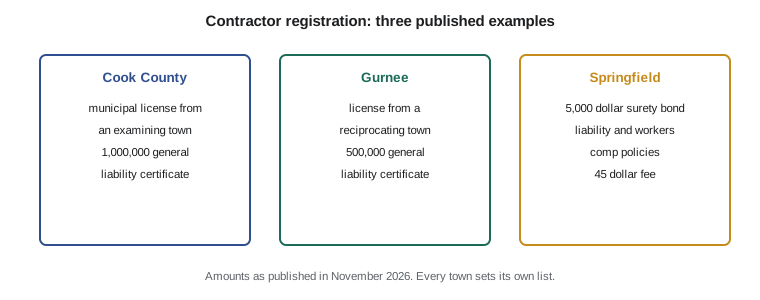
Cook County registers electrical contractors that work in its unincorporated areas. Its registration page lists the requirements: a current license for the supervising electrician from an Illinois city, town or village that has an electrical commission administering an examination; a copy of the supervising electrician's driver's license; a signed electrical contractor registration affidavit; proof of good standing with the State of Illinois for corporations; and a general liability insurance certificate for 1,000,000 dollars, with the Cook County Department of Building and Zoning listed as the certificate holder. The page checked did not list a bond or a fee.
Two parts of that list deserve attention. The license requirement means that only a license earned by examination counts, which Kevin's Chicago license will satisfy. And the certificate holder requirement is a detail that trips up many applicants: an insurance certificate made out to the contractor, or to a different town, will not do. Beth asks the company's insurance agent for a separate certificate for each authority, naming that authority exactly as its instructions require.
Suburban registration: Gurnee as an example
The Village of Gurnee, in Lake County, publishes a short list for electrical contractors who register with its building department: a copy of a current electrical license from a reciprocating municipality, and a certificate of insurance showing at least 500,000 dollars in general liability coverage, with the village as certificate holder, and with the name on the license matching the name on the insurance. Gurnee's page lists a 10,000 dollar license or permit bond, but for contractors working in the public right-of-way, on streets or on water and sewer lines, who register with its engineering department, not for electricians as such.
Gurnee's list shows the typical shape of suburban registration: a license the town accepts, insurance in a stated amount naming the town, and matching names. The phrase reciprocating municipality means that the village accepts licenses from certain other towns, and the village's building department can tell you which ones. Do not assume that every license qualifies.
Springfield: a bond and two policies
Springfield's 2026 electrical contractor registration form, which Lessons 2 and 3 discussed, requires a 5,000 dollar surety bond, in original form, payable to the City of Springfield and issued in the business name, covering the calendar year from January 1 to December 31. It also requires a copy of the liability insurance policy and the workers compensation policy, proof of the applicant's position in the business, and a 45 dollar fee.
A surety bond is different from insurance. Insurance protects the contractor against claims for injury or damage. A license or permit bond protects the town and the public: if the contractor fails to meet obligations the bond covers, such as complying with the town's ordinances or paying fees, a claimant can recover from the surety up to the bond amount, and the surety then seeks repayment from the contractor. The bond's wording decides what it covers, so read it. A bond is an obligation the contractor ultimately pays, not a policy that pays on the contractor's behalf.
Worked problem
Registering in three places
Kedzie Avenue Electric wants to work in unincorporated Cook County, in Gurnee and in Springfield next year. Beth builds a checklist from the published requirements.
Show solution
- Cook County: Stan's Chicago license, his driver's license, the signed affidavit, proof of good standing, and a 1,000,000 dollar general liability certificate naming the Cook County Department of Building and Zoning.
- Gurnee: Stan's Chicago license, if Gurnee treats Chicago as a reciprocating municipality, and a certificate for at least 500,000 dollars naming the village, with matching names.
- Springfield: the license Springfield accepts, a 5,000 dollar surety bond payable to the city for the calendar year, copies of the liability and workers compensation policies, proof of position, and the 45 dollar fee.
- The company's general liability policy already exceeds 1,000,000 dollars per occurrence, so one policy supports all three certificates; the agent issues a separate certificate for each authority.
Answer: One insurance policy can support several certificates, but each authority needs its own certificate, and a bond is a separate document.
Insurance coverage beyond the minimums
A registration minimum is the least a town will accept, not the coverage a contractor needs. General contractors and owners often require higher limits, additional insured status, waivers of subrogation and specific policy forms in their contracts. Commercial auto coverage protects the company's vans. Workers compensation is required by Illinois law for employers, as Lesson 10 explains. Umbrella coverage adds limits above the primary policies. Kedzie's agent reviews the company's contracts each year to make sure the policies match what the contracts demand; a contract that requires coverage the company does not carry is a breach waiting to happen.
The calculator below compares a contractor's limits against each authority's published minimum, the way Beth checks the company's certificates. The amounts for Cook County and Gurnee come from this lesson; Chicago's are not stated because the city's page did not list them.
# Compare the policy limit with published registration minimums (from this lesson)
gl_per_occurrence = 2_000_000    # Kedzie's policy limit (invented)
minimums = {"Cook County": 1_000_000, "Gurnee": 500_000}
for place, need in minimums.items():
    ok = gl_per_occurrence >= need
    print(f"{place}: needs {need:,}; policy {gl_per_occurrence:,} -> {'meets' if ok else 'SHORT'}")
print("Springfield: 5,000 surety bond plus copies of the liability and workers comp policies")Cook County: needs 1,000,000; policy 2,000,000 -> meets Gurnee: needs 500,000; policy 2,000,000 -> meets Springfield: 5,000 surety bond plus copies of the liability and workers comp policies
Low voltage and alarm contractors
Chicago's low voltage contractor license covers remote-control, signaling, power-limited and communications circuits, the circuits the code groups as Class 1, Class 2 and Class 3. Companies that install data cabling, security systems, sound systems and building controls often hold this license, backed by a low voltage supervising electrician. They may not do general power wiring under it. A data company that wants to run a new circuit for a server rack must hire a general contractor or get its own general license.
Fire alarm and security work adds the state's private alarm contractor license. The state licenses private alarm contractors under its own professional regulation laws, and Chicago exempts state-licensed alarm contractors from its electrical contractor license for work within their state license, while requiring them to register that state license with the city to obtain permits. Required fire alarm systems in Chicago also need a separate wiring permit and Fire Prevention Bureau review, as Lesson 6 explained. A contractor bidding fire alarm work must sort out which license applies before the bid, not after the permit desk asks.
Keeping registrations current
Registrations expire, and they expire on different schedules. Chicago's contractor license runs one year from issuance. Springfield's bond covers the calendar year, and its form is filed for a stated year. Many suburbs register contractors by calendar year, and some ask for new insurance certificates whenever a policy renews. A contractor can be fully licensed in one town and lapsed in the next without noticing until a permit is refused.
Beth keeps a registration table with five columns for every authority: what is registered, the expiration date, the certificate or bond on file and its own expiration, the renewal fee, and the person responsible for renewing it. Each month she sorts the table by date and renews anything due in the next sixty days. When the company's insurance renews each spring, she orders new certificates for every authority on the list the same day. The effort is an hour a month; a lapsed registration can cost a week of permits.
Business registration and taxes
A contractor's licenses rest on a properly formed business. Corporations and limited liability companies register with the Illinois Secretary of State and must stay in good standing, which Cook County checks. Sole proprietors doing business under an assumed name typically register that name with the county, as Springfield's form reflects. Businesses register with the Illinois Department of Revenue for state tax purposes and with the Illinois Department of Employment Security for unemployment insurance when they have employees. These registrations are outside the electrical licensing system, but a license application can stall when one of them is missing or out of date.
Common mistakes
MistakeAssuming every town requires the same insurance amount.
InsteadEach authority sets its own; Cook County lists 1,000,000 and Gurnee 500,000 in the examples checked.
MistakeSending one certificate made out to the contractor to every town.
InsteadEach authority needs a certificate naming it as the certificate holder.
MistakeTreating a surety bond as insurance for the contractor.
InsteadA bond protects the town and the public; the contractor must repay the surety.
MistakeForgetting that Chicago's contractor license depends on its supervising electrician.
InsteadIt is inactivated if no valid supervising electrician license is associated.
MistakeAssuming any municipal license satisfies Cook County.
InsteadThe county requires a license from a municipality whose electrical commission administers an exam.
Summary and key terms
- Chicago electrical contractor license: general or low voltage, 150 dollars initial and renewal, valid one year, requires at least one supervising electrician.
- A change of supervising electrician costs 100 dollars; a duplicate document costs 25 dollars.
- Chicago's page did not list insurance or bond amounts; read Chapter 4-290 and the current application.
- Cook County: an examining municipality's license and a 1,000,000 dollar general liability certificate naming the county department.
- Gurnee: a license from a reciprocating municipality and at least 500,000 dollars of general liability naming the village.
- Springfield: a 5,000 dollar calendar-year surety bond, liability and workers compensation policies, proof of position and a 45 dollar fee.
- Electrical contractor license
- Chicago's license for a business that does electrical work.
- Certificate of insurance
- A document from an insurer showing coverage, issued to a named certificate holder.
- Certificate holder
- The party named on a certificate, usually the authority requiring proof.
- Surety bond
- A three-party guarantee that protects a town or the public; the contractor repays any claim.
- Reciprocating municipality
- A town whose license another town accepts for registration.
Practice problems
Work each problem on paper first, then reveal the answer to check.
What insurance certificate does Cook County ask for?
Show answer
General liability of 1,000,000 dollars, with the Cook County Department of Building and Zoning as certificate holder.
Does Gurnee's 10,000 dollar bond apply to electricians registering with the building department?
Show answer
No. Gurnee's page lists it for right-of-way, street and water and sewer contractors registering with engineering.
What is the difference between insurance and a surety bond?
Show answer
Insurance pays covered claims on the contractor's behalf; a bond protects the obligee, and the contractor repays the surety.
How much does Chicago charge to change a contractor's supervising electrician?
Show answer
100 dollars, as published.
Lesson quiz · 5 questions
Score 60% or more to complete this lesson.
Create a free account to save your progress, take quizzes and earn a certificate.