
MELU-213 · Lesson 1 of 12 · 19 min
How electrical licensing works in Illinois
▶ Video coming soon A video version of this lesson is on the way.
Kevin Okonkwo has been an electrician in Chicago for fifteen years. He started as a helper on a north side rehab crew at nineteen, finished a registered apprenticeship of more than 8,000 hours in 2017, and has spent the last seven years as a journeyman and then a foreman at Kedzie Avenue Electric, Inc., an eleven-person contractor in the Avondale neighborhood. The company is invented for this course, but its problems are real. Its founder, Stan Wozniak, has held his Chicago supervising electrician license since 1991, and that license is what keeps the company's electrical contractor license alive. Stan is sixty-six and has told the crew he wants to retire within two years. He wants Kevin to earn his own supervising electrician license and take over that role. Kevin wants it too, and this course follows him from his first question to his exam day.
This is the Illinois course in the HSM University master electrician exam prep series. The core courses, MELU-101 through MELU-107, teach the National Electrical Code skills every master-level exam tests: navigating the code, load calculations, conductors and overcurrent protection, grounding and bonding, motors and transformers, special occupancies, and business and law. This course adds what is specific to Illinois, and Illinois is unusual. It has no statewide electrician license at all. Licensing is local, so the course spends most of its time on Chicago, the largest licensing authority in the state, and uses a few other towns and Cook County as examples of how the rest of Illinois works.
Two cautions apply to every lesson. First, licensing rules change, and local rules change without much notice. The facts in this course were checked in November 2026 against the City of Chicago Department of Buildings, the exam vendor's pages, Cook County, several municipal websites and the Illinois statutes, and the lessons say so when a fact comes from a secondary source or could not be confirmed. Before you apply, pay a fee or book an exam, check the current pages yourself. Second, electrical codes are copyrighted. This course cites code sections and chapters by number and explains them in plain words, but it never reproduces their text, tables or figures. Keep your own copy of the code your exam uses open beside you.
A state without a state license
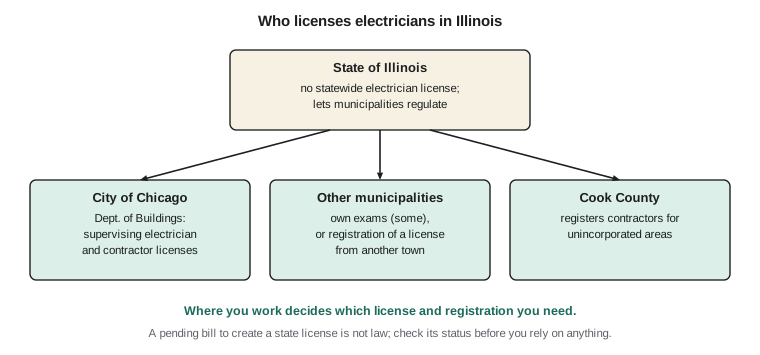
In most states, a single state board licenses electricians, and a license earned in one city is good across the state. Illinois never adopted that system for electricians. The state does license some related work, such as private alarm contractors and plumbers, and it licenses professional engineers, but it does not issue a license to electricians or electrical contractors as such. Instead, electrical licensing grew up city by city. Chicago has licensed electrical contractors and supervising electricians for more than a century. Many suburbs, larger downstate cities and some counties built their own systems, and some smaller towns adopted none at all.
The result is a patchwork, and an electrician who works across the Chicago area has to understand it. A license that one municipality issues after its own exam may be accepted by a neighboring village, accepted only for registration, or not accepted at all. A contractor that moves from a Chicago job to a suburban job across the city line may have to register with the suburb, file insurance certificates, sometimes post a bond, and pull a permit under that suburb's adopted code. Kevin has watched Stan's office manager, Beth Lindqvist, keep a binder of registrations for the towns where Kedzie Avenue Electric works, and Kevin now understands why the binder exists.
Where local authority comes from
Illinois municipalities regulate electrical work under the powers the state gives them. The Illinois Municipal Code lets a city or village regulate the installation, alteration and use of electrical equipment by ordinance, create an electrical inspection department, require permits before equipment is installed or altered, inspect the work and charge inspection fees. If a municipality creates that inspection department, the statute also calls for a six-member electrical commission, chaired by the chief electrical inspector and including an engineer, an electrical contractor, a journeyman electrician, a fire protection representative and a representative of the electric utility. The commission recommends standards for electrical installations.
The statute sections on the electrical commission speak about equipment, permits, inspections and fees; they do not spell out a licensing program for electricians in so many words. The licensing programs that exist come from local ordinances. Chicago and other home rule municipalities, which in general means cities over 25,000 people and others that have chosen home rule by referendum, have broad power to regulate occupations within their limits. Other municipalities rely on the powers the legislature has granted them. For the exam, the practical point is simpler than the legal theory: in Illinois, the rules that apply to you are the rules of the place where the work is done, and you must find out what that place requires before you bid.
The electrical commission matters in a second way. Cook County, as you will see in Lesson 8, registers electrical contractors for unincorporated areas only if their supervising electrician holds a license from an Illinois municipality that has an electrical commission administering an examination. A license from a town that simply registers contractors without examining them does not meet that test. So the question of which town gave your exam, and how, follows you around the county.
Chicago: the main example
Chicago licenses electrical work through its Department of Buildings, usually shortened to DOB. Two licenses matter to Kevin. The supervising electrician license is a license for a person. It shows that the holder has the required experience and has passed the city's written examination, and it lets the holder supervise and direct electrical work for an electrical contractor. The electrical contractor license is a license for a business. To hold it, a business must own or employ at least one licensed supervising electrician, and all electrical work it does must be done by that supervising electrician or by employees working under the supervising electrician's direction.
Both licenses come in two types, general and low voltage, and the type of a contractor's license follows the type of exam its supervising electrician passed. A general license covers electrical work of any type, subject to the limits in the city's rules. A low voltage license is limited to remote-control, signaling, power-limited and communications circuits, the circuits the code groups as Class 1, Class 2 and Class 3. Kedzie Avenue Electric does service upgrades, rehabs and commercial buildouts, so it needs a general license, and Kevin must pass the general exam.
The city's municipal code is the source of these rules: Chapter 4-290 covers electrical contractor licenses and Chapter 4-292 covers supervising electrician licenses. The department's web pages summarize them and say plainly that the municipal code controls if the summary differs. That is good advice for the whole course. A summary, including this one, helps you understand; the ordinance is what an inspector or a hearing officer will apply.
| License | Who holds it | Key point |
|---|---|---|
| Supervising electrician, general | A person who passed the general exam | Can supervise any type of electrical work for a contractor |
| Supervising electrician, low voltage | A person who passed the low voltage exam | Limited to Class 1, 2 and 3 circuits and communications |
| Electrical contractor, general | A business | Must own or employ a general supervising electrician |
| Electrical contractor, low voltage | A business | Must own or employ a low voltage supervising electrician |
The exam vendor and the code
Chicago does not give its exam itself. Applications for the supervising electrician exam go through Continental Testing Services, usually called CTS, which processes them for the Department of Buildings and gives the written exam on announced dates. Lesson 3 covers the application and the schedule, and Lesson 4 covers the exam rules, including the important rule about which book you may bring.
The code itself is local too. Chicago adopted its own electrical code, Title 14E of the Municipal Code, based on the 2017 edition of the National Electrical Code with many Chicago amendments. It became mandatory on March 1, 2018. Chicago's amendments are not small. For decades the city has required wiring in raceway in most buildings where much of the country uses nonmetallic cable, and its rules on services, high-rise buildings and other topics differ from the model code. Lesson 5 explains how to study a locally amended code and what the rest of the state adopts.
Beyond Chicago
Outside Chicago, the picture varies from town to town. Some municipalities run their own licensing exams. The Village of Libertyville, for example, gives its own open-book electrical exam and requires four years of supervised experience. Some cities register contractors whose supervising electrician holds a license from another municipality, sometimes only if the issuing town examined the applicant. The City of Springfield accepts out-of-town municipal licenses issued before October 10, 2007, and asks applicants with later licenses to pass the International Code Council's master electrician exam. Some villages accept a license from what they call a reciprocating municipality and ask for an insurance certificate. Cook County registers electrical contractors for its unincorporated areas. Lesson 2 compares these requirements and Lesson 8 covers registration and insurance.
This variety is why the course title talks about local master and supervising electrician licenses. Chicago uses the term supervising electrician. Other towns may call their license a master electrician license, an electrical contractor license or an electrician's registration, and they may attach it to a person, a business or both. When you read a town's ordinance, ask three questions: who must hold the license, what does it allow, and what does the town accept from other places.
A pending bill, not a law
Illinois electricians have debated statewide licensing for years. In February 2025 a bill called the Electrician Licensing Act, Senate Bill 2307, was filed in the Illinois General Assembly. As introduced, it would have created state licenses for electrical contractors and supervising electricians under the state's professional regulation department, while letting the largest cities keep their own boards. As of November 2026, the bill's status page shows that it was referred to the Senate's Assignments committee on the day it was filed and has had no further action. It is not law. If a statewide system is ever adopted, it will change much of this course, so check the General Assembly's website when you study.
Enforcement
Licensing would mean little without enforcement. In Chicago, the Department of Buildings can refuse permits to unlicensed contractors, inspectors can write violations and issue stop work orders on jobs that break the licensing rules, and the municipal code provides for suspending or revoking licenses and permit privileges. Suburban towns enforce their own registration rules mainly through the permit process: no registration, no permit, and no permit, no legal work. The exam is more likely to ask what kinds of action a city can take, and who takes them, than for a fine amount, and fine amounts change. Check the current ordinance before you rely on a number.
For a supervising electrician, enforcement is personal. The city's rules make the supervising electrician responsible for doing or directing the electrical work, and a contractor license goes inactive if no valid supervising electrician license is associated with it. Stan has told Kevin that the best protection is dull paperwork: a current license for the company and its supervising electrician, apprentices and electricians on the payroll as employees, permits pulled before work starts, and a file for every inspection. Lesson 7 returns to these habits.
How this course is organized
The lessons follow Kevin's path. Lesson 2 covers eligibility in Chicago and elsewhere, Lesson 3 the application and booking process, and Lesson 4 the exam format and the references allowed. Lesson 5 explains local code adoption, and Lesson 6 permits and inspections. Lesson 7 covers the duties of the supervising electrician, Lesson 8 contractor licensing, registration, insurance and bonds, and Lesson 9 contracts and mechanics liens. Lesson 10 covers safety law, OSHA and workers compensation, Lesson 11 renewal and working in other jurisdictions, and Lesson 12 a practice review with test-day strategy. Every lesson ends with a quiz that mixes multiple choice, true or false, number, ordering and matching questions, and the course ends with a final exam.
The calculator below shows the kind of planning Kevin does first. Stan wants to retire in about two years. Kevin needs time to collect his experience letters, apply by an exam deadline, study, sit the exam, possibly wait six months and retake it, and then have the company file its change of supervising electrician. Change the numbers to fit your own plan.
# Kevin's planning check (illustrative months)
months_until_stan_retires = 24
steps = {
    "collect supervisor letters and apply": 2,
    "wait for the next exam date": 3,
    "first attempt and result letter": 1,
    "six-month wait and a retake, if needed": 7,
    "company files the change of supervising electrician": 1,
}
needed = sum(steps.values())
for step, months in steps.items():
    print(f"{step}: {months} months")
print(f"Total: {needed} months; margin: {months_until_stan_retires - needed} months")collect supervisor letters and apply: 2 months wait for the next exam date: 3 months first attempt and result letter: 1 months six-month wait and a retake, if needed: 7 months company files the change of supervising electrician: 1 months Total: 14 months; margin: 10 months
Common mistakes
MistakeAssuming Illinois issues a statewide electrician license.
InsteadIllinois has no statewide electrician license; licensing and registration are local.
MistakeThinking a Chicago license lets you work anywhere in Illinois without further steps.
InsteadOther municipalities and Cook County set their own registration rules and decide what they accept.
MistakeTreating a pending bill as law.
InsteadSenate Bill 2307 was filed in 2025 and referred to committee; it is not law unless passed and signed.
MistakeBelieving the city's web summary overrides the ordinance.
InsteadThe municipal code controls; the department's summary only explains it.
MistakeAssuming every town examines electricians.
InsteadSome towns give exams, some register licenses from other towns, and some do neither.
Summary and key terms
- Illinois has no statewide electrician license; cities, villages and counties regulate electrical work locally.
- Chicago's Department of Buildings licenses supervising electricians (people) and electrical contractors (businesses), each general or low voltage.
- Continental Testing Services processes Chicago applications and gives the written exam.
- Chicago uses its own electrical code, Title 14E, based on the 2017 NEC with local amendments, mandatory since March 1, 2018.
- Other towns give their own exams, accept licenses from other towns, or register contractors with insurance and sometimes a bond.
- A 2025 bill for statewide licensing was referred to committee and is not law; check its status.
- Supervising electrician
- Chicago's license for a person who may supervise and direct a contractor's electrical work.
- Electrical contractor license
- Chicago's license for a business, which must own or employ a supervising electrician.
- Home rule
- Broad local power held by larger Illinois municipalities and others that adopt it.
- Electrical commission
- A six-member municipal body that recommends electrical standards where a town has an inspection department.
- CTS
- Continental Testing Services, which processes Chicago applications and gives the exam.
Practice problems
Work each problem on paper first, then reveal the answer to check.
A contractor with a Chicago license wins a job in a suburb. What should it check before bidding?
Show answer
The suburb's registration rules: what license it accepts, insurance and bond requirements, permit process and adopted code.
Why does Kedzie Avenue Electric need Kevin to pass the general exam rather than the low voltage exam?
Show answer
Its work includes services, rehabs and buildouts beyond Class 1, 2 and 3 circuits, so it needs a general contractor license backed by a general supervising electrician.
Is Senate Bill 2307 in force?
Show answer
No. As of November 2026 it had been referred to the Senate Assignments committee with no further action.
What code does Chicago use?
Show answer
The Chicago Electrical Code, Title 14E, based on the 2017 NEC with local amendments, mandatory since March 1, 2018.
Lesson quiz · 5 questions
Score 60% or more to complete this lesson.
Create a free account to save your progress, take quizzes and earn a certificate.