
MELU-213 · Lesson 4 of 12 · 20 min
The exam format and the references allowed
▶ Video coming soon A video version of this lesson is on the way.
Kevin has taken open-book code tests before, in his apprenticeship and on practice sets, but the Chicago supervising electrician exam has rules of its own. This lesson explains what the published rules say about the exam's format and the one book you may bring, what they do not say, and how to prepare a book that is legal on exam day. It then compares the exams other Illinois authorities use. As always, the facts come from the published pages as of November 2026, and where a page is silent the lesson says so instead of guessing.
What CTS publishes about the Chicago exam
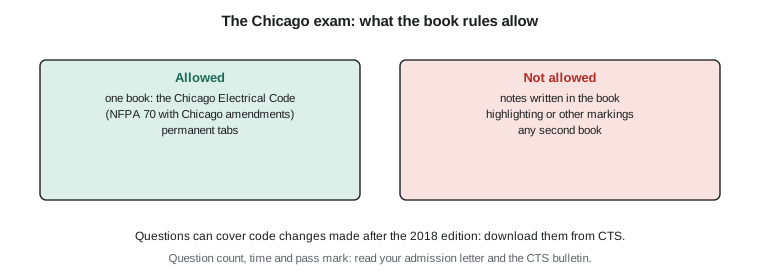
Continental Testing Services describes the Chicago supervising electrician exam as a written examination given on announced dates. It is an open-book exam, and the open book is a single book: the Chicago Electrical Code, which CTS describes as the 2018 edition, published as NFPA 70, the National Electrical Code, with the Chicago amendments. CTS states that this is the only book a candidate may bring into the examination. Tabs are allowed. Notes, highlighting or other changes to the published text are prohibited.
CTS also publishes a free download of the changes made to the Chicago code after the 2018 edition, and it states that questions based on those changes will appear on the exam. That is a crucial detail. A candidate who studies only the printed 2018 book can miss questions on later amendments. Download the changes, read them, and understand how they modify the rules in your book. CTS's page also refers to a clean copy being provided on test day; read your admission information to see exactly what CTS hands out and what you must bring.
What CTS's public page does not state is just as important: the number of questions, the time allowed and the passing score were not given on the page checked for this course. Some exam prep websites publish figures for these, but they are secondary sources and may be out of date. This course does not repeat them. Your admission letter and the current CTS candidate information are the only reliable sources. Read them, and plan your pacing from the numbers they give.
Preparing a legal book
Tabs are allowed and notes are not, so the craft of preparing a Chicago exam book is the craft of tabbing well. Good tabs are permanent, firmly attached and labeled only with chapter, article or topic names that help you find a place in the book. A tab that says Article 220 is a finding aid. A tab that says use 3 VA per square foot is a note, and it breaks the rule. When in doubt, keep tab labels to article numbers and short topic names, and never write rules, values or formulas on a tab.
Plan your tabs around how you search, not around the table of contents alone. Kevin tabbed the start of each chapter, the articles he uses most often, the definitions article, and the major tables he expects to use in calculations, such as the conductor ampacity tables and the raceway fill information in the annexes. He also tabbed the places where the Chicago amendments change the model code in ways he expects to be tested, such as wiring methods. He used two colors: one for chapters and one for the articles and tables inside them. He kept a separate practice copy for marking up during study and a clean copy for the exam, so that his study notes could never end up in the test room.
Remember that a legal book can still slow you down. Too many tabs make a fan of paper that hides the one you need. Kevin started with more than ninety tabs and cut them to about fifty after timed practice showed which ones he never used. Lesson 12 returns to tabbing as part of test-day strategy.
| Item | Allowed? | Reason |
|---|---|---|
| Chicago Electrical Code, as described by CTS | Yes | The one permitted book |
| Permanent tabs with article numbers | Yes | Tabs are allowed |
| Tabs with values or formulas written on them | No | That is a note in disguise |
| Highlighting or underlining | No | Changes to the published text are prohibited |
| A second reference book or handbook | No | Only one book may be brought |
What kinds of questions to expect
Because the exam is a supervising electrician exam on the Chicago Electrical Code, expect questions on the same broad areas the core courses in this series cover, applied through the Chicago code. Code navigation and definitions come first: knowing where rules live and what the defined terms mean. Calculations follow: branch circuit, feeder and service loads, conductor sizing with correction and adjustment, voltage drop, box and raceway fill, motor and transformer protection. Grounding and bonding appear on every master-level exam. And because this is Chicago, expect questions on the local amendments: wiring methods, services and other areas where the city differs from the model code. The download of post-2018 changes tells you which rules have changed recently, and recently changed rules are natural exam material.
Law and business topics may be tested less on a Chicago code exam than on a state business and law exam, but the duties of a supervising electrician, the licensing rules in the municipal code and the permit process are all fair game for a license that carries those duties. Study Lessons 6 to 8 with that in mind.
Calculators and other materials
Most open-book code exams allow a calculator under conditions, such as a silent, non-programmable model without a printer or text storage, and provide scratch paper. The public CTS page checked for this course did not list calculator rules. Read your admission information for the rules on calculators, scratch paper, watches, phones and personal items, and follow them exactly. A banned calculator discovered at check-in is a bad start; a phone discovered during the exam can end it.
Other Illinois exams
Other authorities use other exams. Libertyville's exam, as described on the village's page, is open book, uses the 2014 or 2017 NEC, requires a grade of 70 to pass and may be taken twice in any 12-month period. Springfield, for applicants whose out-of-town license was obtained after October 10, 2007, requires the International Code Council's master electrician exam, a national exam based on the NEC. The ICC publishes its own bulletin with the exam's content outline, question count, time limit and permitted references; read the current bulletin before you prepare, because those details change with code editions.
The main difference between these exams is the code they test. Chicago tests its own amended code. Most other exams test an NEC edition, though not always the newest one. A candidate who studies the 2023 NEC for an exam on the 2017 NEC will find rules that moved, changed or did not yet exist. Always study the edition the exam names.
Worked problem
Which book for which exam?
Kevin is preparing for the Chicago exam. Tamika is considering the Libertyville exam to work in Lake County. A friend from Springfield must take the ICC master electrician exam for registration there.
Show solution
- Kevin brings only the Chicago Electrical Code as described by CTS, with tabs and without notes, and studies the post-2018 changes CTS publishes.
- Tamika brings the NEC edition Libertyville names, 2014 or 2017, and follows the village's book rules.
- The Springfield friend reads the ICC bulletin for that exam, which names the edition and the permitted references.
- None of them assumes that their book is allowed at another authority's exam.
Answer: Each exam names its own book; studying the wrong edition is one of the most common and costly mistakes.
A pacing plan without published numbers
Kevin will learn the question count and time limit from his admission letter. Until then, he practices with a flexible plan that works for any open-book code exam: a first pass answering every question he knows without opening the book, marking the rest; a second pass looking up the marked questions; and a short final review. The program below turns any published time and question count into a pacing plan. Change the numbers when your letter arrives.
# Pacing plan for an open-book code exam (enter the numbers from your admission letter)
minutes = 240        # illustrative
questions = 100      # illustrative
split = {"first pass": 0.55, "second pass (look-ups)": 0.35, "final review": 0.10}
print(f"Average time per question: {minutes / questions:.1f} minutes")
for phase, share in split.items():
print(f"{phase}: {round(minutes * share)} minutes")Average time per question: 2.4 minutes first pass: 132 minutes second pass (look-ups): 84 minutes final review: 24 minutes
The values in the program are illustrative only. They are not the Chicago exam's numbers, which the public page did not state. The method is what matters: know your average time per question, protect time for look-ups, and keep a few minutes for review.
Look-up drills
Speed in an open-book exam comes from practice with the book you will use. Kevin's drill is simple. He writes a list of topics on cards, such as a dwelling general lighting load, the grounding electrode conductor for a given service, the allowable fill for a box, or the rule for receptacles near a sink, shuffles them, and times himself finding the governing section in his clean, tabbed book. He records the time and the section for each card. After a few weeks, the cards that still take longest show him where to add a tab or which part of the index to study. The program below keeps the same kind of log and reports his slowest topics and his average.
# Look-up drill log: seconds to find the governing section (Kevin's practice, illustrative)
drills = [
    ("dwelling general lighting load", 48), ("box fill allowance", 95),
    ("grounding electrode conductor size", 62), ("motor branch-circuit protection", 120),
    ("receptacle near a sink", 40), ("raceway fill in the annex", 110),
    ("feeder neutral load", 85), ("service clearance rules", 70),
]
average = sum(t for _, t in drills) / len(drills)
slowest = sorted(drills, key=lambda d: d[1], reverse=True)[:3]
print(f"Average: {average:.0f} seconds per look-up")
for topic, t in slowest:
print(f"Slow: {topic} ({t} s) -> add a tab or study the index entry")Average: 79 seconds per look-up Slow: motor branch-circuit protection (120 s) -> add a tab or study the index entry Slow: raceway fill in the annex (110 s) -> add a tab or study the index entry Slow: box fill allowance (95 s) -> add a tab or study the index entry
The goal is not a magic number of seconds. It is a steady fall in the slowest times, so that no single look-up can eat several minutes on exam day.
How the Chicago amendments appear in the book
A locally amended code can be organized in different ways. Some cities publish the model code with their changes woven into the text, so that a reader sees the final rule in one place. Others publish a list of amendments that must be read against the model code. CTS describes the Chicago exam book as NFPA 70 with the Chicago amendments, which suggests the woven style, but the details of the printed book are for you to learn from the book itself. Whatever the layout, learn how to recognize a Chicago-specific rule, how its numbering relates to the NEC article it changes, and where the city's added material sits. Then add the post-2018 changes CTS publishes, which you cannot write into the exam book, so you must know them well enough to apply them from memory and from the clean copy CTS describes.
Kevin made a study sheet, kept at home and never brought to the exam, listing each post-2018 change, the chapter it affects and a one-line summary in his own words. He reviewed it weekly. On exam day he will bring only the permitted book, but the sheet will have done its work in his head.
Why the book rule matters so much
On a closed-book exam, a candidate's preparation lives in memory. On an open-book exam, it lives partly in the book: in the tabs, in familiarity with the layout, and in the habit of checking exceptions and definitions. That is why the one-book rule shapes everything. Kevin cannot bring a handbook that explains rules in plain words, so he must understand the rules well enough to apply them from the code's own text. He cannot bring a sheet of formulas, so the formulas he needs must be in his head or found quickly in the code and its annexes. Practicing with the same clean, tabbed book he will use on exam day is the single best preparation the rules allow.
Common mistakes
MistakeBringing a handbook or a second book to the Chicago exam.
InsteadCTS allows only the Chicago Electrical Code, as it describes on its page.
MistakeWriting values or formulas on tabs.
InsteadTabs may only help you find places in the book; writing rules on them is a prohibited note.
MistakeStudying only the printed 2018 edition.
InsteadCTS publishes later code changes and says questions on them will appear.
MistakeTrusting prep websites for the question count and time limit.
InsteadUse the admission letter and current CTS information; the public page did not state these figures.
MistakeStudying the newest NEC for an exam on an older edition.
InsteadStudy the edition the exam names.
Summary and key terms
- The Chicago supervising electrician exam is a written, open-book exam given by CTS on announced dates.
- The only book allowed is the Chicago Electrical Code, which CTS describes as the 2018 edition, NFPA 70 with Chicago amendments.
- Tabs are allowed; notes, highlighting and other changes to the text are prohibited.
- CTS publishes the code changes made after the 2018 edition, and questions on them appear on the exam.
- The public page did not state the question count, time or pass mark; use your admission letter.
- Libertyville's exam uses the 2014 or 2017 NEC with 70 to pass; Springfield may require the ICC master electrician exam.
- Open-book exam
- An exam where a named reference may be used during the test.
- Tab
- A permanent marker attached to a page to help find a place in the book.
- Post-2018 changes
- Chicago code amendments made after the 2018 edition, published by CTS.
- Admission information
- The CTS instructions for a specific exam date.
- ICC master electrician exam
- A national NEC-based exam some Illinois towns require.
Practice problems
Work each problem on paper first, then reveal the answer to check.
May Kevin write 'continuous load x 1.25' on a tab?
Show answer
No. That is a note; tabs may carry only finding labels such as article numbers or topic names.
Where should Kevin find the exam's time limit?
Show answer
In his admission letter and the current CTS candidate information.
Why must Kevin study the changes made after the 2018 edition?
Show answer
CTS says questions based on those changes appear on the exam.
Which NEC editions does Libertyville's exam use?
Show answer
The 2014 or 2017 NEC, according to the village's page.
Lesson quiz · 5 questions
Score 60% or more to complete this lesson.
Create a free account to save your progress, take quizzes and earn a certificate.