
MELU-213 · Lesson 10 of 12 · 19 min
Workplace safety law and OSHA for electrical contractors
▶ Video coming soon A video version of this lesson is on the way.
Electrical work is dangerous, and the laws that govern workplace safety apply to every job a supervising electrician directs. This lesson covers the safety and injury laws that matter most to an Illinois electrical contractor: federal OSHA for private employers, Illinois OSHA for public employers, the main OSHA standards for electrical work, injury recording and reporting, NFPA 70E, and Illinois workers compensation. The OSHA recordkeeping facts were checked against federal sources and the workers compensation facts against a University of Illinois guide in November 2026; details not checked are described in general terms.
Who enforces safety law in Illinois
The federal Occupational Safety and Health Act lets states run their own job safety programs if they meet federal standards. Some states run plans that cover private employers. Illinois runs a state plan that covers state and local government workers, administered by the Illinois Department of Labor, while private employers in Illinois, including private electrical contractors, are covered by federal OSHA. For Kedzie Avenue Electric, that means federal OSHA standards and federal OSHA inspectors. If Kevin's crew wired a building for a city agency, the agency's own workers would be covered by Illinois OSHA, but Kedzie's employees would still be covered by federal OSHA as employees of a private company.
The general duty clause of the federal law requires every employer to keep its workplace free of recognized hazards likely to cause death or serious harm, even where no specific standard applies. Specific standards fill in the details, and an electrical contractor works under two sets: the construction standards in 29 CFR Part 1926, especially Subpart K on electrical safety, and, for maintenance and work in existing workplaces, the general industry standards in 29 CFR Part 1910, including Subpart S on electrical safety and section 1910.147 on the control of hazardous energy, usually called lockout and tagout.
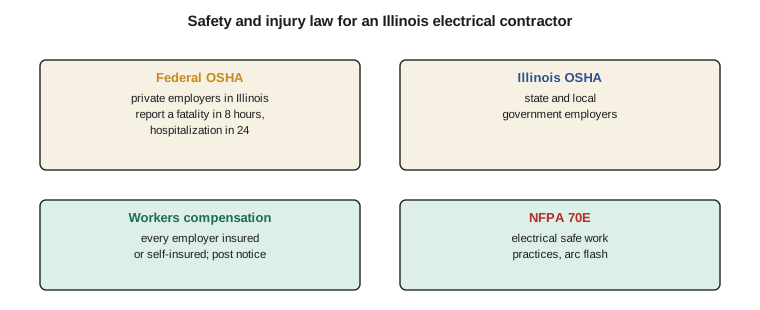
Electrical hazards and the standards that address them
The leading electrical hazards on construction sites are well known: contact with energized parts, contact with overhead power lines, arc flash and arc blast, faulty tools and cords, and falls from ladders and lifts after a shock. The OSHA standards address each. In general terms, they require employers to protect workers from contact with energized parts by deenergizing equipment where feasible and by guarding, insulation and safe work practices where not; to keep workers and equipment clear of overhead lines by required distances; to protect temporary wiring and cord sets with ground-fault circuit interrupters or an assured equipment grounding conductor program on construction sites; and to control hazardous energy with locks, tags and verified isolation before servicing equipment.
The detailed requirements, such as clearance distances and inspection intervals, are in the standards themselves and are not repeated here. A supervising electrician should own current copies, or know where to find them online, and should train foremen to apply them. On Kedzie's jobs, Kevin's rule is that equipment is deenergized and locked out before work unless the job truly cannot be done that way, and in that case the work requires a written plan, qualified workers and the protective equipment NFPA 70E calls for.
NFPA 70E
NFPA 70E, the Standard for Electrical Safety in the Workplace, is a consensus standard published by the National Fire Protection Association. It is not itself an OSHA regulation, but OSHA and courts treat it as describing recognized ways to meet OSHA's general requirements for electrical safety, and many owners and general contractors require it by contract. In general terms, it calls for an electrical safety program, training that distinguishes qualified from unqualified persons, establishing an electrically safe work condition as the preferred approach, risk assessments for shock and arc flash before energized work, approach boundaries, and personal protective equipment selected for the hazard. Like the NEC, NFPA 70E is copyrighted; this course describes it but does not reproduce it.
Recording and reporting injuries
OSHA requires most employers with more than ten employees to keep records of serious work-related injuries and illnesses, using three forms: the OSHA 300 log, the 301 incident report and the 300A annual summary. Employers must post the 300A summary from February 1 to April 30 each year where employees can see it, and keep the records for five years. Certain employers must also submit injury data electronically to OSHA by March 2 each year, depending on their size and industry. Kedzie has eleven employees, so it keeps the log.
Separately from recordkeeping, every employer must report the most serious events to OSHA quickly, whether or not it keeps the log. A work-related fatality must be reported within 8 hours. An inpatient hospitalization, an amputation or the loss of an eye must be reported within 24 hours. Reports go to OSHA by phone or online. Kevin keeps the reporting numbers in his phone and in every foreman's binder, and he hopes never to use them.
| Event or task | Deadline or rule | Applies to |
|---|---|---|
| Work-related fatality | Report to OSHA within 8 hours | All employers |
| Inpatient hospitalization, amputation, loss of an eye | Report to OSHA within 24 hours | All employers |
| 300A annual summary | Post February 1 to April 30 | Employers required to keep records |
| Records retention | Keep for five years | Employers required to keep records |
| Electronic submission | By March 2, for covered employers | Depends on size and industry |
# OSHA reporting clock for serious events (rules from this lesson)
events = [("fatality", 8), ("inpatient hospitalization", 24), ("amputation", 24), ("loss of an eye", 24)]
learned_at_hour = 15    # 3 p.m. on the day the employer learns of the event
for event, hours in events:
    due = learned_at_hour + hours
    day = "same day" if due < 24 else f"next day at {due - 24}:00"
print(f"{event}: report within {hours} hours -> {day if due >= 24 else f'by {due}:00 same day'}")fatality: report within 8 hours -> by 23:00 same day inpatient hospitalization: report within 24 hours -> next day at 15:00 amputation: report within 24 hours -> next day at 15:00 loss of an eye: report within 24 hours -> next day at 15:00
Illinois workers compensation
Illinois workers compensation law requires every employer to be insured for workers compensation or properly self-insured. The Illinois Workers' Compensation Commission administers the system. Employers must post a notice of employees' rights, including the name of the insurer, where workers can easily see it, and it is illegal for an employer to charge any part of the premium or benefits to employees. If an employer has no coverage, an injured worker may still recover through the state's Injured Workers' Benefit Fund, though that path is slower and harder, and an uninsured employer faces penalties under the Act, which this course describes only in general terms.
Two deadlines belong to the worker but matter to the supervising electrician. An injured worker must report the injury to the employer within 45 days of the accident, and a claim must generally be filed with the Commission within three years, with exceptions. A supervising electrician who hears about an injury should make sure it is reported to the company right away, recorded if required, reported to the insurer promptly, and reported to OSHA if it is one of the serious events above. Early reporting helps the worker get care and helps the company manage the claim.
Workers compensation also connects to licensing. Lesson 7 explained that Chicago's rules require a contractor's electrical work to be done by employees, and that misclassifying workers as independent contractors is a problem under the Illinois Employee Classification Act. A worker wrongly treated as an independent contractor may also be a worker without workers compensation coverage, and the injury that follows can become a very expensive lesson.
Worked problem
An injury on the tower buildout
At 2 p.m. on a Tuesday, Luis is hurt when a ladder slips on the 9th floor of the West Loop tower. The foreman calls an ambulance, and Luis is admitted to the hospital overnight for observation.
Show solution
- The foreman secures the area and calls Kevin, who notifies the company and the general contractor at once.
- An inpatient hospitalization must be reported to OSHA within 24 hours: by 2 p.m. Wednesday at the latest. Beth reports it Tuesday afternoon.
- Beth reports the claim to the workers compensation insurer and records the case on the OSHA 300 log and a 301 report.
- Kevin investigates the cause, a ladder without proper footing on a slick floor, and changes the job's ladder rules and inspection routine.
Answer: Care first, then the 24-hour OSHA report, the insurer, the log, and a fix that prevents a repeat.
Where the NEC and safety law meet
The electrical code and safety law overlap in useful ways. The NEC requires certain equipment to be field marked with warnings about arc flash hazards and, for some services and feeders, with information such as available fault current, so that the people who later work on the equipment can choose safe practices and protective equipment. It requires working space around equipment, which protects the worker as much as the equipment. And it requires disconnecting means that make lockout practical. A supervising electrician who installs equipment that meets these rules makes the next electrician's safety program possible. Chicago's amended code may add its own requirements in these areas; check the city's version of each rule.
Overhead lines are a second meeting point. Utilities, OSHA standards and the code all address clearances, from different angles: the utility protects its system, OSHA protects workers near energized lines, and the code governs the installation of services and conductors. A crew setting a ladder or a lift near a service drop must apply the OSHA clearance rules regardless of what the code says about the finished installation.
Training and supervision records
OSHA standards and NFPA 70E both turn on training. Workers who work on or near exposed energized parts must be qualified for the task, which means trained to recognize and avoid the hazards; unqualified workers must be trained in the hazards that apply to them and kept at a safe distance. Apprentices work under supervision, and the level of supervision should match their training. Kevin keeps a training record for every worker: the dates of safety training, the topics, the trainer, and, for apprentices, the tasks they have been cleared to perform. The same record supports the Class 1 documentation in Lesson 7 and answers an OSHA inspector's first question after an incident: who was trained to do what.
Multi-employer job sites
On a commercial buildout, Kedzie's crew works alongside drywall, plumbing, mechanical and fire protection crews, all employed by different companies. OSHA's approach to multi-employer sites can hold more than one employer responsible for a hazard: the employer that created it, the employer whose workers are exposed, the employer responsible for correcting it, and the employer controlling the site, often the general contractor. For a supervising electrician, that means two duties. Protect your own crew from hazards others create, such as an unguarded floor opening, and do not create hazards for others, such as temporary wiring left energized and unprotected. Raise problems with the general contractor's superintendent in writing.
Building a safety culture
Laws set the minimum. A company's safety record comes from daily habits: tailgate talks at the start of each week, a written lockout procedure that everyone follows, ladders and lifts inspected before use, tools and cords checked, and a rule that anyone can stop work that looks unsafe without being punished for it. Kevin's experience mod, the insurance rating that reflects the company's claim history, affects premiums and, increasingly, whether general contractors will hire Kedzie at all. Good safety is good business as well as good ethics.
Common mistakes
MistakeAssuming Illinois OSHA covers private contractors.
InsteadIllinois' state plan covers public employers; private employers are covered by federal OSHA.
MistakeWaiting until the next business day to report a hospitalization.
InsteadInpatient hospitalizations must be reported within 24 hours.
MistakeCharging workers part of the workers compensation premium.
InsteadThat is illegal under Illinois law.
MistakeTreating NFPA 70E as irrelevant because it is not a regulation.
InsteadOSHA and courts treat it as recognized practice, and contracts often require it.
MistakePaying electricians as independent contractors to avoid workers comp.
InsteadThat risks misclassification penalties, licensing problems and uninsured injuries.
Summary and key terms
- Private Illinois employers are covered by federal OSHA; Illinois OSHA covers state and local government employers.
- Key OSHA standards: 29 CFR 1926 Subpart K for construction, 1910 Subpart S and 1910.147 for general industry and lockout.
- Report a fatality within 8 hours; hospitalization, amputation or loss of an eye within 24 hours.
- Covered employers keep 300, 301 and 300A records for five years and post the summary February 1 to April 30.
- NFPA 70E describes recognized electrical safe work practices, including arc flash risk assessment and PPE.
- Illinois employers must carry workers compensation or self-insure, post notice and never charge workers; workers report within 45 days.
- Federal OSHA
- The federal agency that enforces job safety standards for private employers in Illinois.
- Illinois OSHA
- The state plan covering state and local government workers.
- Lockout and tagout
- Procedures that isolate and lock hazardous energy before servicing equipment.
- NFPA 70E
- The consensus standard for electrical safety in the workplace.
- Injured Workers' Benefit Fund
- An Illinois fund that can pay benefits when an employer lacks coverage.
Practice problems
Work each problem on paper first, then reveal the answer to check.
A private Chicago contractor's worker is injured. Which OSHA program applies?
Show answer
Federal OSHA, because private employers in Illinois are covered federally.
A worker loses part of a finger at 10 a.m. When must the company report to OSHA?
Show answer
An amputation must be reported within 24 hours: by 10 a.m. the next day.
When must the OSHA 300A summary be posted?
Show answer
From February 1 to April 30.
Within how many days must an Illinois worker report an injury to the employer?
Show answer
Within 45 days of the accident.
Lesson quiz · 5 questions
Score 60% or more to complete this lesson.
Create a free account to save your progress, take quizzes and earn a certificate.