
MELU-213 · Lesson 6 of 12 · 19 min
Permits, inspections and the inspection authority
▶ Video coming soon A video version of this lesson is on the way.
A license lets Kevin supervise electrical work. A permit lets a specific job go ahead. In Illinois, as in most places, permits and inspections are where licensing rules meet the job site: the permit application names the licensed contractor and supervising electrician, and the inspector checks the work against the code that applies. This lesson explains how permits and inspections work in Chicago, how they work in suburbs and unincorporated Cook County, and what a supervising electrician should do before, during and after an inspection. The Chicago details come from the Department of Buildings' electrical inspection page as published in November 2026.
Chicago: only licensed contractors get permits
The Department of Buildings states the basic rule plainly: only registered electrical contractors are issued permits to perform electrical work in Chicago. Owners generally cannot do electrical work on their own buildings under their own permits, and the contractor files the permit application, which carries the supervising electrician's signature and license number. That signature is not a formality. It ties the job to a specific licensed person who is responsible, under the city's rules, for doing or directing the work.
Chicago issues electrical permits in two main ways. When electrical work is part of a larger building project, it is included in the building permit; the electrical contractor's name, address and license number go on the building permit form, and a short-form electrical permit application is completed. When a job involves only electrical work, such as a service upgrade or new circuits in an existing space, an electrical-work-only permit is used. Either way, the department may require drawings, load calculations or letters requesting relief from a code requirement, and the department considers code relief only before a permit is issued, not after the work is done.
Some jobs need review by other parts of city government. The department's page notes that jobs needing exit and emergency lighting or fire prevention review must include a receipt from the Fire Prevention Bureau along with electrical drawings, that standard fire alarm jobs need that receipt but not drawings, and that a separate wiring permit is required before work starts on a required fire alarm system. A supervising electrician who plans a commercial buildout should read these requirements at the estimating stage, because missing reviews delay permits.
What the city inspects
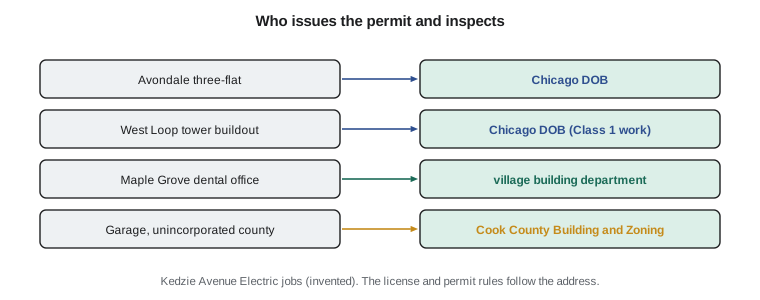
Chicago's electrical inspection bureau inspects electrical installations made under permits, responds to code complaints, and conducts regular inspections of certain occupancies, including nursing homes, day care centers, electrical signs and public places of assembly. It also inspects fire alarm and life safety emergency systems. For a contractor, the permit inspections are the ones that shape the schedule: work is typically inspected before it is covered, so that the inspector can see raceways, boxes, grounding and conductors, and again when it is complete. The exact inspection stages and how to request them depend on the permit type and the department's current procedures; check them for each job.
Inspections also check licensing on certain jobs. Lesson 7 explains Class 1 work, the category of large and assembly projects where every worker must meet the city's apprenticeship or license standard and where compliance records must be kept at the site. Building inspectors enforce those rules and can write violations or stop work. A supervising electrician should expect an inspector to ask about who is doing the work, not only about how it was done.
| Stage | Typical purpose | Kevin's preparation |
|---|---|---|
| Permit application | Names contractor and supervising electrician; review if needed | Drawings, load calculation, other reviews |
| Rough-in | Raceways, boxes, grounding and conductors before cover | Walk the job, check every box and bond |
| Other reviews | Fire alarm, emergency systems, signs as applicable | Separate permits and receipts in hand |
| Final | Completed installation | Labels, panel schedules, covers, tests done |
Suburbs: registration, then permits
In suburbs, the permit process usually starts with registration. A village building department typically requires a contractor to be registered with the village before it will issue an electrical permit, and registration requires the license the village accepts, insurance certificates and sometimes a bond, as Lesson 8 explains. Once registered, the contractor applies for permits under the village's adopted code and schedules inspections with the village's electrical inspector, who may be a village employee or an inspector from a firm the village hires.
Suburban inspection practices vary as much as suburban codes. Some villages inspect underground work, rough-in and final as separate visits; some combine visits on small jobs; some require a service inspection before the utility will energize a new service. Read each village's permit instructions, and when they are unclear, ask. Kevin has learned that the electrical inspector's phone number is one of the most valuable entries in Beth's town reference.
Unincorporated Cook County
In unincorporated Cook County, the county's Department of Building and Zoning issues permits and inspects. Before permits, the contractor registers with the county, which, as Lesson 2 noted, accepts a supervising electrician's license from an Illinois municipality whose electrical commission administers an exam, and requires a general liability certificate naming the department. After registration, permits and inspections follow the county's procedures and adopted codes.
The utility's role
Electric utilities are not code enforcement agencies, but they control the point where a new or upgraded service is connected. Utilities generally require a release from the local inspection authority, showing that the service passed inspection, before they energize it, and they have their own standards for meter locations, service entrances and clearances. In the Chicago area, the utility's requirements for service equipment and metering are part of planning every service job. Read the utility's current service standards, coordinate early, and do not assume that passing a city inspection settles every utility requirement.
Before, during and after an inspection
A supervising electrician's job is to make inspections boring. Before an inspection, walk the job with the code in mind: every box accessible, every conductor identified, grounding and bonding complete, raceways supported, required labels and panel directories in place, and the permit posted where the inspector can see it. Make sure the right person will be there: someone who knows the job and can answer questions calmly. During the inspection, listen, take notes and ask the inspector to cite the code section for any correction. After the inspection, make the corrections, request a reinspection if needed, and keep the correction notice and the result in the job file.
When an inspector and a contractor disagree about a code interpretation, the first step is a respectful conversation, with the code open. If that does not settle it, the city's procedures provide for review by supervisors and, ultimately, formal appeals or code relief requests. Chicago's department states that code relief is considered only before a permit is issued, which is another reason to settle questions early. Arguing on the job site rarely helps; a well-documented question asked before work starts usually does.
Worked problem
A failed rough-in inspection
Inspector Angela Price, an invented Chicago electrical inspector, fails the rough-in on Kedzie's Avondale three-flat. Her notice lists three items: a missing bonding jumper at a service raceway, two boxes overfilled, and a run of cable where the Chicago code requires raceway.
Show solution
- Kevin asks for the code section behind each item and writes them on the job's correction list.
- The crew installs the bonding jumper, replaces the two boxes with larger ones after recalculating fill, and replaces the cable run with raceway.
- Kevin checks every other box on the floor for fill, since the same mistake could repeat.
- Beth schedules the reinspection, and the correction notice and the passed result go in the job file.
Answer: Fix the cited items, check for the same mistake elsewhere, request reinspection and keep the records.
Complaints and violations on existing buildings
Not every inspection starts with a permit. Chicago's department responds to electrical code complaints, and tenants who report unrepaired electrical problems can call the city's 311 service, giving details and a daytime phone number so that an inspector can schedule a visit. A complaint inspection can lead to violations against the building owner, who then hires a licensed contractor to correct them under a permit. For a contractor, these jobs come with a deadline set by someone else, often a court or a hearing officer, and with an inspector who already knows the building. Read the violation list carefully, price every item, and make sure the permit covers all of it.
Annual inspections of assembly occupancies, day care centers, nursing homes and signs can also generate repair work. A restaurant owner who receives a list of corrections after an annual inspection needs a contractor who understands that the inspector will come back to check each item, and that the work must meet the code in force for the repair.
Planning a service job
Service jobs bring every part of this lesson together. A service upgrade on a Chicago three-flat needs an electrical permit, often a load calculation to justify the new service size, coordination with the utility on the meter and service location, inspections before the utility reconnects, and attention to the Chicago code's service rules, which differ in places from the model code. Kevin plans these jobs backward from the day the utility will disconnect and reconnect, because tenants without power are the costliest delay of all. He confirms the permit, the inspection booking, the utility appointment and the material delivery before the crew touches the old service.
Generators and other standby systems add more steps: transfer equipment, fuel and exhaust questions for other trades and departments, and, for systems required by code, fire and life safety reviews. The department publishes instructions for generator inspections; read the current version before bidding such a job.
Records you keep
Every job file at Kedzie Avenue Electric holds the permit, the drawings and calculations submitted, the inspection results and any correction notices, the utility correspondence, and photographs of the work before it was covered. Photographs are cheap insurance. When a question arises years later about what was installed behind a finished wall, a dated photo answers it better than memory. For Class 1 work, Lesson 7 explains the records the city requires at the site and afterward.
Tracking permits and inspections
A contractor with a dozen open permits in several towns needs a system. Beth tracks every permit: the authority, the permit number, the date issued, the inspections required, the inspections passed and the date of the final. The program below shows a simple version that lists permits with inspections still to pass, which is the list Kevin reviews every Monday.
# Open permits and inspections still to pass (invented jobs)
permits = [
    {"job": "Avondale three-flat", "authority": "Chicago", "needed": ["rough-in", "final"], "passed": ["rough-in"]},
    {"job": "West Loop buildout", "authority": "Chicago", "needed": ["rough-in", "fire alarm", "final"], "passed": []},
    {"job": "Maple Grove dental", "authority": "Maple Grove", "needed": ["underground", "rough-in", "final"], "passed": ["underground", "rough-in", "final"]},
    {"job": "Garage feed", "authority": "Cook County", "needed": ["final"], "passed": []},
]
for p in permits:
    left = [i for i in p["needed"] if i not in p["passed"]]
    status = "closed" if not left else "still to pass: " + ", ".join(left)
print(f"{p['job']} ({p['authority']}): {status}")Avondale three-flat (Chicago): still to pass: final West Loop buildout (Chicago): still to pass: rough-in, fire alarm, final Maple Grove dental (Maple Grove): closed Garage feed (Cook County): still to pass: final
The structure matters more than the tool. Whether Beth uses a spreadsheet, a permit tracking service or a whiteboard, every permit must end with a passed final, and every passed final must be filed.
Common mistakes
MistakeStarting work before the permit is issued.
InsteadObtain the permit first; code relief is considered only before a permit is issued.
MistakeLetting an owner pull a Chicago electrical permit for the contractor's work.
InsteadOnly licensed electrical contractors are issued electrical permits in Chicago.
MistakeCovering work before the rough-in inspection.
InsteadWork must be visible for inspection; covering it can mean tearing it open.
MistakeAssuming the utility will energize a service that passed nothing.
InsteadUtilities generally need an inspection release and have their own service standards.
MistakeArguing an interpretation on the job site.
InsteadAsk for the code section, discuss respectfully, and use the authority's review procedures if needed.
Summary and key terms
- In Chicago, only licensed electrical contractors are issued electrical permits, and the application carries the supervising electrician's signature and license number.
- Electrical work is permitted either within a building permit or on an electrical-work-only permit.
- Drawings, load calculations or relief letters may be required; code relief is considered only before a permit is issued.
- Fire alarm and emergency systems involve Fire Prevention Bureau review, and required fire alarm systems need a separate wiring permit.
- Suburbs usually require contractor registration before permits; Cook County permits and inspects in unincorporated areas.
- Prepare for inspections, record corrections with code sections, and keep every result in the job file.
- Electrical permit
- Permission from the authority to perform specific electrical work.
- Rough-in inspection
- An inspection of wiring before it is covered.
- Final inspection
- An inspection of the completed installation.
- Code relief
- A request for permission to depart from a code requirement, considered before a permit is issued in Chicago.
- Inspection release
- Confirmation from the authority that a service passed, which utilities generally need before energizing.
Practice problems
Work each problem on paper first, then reveal the answer to check.
Can a Chicago homeowner hire an unlicensed handyman and pull an electrical permit for him?
Show answer
No. Only licensed electrical contractors are issued electrical permits in Chicago.
When does Chicago consider requests for code relief?
Show answer
Before a permit is issued.
What must accompany a Chicago job that needs fire prevention review?
Show answer
A Fire Prevention Bureau receipt along with electrical drawings.
What should a supervising electrician do after a failed inspection?
Show answer
Correct the cited items, check for the same problem elsewhere, request reinspection and file the records.
Lesson quiz · 5 questions
Score 60% or more to complete this lesson.
Create a free account to save your progress, take quizzes and earn a certificate.