
MELU-213 · Lesson 12 of 12 · 24 min
Practice exam review and test-day strategy
▶ Video coming soon A video version of this lesson is on the way.
Kevin's exam is close. This final lesson pulls the course together in three parts: a review of the Illinois facts a candidate must know cold, a mixed practice set that combines those facts with code skills from the core courses, and a plan for exam day itself. The Chicago supervising electrician exam is a code exam first, so most of the practice in the core courses applies directly. What this lesson adds is the local layer: the Chicago book rules, the Chicago code, and the licensing, permit and business rules that a supervising electrician in Illinois must know.
The Illinois facts to know cold
Start with the structure. Illinois has no statewide electrician license; licensing is local. Chicago's Department of Buildings licenses supervising electricians, who are people, and electrical contractors, which are businesses, each in general or low voltage types. Continental Testing Services processes Chicago applications and gives the written, open-book exam. Cook County registers contractors for its unincorporated areas, accepting a license from an Illinois municipality whose electrical commission administers an exam. Suburbs register contractors under their own rules, often accepting licenses from reciprocating municipalities and requiring insurance certificates.
Then the numbers. Chicago supervising electrician applicants must be at least 21 and have two years of supervised experience verified by letters. Exam fee: 150 dollars per attempt. License fee: 150 dollars. Renewal: 150 dollars per year. Contractor license: 150 dollars, renewing yearly; change of supervising electrician: 100 dollars. Licenses are valid one year; a supervising electrician license expired three or more years cannot be renewed. After a failed exam, wait for the result letter and at least six months. The Chicago Electrical Code, Title 14E, is based on the 2017 NEC and became mandatory March 1, 2018. Class 1 work covers buildings over 55 feet and assembly occupancies of 300 or more, with workers who hold the license, completed an apprenticeship of at least 8,000 hours, or are enrolled in one; records stay at the site and for two years after.
Finally the business and safety rules. Liens: subcontractor notice within 90 days after last work; 60 days after first work on owner-occupied single-family homes; record the claim within four months after last work; sue within two years. Insurance examples: Cook County 1,000,000 dollars general liability naming its department; Gurnee 500,000 dollars naming the village; Springfield a 5,000 dollar calendar-year bond plus liability and workers compensation policies. Safety: federal OSHA covers private Illinois employers; report a fatality in 8 hours and a hospitalization, amputation or loss of an eye in 24; post the 300A from February 1 to April 30; keep records five years. Workers compensation: required for every employer; workers report injuries within 45 days.
| Topic | Fact | Lesson |
|---|---|---|
| Statewide license | None in Illinois; licensing is local | 1 |
| Chicago eligibility | Age 21, two years supervised, letters | 2 |
| Fees | Exam 150, license 150, renewal 150, contractor change 100 | 3, 8 |
| Exam book | Chicago Electrical Code only, tabs yes, notes no | 4 |
| Chicago code | Title 14E, 2017 NEC base, mandatory March 1, 2018 | 5 |
| Permits | Only licensed contractors; relief before permit issued | 6 |
| Class 1 | Over 55 feet or assembly 300+, qualified workers, records 2 years | 7 |
| Liens | 60 / 90 days notices, 4 months record, 2 years suit | 9 |
| OSHA | 8 hours fatality, 24 hours hospitalization | 10 |
| Renewal | One year; not renewable after 3 years expired | 11 |
A mixed practice set
Work these ten problems before reading the answers in the practice section at the end of the lesson. They mix the Illinois facts with code skills. For the code problems, use your own code book and the methods from the core courses; the values given are illustrative and labeled as such.
- 1. A business wants to install new branch circuits in a Chicago restaurant. What two licenses must be in place?
- 2. A candidate failed the Chicago exam on November 18, 2026. Under a six-month wait from the exam date, what is the earliest date she may reapply?
- 3. Which of these may a candidate bring into the Chicago exam: a tabbed Chicago Electrical Code, a highlighted Chicago Electrical Code, a handbook?
- 4. A first tenant buildout on the 6th floor of a new 80-foot building is planned in Chicago. Is it Class 1 work?
- 5. A subcontractor's last day of work on a commercial job was April 30. By when must it serve its notice on the owner?
- 6. A continuous load of 32 amperes is served by a branch circuit. Using the 125 multiplier for continuous loads that the core courses teach, what minimum overcurrent device rating does the calculation give before rounding up to a standard size?
- 7. A worker is hospitalized overnight after a fall at 9 a.m. Monday. By what time must the company report to OSHA?
- 8. Kedzie's general liability policy is 2,000,000 dollars per occurrence. Does it meet Cook County's published minimum?
- 9. Stan's supervising electrician license expired 40 months ago. Can he renew it?
- 10. A three-flat rehab is in Chicago. A crew member suggests nonmetallic cable to save time. What should Kevin check before answering?
The calculator below checks the arithmetic in problems 2, 5 and 6, which is the kind of quick check worth doing on scratch paper during the exam.
from datetime import date, timedelta

# Problem 2: six months (183 days used here) after a November 18, 2026 exam
print("2) earliest reapply date:", date(2026, 11, 18) + timedelta(days=183))

# Problem 5: 90 days after an April 30 last day of work
print("5) subcontractor notice due by:", date(2027, 4, 30) + timedelta(days=90))

# Problem 6: continuous load times the 1.25 continuous-load factor
load = 32
print("6) minimum rating before rounding up:", load * 1.25, "amperes")2) earliest reapply date: 2027-05-20 5) subcontractor notice due by: 2027-07-29 6) minimum rating before rounding up: 40.0 amperes
Test-day strategy
The night before, pack what the admission letter allows and nothing else: identification, the permitted book in its clean, tabbed state, and any calculator and supplies the letter allows. Put your phone where the rules say it must be. Plan to arrive early enough to absorb a late train or a parking problem. Eat before you go; a four-hour exam on an empty stomach is a test of endurance as much as knowledge.
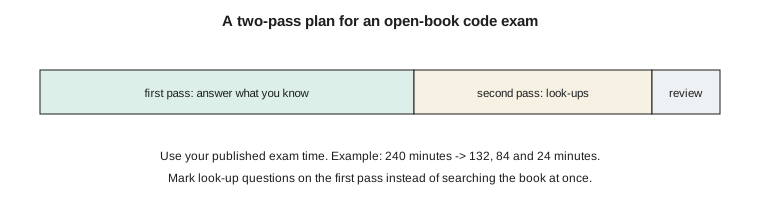
In the room, read the instructions carefully, note the time allowed and calculate your average time per question before you start. Use the two-pass plan from Lesson 4. On the first pass, answer every question you can answer without opening the book, and mark the rest. On the second pass, look up the marked questions in order of difficulty, easiest first, and do not let any single look-up run much past your average. In the last minutes, check that every question has an answer; on most exams an unanswered question scores the same as a wrong one, so a reasoned guess is better than a blank. Check your admission information for any rule that says otherwise.
Read every question twice. Exam questions often turn on a single word: minimum or maximum, shall or may, dwelling or commercial, general or low voltage, Chicago code or NEC. Underline those words on scratch paper if that helps. For calculation questions, write the formula, the values and the units before you compute, and check whether the question asks for a rating before or after rounding to a standard size.
If you panic, stop for thirty seconds, breathe, and do one easy question. Then go back to the plan. Kevin has practiced timed sets often enough that he knows his pace, and he knows that every candidate meets questions they cannot answer.
After the exam
CTS will send an official result letter. If Kevin passes, he pays the license fee to the Department of Buildings, receives his license, and begins planning the change of supervising electrician with Stan. If he does not pass, he reads the letter for any information about his weak areas, waits the required time, and reapplies for the next realistic date, studying the areas that cost him points. Either way, he keeps his study notes, because the code will change and the habits that prepared him for the exam will keep him current.
Worked problem
Kevin's final week
Seven days before the exam, Kevin checks his preparation against this lesson.
Show solution
- He takes one full timed practice set from the core courses in his clean, tabbed book and reviews every miss.
- He reviews his study sheet of Chicago amendments and the post-2018 changes from CTS, which he cannot write in the book.
- He confirms the test site, travel time and the admission letter's list of permitted items.
- He sleeps normally the night before instead of cramming.
Answer: The last week is for consolidation and logistics, not new material.
Common traps, lesson by lesson
Each lesson in this course has a trap that exam writers like. From Lesson 1, the trap is a statewide license that does not exist, or a state agency given a power only a city has. From Lesson 2, it is experience that does not qualify: unsupervised side work, or a letter that praises without verifying. From Lesson 3, it is the calendar: a late application, or a reapplication before the result letter and the six-month wait. From Lesson 4, it is the book: a handbook, a highlighted copy, or a tab with a formula on it. From Lesson 5, it is the edition: an answer drawn from the newest NEC when the question is about the Chicago code. From Lesson 6, it is the permit: an owner or an unlicensed worker pulling it, or a request for code relief after the fact.
The later lessons have traps of their own. From Lesson 7, the trap is a supervising electrician serving two companies, independent contractors doing a company's work, or an unenrolled helper on a Class 1 job. From Lesson 8, it is a certificate made out to the wrong holder, or a bond mistaken for insurance. From Lesson 9, it is a lien clock started on the wrong day, or a final waiver signed before payment. From Lesson 10, it is the wrong safety program, Illinois OSHA instead of federal OSHA for a private contractor, or a 24-hour report treated as next business day. From Lesson 11, it is a license allowed to lapse past the three-year limit, or a village license assumed to qualify a Chicago contractor. When a question feels easy, check whether it is one of these traps before you commit.
Kevin turned the list into flash cards: the trap on one side, the rule and the lesson number on the other. In his last week he shuffled them each evening and set aside any card he hesitated on for another look the next day.
Common mistakes
MistakeSpending ten minutes on one look-up early in the exam.
InsteadMark it and return on the second pass.
MistakeLeaving questions blank.
InsteadA reasoned guess usually scores better than a blank; check the exam's rules.
MistakeBringing a marked practice book by mistake.
InsteadPack only the clean, tabbed exam book the rules allow.
MistakeAnswering from the newest NEC instead of the Chicago code.
InsteadThe exam tests the Chicago Electrical Code and its changes.
MistakeCramming the night before.
InsteadRest and logistics matter more in the final hours.
Summary and key terms
- Know the Illinois structure: local licensing, Chicago DOB, CTS, Cook County and suburban registration.
- Know the Chicago numbers: age 21, two years, 150 dollar fees, one-year terms, the three-year renewal limit and the six-month wait.
- Know the Chicago code basis and Class 1 rules, and the lien, insurance, OSHA and workers compensation deadlines.
- Bring only what the admission letter allows, with a clean, tabbed Chicago Electrical Code.
- Use a two-pass plan, read every question twice, and answer every question.
- After the result, license and plan the company's change, or wait, restudy and reapply.
- Two-pass plan
- Answer known questions first, then return to look-ups.
- Average time per question
- Total time divided by the number of questions.
- Official result letter
- The CTS letter reporting the result.
- Clean exam book
- The permitted code book with tabs and no notes or markings.
- Standard size
- A listed overcurrent device rating; calculated values are often rounded up to one.
Practice problems
Work each problem on paper first, then reveal the answer to check.
Problem 1 answer.
Show answer
A Chicago electrical contractor license for the business, backed by a licensed supervising electrician who performs or directs the work, and a permit pulled by the contractor.
Problem 2 answer.
Show answer
Using 183 days from November 18, 2026: May 20, 2027, and only after receiving the result letter; then apply for the next exam whose deadline can be met.
Problem 3 answer.
Show answer
Only the tabbed Chicago Electrical Code without notes or highlighting; not a highlighted copy or a handbook.
Problem 4 answer.
Show answer
Yes: it is a first buildout in a building over 55 feet with no prior certificate of occupancy.
Problem 5 answer.
Show answer
Within 90 days after April 30: by July 29.
Problem 6 answer.
Show answer
32 x 1.25 = 40 amperes before rounding; check the standard sizes and the code's rules in your book.
Problem 7 answer.
Show answer
Within 24 hours: by 9 a.m. Tuesday.
Problem 8 answer.
Show answer
Yes; 2,000,000 exceeds the 1,000,000 dollar minimum, and the certificate must name the county department.
Problem 9 answer.
Show answer
No; a license expired three or more years cannot be renewed, so he must apply again.
Problem 10 answer.
Show answer
The Chicago code's wiring-method rules for that occupancy, which have long required raceway in most buildings.
Lesson quiz · 5 questions
Score 60% or more to complete this lesson.
Create a free account to save your progress, take quizzes and earn a certificate.