
MELU-213 · Lesson 7 of 12 · 17 min
Duties and responsibilities of the Local Master and Supervising Electrician Licenses holder
▶ Video coming soon A video version of this lesson is on the way.
Passing the exam gives Kevin a license. Becoming Kedzie Avenue Electric's supervising electrician gives him responsibilities, and those responsibilities are what the license is really about. This lesson explains the duties the City of Chicago attaches to the supervising electrician and the electrical contractor, the special rules for Class 1 work, and the practical habits that keep a supervising electrician and a company out of trouble. It closes with how the same ideas appear in suburban licensing. The Chicago rules come from the Department of Buildings pages and the Municipal Code chapters they summarize, as checked in November 2026.
Doing or directing all the work
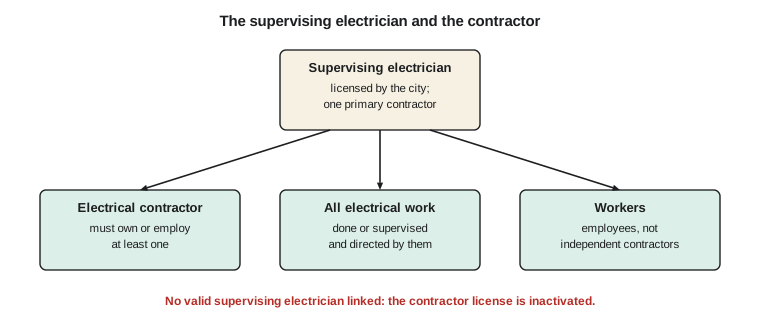
The central duty is short. In Chicago, a supervising electrician must either perform or supervise and direct all electrical work done by the electrical contractor, and all electrical work must be performed by a licensed supervising electrician or by employees working under the supervising electrician's supervision and direction. The rule does not mean that Kevin must stand beside every electrician on every job. It means that he is responsible for the work: for planning it, for assigning qualified people, for checking it, and for its compliance with the code.
That responsibility shapes how a supervising electrician spends the day. Kevin reviews drawings and load calculations before permits are filed, assigns foremen to jobs, visits jobs at key stages, especially before inspections, checks that the crew understands the code that applies at each address, and answers questions from the field. When he cannot be at a job, he makes sure that a qualified foreman is, and that the foreman can reach him. A supervising electrician who signs permit applications for work he never sees is not supervising and directing anything, and the city's rules put the consequences on him.
One primary contractor
A Chicago supervising electrician may not be the primary supervising electrician for more than one licensed electrical contractor. The rule keeps a license from being rented out to several companies whose work the holder could not possibly direct. For Kevin, it means that when he becomes Kedzie's supervising electrician he cannot also serve as the primary supervising electrician for a friend's new company. If he ever wants to start his own company, he will have to leave Kedzie's role first or the two companies must arrange their supervising electricians to comply with the rule.
The rule works in the other direction too. A contractor must be owned by, or employ, at least one licensed supervising electrician. A company may have more than one, which gives it resilience: if one leaves, another can step in. Kedzie will have two for a while, with Stan as primary until he retires and Kevin licensed and ready.
When the supervising electrician leaves
The department's contractor page states that an electrical contractor license is automatically inactivated if no valid supervising electrician license is associated with it. That is the risk Stan and Kevin are planning against. If Stan retired, died or let his license lapse with no licensed replacement associated with the company, Kedzie's contractor license would go inactive, and with it the company's ability to obtain permits. The change of supervising electrician is a filing with a published fee of 100 dollars, and it requires a licensed person ready to be associated. Lesson 3 described the timing problem: a candidate who fails the exam must wait at least six months to reapply, so planning must start years, not weeks, before a retirement.
A supervising electrician's own license matters just as much. Kevin's license is valid for one year from issuance or renewal, and Lesson 11 explains renewal. A lapsed supervising electrician license is not a valid license, and the company that relies on it is exposed. Beth's renewal calendar lists both licenses with reminders a month and a week before each expires.
Employees, not independent contractors
Chicago's rules speak of work performed by employees under the supervising electrician's supervision and direction, and the department's contractor page notes that individuals paid as independent contractors are not covered. The municipal code ties the meaning of employment to the Illinois Employee Classification Act, a state law aimed at misclassification in the construction industry. In general terms, that law presumes that a person performing construction services for a contractor is an employee unless specific conditions are met, and it provides penalties for misclassifying workers. Its details are beyond this course, but the practical lesson is clear: the electricians and apprentices who do a contractor's electrical work should be on its payroll as employees, with taxes withheld and workers compensation in place.
The same idea covers other companies' workers. The contractor page states that if another business's employees will work at a site, that business must hold its own electrical contractor license and be listed on the permit. A contractor cannot borrow another company's crew and treat them as its own for licensing purposes.
Class 1 work
Chicago adds a special category of projects called Class 1 work, effective July 1, 2019. In general terms, Class 1 work includes new construction of buildings over 55 feet tall; additions that increase the floor area of such buildings or make a building taller than 55 feet; the first buildout of a tenant space that has never had a certificate of occupancy in a building over 55 feet; and new construction, additions, first buildouts and changes of use for assembly occupancies of 300 or more people, other than schools and universities. The city's notice lists museums, theaters, conference centers, ballrooms, courthouses, gymnasiums, health clubs and larger bars and restaurants as examples of assembly occupancies.
On Class 1 work, each worker doing electrical work must be a licensed supervising electrician, a graduate of a U.S. Department of Labor-recognized apprenticeship program of at least 8,000 hours of on-the-job training and classroom instruction, or currently enrolled in such a program. The contractor must keep records showing compliance at the work site, and keep them for at least two years after the work is completed. Building inspectors enforce the rules and can issue violations and stop work orders on noncompliant projects.
| Kedzie job | Class 1? | Why |
|---|---|---|
| Avondale three-flat rehab | No | Not a building over 55 feet or an assembly occupancy of 300 or more |
| 9th-floor buildout, new 14-story tower, no prior certificate of occupancy | Yes | First buildout in a building over 55 feet |
| Logan Square restaurant and bar for 320 people | Yes | Assembly occupancy of 300 or more |
| Maple Grove dental office | Not applicable | Outside Chicago; the village's rules apply |
For Kedzie, Class 1 work means crew planning. Luis, the second-year apprentice, is enrolled in a registered program and may work on the tower buildout. A helper who is not enrolled in an apprenticeship may not do electrical work there. Kevin's job as supervising electrician is to assign crews that meet the rule and to keep the records the city requires at the site: a list of the workers, their status, and the certificates or enrollment documents that prove it.
# Class 1 crew check (invented crew; statuses must be proven by documents at the site)
crew = {
    "Kevin": "supervising electrician license",
    "Tamika": "apprenticeship completed (8,000+ hours)",
    "Luis": "enrolled apprentice",
    "Marco": "helper, not enrolled",
}
allowed = ("supervising electrician license", "apprenticeship completed (8,000+ hours)", "enrolled apprentice")
for name, status in crew.items():
print(f"{name}: {'may work' if status in allowed else 'may NOT do electrical work'} on Class 1 ({status})")Kevin: may work on Class 1 (supervising electrician license) Tamika: may work on Class 1 (apprenticeship completed (8,000+ hours)) Luis: may work on Class 1 (enrolled apprentice) Marco: may NOT do electrical work on Class 1 (helper, not enrolled)
Habits that protect the license
Most licensing trouble comes from small lapses, not dramatic misconduct. Kevin's habits are dull on purpose. He reviews every permit application before he signs it. He visits every job before rough-in and final inspections. He keeps a current list of crew members with their status and documents, which doubles as the Class 1 record. He checks that every worker is on the payroll as an employee. He keeps both licenses and the company's registrations on a renewal calendar. He documents code questions and inspector answers in the job file. And he refuses to lend his license number to anyone, for any job, for any reason.
The last habit deserves emphasis. A request to use a license number on someone else's permit is a request to take responsibility for work you do not direct, and in Chicago it also breaks the rule against being primary supervising electrician for more than one contractor. The right answer is always no.
When things go wrong
Chicago's municipal code provides for suspending or revoking electrical contractor and supervising electrician licenses, and for suspending a contractor's building permit privileges, in the sections that follow the licensing rules. The grounds and procedures are set out in the code and the department's rules, and the exam is more likely to ask what actions the city can take than to ask for the details of a hearing. In practice, trouble usually builds from a pattern: repeated failed inspections, work started without permits, unqualified workers on Class 1 jobs, or a license used for work its holder did not direct. Each incident leaves a record, and the records add up.
A supervising electrician who discovers a problem on his own job should fix it before an inspector finds it. If a crew covered work before inspection, he should tell the inspector and open it up. If a worker without the required status was on a Class 1 job, he should remove the worker, correct the records and make sure it does not happen again. Honest correction of a mistake rarely ends a career; hiding one can.
A day in Kevin's future role
Kevin sketched what his day will look like once he becomes Kedzie's supervising electrician. At seven he reviews the day's jobs with the foremen by phone and checks that every crew on the tower buildout meets the Class 1 rule. At eight he signs two permit applications after reading the drawings and the load calculation behind them. At ten he meets Inspector Price at the Avondale rough-in. After lunch he walks the restaurant job with the owner and the general contractor, answering questions about the emergency lighting and the fire alarm wiring permit. In the late afternoon he reviews a bid for a suburban job, checks Beth's town reference for the village's code and registration rules, and adds the job to the permit tracker. None of it is glamorous. All of it is what the license asks.
Suburban licenses and duties
Suburban towns attach duties to their licenses in their own ordinances, but the ideas are similar. Most registrations name a responsible person, often called a master or supervising electrician, whose license qualifies the contractor; most require that person to be connected to the business, sometimes by ownership or employment and sometimes by a document proving position, as Springfield's form does with articles of incorporation or a business registration; and most hold the contractor responsible for the work done under its permits. Read each town's ordinance for its specific duties, and assume that the person whose license appears on a permit will be the person the town calls when something goes wrong.
Common mistakes
MistakeSigning permits for jobs you never see.
InsteadThe supervising electrician must perform or supervise and direct the work.
MistakeServing as primary supervising electrician for two companies.
InsteadChicago allows a supervising electrician to be primary for only one licensed contractor.
MistakePaying electricians as independent contractors.
InsteadWork must be done by employees under the supervising electrician's direction.
MistakePutting an unenrolled helper on a Class 1 job.
InsteadClass 1 workers must be licensed supervising electricians or apprenticeship graduates or enrolled apprentices.
MistakeWaiting until retirement to plan a replacement.
InsteadA contractor license goes inactive with no valid supervising electrician associated; plan years ahead.
Summary and key terms
- A Chicago supervising electrician must perform or supervise and direct all of the contractor's electrical work.
- A supervising electrician may be primary for only one licensed contractor; a contractor must own or employ at least one.
- A contractor license is automatically inactivated if no valid supervising electrician license is associated with it; a change costs 100 dollars.
- Work must be done by employees; employment is judged under the Illinois Employee Classification Act.
- Class 1 work covers buildings over 55 feet and assembly occupancies of 300 or more, with worker qualification and record rules since July 1, 2019.
- Class 1 records must be kept at the site and for at least two years after completion.
- Primary supervising electrician
- The supervising electrician whose license qualifies a contractor.
- Class 1 work
- Chicago's category of tall-building and large-assembly projects with special worker requirements.
- Registered apprenticeship
- A Department of Labor-recognized program; Chicago's Class 1 rule requires at least 8,000 hours.
- Employee Classification Act
- An Illinois law on whether construction workers are employees or independent contractors.
- Change of supervising electrician
- The filing that associates a different supervising electrician with a contractor license.
Practice problems
Work each problem on paper first, then reveal the answer to check.
A friend asks Kevin to be the supervising electrician on his new company's license while Kevin stays primary for Kedzie. Is that allowed?
Show answer
No. A Chicago supervising electrician may be primary for only one licensed contractor.
Is a first tenant buildout on the 3rd floor of a 70-foot building with no prior certificate of occupancy Class 1 work?
Show answer
Yes. It is the first buildout of a tenant space in a building over 55 feet.
How long must Class 1 compliance records be kept?
Show answer
At the site during the work and for at least two years after completion.
What happens to a contractor license if its only supervising electrician's license lapses?
Show answer
It is automatically inactivated until a valid supervising electrician is associated.
Lesson quiz · 5 questions
Score 60% or more to complete this lesson.
Create a free account to save your progress, take quizzes and earn a certificate.