
MELU-206 · Lesson 9 of 12 · 20 min
Contracts and mechanics' liens in Colorado
▶ Video coming soon A video version of this lesson is on the way.
The Johnstown townhome builder paid Timberline on time for the first three buildings. On the fourth, the checks stopped. After two months of promises, Dana brought the file to Lucia and Walt, who still came in on Fridays. "We finished the rough-in in March and the trim in May," she said. "They owe us about 86,000 dollars." Walt asked one question first: "When was our last day of work on that building?" The answer would decide how much time Timberline had to protect its lien rights.
This lesson explains the contract basics an electrical contractor should get right and the Colorado mechanics' lien process under C.R.S. 38-22: who can claim a lien, the notice of intent, the deadline to file, the deadline to sue, the trust fund statute and recent changes to retainage. It is a general explanation of the law for exam and business purposes. Because lien deadlines are strict and the details of each project matter, contractors usually involve a lawyer before filing.
Contract basics
A good contract prevents most payment disputes. An electrical subcontract or customer contract should state the scope of work clearly, including what is excluded; the price and how it is billed; the schedule; how change orders are requested, priced and approved; the payment terms and any retainage; insurance and indemnity requirements; warranty terms; and how disputes are resolved. Plans and specifications should be listed by date and revision so that both sides know what the price covers.
Change orders deserve special attention. Most payment disputes on electrical jobs start with extra work that was requested verbally and never priced in writing. Lucia's rule at Timberline is that no crew installs extra work without a written change order or, in an emergency, a signed field authorization that is converted to a change order within a few days. The office logs every change order with its date, price and the person who approved it.
Who can claim a mechanics' lien
Colorado's mechanics' lien statute gives people who furnish labor or materials to improve real property a lien on that property for the value of their work. That includes contractors who work directly for the owner, subcontractors who work for a general contractor, and suppliers who provide materials. A lien is a claim against the property itself, which gives the claimant leverage that an unsecured debt does not: an owner who wants to sell or refinance usually has to resolve the lien first.
A lien protects the right to be paid; it does not replace a contract claim. A subcontractor who files a lien usually also has a claim against the party that hired it. The lien adds security, especially when the general contractor cannot pay but the owner has an interest in clearing the title.
The notice of intent
Before filing a lien statement, the claimant must serve a notice of intent to file. Under C.R.S. 38-22-109, the notice of intent must be served at least 10 days before the lien statement is filed. It is served on the owner or reputed owner of the property and on the principal or prime contractor, by personal service or by registered or certified mail, return receipt requested, to the last known address. The claimant keeps an affidavit of service, which is filed with the lien statement.
The notice of intent often resolves the dispute. Owners who learn that a lien is coming may pressure the general contractor to pay, or may pay the subcontractor directly in exchange for a lien waiver. Timberline's office sends the notice by certified mail and keeps the receipts in the job file.
Filing the lien statement
The lien statement is recorded with the clerk and recorder of the county where the property is located. Under C.R.S. 38-22-109, it must generally be filed within four months after the last labor or materials were furnished. Day laborers have a shorter period, two months after completion of the work. The statute lists what the statement must contain, including the claimant's name, the owner's name, a description of the property, the name of the person who hired the claimant, the amount owed and a statement verified under oath.
Because the deadline runs from the last day labor or materials were furnished, the job file must show that date clearly. Minor warranty or punch-list visits after the work is complete may not extend the deadline, so contractors should not rely on them. On the Johnstown building, Timberline's last day of trim work was May 22, so the four-month filing window ran to about September 22, and the notice of intent had to be served at least 10 days earlier.
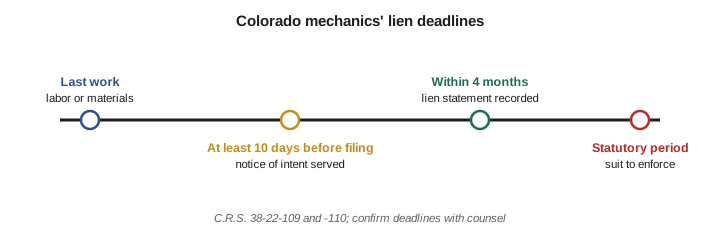
| Step | Deadline or rule | Source |
|---|---|---|
| Serve notice of intent | At least 10 days before filing the lien statement | C.R.S. 38-22-109 |
| Serve by | Personal service or registered or certified mail to owner and prime contractor | C.R.S. 38-22-109 |
| File lien statement | Within 4 months after last labor or materials (2 months for day laborers) | C.R.S. 38-22-109 |
| Sue to enforce | Within the period the statute sets; commonly cited as 6 months after completion or last work | C.R.S. 38-22-110 (confirm with counsel) |
| Trust funds | Construction funds received are held in trust for those who furnished labor and materials | C.R.S. 38-22-127 |
# Lien calendar from the last day of work (study aid; confirm with counsel)
from datetime import date
import calendar

def add_months(d, n):
    y, m = divmod(d.month - 1 + n, 12)
    y += d.year
    m += 1
    return date(y, m, min(d.day, calendar.monthrange(y, m)[1]))

last_work = date(2026, 5, 22)
file_by = add_months(last_work, 4)
notice_by = date.fromordinal(file_by.toordinal() - 10)
print("Last labor or materials:", last_work.isoformat())
print("Serve notice of intent no later than:", notice_by.isoformat())
print("File lien statement no later than:", file_by.isoformat())Last labor or materials: 2026-05-22 Serve notice of intent no later than: 2026-09-12 File lien statement no later than: 2026-09-22
The output gives the outer limits. In practice, Timberline serves the notice well before the latest date, because certified mail can be slow and the 10 days run from service, and a mistake in the dates can cost the lien entirely.
Enforcing the lien
A recorded lien does not collect money by itself. If the debt is not paid, the claimant must sue to foreclose the lien within the time the statute allows. Section 38-22-110 sets that period, which is commonly described as six months after the last work or completion of the building; a lien that is not enforced in time is lost. The claimant also records a notice of the pending lawsuit. Because the timing and procedure are technical, contractors work with a lawyer once a lien is filed.
The statute also penalizes excessive liens. A claimant who knowingly files a lien for more than is due can lose the lien and face liability for the owner's costs and attorney fees. The lien amount should match the contract balance and approved change orders, supported by invoices.
Protections for homeowners
The lien statute balances the rights of contractors against those of owners. Colorado gives special protection to owners of owner-occupied homes who have paid their contractor in full: such an owner generally has a defense against liens by subcontractors and suppliers that the contractor failed to pay, and the unpaid parties must look to the contractor. A subcontractor on a home remodel therefore has weaker lien leverage than one on a commercial project. For homeowner work, Timberline contracts directly with the owner whenever it can, and when it works under a remodeling contractor, it watches that contractor's payment habits closely.
Getting paid without a lien
Liens are a last resort. Most of Timberline's collections never reach that point because the office follows a routine. Invoices go out on the schedule the contract sets, with backup for every change order. Payments that are more than a few days late get a call from Dana. Payments that are more than 30 days late get a letter from Lucia, and the office checks the lien calendar for that job. If a general contractor stops paying on one project, Lucia reviews the company's exposure on its other projects with the same general contractor before sending more crews.
Good records make every step easier. Daily logs show who worked on which building and when. Supplier delivery tickets show when materials arrived. Signed change orders show what extra work was approved and for how much. When Dana prepared the Johnstown file, each of those records was already in place, which is why the last day of work could be fixed with confidence.
Lien waivers and releases
Owners, lenders and general contractors usually require lien waivers when they pay. A conditional waiver releases lien rights for a payment once the payment clears; an unconditional waiver releases them immediately, whether or not the money arrives. Contractors should sign unconditional waivers only for payments they have actually received. When a lien is paid, the claimant records a release so the title is cleared.
The construction trust fund statute
Colorado's trust fund statute, C.R.S. 38-22-127, provides that money disbursed to a contractor or subcontractor for a project is held in trust for the payment of the subcontractors, laborers and suppliers who furnished work for that project. The contractor must keep separate records for each project showing receipts and payments. A contractor who uses trust funds for other purposes before paying those who are owed can face civil theft claims, which can include treble damages and attorney fees, and in some cases criminal liability.
The trust fund rule protects Timberline as a subcontractor, but it also binds Timberline as a payer of its own suppliers. When Timberline receives a progress payment for the Johnstown buildings, it pays the supplier for that project's materials from that payment before using the money elsewhere. Dana's accounting system tracks receipts and payments by job for that reason.
Retainage
Retainage is a portion of each payment that the owner or general contractor holds back until the job is complete. It protects the payer if the work is not finished, but it ties up the contractor's cash. Colorado law sets limits on retainage for public works projects. For private projects, HB26-1311, signed May 7, 2026, allows a contractor to provide a retainage bond in place of retained money, up to 5 in 100 of earned amounts, for contracts entered into on or after the law's effective date of August 12, 2026. The law does not apply to public projects. Because the law is new, Lucia reads each new subcontract's retainage clause with the company's lawyer.
Disputes and resolution
Many contracts require negotiation, mediation or arbitration before a lawsuit. Those clauses matter for liens too, because a lien must still be enforced within the statutory period even when the contract sends the payment dispute to arbitration. Courts and lawyers handle that overlap in different ways, often by filing the foreclosure action and pausing it while the arbitration proceeds. A contractor who signs a contract with an arbitration clause should ask its lawyer early how lien deadlines will be protected. Attorney fee clauses also matter: some contracts let the winning party recover its legal fees, which changes how hard each side fights.
Public projects and payment bonds
Mechanics' liens generally cannot be filed against public property. On public works projects, subcontractors and suppliers rely on the prime contractor's payment bond and on a statutory claim procedure against the money the public owner is holding. The procedure has its own notice and timing rules, which differ from the private lien process. On the school district remodel, Timberline's subcontract with the general contractor identified the payment bond and the claim procedure, and Dana noted the claim deadlines in the job file at the start of the project.
Worked problem
The Johnstown balance
Timberline's last day of trim work on a Johnstown townhome building was May 22, 2026. The builder owes about 86,000 dollars on approved invoices and change orders. It is now August 20. What should Timberline do?
Show solution
- Confirm the last day of labor or materials from the daily logs and supplier deliveries: May 22.
- Calculate the filing deadline: four months after May 22, about September 22.
- Serve a notice of intent on the owner and the builder by certified mail at least 10 days before filing, and prepare the affidavit of service.
- Prepare a lien statement for the amount actually owed, supported by invoices and change orders, and record it before the deadline.
- Calendar the enforcement deadline and involve the company's lawyer.
Answer: Serve the notice of intent now, file the lien statement before about September 22 for the accurate balance, and calendar the enforcement deadline with counsel.
Common mistakes
MistakeCounting the lien deadline from the invoice date.
InsteadThe filing period runs from the last day labor or materials were furnished.
MistakeFiling the lien statement the day after mailing the notice of intent.
InsteadThe notice must be served at least 10 days before filing.
MistakeFiling for more than is owed to pressure the owner.
InsteadAn excessive lien can be lost and lead to liability for the owner's costs.
MistakeSigning an unconditional waiver for a payment not yet received.
InsteadUse conditional waivers until the payment clears.
MistakeFiling a mechanics' lien on a public school.
InsteadPublic projects use payment bonds and statutory claim procedures instead.
Summary and key terms
- A clear contract with written change orders prevents most payment disputes.
- Those who furnish labor or materials to improve private property may claim a mechanics' lien.
- Serve a notice of intent on the owner and prime contractor at least 10 days before filing.
- File the lien statement within four months after last labor or materials (two months for day laborers).
- Enforce the lien by lawsuit within the statutory period, with counsel.
- Construction funds are held in trust for those who furnished work; HB26-1311 allows retainage bonds on private contracts from August 12, 2026.
- Mechanics' lien
- A claim against real property by those who furnished labor or materials to improve it.
- Intent notice
- The notice of intent, served on the owner and prime contractor before a lien statement is filed.
- Lien statement
- The verified document recorded with the county to create the lien.
- Lien waiver
- A document releasing lien rights in exchange for payment.
- Retainage
- Part of each payment held back until the work is complete.
Practice problems
Work each problem on paper first, then reveal the answer to check.
How many days before filing must the notice of intent be served?
Show answer
At least 10 days.
Within how long after last labor or materials must a contractor file a lien statement?
Show answer
Four months.
Where is the lien statement recorded?
Show answer
With the clerk and recorder of the county where the property is located.
What does the trust fund statute require contractors to keep?
Show answer
Separate records of receipts and payments for each project.
Lesson quiz · 5 questions
Score 60% or more to complete this lesson.
Create a free account to save your progress, take quizzes and earn a certificate.