
MELU-206 · Lesson 7 of 12 · 21 min
Duties and responsibilities of the Master Electrician License holder
▶ Video coming soon A video version of this lesson is on the way.
On the Monday after Walt's retirement party, Lucia arrived at the shop before anyone else. The company's registration now listed her as the master electrician responsible for supervising all of Timberline's electrical work. On her desk Walt had left a single sheet titled "What you sign for." It listed every crew, every open permit, every apprentice and their supervisor, and a line at the bottom: "Your license is on all of it now." She read it twice, then started calling crew leads.
This lesson explains what the Master Electrician License adds to a journeyman's responsibilities in Colorado: planning and supervising work, qualifying a registered contractor, supervising apprentices within the statutory ratio, keeping registration and records current, and answering to the board when things go wrong. It draws on the practice act, C.R.S. 12-115, and the board's rules and guidance.
What the master license allows
In Colorado, a master electrician is licensed to plan, lay out and supervise the installation of electrical wiring and equipment, as well as to install it. Those are the skills the experience requirement measures: the master route includes a year spent planning, laying out and supervising work beyond journeyman experience. A journeyman may install wiring under the supervision of a master and may supervise apprentices, but only a master can qualify a contractor's registration and be the person the board holds responsible for a company's electrical work.
The license does not by itself allow the holder to contract with the public. To offer electrical work for hire, a business must register with the board as an electrical contractor, and its registration must name a master electrician who supervises all of the company's electrical work. That master can be the owner or a full-time employee.
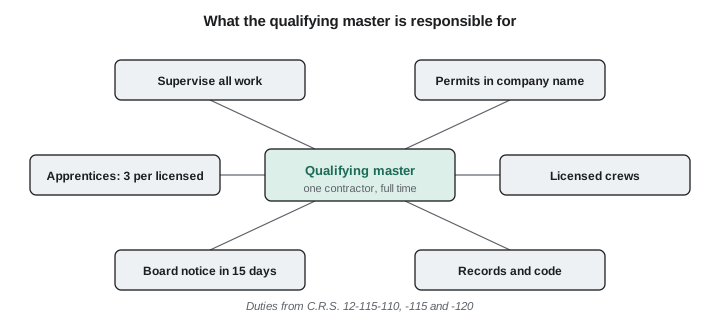
Qualifying one contractor
The statute limits a master electrician to qualifying one electrical contractor at a time. The qualifying master must be employed full time by that contractor, or be its owner, and must supervise all of its electrical work. A master who moonlights for a second company, or who lends a license to a business he does not supervise, violates the act. The rule exists so that the board can hold a real person responsible for every registered company's work.
When a qualifying master leaves a contractor, the statute requires notice to the board within 15 days after the termination. The contractor then cannot perform electrical work until another master qualifies the registration. Timberline planned Walt's retirement so that Lucia's master license and her designation as qualifying master were in place before Walt's last day; the office filed the change with the board and kept a copy of the confirmation.
| Duty | Source | What it looks like at Timberline |
|---|---|---|
| Supervise all of the contractor's electrical work | C.R.S. 12-115-110 | Lucia reviews plans, assigns crews and visits every job |
| Qualify only one contractor, as full-time employee or owner | C.R.S. 12-115-110 | Lucia works only for Timberline |
| Notify the board within 15 days if the qualifying master leaves | C.R.S. 12-115-110 | Dana keeps the board contact form on file |
| Directly supervise no more than three apprentices per licensed electrician | C.R.S. 12-115-115 | Each crew sheet lists apprentices and supervisors |
| Register apprentices within 30 days and report them annually | C.R.S. 12-115-115 | Dana registers new hires in the first week |
| Pull permits in the company's name before work | C.R.S. 12-115-120 | No job starts without a permit number |
Supervision in practice
Supervising all of a contractor's work does not mean standing next to every electrician. It means that the master plans the work, assigns qualified people, sets the company's standards, checks the work at the right stages and corrects problems. A master with eight crews cannot inspect every box personally, so she builds a system: written standard details, crew leads who hold journeyman or master licenses, job-start meetings, rough-in walk-throughs before inspection requests, and a clear path for crews to ask questions.
Lucia's system has four layers. Every job starts with a meeting where she or a crew lead reviews the plans and the permit. Crew leads walk each rough-in with a checklist before calling the inspector. Lucia visits each active job at least once a week, more often on commercial work. And every correction notice comes to her desk, so she sees patterns early. When the board or an inspector asks who supervised a job, she can show the records.
Apprentice supervision and ratios
Colorado's practice act limits how many apprentices one licensed electrician may directly supervise on a job site. Under C.R.S. 12-115-115, a licensed electrician shall not directly supervise more than three apprentices at a job site. The board's inspectors check ratios during compliance visits, and some local programs, such as Denver's, enforce the same limit on their sites and can stop work when it is exceeded.
The ratio is per supervising electrician, not per company. A crew of one journeyman and four apprentices is out of compliance even if the company has plenty of journeymen elsewhere. When an apprentice is sent to a different site, he must have a licensed supervisor there. Lucia writes the supervisor's name next to each apprentice on the daily crew sheet, so that a compliance inspector can see the ratio at a glance.
The contractor also has registration duties. Under the same section, the contractor registers each apprentice with the board within 30 days after employment and reports its apprentices annually, by January 1. Apprentice registration lets the board track supervised hours that will later count toward a journeyman application, so careful records help the apprentice too.
# Checking apprentice ratios on today's crew sheet (study aid)
MAX_PER_SUPERVISOR = 3

crews = {
    "Johnstown townhomes": {"licensed": ["Lucia", "Mateo"], "apprentices": ["Eli", "Maya", "Sam", "Jo", "Ray"]},
    "Fort Collins tenant finish": {"licensed": ["Ana"], "apprentices": ["Kai", "Lee", "Max", "Rob"]},
    "Ranch shop": {"licensed": ["Ben"], "apprentices": ["Tia"]},
}
for site, c in crews.items():
    allowed = MAX_PER_SUPERVISOR * len(c["licensed"])
    n = len(c["apprentices"])
    status = "OK" if n <= allowed else f"OVER by {n - allowed}"
print(f"{site}: {n} apprentices, {allowed} allowed -> {status}")Johnstown townhomes: 5 apprentices, 6 allowed -> OK Fort Collins tenant finish: 4 apprentices, 3 allowed -> OVER by 1 Ranch shop: 1 apprentices, 3 allowed -> OK
The Fort Collins crew is over the limit by one. The fix is to send a second licensed electrician or move an apprentice to a site with spare supervision, before work starts that morning.
Planning and layout
The words plan and lay out in the license describe real work. Before a crew pulls wire, someone decides where the service goes, how the feeders run, how many circuits each area needs, which loads share a panel and how the system will grow. On small jobs the master does this herself; on larger jobs she reviews an engineer's drawings and turns them into a buildable plan. Planning includes load calculations, voltage drop checks on long runs, coordination with the utility on service size and location, and coordination with other trades on routes and clearances.
On the Johnstown townhomes, Lucia's layout work began with the utility's service design and the builder's unit plans. She chose a standard panel schedule for each unit type, laid out the meter banks and house panels, and wrote a short sheet of details for the crews: box heights, kitchen circuit counts, garage receptacle locations and where the electric vehicle conduit would stub up. Each crew followed the same sheet, so the inspector saw the same work in every building.
Handing over a job
Responsibility does not end when the inspector signs the final. A master electrician hands the owner a clear record: the panel directories, any equipment manuals and warranties, any special instructions for generators, solar or battery systems, and contact information for service. On commercial jobs the handover often includes as-built drawings and test results. A clean handover reduces callbacks and gives the owner what a future electrician will need.
Handing over also applies inside the company. When Walt retired, he handed Lucia every open permit with a short note on each: what was installed, what inspections remained and any promises made to the customer. When Lucia moves a crew lead from one job to another, she asks for the same kind of note. A job that changes hands without a record is where mistakes and missed inspections come from.
Licensing of the crew
Every person doing electrical work for a registered contractor must hold the appropriate license or be a registered apprentice working under supervision. The qualifying master and the contractor share responsibility for checking this. Timberline keeps copies of every electrician's license and expiration date, and Dana's calendar flags renewals months ahead. A journeyman whose license lapses at the end of a renewal period cannot keep working as a journeyman; Lucia moves him to non-electrical tasks until he renews.
Out-of-state electricians need Colorado licenses before they work in Colorado. Some may qualify by endorsement or reciprocity for a journeyman license, but the board's rules do not allow a master license by reciprocity. A traveling crew from another state that shows up without Colorado licenses is a violation for the company that employs them.
Permits and code compliance
The qualifying master's name appears on the company's permits, and the master is responsible for the work they cover. That includes making sure work starts only after the permit is issued, scheduling inspections at the right stages, correcting disapproved work, and making sure final approval is obtained. When work fails inspection, the inspector writes the correction against the permit; repeated failures can draw the board's attention to the master and the company.
Code compliance is the heart of the job. The master electrician interprets the adopted code for the company, settles disagreements among crews, and decides when a question should go to the inspector before work is installed. She keeps current with code changes, reads the board's policies and bulletins, and makes sure the company's standard details match the edition in force.
Discipline and the board's authority
The board can discipline licensees and registered contractors for violating the act or its rules. Grounds generally include doing work without required permits, allowing unlicensed people to do electrical work, exceeding apprentice ratios, fraud or misrepresentation in applications, and serious or repeated code violations. Sanctions can include letters of admonition, fines, probation, suspension and revocation, and the statute also provides for citations for some violations found during compliance checks. Because the details depend on the statute and the board's rules, a master electrician who receives a complaint or citation reads it carefully and responds within the stated deadline, often with legal advice.
A disciplinary action against a qualifying master affects the contractor too. If a master's license is suspended, the contractor has lost its qualifying master and cannot work until another master qualifies. That risk is one reason some larger contractors employ more than one master, so that a second master can step in.
Records the master keeps
Good records are the master electrician's best defense and the company's memory. The core records are: copies of every employee's license or apprentice registration; daily crew sheets showing who worked where and who supervised whom; permits, inspection results and correction notices; plans and load calculations; and records of continuing education for the master and each licensed electrician. Records of supervised hours also matter to the people being supervised, because they support future license applications.
Lucia also keeps a short log of decisions: code questions she answered, calls to inspectors and the result, and changes to standard details. When a crew lead asks why the company does something a certain way, the log answers the question. When a new edition takes effect, the log tells her which decisions to revisit.
Ethics and professional judgment
Some duties are not written in a statute but follow from the license. A master electrician refuses to cover work that has not been inspected, even when a builder is pushing the schedule. She tells a homeowner when existing wiring is unsafe, even if fixing it is not in the contract. She does not sign permits for work she will not supervise. And she treats apprentices as future electricians, giving them varied work and honest records of their hours. These habits protect the public, and they also protect the license that her career depends on.
Professional judgment also means knowing the limits of one's own expertise. A master electrician who is asked to design a medium-voltage system, a hazardous-location installation or a large fire alarm system she has never worked on brings in an engineer or an experienced specialist, or declines the work. Saying no to the wrong job protects the company as much as doing the right job well. Lucia turned down a request to design a grain elevator's classified-location wiring in her first month and referred the owner to an engineering firm that does that work regularly.
Worked problem
A crew over the ratio
A compliance inspector arrives at the Fort Collins tenant finish and counts one journeyman supervising four apprentices. What happens, and what should Lucia do?
Show solution
- The site exceeds the limit of three apprentices per licensed supervisor under C.R.S. 12-115-115.
- The inspector can cite the violation and, on some local sites, stop work until the ratio is corrected.
- Lucia sends a second licensed electrician or moves one apprentice to a site with available supervision.
- She documents the correction and reviews why the crew sheet allowed it.
- She changes the morning dispatch process so ratios are checked before crews leave the shop.
Answer: Correct the ratio immediately by adding a licensed supervisor or moving an apprentice, then fix the dispatch process that allowed it.
Common mistakes
MistakeQualifying a second company on weekends.
InsteadA master may qualify only one contractor, as owner or full-time employee.
MistakeWaiting until the next renewal to tell the board a qualifying master has left.
InsteadThe board must be notified within 15 days after termination.
MistakeCounting apprentices per company instead of per supervisor.
InsteadThe limit is three apprentices per licensed electrician at a job site.
MistakeRegistering apprentices at the end of the year.
InsteadApprentices are registered within 30 days after employment and reported annually by January 1.
MistakeTreating supervision as personal presence on every job.
InsteadSupervision is a system of planning, qualified leads, checks and records.
Summary and key terms
- A master electrician may plan, lay out and supervise electrical work, and may qualify one registered contractor as owner or full-time employee.
- The qualifying master supervises all of the contractor's electrical work; the board is notified within 15 days if the master leaves.
- A licensed electrician may directly supervise no more than three apprentices at a job site.
- Apprentices are registered within 30 days after employment and reported annually by January 1.
- The master is responsible for permits, inspections and code compliance under the company's name.
- The board can discipline masters and contractors; records are the master's best defense.
- Qualifying master
- The master electrician named on a contractor's registration as responsible for supervising all its electrical work.
- Direct supervision
- Supervision by a licensed electrician present at the job site.
- Apprentice ratio
- The maximum number of apprentices one licensed electrician may supervise at a site.
- Compliance check
- A board inspector's site visit to verify licenses, registrations, ratios and permits.
- Letter of admonition
- A formal written reprimand that the board may issue as discipline.
Practice problems
Work each problem on paper first, then reveal the answer to check.
How many contractors may one master electrician qualify at a time?
Show answer
One.
Within how many days must the board be notified when a qualifying master leaves?
Show answer
Within 15 days after termination.
How many apprentices may one licensed electrician directly supervise at a job site?
Show answer
No more than three.
When must a new apprentice be registered with the board?
Show answer
Within 30 days after employment.
Lesson quiz · 5 questions
Score 60% or more to complete this lesson.
Create a free account to save your progress, take quizzes and earn a certificate.