
MELU-206 · Lesson 3 of 12 · 20 min
Applying, approval and booking the exam
▶ Video coming soon A video version of this lesson is on the way.
On a Saturday morning in February, Lucia sat at her kitchen table with a cup of coffee, her laptop and a folder of signed verification forms. Dana had scanned everything at the office. The division's online licensing system asked for her personal details, her current journeyman license number, her work history and the documents. It also asked for the application fee, which she paid by card. When she clicked submit, the screen said the application would be reviewed and that she would receive instructions for scheduling the exam if approved. "Now we wait," she texted Walt. "And study."
This lesson walks through the steps from application to exam day: what the application contains, how approval works, how candidates schedule with PSI, what the exam and retest fees are, what happens on the day of the exam and after, and how long each step can take. Procedures and fees change, so treat the numbers as examples and confirm them in the division's current instructions and the PSI candidate information bulletin.
The order of the steps
In Colorado the board approves the candidate before the testing company schedules the exam. That order matters. A candidate cannot simply book an exam with PSI and hope to sort out the experience later. The application goes to the Division of Professions and Occupations first, the board or its staff review it, and only after approval does the candidate receive authorization to schedule with PSI. The PSI bulletin says this directly: passing the exam does not guarantee a license, because applicants must also meet the minimum qualifications under Colorado law.
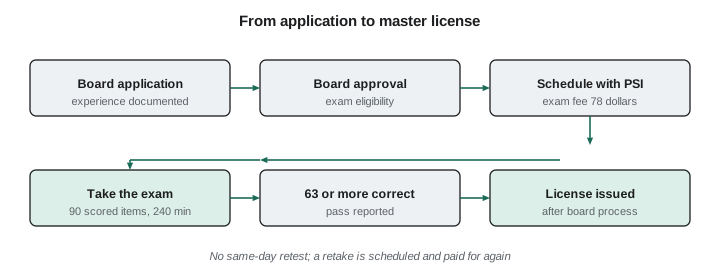
| Step | Who handles it | What to have ready |
|---|---|---|
| Online application | Division of Professions and Occupations | Personal details, license history, application fee |
| Experience and education documents | Applicant, employers and schools | Board verification forms, transcripts, translations |
| Review and approval | Board or division staff | Answers to any follow-up questions |
| Exam scheduling | PSI | Authorization, exam fee, identification |
| Exam | PSI test center | Approved identification; no personal books |
| License issuance | Division | Any final fees or forms the division requests |
What goes into the application
The application itself is short; the attachments are what take time. A complete master application normally includes the online form, the application fee, the experience verification forms signed by employers or supervising electricians, proof of education credit if the candidate is claiming any, and any explanations the form asks for, such as prior discipline or criminal history. Candidates with experience outside the country add certified English translations. A candidate claiming the engineering route adds the degree and evidence of the year of practical construction experience.
Dana's rule for Timberline's applicants is to check each verification form against three questions before scanning it. Are the dates exact and continuous? Do the hours add up and break down by type of work? Is the description specific enough that a stranger could tell what the candidate did? Forms that fail any of those tests generate follow-up questions, and follow-up questions add weeks.
Review and approval
Staff review each application against the statute and rule 1.7. Straightforward applications that clearly meet the minimums may be approved at the staff level; applications that need judgment, such as unusual experience, foreign work or a disciplinary history, may go to the board. If something is missing, the division contacts the applicant. An incomplete application stays open for one year from the date it was submitted. After that it lapses, and the applicant must start over and pay the fee again. A candidate who is denied can request reconsideration in writing within 45 days, but only with new information.
How long does review take? It varies with the season and the complexity of the file. Applications tend to pile up before renewal deadlines and after code adoptions, when many electricians try to test before an exam changes editions. Lucia applied in February, well away from the renewal rush that peaks every third autumn, and her approval email arrived in early April.
The temporary work permit
Board rules provide a temporary work permit issued when a candidate is approved to take the exam. It is valid for up to 30 days. The temporary permit lets a qualified candidate work at the level applied for while scheduling and taking the exam, but it has a firm limit that matters to master candidates: it cannot be used to meet the electrical contractor registration requirements. A company cannot name someone holding only a temporary permit as its qualifying master. For Timberline, that meant Walt's license had to keep qualifying the company until Lucia actually held her master license.
Scheduling with PSI
Once approved, the candidate schedules the exam with PSI, either online or by phone. According to the PSI candidate information bulletin updated in June 2026, the examination fee is 78 dollars and the retest fee is 73 dollars. Fees are not refundable or transferable, and a fee is valid for one year from the date of payment. A candidate who pays and then does not test within that year loses the fee.
PSI runs test centers in several Colorado cities and elsewhere, and seats fill up, especially on Saturdays and before code changes. Lucia booked a weekday morning at a center in the Denver area three weeks after her approval, which gave her time to finish her practice exams. PSI's bulletin explains how to reschedule or cancel in advance and what happens to a candidate who misses an appointment; reading those rules before booking avoids losing a fee to a schedule conflict.
Identification and test-center rules
PSI requires valid, government-issued photo identification with a signature, and the name on the identification must match the name on the registration. A candidate who recently married or changed names needs to sort that out with the division and PSI before exam day. Test centers do not allow personal reference books, notes, phones, smartwatches or bags in the testing room. Candidates store personal items in a locker or leave them in the car. Arriving late can mean losing the appointment and the fee. Lesson 4 covers what the test center provides, including the code book and a formula page.
# Planning exam fees and dates (study aid using the bulletin's example fees)
EXAM_FEE = 78    # dollars, PSI bulletin updated June 2026
RETEST_FEE = 73  # dollars per retest

def cost(attempts):
    if attempts < 1:
        return 0
    return EXAM_FEE + RETEST_FEE * (attempts - 1)

for n in range(1, 4):
    print(f"{n} attempt(s): {cost(n)} dollars in PSI fees")

# A fee is valid for one year from payment; check how many days remain.
from datetime import date
paid = date(2026, 4, 10)
exam = date(2026, 4, 29)
expires = date(paid.year + 1, paid.month, paid.day)
print("Fee paid", paid.isoformat(), "- valid until", expires.isoformat())
print("Days between payment and exam:", (exam - paid).days)1 attempt(s): 78 dollars in PSI fees 2 attempt(s): 151 dollars in PSI fees 3 attempt(s): 224 dollars in PSI fees Fee paid 2026-04-10 - valid until 2027-04-10 Days between payment and exam: 19
The calculation is simple, but it shows why candidates prepare thoroughly before the first attempt: every retest costs another fee, more time off work and another trip to the test center. The application fee paid to the division is separate from these PSI fees.
Results and retests
The PSI bulletin explains how results are reported for this computer-based exam; candidates normally learn the outcome at the test center, and PSI reports results to the division. A candidate who fails receives a diagnostic report showing performance by content area, which is the best guide to what to study before retesting. The PSI bulletin says a candidate cannot schedule a new exam on the same day as a failed attempt; it gives the example of a candidate who fails on a Wednesday, calls on Thursday and might retest as early as Friday if a seat is open. In practice, most candidates benefit from a week or more of focused study on their weak areas before trying again.
From passing score to license
Passing the exam is not the end. The division issues the license once it has the passing result and everything else it needs. For a master electrician who will qualify a contractor, there is a second step: the contractor's registration must be updated to name the new qualifying master, and if the old master is leaving that role, the old master must notify the board within 15 days after the termination. Lesson 8 covers the registration side.
Worked problem
Planning around the temporary permit
Lucia was approved on April 2 and received a temporary work permit. Walt planned to retire on April 20 and asked whether Timberline could list Lucia as qualifying master that day, before her exam on April 29. What should Timberline do?
Show solution
- The temporary work permit is valid for up to 30 days from exam approval.
- Board rules say a temporary permit cannot be used to meet contractor registration requirements.
- Timberline's registration depends on a licensed master who supervises all its electrical work.
- Lucia will not hold a master license until she passes and the division issues it.
- Walt must remain the qualifying master until Lucia's license is issued and the registration is updated.
Answer: Walt should postpone stepping down as qualifying master until Lucia actually holds her master license; the temporary permit cannot qualify the company.
When the exam's code edition changes
Code changes affect scheduling. When the board adopted the 2023 NEC effective August 1, 2023, PSI rolled out 2023-based exams on that date and, for 90 days, let candidates choose between the 2020 and 2023 versions. The 2026 cycle followed a similar pattern: according to the June 2026 bulletin, the test center provides the 2026 NEC beginning August 1, 2026, and the 2023 book is available on request until December 1, 2026. A candidate who studied on one edition should decide which edition to test on, and book accordingly, rather than walking in unsure. Lucia had studied on the 2023 edition in the core courses and tested in April 2026, before the change, so the question did not arise for her. Candidates applying in late 2026 or later will test on the 2026 edition and should study from it.
Accommodations and special situations
Candidates with a disability or other condition that requires a testing accommodation request it through the process described in the PSI bulletin, usually well before scheduling and with supporting documentation. Accommodations are arranged in advance; they cannot be added at the test center on exam day. Candidates whose names have changed, who hold licenses under a different name in another state, or whose verification forms carry an old name should explain the change in the application and bring matching identification. Candidates who are deployed in the military, or who have a serious illness during the process, should contact the division and PSI about extensions before deadlines pass rather than after.
A checklist before you click submit
Dana's checklist for Timberline's applicants is short. Every period of work is verified by someone other than the applicant, on the board's form, with exact dates and hours by type of work. The hours and calendar time meet the rule's minimums with a margin. Education credit is supported by transcripts and meets the board's definitions. Foreign documents have certified translations. The applicant's name matches across the application, the verification forms and the identification she will bring to the test center. The applicant has set aside study time for the weeks after approval, because the fee clock starts when she pays PSI. A candidate who can tick every box rarely gets a follow-up letter.
A realistic calendar
Candidates often underestimate how long the process takes from start to finish. Gathering verification forms can take weeks, especially from former employers. Review can take weeks more. PSI seats may be booked out for a few weeks. If the first attempt fails, a retest adds more time. A realistic plan allows two to four months from the first phone call to a former employer until the license arrives, and longer during busy seasons. Companies planning an ownership or leadership change should start early so the qualifying master's license is in hand before the old master steps away.
Keeping the paperwork
Lucia saved a copy of every form, receipt, approval email and score report in a folder on her computer and a printed set in the office. Those records answer questions later: when a city's contractor licensing office asks for proof of a state license, when an insurer wants the date she became a master, or when the board audits continuing education. They also help the next candidate at Timberline, because Dana now has a checklist built from Lucia's experience.
Good records also make the next renewal easier. The license number, issue date and expiration date go on the company's compliance calendar, along with the date the contractor registration was updated. Continuing education certificates go in the same folder as they are earned. When the board's renewal window opens every third year, the electrician who kept records spends ten minutes renewing; the one who did not spends an afternoon hunting for certificates and calling course providers.
Common mistakes
MistakeBooking the PSI exam before board approval.
InsteadThe board approves the application first; only then does the candidate schedule with PSI.
MistakeUsing a temporary work permit to qualify a contractor.
InsteadBoard rules say a temporary permit cannot be used to meet contractor registration requirements.
MistakeAssuming an unused exam fee stays valid indefinitely.
InsteadPSI fees are valid for one year from payment and are not refundable.
MistakeRetesting the same day after a failed attempt.
InsteadPSI does not allow a new exam to be scheduled on the same day as the failed attempt.
MistakeLetting an incomplete application sit.
InsteadIncomplete applications lapse after one year; the applicant must reapply and pay again.
Summary and key terms
- Apply to the Division of Professions and Occupations first; the board approves eligibility before PSI scheduling.
- Complete applications include signed experience verifications, education proof and any required explanations.
- A temporary work permit, valid up to 30 days from exam approval, cannot qualify a contractor.
- The PSI bulletin lists a 78 dollar exam fee and a 73 dollar retest fee, valid one year and not refundable.
- Failed candidates receive a diagnostic report and cannot retest the same day.
- After passing, the contractor's registration must be updated, and a departing qualifying master notifies the board within 15 days.
- Authorization to test
- The approval that lets a candidate schedule with PSI.
- Temporary work permit
- A permit issued at exam approval, valid up to 30 days, that cannot meet contractor registration requirements.
- Diagnostic report
- The breakdown by content area given to a candidate who does not pass.
- Lapsed application
- An incomplete application closed after one year, requiring a new application and fee.
Practice problems
Work each problem on paper first, then reveal the answer to check.
What must happen before a candidate can schedule the master exam with PSI?
Show answer
The board must approve the application.
How long is the temporary work permit valid?
Show answer
Up to 30 days from exam approval.
What does the bulletin list as the retest fee?
Show answer
73 dollars, valid for one year from payment.
Can a candidate who fails on Monday retest that afternoon?
Show answer
No; a new exam cannot be scheduled the same day as a failed attempt.
Lesson quiz · 5 questions
Score 60% or more to complete this lesson.
Create a free account to save your progress, take quizzes and earn a certificate.